How California’s At-Will Employment Laws Might Impact a Wrongful Termination Case
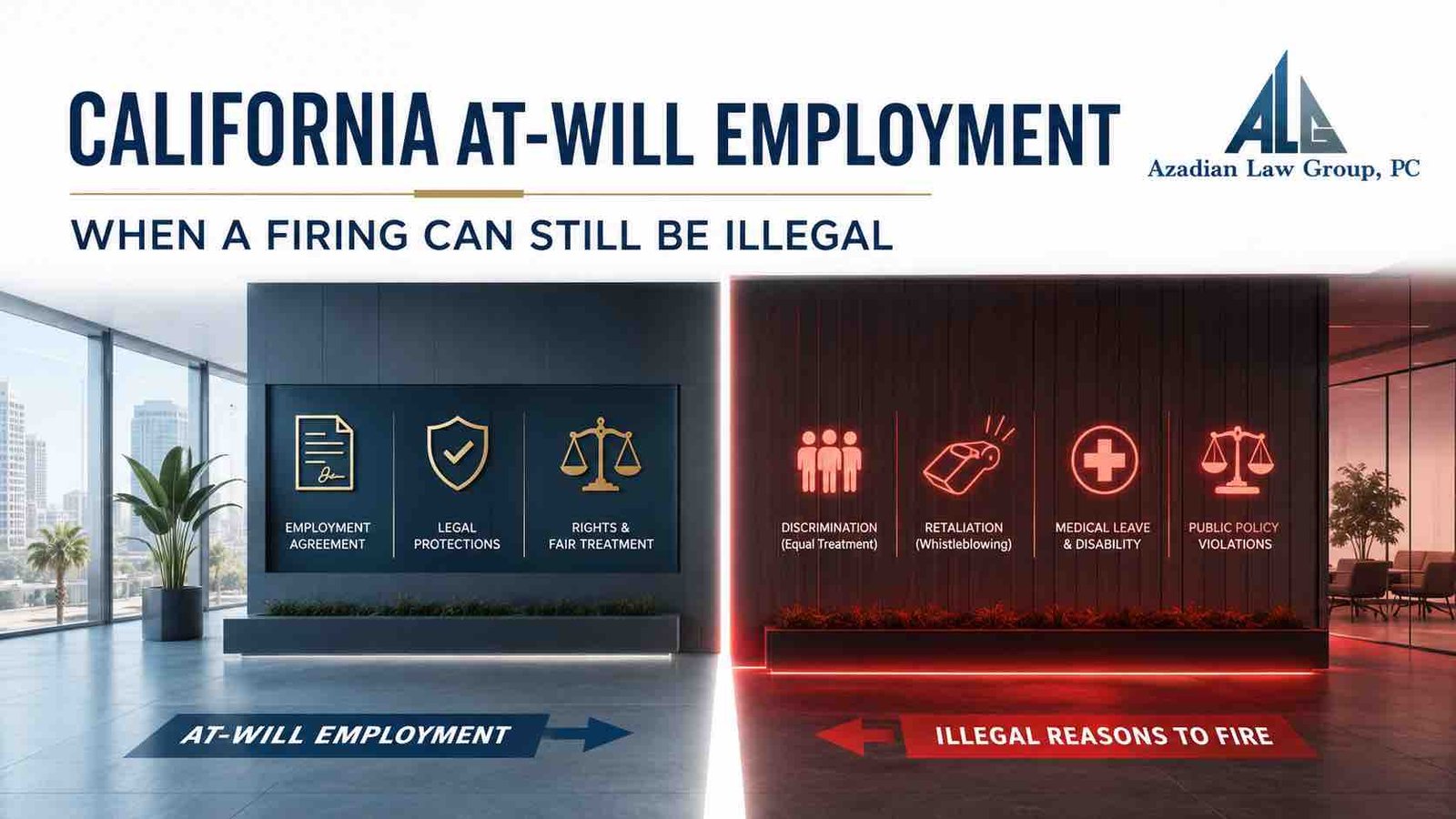
California is generally an at-will employment state, but “at will” does not mean “for absolutely any reason.” In most jobs without a specified term, either the employee or the employer may end the relationship. An employer usually does not need to prove misconduct, provide progressive discipline, or show that the decision was fair.
However, an employer cannot lawfully use the at-will rule as cover for discrimination, retaliation, whistleblower punishment, protected leave violations, refusal to break the law, or another reason prohibited by statute or public policy. A contract, collective bargaining agreement, or clear employer promise may also change the analysis.
That distinction is the heart of many California wrongful-termination disputes. The question is rarely whether an employer had the general power to terminate. The real question is why this employee was terminated at this time and whether the stated explanation matches the evidence.
What Does At-Will Employment Mean in California?
California Labor Code section 2922 states that employment without a specified term may be ended at the will of either party on notice to the other. This creates a general presumption of at-will employment for an indefinite relationship.
In practical terms, an employee may usually resign without proving a reason. Similarly, an employer may often terminate an employee because of poor performance, restructuring, personality conflict, a change in business direction, or no clearly stated reason—provided the actual reason is not unlawful and no enforceable agreement supplies greater protection.
At-will employment also means that ordinary workplace unfairness is not automatically illegal. A manager may make a poor decision, favor a friend, misunderstand a situation, or apply questionable business judgment without necessarily creating a wrongful-termination claim. California law does not turn every harsh or mistaken firing into a lawsuit.
Still, labels are not decisive. An offer letter or handbook may say “at will,” yet the termination can remain unlawful if protected activity or protected status substantially motivated the decision. The employer’s stated reason, the employee’s history, the timing, comparative treatment, and decision-making process all require attention.
At Will Does Not Mean an Employer Can Fire Someone for an Illegal Reason
California’s at-will presumption and its worker-protection laws operate at the same time. The rule gives employers flexibility, while the exceptions set legal boundaries. An employer does not escape those boundaries merely by declining to give a reason or describing the separation as an at-will decision.
| Potentially unlawful reason | What it may look like | Evidence that may matter |
|---|---|---|
| Discrimination | Termination influenced by race, sex, pregnancy, disability, age 40 or older, religion, national origin, sexual orientation, gender identity, or another protected characteristic | Biased comments, comparator treatment, changing explanations, workforce patterns, qualifications, reviews, and decision-maker communications |
| Retaliation | Adverse action after reporting discrimination, harassment, wage violations, safety concerns, or other protected conduct | The complaint, who knew about it, timing, treatment before and after the complaint, and departures from policy |
| Whistleblowing | Punishment for disclosing suspected legal violations or refusing to participate in unlawful activity | The disclosure, reasonable basis for the concern, recipient, management knowledge, and later employment actions |
| Protected leave or accommodation | Firing connected to qualifying medical, family, pregnancy, disability, military, jury-duty, or other protected leave and accommodation rights | Requests, certifications, interactive-process communications, attendance records, approvals, and termination timing |
| Public-policy violation | Termination for exercising an important statutory right, performing a legal obligation, reporting suspected illegality, or refusing illegal conduct | The underlying law or policy, the employee’s conduct, employer knowledge, causation, and the asserted business reason |
| Contract violation | Termination contrary to an enforceable written, oral, or implied promise requiring cause or a particular process | Offer letters, agreements, policies, consistent assurances, length of service, practices, and communications |
These categories can overlap. An employee might request a disability accommodation, report discriminatory remarks, and then be fired after a supervisor begins manufacturing performance concerns. The legal analysis may involve disability discrimination, failure to accommodate, retaliation, and wrongful termination—not just one theory.
Discriminatory Termination Is Not Protected by the At-Will Rule
California employers covered by the Fair Employment and Housing Act generally may not make termination decisions because of protected characteristics. Federal laws provide overlapping protections in covered workplaces, although coverage rules and legal standards can differ.
Discrimination is often proven through circumstances rather than an admission. A supervisor rarely writes that an employee is being fired because of race, pregnancy, disability, age, religion, or another protected trait. Instead, the evidence may show that the employee was performing adequately, similarly situated coworkers were treated differently, management used biased language, or the explanation changed after the termination.
No single fact automatically proves discrimination. Close timing can be meaningful, but an employer may have documented a legitimate concern before the protected event. A younger replacement can be relevant in an age case, but the replacement’s age does not decide the entire dispute. A suspicious remark can carry weight, especially when made by a decision-maker, yet context remains essential.
Employees separating ordinary unfairness from a potentially unlawful pattern can review these California workplace discrimination examples. The examples show how protected status may affect hiring, assignments, pay, promotion, discipline, and termination without suggesting that every negative decision is discriminatory.
Retaliation Can Turn an Otherwise Lawful Termination Into a Legal Dispute
Retaliation occurs when an employer takes materially harmful action because a worker engaged in protected activity. Protected activity may include reporting suspected discrimination, participating in an investigation, requesting a legally protected accommodation, raising certain wage concerns, or opposing conduct the worker reasonably believes violates applicable law.
A complaint does not grant permanent immunity from discipline. An employer may still address legitimate misconduct, poor performance, or a genuine reduction in force. The dispute centers on the actual reason for the decision and whether the employer would have acted the same way without the protected conduct.
Retaliation deserves serious attention because it is consistently one of the most frequently alleged issues in federal employment charges. In fiscal year 2025, the U.S. Equal Employment Opportunity Commission recorded 54,350 retaliation allegations—61.6% of all charges received. A charge may contain multiple legal bases, and a charge is an allegation rather than a finding that the employer violated the law.
Employees considering filing an EEOC charge in California should understand that an online inquiry and a signed charge are not always the same step. Internal complaints, union grievances, or settlement discussions also may not pause an agency deadline.
California Whistleblower Protections Limit At-Will Termination
California law protects many employees who disclose suspected legal violations to a government agency, a person with authority over the employee, or another worker authorized to investigate or correct the problem. Protection may also apply when the employee refuses to participate in conduct that would violate a state or federal statute, rule, or regulation.
California Labor Code section 1102.5 is an important whistleblower statute, but its application depends on the facts. A general disagreement over business strategy is not necessarily a protected disclosure. The employee’s reasonable belief, what was reported, to whom it was reported, and what decision-makers knew can be critical.
Employees should preserve the actual language of the report. A contemporaneous email identifying a suspected legal violation is usually more informative than a later summary saying, “I complained about wrongdoing.” Employees should also distinguish facts they personally observed from rumors and avoid taking privileged, confidential, or trade-secret material they are not authorized to possess.
Medical Leave and Disability Requests May Create Separate Protections
An at-will employee may have rights involving disability accommodation, pregnancy-related limitations, family or medical leave, paid sick leave, or another protected absence. Eligibility and coverage vary. The existence of a medical condition does not automatically prohibit termination, and protected leave does not erase legitimate performance or misconduct issues unrelated to the leave.
However, an employer may face liability if it fires an employee because the worker requested a reasonable accommodation, needed protected leave, disclosed a covered medical condition, or participated in an interactive process. Suspicion increases when approval is followed by hostility, inconsistent attendance rules, rushed discipline, or termination before the employer completes the required evaluation.
The article on wrongful termination and disability rights under the ADA explains how qualification, essential job functions, accommodation, and termination can intersect. California law may provide additional or broader protections in some circumstances.
Wrongful Termination in Violation of Public Policy
California recognizes a common-law claim for termination that violates fundamental public policy. Broadly stated, the policy generally must be grounded in a constitutional or statutory provision, benefit the public rather than only one individual, be well established when the discharge occurred, and be sufficiently important to support the claim.
Public-policy claims commonly arise when an employee alleges termination for refusing unlawful conduct, reporting suspected violations, performing a legal duty, or exercising a statutory right. The precise source of public policy matters. It is not enough to argue only that the termination violated a personal sense of fairness or an internal company preference.
These claims are fact-specific and can overlap with statutory causes of action. An attorney evaluating the matter may identify the protected conduct, the statute or constitutional policy behind it, the employer’s knowledge, the adverse action, and evidence connecting the events.
Contracts Can Modify the At-Will Presumption
Not every California worker is employed solely at will. A written employment agreement may define a term, identify grounds for termination, require notice, or promise a particular procedure. A collective bargaining agreement may impose a just-cause standard and a grievance process.
In some circumstances, an implied agreement may arise from the parties’ conduct, employer policies, repeated assurances, longevity, and established practices. Whether such an agreement exists is not determined by one friendly statement or a worker’s personal expectation of continued employment.
Courts examine the full relationship. Express at-will language in a signed agreement can be highly significant. At the same time, employers cannot contract around every statutory protection. A clear at-will clause does not authorize discriminatory or retaliatory termination.
Employees should preserve all versions of offer letters, employment agreements, compensation plans, handbooks, policy acknowledgments, union materials, and written assurances. A termination analysis based only on the latest handbook may miss earlier or separate commitments.
What Is Pretext in a Wrongful-Termination Case?
“Pretext” means the employer’s stated reason may not be the real reason for the decision. Proving that a manager was mistaken is not always enough. The evidence should help connect the weakness or inconsistency in the explanation to an unlawful motive.
For example, an employer may claim poor performance after years of strong reviews. That conflict matters, but it needs context. Did expectations change? Were problems documented before the protected activity? Were other employees measured the same way? Did the decision-maker ignore objective results? Was the employee given a genuine chance to respond?
| Evidence pattern | Why it may matter | Important caution |
|---|---|---|
| Changing explanations | Materially inconsistent reasons may raise questions about credibility | Different witnesses can describe the same decision differently without proving illegality |
| Close timing | A firing soon after protected activity may support causation | Timing alone may be weak if the decision process began earlier |
| Unequal discipline | Comparable employees outside the protected group may have received better treatment | Comparators must be similar in relevant respects |
| Departure from policy | Skipping an established process may suggest selective treatment | Many policies preserve discretion and are not contracts |
| Biased or retaliatory statements | Decision-maker language can illuminate motive | Speaker, timing, context, and connection to the decision matter |
| Replacement or redistributed duties | Who assumed the work may conflict with a claimed job elimination | A restructuring can divide duties without creating an unlawful motive |
A well-organized chronology often makes these patterns visible. The guide to evidence that may support a California wrongful-termination claim explains how documents, witnesses, comparators, timing, and digital records can fit together.
Can a California Employer Fire You Without Warning?
Often, yes. At-will employment generally does not require advance warning or a progressive-discipline sequence. An employer can sometimes move directly to termination even when the employee expected coaching, a performance plan, or another chance.
Nevertheless, the absence of warning can become relevant when it conflicts with the employer’s normal practice, a binding agreement, or its treatment of comparable employees. A spotless history followed by immediate termination shortly after a protected complaint may deserve closer review. It does not prove the case by itself.
Employees should request the stated reason calmly and preserve the response. California employers are not universally required to provide a detailed termination letter, but documents supplied at separation can reveal whether the explanation remains consistent.
What If the Employer Says the Position Was Eliminated?
Layoffs and reorganizations can be legitimate. A court does not ordinarily replace business judgment merely because another restructuring plan might have been better. Still, an economic explanation does not permit an employer to select workers because of protected status or activity.
Relevant questions include whether the selection criteria existed before the decision, whether they were applied consistently, who participated, and what happened to the employee’s work afterward. A new hire with a different title may or may not be a replacement. The duties, timing, reporting structure, and qualifications provide better context than the title alone.
Employees should not rely only on rumors about company finances. Public job advertisements, organizational announcements, lawful copies of performance records, and direct communications are usually more useful than speculation.
What Should an Employee Do After a Suspicious Termination?
The days after termination can feel chaotic, but a measured response protects both accuracy and credibility. Start by writing a dated chronology while the details are fresh. Identify the decision-makers, protected activity, important statements, witnesses, and the explanation provided.
Then gather records already lawfully available to you. Useful material may include:
- Offer letters, contracts, policies, and severance documents.
- Performance reviews, awards, objective metrics, and praise.
- Complaints, accommodation requests, leave notices, and responses.
- Disciplinary notices and the employee’s factual rebuttals.
- Pay records, schedules, job descriptions, and organizational communications.
- Names of witnesses and a short description of what each person observed.
Do not alter documents, secretly access systems after authorization ends, take trade secrets, or remove privileged and private customer records. Preserve original files and metadata when possible. Evidence obtained unlawfully can create separate problems and distract from an otherwise credible concern.
Finally, review unemployment, final-pay, benefit, and health-coverage information promptly. The legal steps to consider after a suspected wrongful termination provide a broader organization checklist.
Do Not Assume Every Wrongful-Termination Deadline Is One Year
There is no single statute of limitations covering every California wrongful-termination dispute. The deadline depends on the claim, forum, employer, agreement, administrative prerequisites, and facts. Some periods can be much shorter than others.
For many California discrimination and retaliation claims under the Fair Employment and Housing Act, a Civil Rights Department intake generally must be filed within three years of the alleged unlawful practice, subject to statutory details and possible extensions. Federal discrimination charges generally use a 180-day period that is commonly extended to 300 days where a qualifying state or local law applies. Federal employees follow a different process and generally must contact an EEO counselor within 45 days.
Other claims—such as breach of contract, whistleblower retaliation, wage-related theories, or wrongful termination in violation of public policy—can follow different limitation periods and procedural rules. A severance agreement, arbitration provision, union procedure, or government-employer claim requirement may introduce additional deadlines.
For that reason, employees should not calculate a deadline from a generic web article. The safest practical approach is to have the relevant dates and legal theories reviewed promptly rather than waiting for the longest period that might apply.
Should You Sign a Severance Agreement?
A severance offer may provide valuable compensation, continued benefits, or an orderly transition. It can also include a broad release of claims, confidentiality terms, non-disparagement language, cooperation duties, arbitration provisions, and representations about company property.
Do not assume the agreement is routine or that the employer must keep the offer open indefinitely. Employees should read the entire document, identify the deadline, preserve a copy, and understand which rights may be released. Special federal rules can apply to waivers of age-discrimination claims, including required consideration and revocation periods in covered situations.
Requesting time to review an agreement is different from refusing it. An employee should avoid making factual admissions or signing under pressure without understanding the consequences.
How a California Employment Lawyer Evaluates an At-Will Firing
A useful evaluation does not begin and end with “California is at will.” It examines the timeline, protected status or activity, employer knowledge, decision-makers, records, comparators, contract language, and the consistency of the stated reason.
Experienced California wrongful termination attorneys may also identify claims that an employee did not initially recognize. A worker may describe the problem as an unfair firing, while the records point to disability accommodation, retaliation, whistleblowing, unpaid wages, protected leave, or an enforceable agreement.
The at-will rule is often easier to understand when it is applied to real workplace situations. Azadian Law Group discusses retaliation, protected complaints, and termination evidence in its California employee-rights podcast.
Frequently Asked Questions About California At-Will Employment
Is California an at-will employment state?
Yes. California generally presumes that employment without a specified term is at will. Either party may ordinarily end the relationship, but employers remain subject to anti-discrimination, anti-retaliation, whistleblower, leave, contract, and public-policy restrictions.
Does my employer have to give a reason for firing me?
Not always. An at-will employer often can terminate employment without providing a detailed reason. Refusing to state a reason does not make the firing automatically illegal, but it also does not shield an unlawful motive from examination.
Can I be fired for no reason in California?
An employer may sometimes terminate an at-will employee without articulating a cause. It cannot terminate for an illegal reason. The lack of an explanation may make evidence gathering harder, so the surrounding timing, statements, documents, and comparisons become important.
Is an unfair firing the same as wrongful termination?
No. “Wrongful termination” is a legal concept, not simply a firing that feels undeserved. The termination generally must violate a statute, fundamental public policy, enforceable contract, or another recognized legal protection.
Can an at-will employee have an employment contract?
Yes. A written, oral, or implied agreement may alter the at-will presumption in some circumstances. The language, parties’ conduct, employer policies, and signed at-will acknowledgments all require review.
Can my employer fire me after I complain to HR?
An employer may not lawfully fire an employee because the worker made a protected complaint. However, not every HR complaint is legally protected, and filing a complaint does not prevent discipline for a legitimate independent reason. The complaint’s content, management knowledge, timing, and evidence of motive matter.
Can I be fired while on medical leave?
Being on leave does not create absolute job protection. A termination may be lawful if based on a legitimate reason unrelated to protected leave or disability. It may be unlawful when the leave, medical condition, accommodation request, or exercise of protected rights motivated the decision.
What evidence is strongest in an at-will wrongful-termination case?
There is no universal best document. Strong cases often combine a reliable timeline with contemporaneous complaints, positive performance evidence, inconsistent explanations, decision-maker statements, similarly situated employees, policy departures, and witnesses. Evidence must be lawfully obtained and evaluated in context.
How long do I have to file a wrongful-termination claim?
The deadline depends on the legal theory and forum. Agency filings, statutory retaliation claims, contract claims, public-policy claims, union procedures, arbitration, and public-employer matters can have different requirements. Seek a prompt individualized review rather than relying on one generic deadline.
Should I quit if I believe my employer is building a false record?
Do not make that decision from a general article. Resigning can affect legal theories, benefits, leverage, and evidence. Continue performing reasonable duties when possible, respond factually to inaccurate criticism, preserve lawful records, and obtain advice before making an irreversible choice.
Discuss a Potentially Unlawful Termination
At-will employment gives California employers flexibility, but it is not a license to discriminate, retaliate, punish whistleblowers, violate protected leave rights, or disregard enforceable agreements. A careful review separates a lawful but painful business decision from a termination that may cross a legal boundary.
If you believe protected status, a workplace complaint, medical leave, whistleblowing, or another protected act contributed to your termination, you can request a confidential case evaluation or call 213-229-9031.
This article provides general information and is not legal advice. Employment cases are fact-specific, deadlines may apply, and reading this page or contacting the firm does not create an attorney-client relationship.


Related Blog Posts
Wrongful Termination Evidence Often Appears as a Pattern Wrongful termination evidence is rarely found in one dramatic email admitting that...
Read MoreOracle Layoffs Raise New Questions for California Employees Oracle has reportedly begun another round of layoffs in the United States,...
Read MoreArtificial intelligence has already started screening resumes, measuring productivity, writing performance reviews, and recommending layoffs. Now it has reportedly helped...
Read MoreTypes of Cases Handle By Employment Lawyers in Los Angeles, CA
The following presents an overview of the broad range of employment law cases that our employment attorneys are experienced at overseeing and favorably resolving.
Wrongful Termination
Wrongful Termination Lawyers in Los Angeles, CA Attorneys at Azadian Law Group who have filed wrongful termination lawsuits acknowledge that unfair termination can significantly impact an employee’s life. It can…
Age Discrimination
Age Discrimination Lawyers in Los Angeles, CA Azadian Law Group, PC regularly represents clients throughout Los Angeles, CA, who are the victims of age discrimination in the workplace. At Azadian…
Pregnancy Discrimination
Pregnancy Discrimination Lawyer in Los Angeles, CA At Azadian Law Group, PC, our pregnancy discrimination lawyer in Los Angeles, regularly represents clients who are the victims of pregnancy discrimination in…
Sexual Harassment
Sexual Harassment Attorney in Los Angeles, CA The Los Angeles Sexual Harassment Lawyers at Azadian Law Group, PC, know that in today’s modern era, some people often make the mistake of…
Racial Discrimination
Racial Discrimination Lawyers in Los Angeles, CA Azadian Law Group, PC regularly represents clients throughout Los Angeles who are the victims of racial discrimination at work. The Los Angeles Race…
Disability Discrimination
When a Medical Condition Becomes a Workplace Problem, You Have Rights Most employees never expect a health condition to place their career at risk. Yet every day across Los Angeles,…
Praise from Our Clients
Lui H

Arpi Agdere
Tofi
Aracelis Feria
Ivy Gamboa
Jillian Dunlap
Greg Wayne
Elizabeth Eromosele
Steve G
Lisa Galvan
Artur Aleksanyan
Delight Dinopoulos
George Margaros
Chelsea Pham
Trevor Pal-Freeman
Patricio Garza
Taylor
Ashley Londerman
Marissa Zapanta
Nuria Coronado
Barbara Villalobos
Irene Golub
Joshua Butler
J Mo
Employees We Represent in Employment Law Cases
At Azadian Law Group, we represent employees throughout Los Angeles and California who have experienced workplace violations. Our attorneys handle employment law matters including wrongful termination, workplace discrimination, retaliation, harassment, wage and hour violations, and whistleblower protection.
Employees often face unlawful treatment after reporting misconduct, requesting medical leave, or asserting their legal rights at work. Our firm investigates employment law violations and advocates for workers seeking accountability, compensation, and fair treatment under California and federal employment law.

Step 1
Explore our comprehensive range of legal services to find the specialized support you need.
Step 2
Arrange a free initial meeting with our experts to discuss your legal situation.
Step 3
Receive a custom strategy specially created for your case by our legal experts.
Call Us Now 213-229-9031
Tell Us Your Story
Speak out for justice. Your story can be the start of a new chapter of workplace fairness.
