What Is A Wrongful Termination in California?
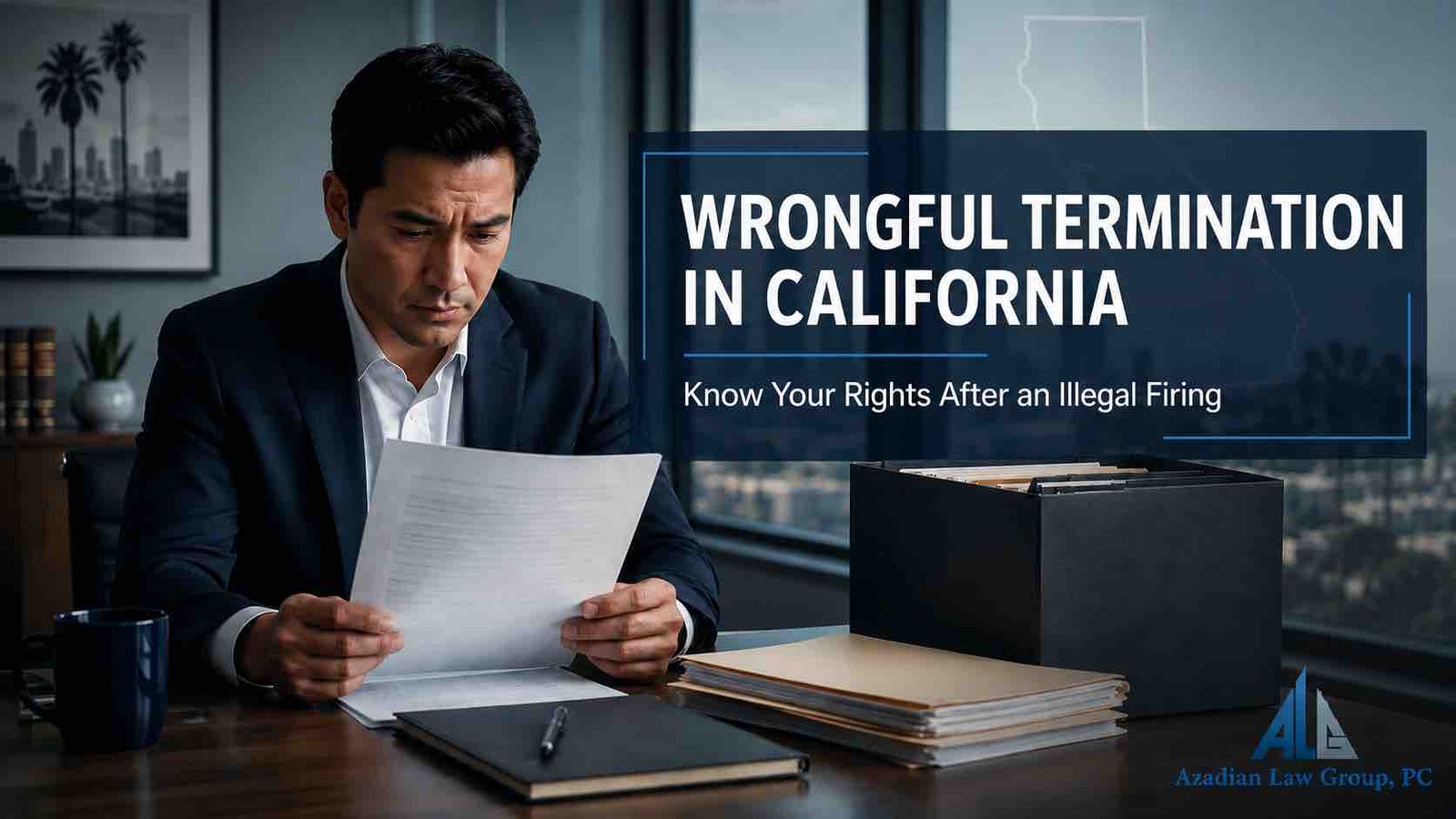
Losing a job can feel deeply unfair. California law, however, does not treat every unfair, abrupt or poorly explained firing as wrongful termination. A termination generally becomes legally wrongful when the employer’s real reason violates a statute, an employment contract or a fundamental public policy.
That distinction matters. California is generally an at-will employment state, but “at will” is not a license to discriminate, retaliate or punish an employee for exercising a protected right. An employer may have broad discretion to end an employment relationship, yet that discretion stops where the law begins.
Wrongful Termination in California: The Short Answer
Wrongful termination occurs when an employer discharges an employee for an unlawful reason. Common examples include firing someone because of a protected characteristic, retaliating against an employee for reporting harassment or wage violations, punishing a whistleblower, interfering with protected medical or family leave, refusing a legally required accommodation, or violating an employment contract or recognized public policy.
The label an employer puts on the decision is not conclusive. A termination letter may say “performance,” “restructuring” or “position eliminated,” while the surrounding evidence points toward discrimination or retaliation. Determining what happened usually requires examining the entire timeline rather than one document in isolation.
For an overview of the firm’s employee-side representation, visit Azadian Law Group’s Los Angeles wrongful termination lawyer resource.
Unfair Firing Versus Illegal Firing
Employees often use “wrongful termination” to describe any firing that seems unreasonable. The legal meaning is narrower.
- Fired for a personality conflict — Yes — Usually not by itself
- Fired without a warning — Yes — Not necessarily
- Fired because of race, disability, pregnancy or another protected characteristic — Yes — Potentially yes
- Fired shortly after reporting harassment or discrimination — Yes — Potentially yes
- Fired after reporting suspected illegal conduct — Yes — Potentially yes
- Fired for requesting legally protected leave or a reasonable accommodation — Yes — Potentially yes
- Fired contrary to an employment contract — Yes — Potentially yes
- Fired based on a false accusation — Yes — Not automatically; the accusation may matter if it conceals an unlawful motive
An employer can make a harsh or mistaken decision without necessarily breaking the law. The central question is not simply whether the firing was unfair. It is whether a prohibited reason materially influenced the decision or whether the employer violated another enforceable legal obligation.
How At-Will Employment Works in California
California Labor Code section 2922 establishes the general presumption that employment without a specified term may be ended by either party. In everyday language, an employer usually does not need “good cause” to discharge an at-will employee.
But the at-will rule has important exceptions. An employer cannot lawfully fire an employee for a discriminatory reason, in retaliation for protected conduct, in violation of a contract, or for a reason that contravenes a fundamental public policy.
This is why “California is an at-will state” should never end the analysis. It should begin it. Our detailed guide to California at-will employment exceptions explains how those boundaries affect a potential termination claim.
Common Illegal Reasons for Firing an Employee in California
1. Discrimination based on a protected characteristic
California’s Fair Employment and Housing Act generally prohibits covered employers from making termination decisions because of protected characteristics. The California Civil Rights Department identifies protected categories including:
- Race or color
- Ancestry or national origin
- Religion or creed
- Age, for workers age 40 and older
- Physical or mental disability
- Medical condition
- Sex, gender, pregnancy, childbirth or related medical conditions
- Sexual orientation
- Gender identity or gender expression
- Genetic information
- Marital status
- Military or veteran status
- Reproductive health decision-making
Discrimination is not always announced openly. It may appear through coded comments, unequal enforcement of policies, sudden criticism, exclusion from opportunities, suspicious timing or better treatment of similarly situated employees outside the protected group.
For example, an employer may claim that a longtime employee was fired for performance immediately after a new supervisor made age-related remarks. Another employee may be terminated soon after disclosing a pregnancy or requesting changes related to a disability. The legal analysis depends on the complete evidence—not just the employer’s stated reason.
2. Retaliation for reporting discrimination, harassment or other workplace concerns
California law can protect employees who oppose conduct they reasonably believe is discriminatory or harassing, participate in an investigation, support another employee’s complaint or otherwise assert protected workplace rights.
A complaint does not need magic legal language. An employee may never say “FEHA violation” or “illegal discrimination.” What matters is whether the employee communicated a concern that could reasonably be understood as opposing prohibited conduct.
Timing is often important. A firing that occurs days or weeks after a complaint may raise questions, especially when the employee previously had a stable record or the employer’s explanation changes. Timing alone does not prove retaliation, but timing combined with other inconsistencies can be significant.
Employees facing this situation can read our focused guide on being fired after complaining to HR.
3. Whistleblower retaliation
California Labor Code section 1102.5 provides important protections for employees who disclose information they reasonably believe shows a violation of a federal, state or local law or regulation. Depending on the circumstances, protected disclosures may be made to a government agency, law enforcement, a supervisor or another person with authority to investigate or correct the violation.
The statute also protects employees who refuse to participate in conduct that would violate the law. A report may involve fraudulent billing, patient safety, financial misconduct, regulatory violations, workplace safety or another suspected legal violation.
The underlying concern does not always have to result in a proven violation. The employee’s reasonable belief, the content of the disclosure, the recipient and the connection between the report and the adverse action can all matter.
4. Taking protected medical, family or pregnancy leave
An employee may have protection under the California Family Rights Act, the federal Family and Medical Leave Act, California pregnancy-disability rules, disability-accommodation law or another leave statute. Coverage and eligibility differ, so not every absence is automatically protected.
Warning signs can include discouraging an eligible employee from taking leave, counting protected absences as performance violations, replacing the employee during leave, refusing reinstatement without a valid basis or firing the employee shortly after a leave request or return.
The California Civil Rights Department explains that qualifying employees may have job-protected leave rights and that firing an employee because of protected leave can violate the law. Our related guide addresses when an employer may unlawfully fire an employee for taking medical leave in California.
5. Requesting a reasonable accommodation
Workers with qualifying disabilities may be entitled to reasonable accommodations that enable them to perform the essential functions of their jobs, unless the accommodation would create an undue hardship. Employers may also have a duty to participate in a timely, good-faith interactive process.
A request does not always need a formal label. An employee may communicate that a medical condition is affecting work and ask for leave, scheduling adjustments, remote work, modified duties or another change. Whether a particular accommodation is reasonable depends on the job, medical restrictions and workplace circumstances.
A termination may warrant closer examination when it occurs immediately after an accommodation request, before meaningful dialogue, or after the employer characterizes disability-related limitations as misconduct without considering its legal obligations.
6. Reporting wage, hour or workplace-safety violations
California employees may be protected when they complain about unpaid wages, overtime, meal or rest-period violations, workplace safety problems or other Labor Code violations. The California Labor Commissioner’s Office accepts retaliation complaints from workers who believe they were fired, demoted or punished for exercising rights enforced by that agency.
Not every payroll disagreement creates a termination claim. The content and timing of the complaint, the employer’s knowledge, the decision-makers involved and the stated reason for termination all require review.
7. Exercising another legally protected right
California and federal law protect many activities beyond discrimination complaints. Depending on the facts, protection may apply when an employee participates in jury service, discusses wages, files a workers’ compensation claim, engages in certain lawful political activity, reports occupational injuries, participates in an investigation or exercises other statutory rights.
Because different laws have different coverage rules, procedures and deadlines, employees should avoid assuming that every workplace right follows the same path.
8. Breach of an employment contract
Some employees have written agreements limiting the reasons or procedures for termination. Contract rights may also arise from offer letters, compensation agreements, collective-bargaining agreements or, in some circumstances, implied promises based on the employer’s words and practices.
Handbooks often contain at-will disclaimers, so a progressive-discipline policy does not automatically guarantee continued employment. Still, inconsistent application of an employer’s stated procedures may matter as contract evidence or as evidence that the stated reason was pretextual.
Read more about employment contracts and wrongful termination claims.
9. Termination that violates fundamental public policy
California recognizes a common-law claim when an employee is discharged in violation of a fundamental public policy grounded in a constitutional or statutory provision. Examples can include firing someone for refusing to commit an illegal act, performing an important legal obligation or exercising a statutory right.
This area is highly fact-specific. The public policy must satisfy legal requirements; a broad sense that the employer acted unfairly is not enough.
Can a Layoff Be Wrongful Termination?
Yes, potentially. Calling a discharge a “layoff,” “reduction in force” or “reorganization” does not immunize it from review. A legitimate business downturn may justify eliminating positions, but the employer cannot use a restructuring as cover to select workers because of age, disability, pregnancy, protected leave, complaints or whistleblowing.
Questions worth examining include:
- Who selected the affected employees?
- What criteria were used, and were they documented before the decision?
- Were the criteria applied consistently?
- Were substantially similar employees retained?
- Was the position genuinely eliminated or soon refilled?
- Did the selection follow a recent complaint, leave request or accommodation request?
The existence of a business reason does not automatically defeat a claim. The question is whether the reason is genuine and whether an unlawful factor influenced the selection.
How Employers May Disguise an Unlawful Reason
Employers rarely write “terminated because of disability” in a personnel file. Wrongful-termination cases often turn on circumstantial evidence showing that the official explanation may not be the real one.
Possible indicators of pretext include:
- Positive reviews followed by sudden criticism after protected activity
- Performance standards created or changed after the fact
- Different explanations given to the employee, coworkers, an agency or the court
- Rules enforced against one employee but ignored for others
- Missing, altered or backdated documentation
- A decision-maker’s discriminatory or retaliatory comments
- A termination unusually close to a complaint, leave or accommodation request
- Replacing the employee with someone outside the protected group
- Claiming a position was eliminated and then advertising substantially the same job
- Departing from normal investigation or disciplinary procedures without explanation
None of these facts automatically proves liability. Together, however, they may help show that the stated reason lacks credibility.
What Evidence Can Prove Wrongful Termination?
Strong cases are often built from ordinary workplace records. Useful evidence may include:
- Offer letters, contracts and employee handbooks
- Performance evaluations, awards and objective productivity records
- Emails, text messages and internal chat messages
- Written complaints to HR, supervisors, compliance or government agencies
- Leave and accommodation requests
- Medical restrictions and employer responses
- Disciplinary notices and performance-improvement plans
- Names of witnesses and comparable employees
- Payroll, scheduling and attendance records
- Layoff criteria, organizational charts and replacement job postings
- Notes identifying who said what, when and in whose presence
- The termination notice, separation agreement and final-pay records
Direct evidence is uncommon and is not always required. A timeline combining performance history, protected conduct, decision-maker knowledge and inconsistent explanations may tell a powerful story.
Our comprehensive guide explains what evidence can prove wrongful termination in California and how to preserve it lawfully.
Employees should preserve documents they already possess legally. They should not access restricted systems after termination, take privileged materials, download trade secrets or secretly remove confidential records they are not entitled to keep.
What Does Not Automatically Prove Wrongful Termination?
Several frustrating situations are not automatically illegal:
- Being fired without advance notice
- Being terminated during a probationary period
- Receiving an inaccurate or unfair review
- Losing a job because a supervisor dislikes the employee
- Being replaced by another worker
- Disagreeing with the employer’s business judgment
- Being fired after an ordinary complaint unrelated to a legally protected right
- Being accused of misconduct that the employee denies
Context can transform the analysis. A false accusation, for example, may not create a claim by itself, but it may be evidence of pretext when it appears only after an employee reports discrimination. Our guide explains when being fired over false accusations may support a legal claim.
Likewise, probationary employees can still be protected against discrimination, retaliation and other unlawful reasons for discharge. See our discussion of wrongful termination during a probationary period.
What Should You Do After a Suspected Wrongful Termination?
The first days after termination can affect the evidence available later.
- Write a private chronology. Record relevant dates, comments, complaints, leave requests, reviews, disciplinary events and the people involved.
- Preserve lawful evidence. Save records already in your possession without accessing systems or materials you are not authorized to use.
- Request and review termination documents. Keep the termination notice, severance agreement, final-pay information and benefits communications.
- Do not rush to sign a release. A severance agreement may waive important claims and impose confidentiality, nondisparagement or cooperation obligations.
- Avoid emotional public posts. Social-media statements can create evidence disputes and distract from the underlying facts.
- Identify possible witnesses. Record names and personal contact details you already possess lawfully, but do not pressure coworkers or ask them to take company records.
- Consider unemployment benefits and mitigation. Keep records of job-search efforts and replacement earnings.
- Obtain timely legal advice. Different claims can require different agency filings and deadlines.
For a broader procedural roadmap, review the wrongful termination claim process in Los Angeles.
How Long Do You Have to File a Wrongful Termination Claim?
There is no single deadline covering every California wrongful-termination case. The applicable period may depend on whether the claim involves FEHA discrimination, whistleblower retaliation, wage-related retaliation, breach of contract, a public entity, federal law or another legal theory.
For example, the California Civil Rights Department states that an employment-discrimination complaint generally must be filed within three years of the alleged discriminatory act. Federal administrative deadlines can be shorter, and claims involving government entities may require much earlier action. Exceptions and tolling rules are fact-dependent.
Never calculate a deadline from a general article alone. Review our California wrongful termination statute-of-limitations guide and obtain advice about the specific claims and dates involved.
What Compensation May Be Available?
Available remedies depend on the legal claims, evidence and losses. Potential relief may include:
- Back pay for lost earnings and benefits
- Front pay when future wage loss can be established
- Reinstatement in appropriate cases
- Compensation for emotional distress
- Reimbursement of certain out-of-pocket losses
- Punitive damages when legally available and supported by the evidence
- Statutory penalties under particular laws
- Attorney’s fees and litigation costs where authorized
- Injunctive or policy-related relief
The California Civil Rights Department lists back pay, front pay, reinstatement, emotional-distress damages, punitive damages and attorney’s fees among remedies potentially available in employment-discrimination matters. No result is guaranteed, and the value of a claim cannot be determined from salary or job title alone.
Experience Matters: Evidence, Credibility and Results
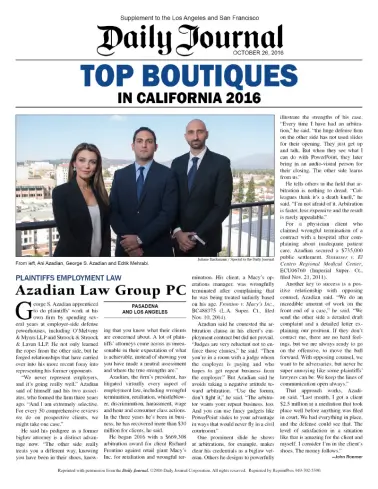
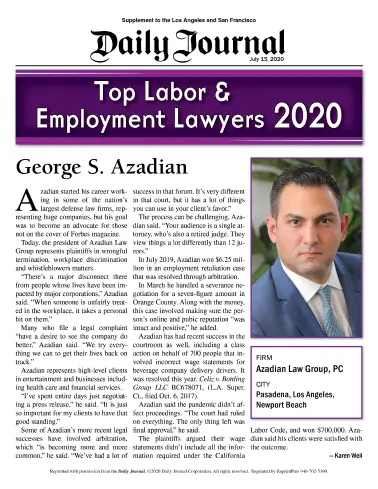
Azadian Law Group represents employees—not employers—in wrongful-termination, retaliation, discrimination, whistleblower and related employment disputes. The firm’s published results show why documentation, timing and pretext analysis matter.
In Frontino v. Macy’s, the firm reports obtaining a $669,308 retaliation and wrongful-termination result for an operations manager who complained of age discrimination. The firm’s account explains that objective performance metrics improved even as the employer continued documenting alleged performance issues.
The firm also reports a $9,957,411.17 wrongful-termination arbitration award. Prior results depend on their specific facts and do not guarantee a similar outcome in another matter.
Frequently Asked Questions About California Wrongful Termination
Can an at-will employee sue for wrongful termination in California?
Yes. At-will employment generally allows either party to end the relationship, but it does not permit termination for an illegal reason. An at-will employee may still have claims involving discrimination, retaliation, whistleblowing, protected leave, public policy or other legal protections.
Can my employer fire me without giving a warning?
Often, yes. California employers generally are not required to use progressive discipline for an at-will employee unless a contract, collective-bargaining agreement or other enforceable rule applies. However, lack of warning may become relevant when the employer normally gives warnings, departs from its practices or uses an alleged violation to conceal discrimination or retaliation.
Is it wrongful termination if my employer lied about my performance?
Not automatically. Employers can be wrong or unfair about performance without necessarily violating the law. A false or shifting performance explanation may support a claim when other evidence connects the firing to a protected characteristic or protected activity.
Is being fired after an HR complaint always retaliation?
No. The complaint must involve conduct protected by an applicable law, and there must be evidence connecting the complaint to the termination. Timing, decision-maker knowledge, treatment of comparable employees and changing explanations may help establish that connection.
Can I be fired while taking medical leave?
Protected leave does not create absolute immunity from every legitimate employment decision. An employer may still take action for genuinely unrelated reasons. It generally cannot fire an employee because the employee requested or used protected leave, count protected leave against the employee unlawfully, or use a supposed restructuring as a pretext for retaliation.
Do I need an email admitting discrimination or retaliation?
No. Direct admissions are rare. Wrongful-termination claims can be proven through circumstantial evidence such as timing, comparative treatment, inconsistent reasons, departures from policy and the employee’s history before and after protected activity.
Can quitting count as wrongful termination?
In limited circumstances, an employee may claim constructive discharge when working conditions become so intolerable that a reasonable person would feel compelled to resign, along with the other required legal elements. Ordinary stress, criticism or dissatisfaction is generally insufficient. Employees should seek advice before resigning when possible.
Should I sign a severance agreement after being fired?
Do not assume a severance agreement is routine paperwork. It may release discrimination, retaliation, wage or other claims and impose continuing obligations. Consider having the agreement and relevant timeline reviewed before the deadline to sign.
Speak With a California Wrongful Termination Attorney
If you were fired after reporting misconduct, opposing discrimination, requesting an accommodation, taking protected leave or exercising another workplace right, the employer’s stated explanation may not tell the whole story.
Azadian Law Group, PC represents employees in Los Angeles and throughout California. A review of the timeline, employment records, communications, witnesses and the employer’s explanation can help determine whether the termination was merely unfair or potentially unlawful.
Contact Azadian Law Group or call 213-229-9031 to request a confidential case evaluation.
This article provides general information and is not legal advice. Employment laws and deadlines can change, and the outcome of any matter depends on its specific facts. Reading this page or contacting the firm does not create an attorney-client relationship.


Related Blog Posts
Wrongful Termination Evidence Often Appears as a Pattern Wrongful termination evidence is rarely found in one dramatic email admitting that...
Read MoreOracle Layoffs Raise New Questions for California Employees Oracle has reportedly begun another round of layoffs in the United States,...
Read MoreArtificial intelligence has already started screening resumes, measuring productivity, writing performance reviews, and recommending layoffs. Now it has reportedly helped...
Read MoreTypes of Cases Handle By Employment Lawyers in Los Angeles, CA
The following presents an overview of the broad range of employment law cases that our employment attorneys are experienced at overseeing and favorably resolving.
Wrongful Termination
Wrongful Termination Lawyers in Los Angeles, CA Attorneys at Azadian Law Group who have filed wrongful termination lawsuits acknowledge that unfair termination can significantly impact an employee’s life. It can…
Age Discrimination
Age Discrimination Lawyers in Los Angeles, CA Azadian Law Group, PC regularly represents clients throughout Los Angeles, CA, who are the victims of age discrimination in the workplace. At Azadian…
Pregnancy Discrimination
Pregnancy Discrimination Lawyer in Los Angeles, CA At Azadian Law Group, PC, our pregnancy discrimination lawyer in Los Angeles, regularly represents clients who are the victims of pregnancy discrimination in…
Sexual Harassment
Sexual Harassment Attorney in Los Angeles, CA The Los Angeles Sexual Harassment Lawyers at Azadian Law Group, PC, know that in today’s modern era, some people often make the mistake of…
Racial Discrimination
Racial Discrimination Lawyers in Los Angeles, CA Azadian Law Group, PC regularly represents clients throughout Los Angeles who are the victims of racial discrimination at work. The Los Angeles Race…
Disability Discrimination
When a Medical Condition Becomes a Workplace Problem, You Have Rights Most employees never expect a health condition to place their career at risk. Yet every day across Los Angeles,…
Praise from Our Clients
Lui H

Arpi Agdere
Tofi
Aracelis Feria
Ivy Gamboa
Jillian Dunlap
Greg Wayne
Elizabeth Eromosele
Steve G
Lisa Galvan
Artur Aleksanyan
Delight Dinopoulos
George Margaros
Chelsea Pham
Trevor Pal-Freeman
Patricio Garza
Taylor
Ashley Londerman
Marissa Zapanta
Nuria Coronado
Barbara Villalobos
Irene Golub
Joshua Butler
J Mo
Employees We Represent in Employment Law Cases
At Azadian Law Group, we represent employees throughout Los Angeles and California who have experienced workplace violations. Our attorneys handle employment law matters including wrongful termination, workplace discrimination, retaliation, harassment, wage and hour violations, and whistleblower protection.
Employees often face unlawful treatment after reporting misconduct, requesting medical leave, or asserting their legal rights at work. Our firm investigates employment law violations and advocates for workers seeking accountability, compensation, and fair treatment under California and federal employment law.

Step 1
Explore our comprehensive range of legal services to find the specialized support you need.
Step 2
Arrange a free initial meeting with our experts to discuss your legal situation.
Step 3
Receive a custom strategy specially created for your case by our legal experts.
Call Us Now 213-229-9031
Tell Us Your Story
Speak out for justice. Your story can be the start of a new chapter of workplace fairness.
