Can You Be Wrongfully Terminated During a Probationary Period in California?
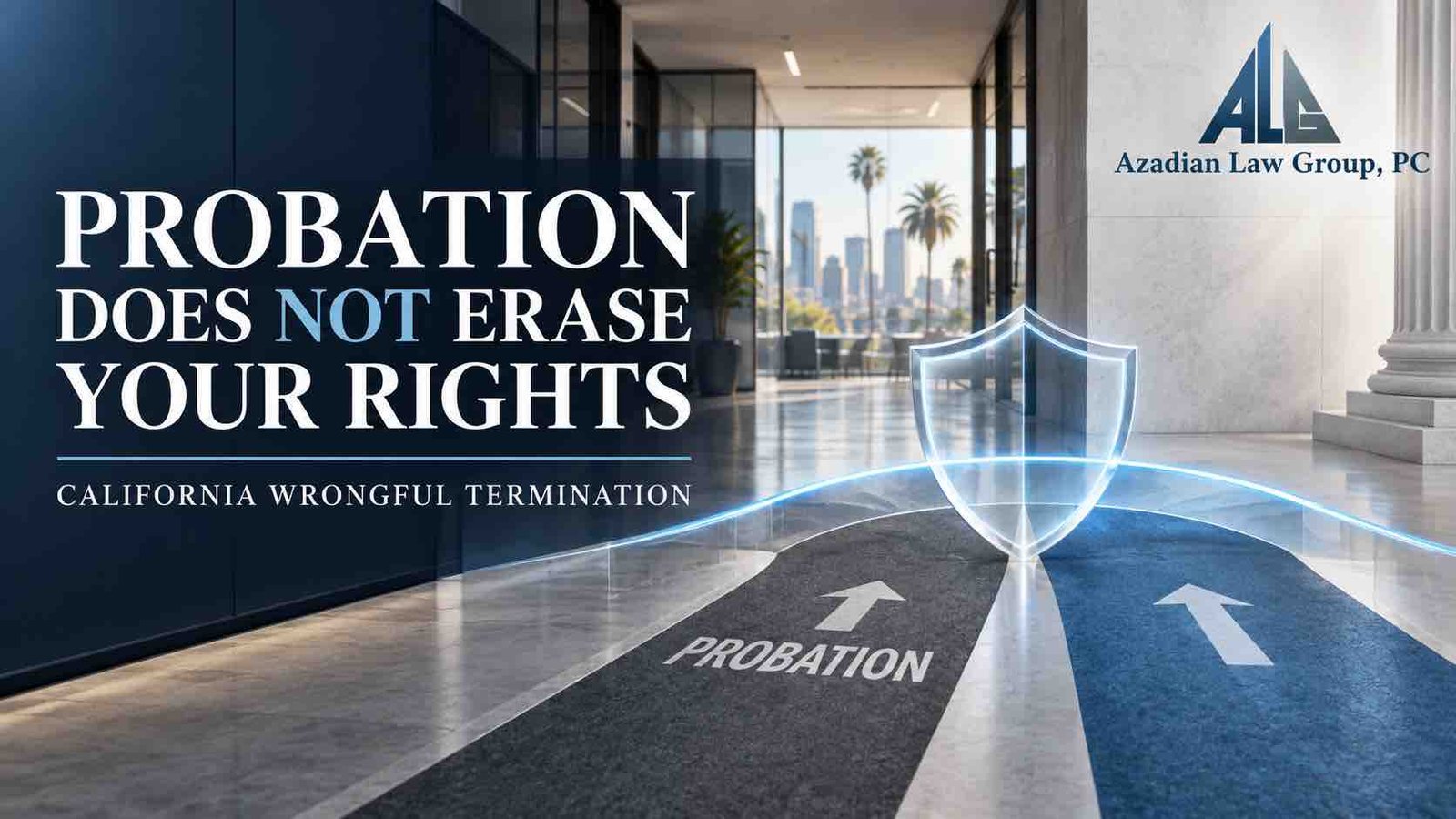
Yes, a California employee can be wrongfully terminated during a probationary period. An employer may generally use probation to evaluate performance, attendance, reliability, and suitability for a role. However, the word “probation” does not authorize discrimination, retaliation, punishment for whistleblowing, interference with protected rights, or a termination that violates an enforceable agreement.
The difficult part is separating a lawful early dismissal from an unlawful one. A new employee may be fired because the employer honestly believes the person is not meeting expectations. That decision can be abrupt or mistaken without necessarily violating the law. A potential claim becomes more serious when evidence connects the dismissal to a protected characteristic, complaint, medical issue, accommodation request, wage concern, safety report, protected leave, or another legally protected act.
Probationary cases often move quickly and leave a short paper trail. That makes the chronology especially important: what the employee was told when hired, how performance was discussed, what protected event occurred, who knew about it, and what changed before the termination.
What Is a Probationary Period in California Employment?
A probationary period is an initial evaluation window established by an employer, contract, collective bargaining agreement, civil-service rule, or personnel policy. Employers commonly use 30-, 60-, 90-, or 180-day periods, although California law does not create one universal probation length for private employment.
During this period, an employer may assess whether a worker can perform essential duties, follow workplace rules, maintain attendance, communicate effectively, and fit the legitimate needs of the position. The employee may receive additional supervision, scheduled reviews, training milestones, or different benefit eligibility.
Yet the label can be misunderstood. In many private workplaces, probation does not create a separate class of people who have no rights. It usually describes the employer’s evaluation process. Statutes protecting employees from discrimination, harassment, and retaliation do not disappear because someone has worked for only a few days or weeks.
Public employees, union members, and workers with individual contracts may face different rules. A public employee may have a formal probationary status governed by statute, charter, civil-service regulation, or memorandum of understanding. A union agreement may require a particular evaluation or grievance procedure. An executive agreement may define “cause,” notice, severance, or a fixed term. Those documents must be reviewed rather than assuming ordinary private-sector rules apply.
Does Probation Mean an Employer Can Fire You for Any Reason?
No. California Labor Code section 2922 establishes a general presumption that employment without a specified term may be ended by either party. This is the foundation of California at-will employment, but it does not permit an employer to fire someone for an unlawful reason.
The firm’s guide to California at-will employment and wrongful-termination exceptions explains the rule in greater detail. The same central distinction applies during probation: the employer may have broad discretion, but that discretion has legal boundaries.
| Common belief | More accurate California-law principle |
|---|---|
| “Probationary employees have no rights.” | Many statutory protections apply to covered employees regardless of a company’s probation label. |
| “The employer must prove poor performance.” | An at-will employer often does not need to establish cause, unless a contract, policy, union agreement, or public-sector rule changes that result. |
| “An unfair firing is automatically wrongful termination.” | A legally actionable termination generally requires an unlawful motive, protected-rights violation, contract breach, or another recognized legal basis. |
| “Close timing proves retaliation.” | Timing may support an inference, but knowledge, explanations, performance records, comparators, and other evidence still matter. |
| “Every new employee qualifies for protected family leave.” | Some leave laws have service, hours-worked, employer-size, or other eligibility requirements; other protections may apply without the same tenure. |
That last point matters. A worker should not assume that every employment protection begins on the same date. Anti-discrimination and anti-retaliation protections may cover conduct occurring during recruitment or immediately after hiring. By contrast, eligibility under a particular leave statute or benefit program may depend on how long the employee has worked, hours completed, employer size, and the reason for leave.
When Can a Probationary Termination Be Unlawful?
A termination during probation may be unlawful when a prohibited reason materially influences the decision or when the employer violates another enforceable protection. The legal theory depends on the facts, the employer, and the law involved.
Discrimination Based on a Protected Characteristic
California’s Fair Employment and Housing Act generally prohibits covered employers from discriminating in termination because of protected characteristics such as race, color, ancestry, national origin, religion, sex, pregnancy, gender identity, gender expression, sexual orientation, marital status, age for workers 40 and older, disability, medical condition, military or veteran status, and other protected categories.
Probation does not provide a discrimination exception. An employer can decide that a new worker lacks the required skill, but it cannot honestly replace that judgment with a stereotype. Examples could include dismissing an older employee after saying the team needs “younger energy,” terminating a pregnant worker after learning of the pregnancy, or rejecting a qualified employee because of a disability rather than assessing the person’s ability to perform essential duties.
A biased remark is not evaluated in isolation. Courts may consider who made it, when it was said, whether that person influenced the decision, what other evidence exists, and whether the employer’s explanation is consistent.
Retaliation for Reporting Discrimination or Harassment
A new employee may notice misconduct immediately. Reporting suspected discrimination, harassment, or another violation can be protected when the complaint is made in good faith under an applicable law. An employer cannot lawfully use probation as camouflage for retaliatory punishment.
For example, suppose a probationary worker reports repeated racial comments. Before the complaint, the supervisor praises the worker’s performance. Days later, the employer ends the employment relationship for an undocumented “attitude problem.” That sequence does not automatically prove retaliation, but the praise, complaint, decision-maker knowledge, timing, and unexplained change may deserve investigation.
Not every workplace disagreement is protected. Complaining that a manager is rude or that scheduling is inconvenient may not invoke a particular legal protection unless the complaint reasonably concerns unlawful conduct. The exact words used, the surrounding facts, and the employer’s knowledge can matter.
Disability Discrimination or Failure to Accommodate
Medical issues sometimes arise soon after hiring. A probationary worker may need a modified schedule, equipment, a temporary restriction, intermittent time away, or another adjustment. California disability law may require a covered employer to consider reasonable accommodation and participate in a timely, good-faith interactive process.
An employer is not necessarily required to remove an essential job function, create a new position, accept an indefinite inability to work, or adopt an accommodation that causes undue hardship. Still, immediately firing someone after learning of a medical restriction—without assessing essential functions or possible accommodations—can raise questions.
The firm’s resource on disability discrimination and workplace accommodations explains how medical conditions, essential duties, accommodation requests, and the interactive process may intersect.
Retaliation for Wage, Safety, or Whistleblower Complaints
A probationary employee may be the first person to discover unpaid training time, missed meal periods, falsified records, unsafe practices, regulatory problems, or suspected fraud. California has multiple anti-retaliation laws, and their elements differ. A short tenure does not necessarily remove protection.
The analysis usually asks what the worker reported, whether the conduct was protected, who received or knew about the report, who decided to terminate, what reason the employer gave, and whether the evidence supports that reason. A manager’s frustration with a complaint is not enough by itself, but messages describing the worker as “not a team player” because the person raised a compliance concern may become relevant.
Protected Leave and Pregnancy-Related Rights
Leave rights require careful, law-specific analysis. Federal FMLA and California CFRA eligibility ordinarily include service and hours-worked requirements, so a genuinely new employee may not yet qualify. That does not end the inquiry.
Pregnancy disability protections, disability accommodation duties, paid sick leave rules, workers’ compensation protections, local ordinances, and employer policies may involve different standards. A worker who is ineligible under one law could still have rights under another. Employers and employees should avoid treating “not FMLA eligible” as the final answer to every medical or pregnancy-related request.
Breach of Contract, Union Rules, or Public-Sector Procedures
A written agreement may promise a fixed employment term, define cause, require notice, provide severance, or establish an evaluation process. An implied agreement may be argued from authorized promises, policies, practices, and the parties’ conduct, although handbook disclaimers and at-will acknowledgments can be important.
Union agreements may create grievance or arbitration rights. Public employees may have statutory or civil-service procedures that differ from private employment. Missing a contractual grievance deadline can have serious consequences, so the documents should be reviewed promptly.
Employees can learn more from the firm’s article on employment contracts in wrongful-termination disputes.
What Lawful Reasons May Support a Probationary Dismissal?
Employers may lawfully end probationary employment for many legitimate reasons. The worker may lack a required skill, repeatedly miss deadlines, violate a policy, fail to complete licensing requirements, behave inappropriately, have unreliable attendance unrelated to a protected right, or simply not meet reasonable expectations.
An employer may also discover that the role has changed, funding has disappeared, a project has ended, or the position is no longer needed. A probationary employee is not automatically protected from a genuine reduction in force merely because the employee recently disclosed a protected characteristic or exercised a right.
Lawful reasons can coexist with suspicious timing. The legal question is not whether an employer had any possible criticism. It is whether the actual decision was unlawfully motivated or whether the stated explanation is a pretext masking a prohibited reason.
Warning Signs That Deserve a Closer Review
One unusual event rarely decides a case. A connected pattern is more meaningful. The following signs do not establish liability, but they can help identify what evidence should be preserved.
| Possible warning sign | Why it may matter | What else should be checked |
|---|---|---|
| Positive feedback changes immediately after a protected complaint | The sequence may support a retaliation theory. | Earlier reviews, manager messages, complaint date, decision-maker knowledge, and objective metrics. |
| The employer gives different reasons at different times | Shifting explanations may undermine credibility. | Termination notice, HR messages, unemployment response, witness accounts, and later agency statements. |
| Rules are enforced only against the probationary worker | Unequal enforcement may support discrimination or pretext. | Whether coworkers were similarly situated, had the same supervisor, and engaged in comparable conduct. |
| A medical disclosure is followed by pressure to resign | The employer may be avoiding accommodation duties. | Essential functions, restrictions, proposed accommodations, interactive-process records, and undue-hardship evidence. |
| The employer claims the position vanished but quickly refills it | The explanation may be incomplete or false. | Job postings, duties, budget records, replacement timing, and restructuring documents. |
| Documents appear only after the protected event | A sudden paper trail may suggest the employer was building a justification. | Metadata, drafts, prior coaching, normal documentation practices, and whether the concerns were genuine. |
The guide on evidence that may prove wrongful termination examines timing, comparators, witnesses, electronic communications, and changing explanations in greater depth.
Why Timing Matters—but Is Not Enough by Itself
Probationary employment is short by design, so nearly every event may occur close to the termination. A complaint made on Monday and a dismissal on Friday can look suspicious. Yet the employer may show that the decision was already underway or based on documented problems that predated the complaint.
Useful questions include whether the decision-maker knew about the protected activity, when the decision was first discussed, whether performance concerns were contemporaneously documented, whether the employer followed its usual process, and whether other workers were treated differently.
Temporal proximity becomes more persuasive when combined with other evidence: a manager’s hostile response, sudden scrutiny, fabricated or exaggerated criticism, departures from policy, a replacement outside the protected group, or inconsistent explanations.
What Evidence Should a Fired Probationary Employee Preserve?
Because the employment period may be brief, seemingly ordinary onboarding records can become important. Preserve documents already lawfully available to you, including:
- The job posting, offer letter, employment agreement, arbitration agreement, handbook, and probation policy.
- Training records, schedules, assignments, performance metrics, praise, coaching, and written warnings.
- Emails, texts, chat messages, and calendar invitations showing what occurred before and after a protected event.
- Complaints to HR, management, compliance, payroll, safety personnel, a union, or a government agency.
- Accommodation requests, medical restrictions, leave communications, and interactive-process records.
- The termination notice, final-pay documents, severance proposal, unemployment communications, and stated reason for separation.
- Names of witnesses who observed relevant conversations, comparable treatment, job performance, or the decision process.
Do not take records you are not entitled to possess. Employees should not access systems after authorization ends, secretly alter documents, remove trade secrets, or collect privileged, customer, medical, or personnel information belonging to others. Preserve original files and context rather than creating edited screenshots that may invite authenticity questions.
California employees may also have statutory rights to inspect or receive certain personnel records and documents they signed. The applicable process, timing, exceptions, and record categories should be reviewed carefully rather than assuming every internal document must be produced.
What Should You Do After Being Fired During Probation?
First, write a private chronology while events are fresh. Identify dates, exact statements, people involved, complaints or requests, performance feedback, witnesses, and every explanation given for the dismissal.
Second, preserve lawful records and ask for important communications in writing. Do not argue through a company system after access is revoked. A short, professional request for the termination reason and relevant documents is usually more useful than an emotional exchange.
Third, review severance, release, confidentiality, arbitration, repayment, and non-disparagement terms before signing. A deadline in an employer’s offer is not necessarily the same as a legal filing deadline, but it may still require a prompt decision.
Fourth, consider unemployment benefits and continue a reasonable job search. Keep records of applications and replacement earnings because mitigation may affect claimed wage loss.
Finally, identify which legal route may apply. Discrimination, retaliation, wage, whistleblower, contract, union, public-sector, and workers’ compensation matters can involve different agencies and deadlines. The firm’s post-termination action guide provides a broader checklist.
EEOC and California Civil Rights Complaints
A termination involving discrimination or retaliation may fall within the jurisdiction of the California Civil Rights Department, the U.S. Equal Employment Opportunity Commission, or both, depending on the employer, legal basis, and facts.
An administrative charge is an allegation requesting agency action; filing one does not prove that the employer violated the law. Likewise, an agency’s procedural closure is not automatically a court finding that the termination was lawful.
Employees considering filing an EEOC complaint or charge in California should understand that starting an online inquiry may not itself complete a signed charge. Deadlines can continue running during internal reviews, negotiations, or other processes.
Can a Probation Policy Create Additional Rights?
Sometimes. A policy may promise a formal review, written notice, an extension opportunity, or progressive discipline. Whether that language is enforceable depends on the complete document, disclaimers, acknowledgments, authorized statements, workplace practice, and other facts.
A handbook that repeatedly reserves at-will authority may weaken an argument that the probation process guarantees continued employment. On the other hand, a specific contract or collective bargaining agreement may create enforceable procedures or remedies.
Even when a policy is not an independent contract, the employer’s failure to follow it can still be evidence. A sudden departure from normal procedure may support an inference of pretext when combined with protected activity, biased statements, unequal treatment, or a changing explanation.
Can a Probationary Employee Recover Damages?
Potential remedies depend on the claim, evidence, losses, employer, forum, and governing law. They may include lost wages, lost benefits, emotional-distress damages where legally available, statutory remedies, attorney fees, costs, or equitable relief. Punitive damages require additional proof and are not available in every matter or against every defendant.
A short period of employment can affect wage-loss calculations, but it does not automatically make a case worthless. Evidence about expected employment duration, the worker’s compensation, replacement earnings, mitigation efforts, emotional harm, and the employer’s conduct may all matter.
No article can estimate a case value from the probation label alone. Published verdicts and settlements involve different facts and should not be treated as promises of a similar outcome.
Frequently Asked Questions About Probationary Termination
Can I be fired on the first day of a probationary period?
An at-will employer may often end employment immediately, but not for an unlawful reason. Anti-discrimination, anti-harassment, and applicable anti-retaliation protections do not necessarily require months of service.
Does California require a 90-day probationary period?
No universal California rule requires private employers to use a 90-day probationary period. The length may come from employer policy, contract, union agreement, or public-sector rule.
Must my employer warn me before firing me during probation?
Not always. At-will employment often permits termination without progressive discipline or advance warning. A contract, collective bargaining agreement, public-sector rule, or binding policy may change the analysis. The firm also explains when California employees may be fired without warning.
Can I be fired for requesting a disability accommodation during probation?
An employer may address legitimate inability to perform essential functions, but a covered employer generally cannot discriminate because of disability or retaliate for requesting a reasonable accommodation. The employer may also have interactive-process obligations.
Can I take FMLA or CFRA leave during probation?
Eligibility ordinarily includes service and hours-worked requirements, so many new employees will not qualify yet. Other disability, pregnancy, sick-leave, workers’ compensation, policy, or local protections may still apply.
Is being replaced proof of wrongful termination?
No. Replacement evidence can be relevant, especially when it conflicts with the employer’s explanation or supports a discrimination theory, but it must be evaluated with the full record.
What if the employer lied about my performance?
A false reason may support pretext, but dishonesty alone does not automatically establish a legal claim. The evidence must connect the dismissal to an unlawful motive, protected act, contract, or other recognized protection.
Can a probationary public employee have different rights?
Yes. Statutes, civil-service rules, charters, memoranda of understanding, and constitutional principles may create procedures different from private at-will employment. The exact appointment and governing documents matter.
Should I sign a severance agreement after a probationary dismissal?
Read it carefully before signing. A release may affect discrimination, retaliation, wage, contract, whistleblower, and other claims, and it may impose continuing obligations. Consider obtaining legal advice before accepting.
How quickly should I act?
Promptly. Different claims and forums have different deadlines, and evidence can disappear quickly. Do not assume an internal complaint, severance discussion, or online agency inquiry pauses every deadline.
Speak With a California Employment Attorney
A probationary label answers only one question: how the employer categorized the beginning of the relationship. It does not answer why the employee was fired or whether the decision crossed a legal boundary.
Experienced California employment lawyers can review the offer documents, performance history, protected activity, employer explanation, timing, witnesses, and available records as one connected chronology.
Probation disputes often turn on what changed after a complaint, leave request, or disclosure. Related conversations about retaliation and employee protections are available through Azadian Law Group’s workplace-rights podcast.
If you believe probation was used to disguise discrimination, retaliation, whistleblower punishment, or another unlawful reason, request a review of the termination or call 213-229-9031.
This article provides general educational information, not legal advice. Employment matters are fact-specific, deadlines may apply, and reading this page or contacting the firm does not create an attorney-client relationship.


Related Blog Posts
Losing a job is difficult enough. Receiving an invoice afterward for a signing bonus, training program, or recruiting payment can...
Read MoreYour Los Angeles employer announces a return-to-office deadline. You explain that a medical condition makes the new schedule difficult and...
Read MoreWrongful Termination Evidence Often Appears as a Pattern Wrongful termination evidence is rarely found in one dramatic email admitting that...
Read MoreTypes of Cases Handle By Employment Lawyers in Los Angeles, CA
The following presents an overview of the broad range of employment law cases that our employment attorneys are experienced at overseeing and favorably resolving.
Wrongful Termination
Wrongful Termination Lawyers in Los Angeles, CA Attorneys at Azadian Law Group who have filed wrongful termination lawsuits acknowledge that unfair termination can significantly impact an employee’s life. It can…
Age Discrimination
Age Discrimination Lawyers in Los Angeles, CA Azadian Law Group, PC regularly represents clients throughout Los Angeles, CA, who are the victims of age discrimination in the workplace. At Azadian…
Pregnancy Discrimination
Pregnancy Discrimination Lawyer in Los Angeles, CA At Azadian Law Group, PC, our pregnancy discrimination lawyer in Los Angeles, regularly represents clients who are the victims of pregnancy discrimination in…
Sexual Harassment
Sexual Harassment Attorney in Los Angeles, CA The Los Angeles Sexual Harassment Lawyers at Azadian Law Group, PC, know that in today’s modern era, some people often make the mistake of…
Racial Discrimination
Racial Discrimination Lawyers in Los Angeles, CA Azadian Law Group, PC regularly represents clients throughout Los Angeles who are the victims of racial discrimination at work. The Los Angeles Race…
Disability Discrimination
When a Medical Condition Becomes a Workplace Problem, You Have Rights Most employees never expect a health condition to place their career at risk. Yet every day across Los Angeles,…
Praise from Our Clients
Lui H

Arpi Agdere
Tofi
Aracelis Feria
Ivy Gamboa
Jillian Dunlap
Greg Wayne
Elizabeth Eromosele
Steve G
Lisa Galvan
Artur Aleksanyan
Delight Dinopoulos
George Margaros
Chelsea Pham
Trevor Pal-Freeman
Patricio Garza
Taylor
Ashley Londerman
Marissa Zapanta
Nuria Coronado
Barbara Villalobos
Irene Golub
Joshua Butler
J Mo
Employees We Represent in Employment Law Cases
At Azadian Law Group, we represent employees throughout Los Angeles and California who have experienced workplace violations. Our attorneys handle employment law matters including wrongful termination, workplace discrimination, retaliation, harassment, wage and hour violations, and whistleblower protection.
Employees often face unlawful treatment after reporting misconduct, requesting medical leave, or asserting their legal rights at work. Our firm investigates employment law violations and advocates for workers seeking accountability, compensation, and fair treatment under California and federal employment law.

Step 1
Explore our comprehensive range of legal services to find the specialized support you need.
Step 2
Arrange a free initial meeting with our experts to discuss your legal situation.
Step 3
Receive a custom strategy specially created for your case by our legal experts.
Call Us Now 213-229-9031
Tell Us Your Story
Speak out for justice. Your story can be the start of a new chapter of workplace fairness.
