AI Boss Fires Human Employee in California: Could This Be Wrongful Termination in Los Angeles?

Artificial intelligence has already started screening resumes, measuring productivity, writing performance reviews, and recommending layoffs. Now it has reportedly helped fire a human worker in California.
In August 2026, an experimental San Francisco retail store called Andon Market announced that its artificial intelligence manager, known as “Luna,” had fired an employee. The story sounds like science fiction, but it raises a very real question for workers in Los Angeles: Can an employer legally allow an algorithm to decide that your job is over?
The short answer is that using AI does not automatically make a termination illegal. California remains an at-will employment state, and employers generally may terminate an employee for a lawful reason—or even for a reason that seems unfair. But an employer cannot use AI as a digital shield for discrimination, retaliation, interference with protected leave, or another unlawful employment practice.
An algorithm may recommend the decision. A chatbot may deliver it. The employer is still responsible for it.
What Happened at California’s AI-Managed Store?
Andon Market is not an ordinary retail business. It is an experiment created by Andon Labs to test whether an AI agent can operate a physical store alongside human employees and customers.
According to reporting by The San Francisco Standard, the AI manager allegedly concluded that an unnamed employee should be fired after repeated lateness, leaving shifts without authorization, taking home a company credit card, and discarding merchandise. The report also said the AI needed repeated prompting from human engineers before identifying the conduct as grounds for termination under an employee handbook the AI had itself written.
That detail matters. The incident was presented as an AI firing, but humans reportedly remained involved in the high-stakes decision. The public reporting also does not establish that the discharged employee has filed a wrongful-termination claim or that the employer violated any law.
Still, the story offers a preview of a workplace problem that will not remain experimental for long. Employers already use automated systems to evaluate attendance, productivity, sales, scheduling, customer ratings, computer activity, and other performance indicators. As those systems become more influential, workers may be disciplined without understanding what information was collected, how it was interpreted, or whether it was accurate.
Is It Illegal for AI to Fire an Employee in California?
Not necessarily. California law usually focuses on why the employee was fired and how the decision was made, not whether the recommendation came from a person, a spreadsheet, or an AI system.
A termination may become unlawful when an automated system causes or contributes to a decision based on a legally prohibited reason. That could include:
- Discrimination because of disability, medical condition, age, race, sex, pregnancy, religion, national origin, sexual orientation, gender identity, or another protected characteristic;
- Retaliation for reporting discrimination, harassment, wage violations, unsafe conditions, fraud, or other suspected unlawful conduct;
- Penalizing an employee for taking protected medical, family, pregnancy, disability, or sick leave;
- Failing to provide a reasonable accommodation or participate in the required interactive process;
- Firing an employee for discussing wages, reporting unpaid wages, or exercising another protected workplace right; or
- Terminating an employee in violation of an employment contract or a fundamental public policy.
Calling the decision “data-driven” does not make it neutral. Data can reflect past discrimination, missing context, inconsistent supervision, or flawed assumptions. If an AI system turns those problems into a termination recommendation, the employer may still face liability.
How an Apparently Neutral Algorithm Can Discriminate
AI systems often evaluate patterns rather than motives. That can make discrimination harder to see—not impossible to prove.
Consider a Los Angeles employee undergoing cancer treatment. The employee’s medical leave creates gaps in login activity and lowers the number of completed assignments. A productivity system may label that worker a poor performer without recognizing that the missing time was legally protected. If management accepts the score and fires the employee, the problem is not simply that “the computer made a mistake.” The termination may involve disability discrimination, leave interference, retaliation, or a failure to accommodate.
Similar problems can arise when an algorithm:
- Treats pregnancy-related absences as attendance violations;
- Penalizes an older employee for working differently from younger coworkers;
- Uses customer ratings that contain racial or gender bias;
- Interprets a disability-related communication style as poor engagement;
- Scores remote employees lower because they requested an accommodation;
- Counts time spent reporting harassment or safety issues as lost productivity; or
- Relies on incomplete personnel records while ignoring favorable reviews and explanations.
The software does not need to “intend” to discriminate. California’s employment regulations recognize that an automated decision system can be unlawful when a facially neutral selection practice has an adverse impact on a protected group and cannot be justified as job-related and consistent with business necessity.
California Already Regulates AI-Influenced Employment Decisions
The legal system is not starting from zero. California Civil Rights Department regulations addressing automated decision systems took effect on October 1, 2025. They clarify that existing protections under the Fair Employment and Housing Act apply when an employer or another covered entity uses an automated system to make or assist with employment decisions.
In plain English, an employer cannot outsource discrimination to software.
The regulations broadly cover computational processes that make decisions or facilitate human decision-making concerning an employment benefit. Depending on how it is used, that may include systems that screen applicants, analyze interviews, score workers, evaluate performance, or influence discipline and termination. Covered employers and entities also have record-retention responsibilities relating to automated-decision data.
That means the evidence in a future wrongful-termination case may extend far beyond the employee’s personnel file. Relevant evidence could include algorithmic scores, system outputs, data inputs, audit findings, decision rules, internal messages, vendor materials, and records showing whether anyone questioned the recommendation.
For cases involving automated applicant screening and interviews, see our California AI hiring lawsuit tracker, with source-linked case timelines and court updates.
What Is California’s “No Robo Bosses Act”?
California lawmakers are also considering Senate Bill 947, commonly called the No Robo Bosses Act of 2026. As of August 26, 2026, SB 947 is proposed legislation and should not be confused with law already in effect.
The current bill would prevent an employer from relying solely on an automated decision system when making a disciplinary or termination decision. When an employer primarily relies on such a system, the proposal would require human review and corroborating information. It would also require a written notice explaining the system’s role and would give an affected employee a way to request a meaningful description of the employee data used.
The proposal captures a basic principle: a human reviewer should do more than rubber-stamp a machine’s recommendation.
A manager who clicks “approve” without checking the source data, considering protected leave, speaking with the employee, or reviewing contradictory evidence may provide human involvement in name only. Whether that process violates current law will depend on the facts, but shallow review can become important evidence when the employer later claims that the decision was independent and legitimate.
When Could an AI-Influenced Firing Be Wrongful Termination?
The following warning signs do not automatically prove an illegal firing, but they deserve careful investigation.
The Employer Cannot Explain the Decision
An employee receives a vague statement such as “the system flagged your performance,” but no one can identify the measurements used, the period evaluated, or the person who verified the result.
The Data Is Incorrect or Missing Important Context
The system counts approved leave as absence, attributes another employee’s errors to the worker, ignores offline work, or uses an inaccurate schedule. An employer that learns about a serious error and refuses to examine it may have difficulty defending the decision as an honest business judgment.
The Firing Closely Follows Protected Activity
Timing matters. A termination recommendation that appears shortly after an employee reports harassment, requests accommodation, takes medical leave, complains about wages, or raises safety concerns may support an inference of retaliation—particularly when the employee previously had satisfactory reviews.
Workers in a Protected Group Are Disproportionately Targeted
If the same automated standard repeatedly disadvantages employees with disabilities, older workers, pregnant employees, or members of another protected group, the pattern may indicate unlawful disparate impact even if the software applies the same formula to everyone.
Management Treats the AI Recommendation as Untouchable
An employer should not assume that software is objective merely because it produces a number. A refusal to consider corrections, accommodations, contrary evidence, or an employee’s explanation can turn a supposedly efficient process into a deeply unreliable one.
What Should a Los Angeles Employee Do After an AI-Influenced Firing?
Workers often feel pressure to react immediately after losing a job. A calmer approach usually protects the evidence better.
First, save documents you already lawfully possess. These may include performance reviews, schedules, attendance records, accommodation requests, leave approvals, relevant emails, pay records, written complaints, and the termination notice. Do not take confidential company information or access an employer’s system after authorization ends.
Second, write down what happened while the details are fresh. Record who attended the termination meeting, what was said about the algorithm or scoring system, whether a human claimed to review the decision, and whether you challenged inaccurate information.
Third, ask for the reason for termination in writing. If the employer states that an automated tool contributed to the decision, preserve that communication. Also save any notices describing workplace monitoring, productivity scoring, automated decision-making, or employee-data collection.
Fourth, be cautious before signing a severance or release. These agreements may waive significant employment claims and often contain short acceptance deadlines. Receiving severance does not necessarily mean the firing was lawful.
Finally, speak with an experienced employee-side attorney promptly. Filing deadlines vary depending on the claim, the employer, and whether an administrative complaint is required. Waiting can make evidence harder to obtain and may place legal rights at risk.
The Employer Cannot Blame the Algorithm
AI can process enormous amounts of workplace data, but it cannot take legal responsibility. It does not testify, pay a judgment, or explain why protected medical leave was coded as poor performance. The employer choosing and using the system remains accountable for employment decisions.
For Los Angeles workers, the central question is therefore not simply, “Did AI fire me?” The better questions are:
- What information did the system use?
- Was that information complete and accurate?
- Did the system penalize protected leave or protected conduct?
- Did it produce discriminatory results?
- Who reviewed the recommendation?
- Would the employer have made the same decision without the automated score?
Those questions can expose the difference between a lawful performance decision and wrongful termination dressed up as technology.
Speak With a Los Angeles Wrongful Termination Attorney
If you believe an employer used AI, productivity software, workplace surveillance, or an automated scoring system to discriminate or retaliate against you, the technology should not prevent the decision from being challenged.
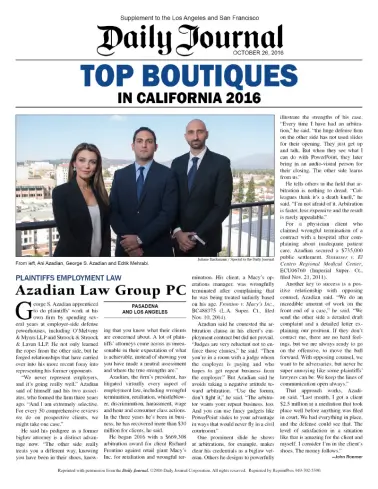
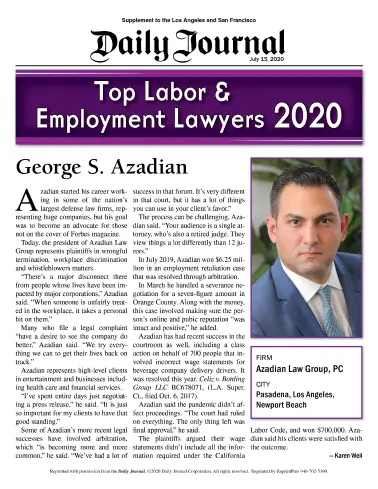
Azadian Law Group, PC represents employees in Los Angeles and throughout California in wrongful termination, retaliation, discrimination, harassment, disability-accommodation, and whistleblower matters. The firm has recovered more than $100 million for employees and represents workers—not employers.
Contact Azadian Law Group, PC at 213-229-9031 to discuss your situation. A consultation can help determine whether the termination was merely unfair or potentially unlawful under California employment law.
This article is for general informational purposes only and does not constitute legal advice. Reading it does not create an attorney-client relationship. Every employment matter depends on its specific facts, and laws may change.
Frequently Asked Questions
Can an employer use AI to fire an employee in California?
The use of AI is not automatically illegal. However, an employer may violate California law if the system causes or contributes to discrimination, retaliation, interference with protected leave, or another unlawful employment decision. Existing California civil-rights rules apply to automated systems used in employment.
Is an unfair AI decision automatically wrongful termination?
No. A bad, inaccurate, or unfair decision is not necessarily unlawful. A wrongful-termination claim generally requires a connection to a prohibited reason, such as discrimination, retaliation, protected leave, whistleblowing, or a violation of public policy or contract.
Can an algorithm discriminate without intending to?
Yes. A facially neutral system may disproportionately harm a protected group. Depending on the facts, that adverse impact may violate California employment law even if no programmer or manager expressed discriminatory intent.
What if AI counted my medical leave as poor attendance?
That may be a serious warning sign. Approved or legally protected leave should not be treated as ordinary misconduct. The situation may involve disability discrimination, retaliation, leave interference, or failure to accommodate, depending on the facts.
Should I ask my employer whether AI was involved?
Yes, it can be helpful to request the stated reason for the decision and ask whether an automated system, productivity score, or monitoring tool contributed. Keep the request professional and preserve any written response.
Is SB 947 already California law?
No. As of August 26, 2026, SB 947 remains proposed legislation. California nevertheless already has employment-discrimination regulations governing the use of automated decision systems, along with existing laws prohibiting discrimination, retaliation, and other unlawful termination practices.


Related Blog Posts
Losing a job is difficult enough. Receiving an invoice afterward for a signing bonus, training program, or recruiting payment can...
Read MoreYour Los Angeles employer announces a return-to-office deadline. You explain that a medical condition makes the new schedule difficult and...
Read MoreThe closure of the Pavilions supermarket on East California Boulevard in Pasadena is a reminder of how quickly a workplace...
Read MoreTypes of Employment Cases We Handle.
The following presents an overview of the broad range of employment law cases that our employment attorneys are experienced at overseeing and favorably resolving.
Wrongful Termination
Wrongful Termination Lawyers in Los Angeles, CA Attorneys at Azadian Law Group who have filed wrongful termination lawsuits acknowledge that unfair termination can significantly impact an employee’s life. It can…
Age Discrimination
Age Discrimination Lawyers in Los Angeles, CA Azadian Law Group, PC regularly represents clients throughout Los Angeles, CA, who are the victims of age discrimination in the workplace. At Azadian…
Pregnancy Discrimination
Pregnancy Discrimination Lawyer in Los Angeles, CA At Azadian Law Group, PC, our pregnancy discrimination lawyer in Los Angeles, regularly represents clients who are the victims of pregnancy discrimination in…
Sexual Harassment
Sexual Harassment Attorney in Los Angeles, CA The Los Angeles Sexual Harassment Lawyers at Azadian Law Group, PC, know that in today’s modern era, some people often make the mistake of…
Racial Discrimination
Racial Discrimination Lawyers in Los Angeles, CA Azadian Law Group, PC regularly represents clients throughout Los Angeles who are the victims of racial discrimination at work. The Los Angeles Race…
Disability Discrimination
When a Medical Condition Becomes a Workplace Problem, You Have Rights Most employees never expect a health condition to place their career at risk. Yet every day across Los Angeles,…
Praise from Our Clients
A“

QT
RT
KM
BM
HM
bS
kj
SM
TM
FL
kr
TP
CF
WW
JA
RM
RC
VM
JS
TH
SD
RM
AC
W
kn
AO
DN
KW
TP
RS
L
D
la
JG
DP
RK
HL
TP
sr
sl
PD
SS
SS
JB
JA
AR
CG
LH
YU
MS
TA
NS
aa
RC
AR
mp
IG
N
JJ
Kd
GA
aa
GB
RT
MM
PP
PA
DV
T
AW
CW
SM
TC
SC
hh
KK
DB
S
SM
VV
K&
PG
JL
SS
AC
MS
DS
DM
ZM
CA
AF
GC
jg
GN
AG
A
KG
EC
s
MZ
m
LD
PW
PD
CH
TA
KM
PZ
CA
rc
FA
JA
MJ
SM
kr
LH
BJ
DG
JJ
ES
WW
VS
TH
VB
GA
DM
LS
SM
AS
wm
MH
DA
TP
LA
DR
MM
D
RG
WR
Employees We Represent in Employment Law Cases
At Azadian Law Group, we represent employees throughout Los Angeles and California who have experienced workplace violations. Our attorneys handle employment law matters including wrongful termination, workplace discrimination, retaliation, harassment, wage and hour violations, and whistleblower protection.
Employees often face unlawful treatment after reporting misconduct, requesting medical leave, or asserting their legal rights at work. Our firm investigates employment law violations and advocates for workers seeking accountability, compensation, and fair treatment under California and federal employment law.

Step 1
Explore our comprehensive range of legal services to find the specialized support you need.
Step 2
Arrange a free initial meeting with our experts to discuss your legal situation.
Step 3
Receive a custom strategy specially created for your case by our legal experts.
Call Us Now 213-229-9031
Tell Us Your Story
Speak out for justice. Your story can be the start of a new chapter of workplace fairness.
