Wrongful Termination Statute of Limitations in California
How Long Do You Have to Sue for Wrongful Termination in California?
There is no single California deadline for every wrongful-termination case. The filing period depends on the legal theory behind the termination. A discrimination claim may begin with the California Civil Rights Department or the Equal Employment Opportunity Commission. A public-policy tort, contract claim, Labor Commissioner retaliation complaint, defamation claim, or case against a government employer can follow a different timetable.
That distinction matters because the shortest deadline may control an important part of the case. An employee can preserve one theory and still lose another by waiting. Agency filing periods and lawsuit deadlines may also be separate. Obtaining a right-to-sue notice does not create unlimited time, and internal HR discussions usually do not stop an external deadline automatically.
The safest approach is to identify every possible claim, agency, triggering event, and filing requirement as soon as the employee suspects an unlawful termination. The date of discharge is often central, but an earlier discriminatory act, later defamatory statement, agency notice, contract breach, or government rejection letter may create a different start date.
Quick Answer: Major California Employment Deadlines
The following table is an orientation tool, not a deadline calculator. Exceptions, tolling rules, federal-sector procedures, collective bargaining agreements, and the specific remedy requested can change the analysis.
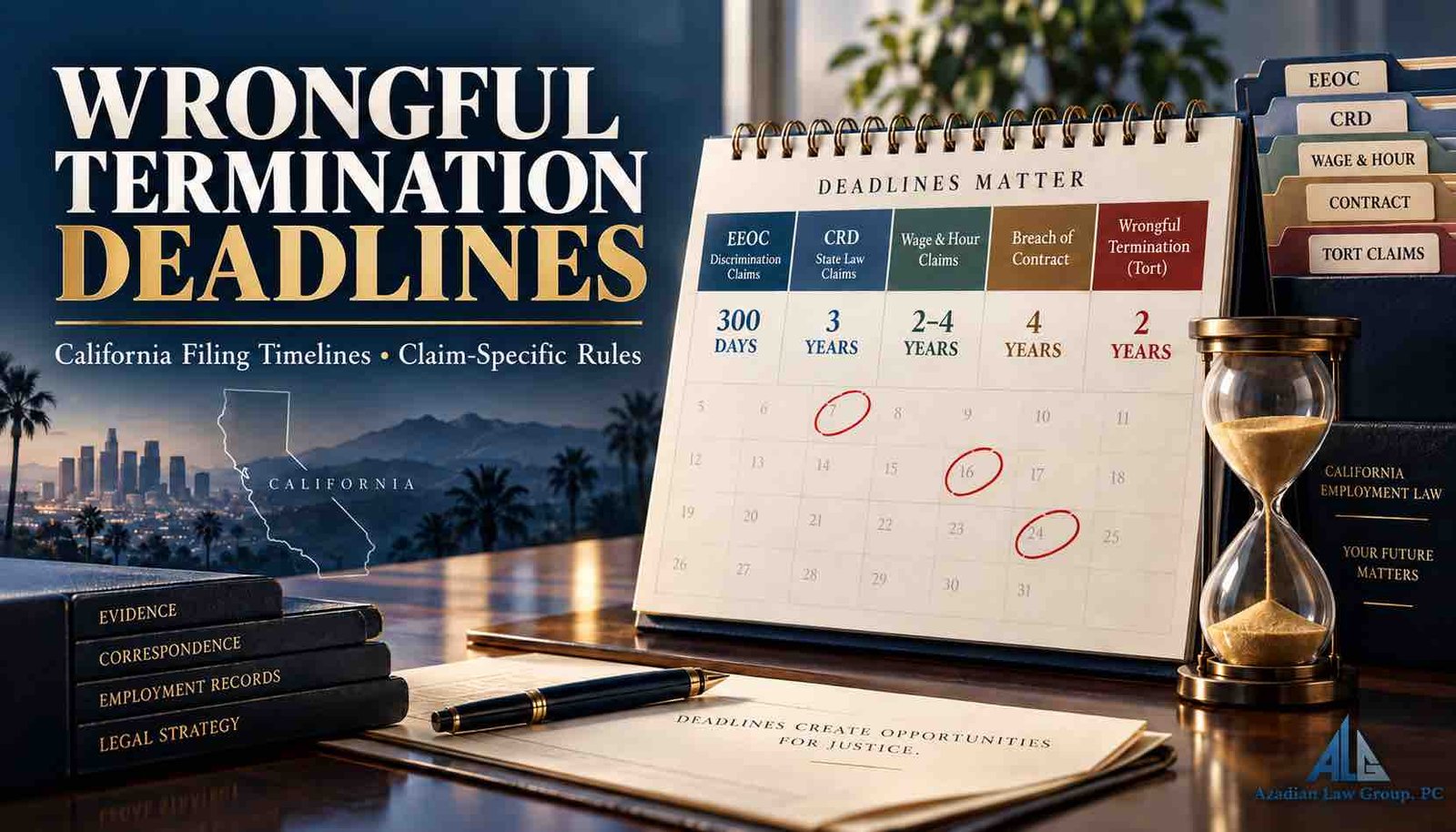
| Potential claim or filing | Common time period | Key caution |
|---|---|---|
| California FEHA discrimination, harassment, or retaliation intake with CRD | Generally three years from the last alleged unlawful practice | A later lawsuit usually requires a CRD right-to-sue notice and has its own deadline. |
| Federal discrimination charge with EEOC | Generally 180 days, often extended to 300 days where a qualifying state or local law applies | Coverage, claim type, work location, and federal-sector status can change the rule. |
| California wrongful termination in violation of public policy | Often two years | The underlying public policy and related statutory claims must be analyzed separately. |
| Written employment contract claim | Often four years | Accrual, contract language, arbitration, and the requested remedy matter. |
| Oral contract claim | Often two years | Proof of the agreement and when the breach occurred are critical. |
| Defamation based on a separate false publication | Generally one year | Termination itself is not defamation; publication, privilege, falsity, and accrual require separate review. |
| Labor Commissioner retaliation complaint | Most commonly one year, with important exceptions | The specific Labor Code or safety provision determines the filing period. |
| Claim involving a public entity | A government claim may be due in as little as six months | Claim-presentation rules can arise before a court filing and vary by cause of action. |
Do not select a deadline solely by choosing the row that sounds closest. One termination can support several claims, each with its own elements and clock.
Why “Wrongful Termination” Does Not Have One Universal Deadline
Wrongful termination describes an unlawful firing, but it is not one uniform claim. The employee must connect the discharge to a recognized legal protection. The firing may violate an anti-discrimination statute, an employment agreement, a whistleblower law, a leave law, a wage-protection rule, or a fundamental public policy.
For example, an employee fired after requesting disability accommodation may have state and federal discrimination theories. Someone discharged for refusing to falsify safety records may have statutory retaliation and public-policy theories. An executive denied promised severance may have a contract dispute. A public employee may face administrative and government-claim requirements that a private employee never encounters.
Each route can specify a different filing office, pleading requirement, limitations period, or right-to-sue process. Therefore, the first task is not merely counting from the termination date. It is mapping the facts to every plausible claim.
When Does the Limitations Clock Usually Start?
Many termination-based periods begin when the employee is notified of the final termination decision or when the discharge becomes effective. Those dates are sometimes the same, but not always. A worker may receive an unequivocal notice weeks before the final day, remain on payroll during leave, or learn later that a supposedly temporary suspension was permanent.
Courts and agencies examine the specific claim and the event that completed it. A discriminatory failure to promote, denied accommodation, retaliatory suspension, hostile-work-environment allegation, and termination may not accrue on one date. A defamation claim can turn on when a statement was published. A contract claim can turn on when the employer failed to perform an obligation.
Record at least four dates: when the decision was communicated, the stated effective date, the final day worked, and the final payroll date. Preserve the letter, email, calendar invitation, severance agreement, pay records, and notes from the meeting. Do not assume the latest date will control.
California CRD Deadline for Discrimination and Retaliation
For employment discrimination matters, the California Civil Rights Department states that an intake form generally must be submitted within three years of the date the employee was last harmed. Claims may involve discrimination, harassment, failure to accommodate, failure to engage in the interactive process, or retaliation protected by California’s Fair Employment and Housing Act.
The three-year period does not mean every termination claim belongs at CRD. FEHA coverage depends on the employer, the protected basis or activity, and other statutory elements. It also does not mean waiting is harmless. Documents disappear, memories fade, witnesses move, and a federal EEOC deadline may arrive much earlier.
An employee who wants to bring a FEHA lawsuit generally must first obtain a CRD right-to-sue notice. CRD offers an immediate right-to-sue process, but requesting that notice ends the agency investigation route for that complaint. Choosing between investigation and an immediate notice deserves informed legal review.
The Lawsuit Deadline After a CRD Right-to-Sue Notice
The administrative filing deadline and the later court deadline are separate. Current CRD instructions state that a person generally has one year from the date of the right-to-sue notice to file a lawsuit. The notice itself should be reviewed because it identifies the operative date and carries important instructions.
This produces two clocks: one for starting the CRD process and another after CRD issues the notice. A worker should not assume that filing an intake form guarantees all later deadlines will be met. Nor should someone request an immediate notice without a plan for evaluating and filing the lawsuit within the available period.
Keep the complaint, submission confirmation, correspondence, amended allegations, notice, and proof of the date received. If CRD investigates, track every status update. If the employee also wants to preserve federal claims, confirm whether and how the matter was dual filed rather than assuming state and federal rights were automatically preserved.
EEOC Filing Deadlines in California
Federal discrimination claims under laws enforced by the EEOC usually require a timely charge before a lawsuit. The EEOC explains that the basic 180-day period can extend to 300 days when a state or local agency enforces a law prohibiting the same type of employment discrimination. California employees often encounter the 300-day period, but no one should treat it as automatic without checking the claim, employer, work location, and governing statute.
Age-discrimination extension rules have additional requirements. Federal employees also follow a different process and generally must contact an agency EEO counselor within a much shorter period. Equal Pay Act claims have different filing rules.
Because federal and state rights can overlap without being identical, an employee should examine both systems early. Azadian Law Group’s guide to an EEOC complaint in California explains charge preparation, dual filing, agency review, and right-to-sue considerations in more detail.
Does Every Wrongful-Termination Case Require an EEOC Charge?
No. The EEOC handles specified federal discrimination statutes. It does not investigate every contract dispute, wage claim, whistleblower law, defamation allegation, or public-policy tort. The current article’s claim that the EEOC must approve every wrongful-termination case is too broad and should be removed.
An EEOC charge may be essential when a federal discrimination or retaliation theory applies. A CRD filing may be necessary for a California FEHA claim. A Labor Commissioner complaint may be available for certain Labor Code retaliation matters. Other claims can proceed through different routes.
The correct question is: which legal rights may have been violated, and what exhaustion or notice rule applies to each one? One filing may preserve overlapping claims through a work-sharing process, but employees should obtain confirmation instead of relying on an assumption.
Wrongful Termination in Violation of Public Policy
California recognizes a tort claim when an employer terminates an employee in violation of a fundamental public policy established by constitutional or statutory law. Common fact patterns include discharge for refusing illegal conduct, reporting certain suspected violations, exercising a statutory right, or performing a legal obligation.
California Code of Civil Procedure section 335.1 provides a two-year period for actions involving injury caused by another’s wrongful act or neglect. Courts commonly apply that period to a public-policy wrongful-discharge tort. However, the same facts may also support a statute-based retaliation claim with a different period or agency route.
An employee should not label every unfair firing a public-policy tort. The policy must meet legal requirements, relate to the employment decision, and support the remedy sought. The chronology must also connect the protected conduct to the termination.
Retaliation and Whistleblower Deadlines Can Differ
California protects many forms of workplace activity, but those protections do not all use the same enforcement scheme. The Labor Commissioner states that most retaliation complaints within its jurisdiction must be filed within one year of the adverse action. It also lists exceptions, including shorter or longer periods under particular provisions.
A worker may also have a private right of action under the Labor Code or another statute. The limitations period for that court claim can depend on the statutory text, remedy, and case law. For that reason, it is unsafe to treat the Labor Commissioner’s administrative period as the only possible clock—or to assume missing it has no consequence.
Employees should identify what they reported, to whom, when the employer learned of it, the first retaliatory act, and every later adverse action. Azadian Law Group’s discussion of termination after an HR complaint explains why the content of the complaint matters more than the label placed on it.
Contract Deadlines After a Termination
A termination can breach a written employment agreement, commission plan, equity document, severance promise, collective bargaining agreement, or an enforceable agreement created through other communications. California Code of Civil Procedure section 337 generally provides four years for an action founded on a written instrument. Section 339 generally provides two years for an obligation not founded on a writing.
Those headline periods do not answer every contract question. The court must determine whether a contract existed, which promise was breached, when performance became due, whether the agreement requires arbitration, and whether another provision shortens or changes the procedure. A union agreement may require a grievance within days or weeks even when a court limitations period appears longer.
Preserve every version of the offer letter, contract, amendment, compensation plan, handbook acknowledgment, collective bargaining agreement, and severance document. The article on employment contracts in termination disputes explains how written and implied promises can alter an at-will analysis.
Can Defamation Create a Separate One-Year Deadline?
Possibly. California Code of Civil Procedure section 340(c) generally provides one year for libel or slander. Yet a false termination reason does not automatically establish defamation. A claimant generally must examine whether someone made a false statement of fact to another person, whether a privilege applies, whether the speaker acted with the required fault, and whether the statement caused legally recognized harm.
The publication date can control, and each alleged statement needs separate analysis. Internal workplace communications may carry a qualified common-interest privilege. Truth is a defense, while opinions and ambiguous statements raise different issues. Repeating the accusation publicly can also create complications for the employee.
Because the defamation period may be shorter than other employment deadlines, document who said what, to whom, when, and how the employee learned of it. The separate guide to being fired following false accusations explains the difference between an unfair decision, unlawful pretext, and a potentially defamatory publication.
Special Rules for Public Employees and Government Employers
Claims against a city, county, school district, state agency, or other public entity can trigger the California Government Claims Act. California Courts explains that a claimant may need to present a claim to the government agency before filing suit. For certain injury-related claims, that presentation period can be as short as six months.
A written rejection can start another short period for filing the court action. Meanwhile, civil-service appeals, memoranda of understanding, Skelly procedures, union grievances, federal-sector EEO rules, or writ deadlines may operate independently.
Do not assume that a discrimination agency charge replaces a government claim, or that a government claim replaces an administrative appeal. Public employees should identify the employer’s legal status and obtain the governing personnel rules immediately. Missing a preliminary process can affect the case before the ordinary lawsuit deadline arrives.
Do Internal Complaints or Severance Talks Pause the Deadline?
Usually, employees should assume the clock keeps running unless a statute, written tolling agreement, agency rule, or binding legal doctrine says otherwise. An internal appeal, HR investigation, union grievance, unemployment claim, severance negotiation, mediation discussion, or promise that management will “look into it” does not automatically extend every external deadline.
This trap is common because the employee is still waiting for an answer. The employer may request more time, schedule another meeting, or revise the separation offer. None of those events necessarily changes when the claim accrued.
Track negotiations and legal deadlines on separate calendars. If the parties agree to toll a period, the agreement should identify the claims, parties, start date, end date, and effect with precision. Do not infer tolling from a courteous email or ongoing conversation.
Can Continuing-Violation or Delayed-Discovery Rules Help?
Sometimes, but these doctrines are fact specific. A continuing course of harassment can differ from a series of discrete acts such as termination, demotion, or failure to promote. Delayed discovery may affect a claim when the plaintiff could not reasonably have known the essential facts earlier, but later learning stronger evidence does not always restart the period.
Equitable tolling or estoppel may apply in limited circumstances. Courts examine diligence, notice, prejudice, representations, and the relationship between proceedings. These doctrines are not a safe substitute for timely filing.
Employees should tell counsel about hidden decisions, misleading statements, medical incapacity, bankruptcy, minors, military service, prior agency filings, class proceedings, arbitration, and any written agreement about deadlines. A lawyer can then determine whether a doctrine may preserve a claim without assuming that it will.
How Multiple Claims Create Multiple Clocks
Consider an employee fired after requesting pregnancy accommodation and reporting falsified billing. HR later tells a recruiter that the employee committed theft, while a written bonus remains unpaid. That one separation could raise FEHA, federal discrimination, whistleblower, public-policy, defamation, and contract or wage questions.
| Event | Possible legal issue | Deadline question |
|---|---|---|
| Accommodation request denied | Disability or pregnancy protections | Was the denial a discrete act, part of a continuing process, or followed by retaliation? |
| Compliance report submitted | Whistleblower protection | Which statute protects the report, and does it allow an agency complaint or private action? |
| Termination announced | Discrimination, retaliation, contract, or public policy | Did notice or the effective date start the relevant clock? |
| Accusation sent to recruiter | Defamation or interference | When was the statement published, and does a privilege apply? |
| Bonus withheld | Contract or wage claim | When did payment become due, and what plan terms govern? |
This is why a single “two-year deadline” answer can be dangerous. The earliest valid deadline deserves immediate attention.
Evidence to Preserve Before Time Runs Out
Deadline analysis depends on dates, legal theories, and proof. Preserve records lawfully and keep original metadata where possible.
- The termination notice, severance agreement, final wage statement, and benefit notices.
- Emails or messages showing when the decision was announced and when it took effect.
- Complaints, accommodation requests, leave documents, safety reports, and wage objections.
- Performance reviews, discipline, praise, goals, and policy acknowledgments.
- Offer letters, contracts, compensation plans, handbooks, and union agreements.
- CRD, EEOC, Labor Commissioner, government-claim, grievance, or arbitration correspondence.
- A chronology identifying witnesses, decision-makers, statements, and supporting documents.
Do not access a system after authorization ends or take confidential records belonging to clients, patients, coworkers, or the business. Azadian Law Group’s guide to evidence in a California wrongful-termination case shows how timing, comparators, shifting explanations, and documents can fit together.
What to Do During the First Week After Termination
First, write a factual chronology. Separate what you personally saw from what you suspect. Note the people present, words used, dates, and location of each supporting record.
Second, collect the separation documents and calculate several candidate deadlines. Include the shortest plausible administrative filing period, not just the most generous court period.
Third, review any severance offer without rushing. A release can waive claims, impose confidentiality or cooperation duties, and include its own acceptance deadline. Negotiation usually does not pause government or court deadlines automatically.
Fourth, apply for unemployment and comparable employment where appropriate. Keep a job-search log because mitigation can affect damages.
Finally, seek legal review early. Experienced California wrongful termination attorneys can identify the potential claims, confirm the controlling dates, and determine which filings may be required. Early advice is especially important when a public employer, union process, arbitration clause, agency charge, or one-year claim may apply.
Common Deadline Mistakes to Avoid
- Assuming every claim has two years: discrimination, defamation, contracts, retaliation, and government claims may use different periods.
- Waiting for HR to finish: an internal review may not toll an agency or court deadline.
- Treating CRD and EEOC as identical: they enforce overlapping but distinct laws and procedures.
- Counting only from the last day worked: unequivocal notice, publication, breach, or agency notice may matter.
- Ignoring the right-to-sue notice: a new lawsuit period may begin when the notice issues.
- Forgetting public-employer procedures: government claims and administrative appeals can be unusually short.
- Relying on an online calculator: a calculator cannot identify every legal theory, exception, or accrual event.
Frequently Asked Questions
Is the California wrongful-termination deadline always two years?
No. Two years often applies to a public-policy wrongful-discharge tort, but FEHA, federal discrimination, contract, defamation, Labor Code, wage, and public-entity matters can use different deadlines and procedures.
How long do I have to file with CRD?
CRD states that an employment intake generally must be submitted within three years of the date the employee was last harmed. Coverage and accrual still require individual analysis.
How long do I have to file an EEOC charge in California?
The federal period is generally 180 days and may extend to 300 days when a qualifying state or local law applies. Federal employees and some claim types follow different rules, so prompt confirmation is essential.
Does filing with CRD automatically preserve federal claims?
Not necessarily. Work-sharing and dual-filing arrangements can help, but the employee should confirm what was filed, with which agency, under which laws, and on what date.
Does a severance negotiation extend the deadline?
Not automatically. Unless a valid tolling rule or written agreement applies, employees should assume statutory and agency clocks continue during negotiation.
What if I discovered the discriminatory reason months later?
Delayed-discovery or equitable doctrines may affect some claims, but later evidence does not automatically restart a clock. A lawyer should examine what the employee knew, when it was knowable, and which claim is involved.
Can I still have a case if one deadline passed?
Possibly. Another claim may use a different period, and a tolling or accrual rule may apply. However, no one should assume an exception will save the matter. Immediate review is the prudent step.
Speak With a California Employment Attorney About Your Deadline
The most important deadline may not be obvious from the termination letter. A complete review connects the firing to protected activity, protected status, contracts, compensation, later statements, the employer’s identity, and every administrative filing.
Employees who want additional workplace-rights discussions can explore Azadian Law Group’s employment-law podcast episodes. If a termination may have violated California or federal law, request a confidential case evaluation before relying on a generalized deadline.
This article provides general educational information, not legal advice. Laws, agency procedures, and deadlines can change, and individual facts can produce a different result.


Related Blog Posts
Wrongful Termination Evidence Often Appears as a Pattern Wrongful termination evidence is rarely found in one dramatic email admitting that...
Read MoreOracle Layoffs Raise New Questions for California Employees Oracle has reportedly begun another round of layoffs in the United States,...
Read MoreArtificial intelligence has already started screening resumes, measuring productivity, writing performance reviews, and recommending layoffs. Now it has reportedly helped...
Read MoreTypes of Cases Handle By Employment Lawyers in Los Angeles, CA
The following presents an overview of the broad range of employment law cases that our employment attorneys are experienced at overseeing and favorably resolving.
Wrongful Termination
Wrongful Termination Lawyers in Los Angeles, CA Attorneys at Azadian Law Group who have filed wrongful termination lawsuits acknowledge that unfair termination can significantly impact an employee’s life. It can…
Age Discrimination
Age Discrimination Lawyers in Los Angeles, CA Azadian Law Group, PC regularly represents clients throughout Los Angeles, CA, who are the victims of age discrimination in the workplace. At Azadian…
Pregnancy Discrimination
Pregnancy Discrimination Lawyer in Los Angeles, CA At Azadian Law Group, PC, our pregnancy discrimination lawyer in Los Angeles, regularly represents clients who are the victims of pregnancy discrimination in…
Sexual Harassment
Sexual Harassment Attorney in Los Angeles, CA The Los Angeles Sexual Harassment Lawyers at Azadian Law Group, PC, know that in today’s modern era, some people often make the mistake of…
Racial Discrimination
Racial Discrimination Lawyers in Los Angeles, CA Azadian Law Group, PC regularly represents clients throughout Los Angeles who are the victims of racial discrimination at work. The Los Angeles Race…
Disability Discrimination
When a Medical Condition Becomes a Workplace Problem, You Have Rights Most employees never expect a health condition to place their career at risk. Yet every day across Los Angeles,…
Praise from Our Clients
Lui H

Arpi Agdere
Tofi
Aracelis Feria
Ivy Gamboa
Jillian Dunlap
Greg Wayne
Elizabeth Eromosele
Steve G
Lisa Galvan
Artur Aleksanyan
Delight Dinopoulos
George Margaros
Chelsea Pham
Trevor Pal-Freeman
Patricio Garza
Taylor
Ashley Londerman
Marissa Zapanta
Nuria Coronado
Barbara Villalobos
Irene Golub
Joshua Butler
J Mo
Employees We Represent in Employment Law Cases
At Azadian Law Group, we represent employees throughout Los Angeles and California who have experienced workplace violations. Our attorneys handle employment law matters including wrongful termination, workplace discrimination, retaliation, harassment, wage and hour violations, and whistleblower protection.
Employees often face unlawful treatment after reporting misconduct, requesting medical leave, or asserting their legal rights at work. Our firm investigates employment law violations and advocates for workers seeking accountability, compensation, and fair treatment under California and federal employment law.

Step 1
Explore our comprehensive range of legal services to find the specialized support you need.
Step 2
Arrange a free initial meeting with our experts to discuss your legal situation.
Step 3
Receive a custom strategy specially created for your case by our legal experts.
Call Us Now 213-229-9031
Tell Us Your Story
Speak out for justice. Your story can be the start of a new chapter of workplace fairness.
