Can I Sue My Employer for Firing Me Over False Accusations in California?
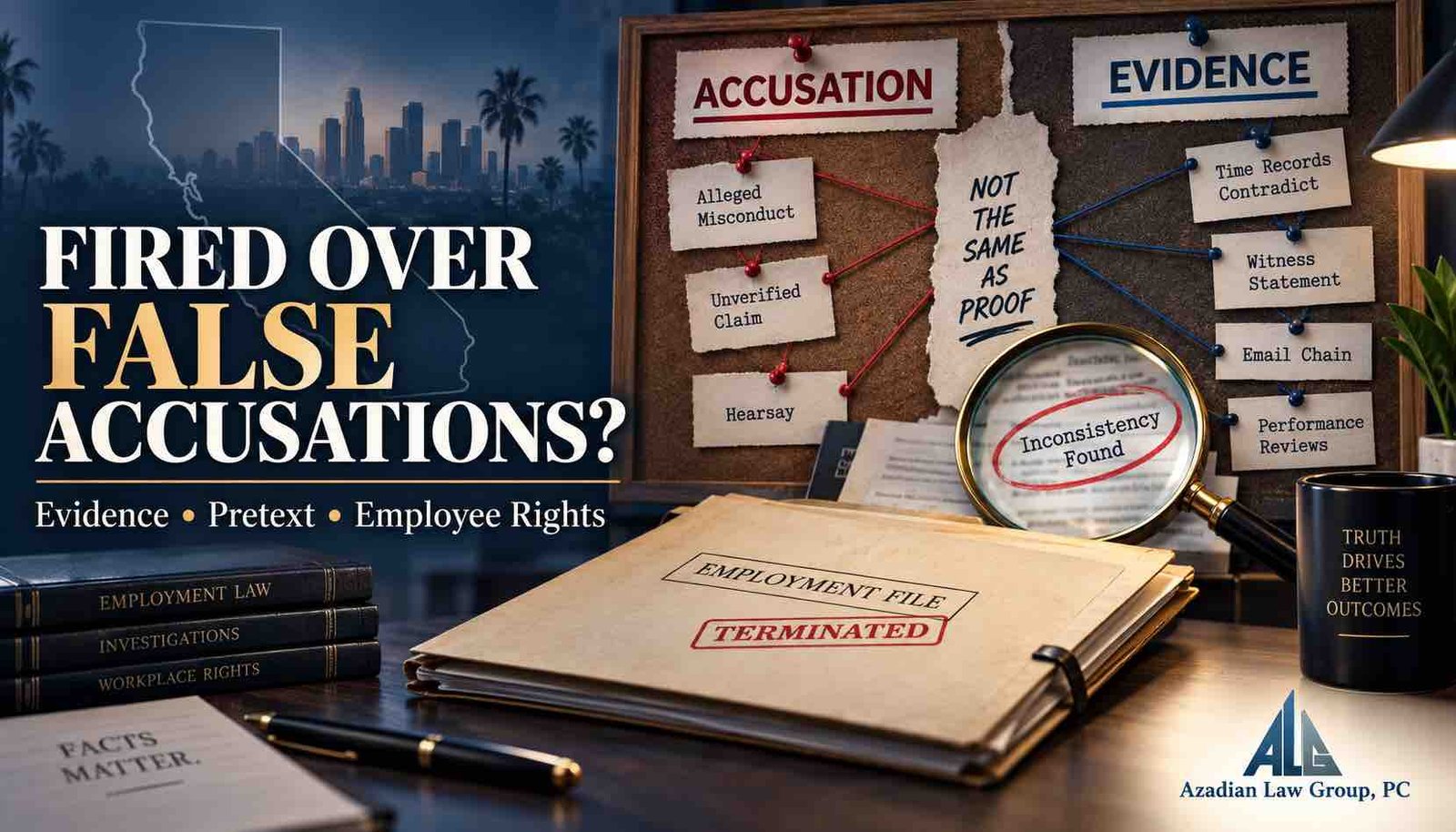
Can You Sue After Being Fired Over False Accusations in California?
Being fired over false accusations can feel devastating, but the accusation’s falsity does not automatically make the termination illegal. California’s at-will rule often allows a private employer to make a mistaken, unfair, poorly investigated, or unreasonable decision. The employee usually needs evidence that the firing violated a specific law, contract, or legally protected right.
A claim may exist when the accusation served as a pretext for discrimination or retaliation, punished protected whistleblowing, breached an employment agreement, violated a union or public-employment procedure, or led to a separately actionable defamatory statement. The legal analysis must separate the employer’s decision from the accusation’s later publication.
That distinction corrects a major problem in the current article. An employee does not “likely” have a wrongful-termination case merely because a coworker lied or an employer reached the wrong conclusion. The better question is why the employer acted, what rules applied, what evidence it ignored, and whether the accusation concealed an unlawful motive.
Quick Answer: When a False-Accusation Firing May Become a Legal Claim
| Situation | Does it automatically create a claim? | What could make it legally significant? |
|---|---|---|
| The employer believed an inaccurate complaint | No | Evidence that the employer did not honestly rely on it or selectively applied its rules |
| The investigation was rushed or one-sided | No | Departures from binding procedures, biased comparators, ignored exculpatory proof, or suspicious timing |
| The accusation appeared after protected activity | No, but timing may matter | Proof that decision-makers knew of the protected activity and used the allegation as retaliation |
| Only a protected employee was punished | No, standing alone | Similarly situated coworkers outside the protected group received better treatment |
| A false factual accusation was shared with another person | No | Unprivileged publication, fault, reputational harm, and other defamation elements |
| A contract promised cause or a defined investigation | No | An enforceable promise and a material breach connected to the termination |
| A public or union employee was denied required process | No | Applicable civil-service, constitutional, statutory, or collective-bargaining protections |
No single row decides a case. Strong claims usually come from a connected chronology rather than one unfair event.
Why False Accusations Do Not Automatically Prove Wrongful Termination
California Labor Code section 2922 creates a presumption that employment without a specified term is at will. In many private workplaces, the employer does not need to prove misconduct beyond a reasonable doubt or conduct a courtroom-style investigation before ending employment.
Therefore, a manager can accept the wrong person’s account, misunderstand an email, or make a poor credibility decision without automatically violating employment law. The decision may be unjust and harmful yet remain lawful unless it crosses a statutory, contractual, or public-policy boundary.
At will does not mean without limits. An employer cannot use a manufactured accusation to hide race, sex, age, disability, pregnancy, religion, national origin, sexual orientation, gender identity, protected leave, wage complaints, whistleblowing, or another prohibited reason. It also cannot disregard an enforceable agreement merely by calling the relationship at will.
Azadian Law Group’s explanation of California at-will employment and its exceptions provides the foundation for this distinction.
The Core Question: Mistake or Pretext?
A pretext is a stated reason that masks the actual unlawful reason for an adverse decision. The employee does not necessarily have to prove that every allegation was invented. Instead, the evidence may show that the employer did not honestly rely on the false accusations, exaggerated them, selectively enforced a rule, or changed its story after the fact.
Suppose a worker receives excellent reviews, reports harassment, and is accused days later of “insubordination” for the same report. HR interviews only the accused manager, ignores contemporaneous messages, and describes the incident differently to the unemployment agency. The accusation’s wording, timing, investigation, and changing explanation may support a retaliation analysis.
By contrast, if the employer received a detailed complaint, reviewed evidence, and honestly reached a mistaken conclusion unrelated to protected status or activity, the employee may face a difficult wrongful-termination claim. The outcome turns on evidence, not simply who was factually correct.
Signs That an Accusation May Be Pretextual
No single indicator proves pretext. Several consistent indicators surrounding false accusations can become persuasive when tied to a protected reason.
- The accusation appeared immediately after a discrimination complaint, accommodation request, leave request, wage objection, safety report, or whistleblower disclosure.
- The employer ignored objective records that contradicted the accusation while accepting weak evidence against the employee.
- Decision-makers changed the alleged misconduct, termination reason, or timeline.
- Coworkers outside the employee’s protected group engaged in comparable conduct but received coaching or no discipline.
- The employer skipped normal procedures only for the accused employee.
- A manager expressed bias or hostility toward the employee’s protected status or activity.
- The accuser or investigator had a documented conflict, yet the employer presented the process as independent.
- The employer began constructing negative documentation only after the protected event.
The article on evidence that can expose a false termination reason explains how chronology, comparators, deviations, documents, and witness accounts work together.
Discrimination Hidden Behind a Misconduct Allegation
An employer may describe a firing as misconduct while treating comparable employees differently because of a protected characteristic. The relevant question is not whether the company can prohibit the conduct. It is whether the employer applied that rule consistently and honestly.
Useful comparisons involve employees with similar duties, supervisors, decision-makers, records, and alleged conduct. A different job, decision-maker, disciplinary history, or degree of misconduct can weaken the comparison. Raw headcounts or general impressions rarely establish the full context.
Bias can also appear through comments, stereotypes, coded language, unequal credibility judgments, or a pattern of targeting complaints against one group. However, not every offensive statement connects to the termination decision. The speaker, timing, subject, and role in the decision matter.
Employees evaluating discriminatory pretext can use the firm’s guide on how to prove workplace discrimination in California to organize direct and circumstantial evidence.
Retaliation After a Protected Complaint
Many false-accusation disputes arise after the employee reports harassment, discrimination, unpaid wages, safety hazards, fraud, legal noncompliance, or another protected concern. Yet not every disagreement with management counts as protected activity. The content, audience, and employee’s reasonable belief can determine whether the law protects the report.
Timing can support an inference, especially when discipline begins shortly after decision-makers learn of the complaint. Timing alone may not be enough if the employer documents an independent reason. Stronger evidence includes threats, pressure to withdraw the complaint, unusual monitoring, inconsistent rules, witness coaching, or a newly invented paper trail.
Employees should preserve the original complaint and delivery evidence. A summary written after termination may help reconstruct events, but it does not replace the contemporaneous record. The guide to being fired after complaining to HR explains how protected content and employer knowledge shape retaliation claims.
What If the Employer Conducted a Bad Investigation?
Private employers do not universally owe every at-will employee a perfect investigation. When false accusations drive a rushed, biased, or incomplete process, the investigation can be powerful evidence, but it is not automatically a standalone lawsuit.
Examine what the employer claimed it would do and what it actually did. Did a policy promise an interview, written notice, appeal, impartial reviewer, or progressive discipline? Did the investigator interview supporting witnesses, preserve messages, test the timeline, disclose the allegation clearly enough for a response, and document credibility reasons? Did the employer treat other investigations differently?
An employer may have legitimate reasons to protect a complainant’s identity or limit disclosure. The employee’s inability to confront the accuser does not by itself prove illegality. Still, selective secrecy, predetermined conclusions, or ignored objective evidence can support an inference that the stated process was a cover.
Does the Employer Have to Show You the Evidence?
California does not impose one universal rule requiring a private employer to disclose every witness statement, investigative note, or confidential record before firing an at-will employee. Contractual, union, public-sector, licensing, and industry rules may create additional rights.
Current and former California employees generally have a statutory right to inspect and receive copies of personnel records relating to performance or grievances. California Labor Code section 1198.5 sets request and production rules, including a general 30-calendar-day response period, subject to exceptions and written extensions. The statute excludes certain records, including records relating to a possible criminal investigation and some reference materials.
A personnel-file request will not necessarily reveal the complete investigation. Even so, it may produce performance reviews, discipline, acknowledgments, training records, and grievance materials that clarify the employer’s timeline.
How to Request a California Personnel File
Send a calm written request to the person designated by the employer. Identify the employee, the requested personnel records, a delivery address or inspection preference, and the date. Keep proof of delivery and a copy of the request.
Do not demand confidential records belonging to coworkers or insist that the statute covers every investigative document. An employer may redact nonsupervisory employee names and rely on statutory exclusions. If litigation begins, section 1198.5 also limits the inspection right while a lawsuit relating to the personnel matter remains pending.
Compare the produced file with documents already in your possession. Missing warnings, newly created entries, inconsistent dates, or a sudden change in reviews may deserve attention. Do not alter the records or add notes to the original files; create a separate index instead.
Could the Accusation Support a Defamation Claim?
Defamation is distinct from wrongful termination. Even when false accusations are involved, a claim generally requires a false statement of fact communicated to another person, the required level of fault, lack of an applicable privilege, and legally recognized harm. A private thought or uncommunicated suspicion is not a publication.
Workplace communications can receive a qualified common-interest privilege when made to people with a legitimate business interest. That privilege is not necessarily absolute, but overcoming it can require evidence of malice or abuse. Truth remains a defense, and pure opinion receives different treatment from a provably false factual assertion.
Identify the exact words, speaker, recipient, date, medium, and reason for communication. “They ruined my reputation” is not enough to evaluate the claim. A statement to HR during an investigation differs from a false accusation sent to customers, recruiters, or people without a work-related need to know.
False References and Interference With New Employment
California Labor Code section 1050 addresses a person who, after an employee leaves, uses a misrepresentation to prevent or attempt to prevent the former employee from obtaining employment. False accusations in a reference can therefore raise a separate issue, but the law does not make every negative reference unlawful. Accuracy, intent, communication, and causation matter.
If a job offer disappears after a reference check, preserve the offer, withdrawal, recruiter communications, authorization form, and names of the people involved. Ask the prospective employer for the reason without pressuring it to disclose protected material. Avoid having friends pose as employers, because manufactured reference checks can create credibility and legal problems.
A separate defamation period can be short. Promptly document any post-termination publication instead of assuming the original termination date controls every later statement.
What If a Coworker Made the False Accusation?
The employer’s liability and the coworker’s potential liability require separate analysis. The employer may honestly rely on the coworker’s report, use it as pretext, ratify a malicious statement, or share it beyond those with a legitimate need to know. The accuser may have misunderstood events, expressed an opinion, made a privileged report, or knowingly stated a false fact.
Do not confront, threaten, or publicly shame the accuser. Those actions may generate new evidence against the employee and can distract from the original dispute. Preserve lawful communications and identify witnesses who personally observed relevant events.
Avoid asking coworkers to copy confidential files or coordinate stories. A credible witness should describe only what that person saw, heard, or did. The quality and independence of the evidence matter more than the number of supporters.
Contract, Union, and Public-Employee Protections
An individual contract may require cause, progressive discipline, notice of allegations, an investigation, or a defined appeal. An employer that materially violates an enforceable promise may face a contract claim even when discrimination or retaliation cannot be proven.
A collective bargaining agreement may require just cause and a grievance or arbitration filed within a short period. Union employees should obtain the agreement, disciplinary notice, steward communications, and grievance deadlines immediately.
Public employees may have civil-service, statutory, or constitutional protections. Some have a property interest in continued employment and a right to notice and an opportunity to respond. Others remain probationary, temporary, or at will under governing rules. A public employer can also trigger administrative appeal and government-claim requirements that do not apply in an ordinary private workplace.
What Evidence Should You Preserve?
Build an evidence map instead of collecting random files.
| Evidence category | What to preserve | What it may show |
|---|---|---|
| The accusation | Exact wording, dates, participants, notices, interview invitations, and written findings | Whether the allegation changed or remained specific |
| Your response | Written rebuttal, supporting messages, time records, location data, and witness names | What the employer knew before deciding |
| Protected activity | Complaints, accommodation requests, leave notices, wage objections, and safety reports | Protected conduct, decision-maker knowledge, and timing |
| Performance history | Reviews, praise, goals, awards, coaching, and prior discipline | Whether the later account conflicts with the existing record |
| Comparators | Lawfully known examples of similar allegations and outcomes | Whether the employer enforced rules consistently |
| Post-termination statements | Reference communications, recruiter notes, offer withdrawal, and publication dates | Potential defamation or interference separate from the firing |
Do not take trade secrets, attorney-client communications, customer files, medical records, or private coworker data. Preserve only material you lawfully possess or can request through proper procedures.
Write a Focused Rebuttal, Not an Emotional Manifesto
A useful rebuttal identifies the allegation, states the employee’s response, cites objective evidence, names firsthand witnesses, and requests that the employer preserve relevant records. It avoids insults, speculation, threats, and unsupported accusations.
Use a clear structure: allegation, response, supporting fact, document, witness, requested correction. If several allegations exist, address them separately. Do not bury the strongest point inside pages of unrelated history.
The employee can also note a protected complaint or accommodation when it genuinely relates to the decision. However, adding legal terminology does not automatically transform an ordinary disagreement into protected activity. Accuracy and contemporaneous facts matter.
If the employer has already terminated the employee, a concise rebuttal can still create a timestamped record. Before sending it, consider whether a severance agreement, investigation, union procedure, or litigation strategy affects the timing.
Do Not Secretly Record Without Legal Review
California Penal Code section 632 generally prohibits intentionally recording a confidential communication without the consent of all parties. Whether a communication is confidential depends on whether participants reasonably expected it to remain limited to them.
Do not assume that being a participant gives an automatic right to record. A recording made unlawfully may create criminal, civil, evidentiary, workplace, and credibility consequences. Public meetings and nonconfidential settings can involve different rules, but employees should obtain advice before recording.
Written notes created immediately after a meeting can preserve detail without creating the same risk. Record the date, participants, statements, documents shown, questions asked, and the employee’s responses. Mark estimates as estimates rather than presenting them as exact quotations.
Other Actions That Can Damage a Potential Case
- Accessing company systems after authorization ends.
- Deleting, editing, or fabricating messages, notes, or electronic records.
- Taking confidential files unrelated to the employee’s own work or rights.
- Threatening the accuser, investigator, manager, or witnesses.
- Posting accusations or internal documents on social media.
- Encouraging witnesses to repeat a shared script.
- Rejecting comparable work without documenting the reason.
- Signing a severance release without understanding the waiver and deadlines.
Preservation should be lawful, targeted, and credible. The goal is to protect evidence, not to create a second dispute.
What Damages Might Be Available?
Potential remedies depend on the claim. A statutory discrimination or retaliation case may involve lost pay, lost benefits, emotional-distress damages, attorney’s fees, and other relief allowed by law. A contract claim often focuses on the compensation or benefits promised under the agreement. A defamation claim requires its own proof of reputational and economic harm.
Reinstatement, front pay, penalties, punitive damages, injunctive relief, or statutory fees may be available in some cases, but none is automatic. Punitive damages require proof beyond an ordinary mistake, and public entities face special restrictions.
Employees must also address mitigation. Keep a dated job-search log, applications, interviews, offers, rejection notices, and income from replacement work. Damages cannot be valued responsibly from a salary figure alone.
Deadlines After a False-Accusation Termination
Different theories create different clocks. A FEHA discrimination or retaliation matter generally requires timely CRD action. Federal discrimination claims can require an EEOC charge within 180 or 300 days. A public-policy tort often uses a two-year period. Defamation generally carries a one-year period from publication. Contract periods can differ for written and oral obligations, while public-employer and union procedures may be much shorter.
Azadian Law Group’s detailed guide to the California wrongful-termination statute of limitations explains why employees must map each claim separately.
Internal appeals, severance talks, unemployment proceedings, and promises to reopen an investigation usually do not pause every external deadline automatically. If discrimination is part of the theory, review the firm’s California EEOC filing guide and confirm both state and federal requirements promptly.
Steps to Take After Being Fired Over an Accusation
- Write the chronology. Record the allegation, interviews, protected activity, decision-makers, explanations, and termination date.
- Preserve lawful records. Keep messages, policies, reviews, schedules, and documents already in your possession without accessing restricted systems.
- Request the reason and personnel file. Use calm written language and save proof of delivery.
- Identify comparators. Note only lawfully known facts about similar employees and outcomes.
- Review separation documents. Check final pay, benefits, unemployment information, and any release or arbitration clause.
- Track later publications. Document reference checks or statements to third parties separately from the termination.
- Apply for work. Preserve mitigation records and avoid public statements that could impair the search.
- Check every deadline. Use the shortest plausible claim period until counsel confirms otherwise.
How an Employment Attorney Evaluates the Case
A careful evaluation starts with the exact accusation, not the employee’s conclusion that it was false. Counsel will ask who made it, what they observed, how the employer tested it, what the employee submitted in response, and who made the final decision.
Next comes motive. Did the employee recently engage in protected activity? Was the accuser or decision-maker aware? Do comments, comparators, policy departures, or changing explanations connect the firing to discrimination or retaliation?
Finally, counsel separates the available causes of action. Wrongful termination, statutory retaliation, discrimination, contract, defamation, wage, privacy, and public-employee procedures have different elements and deadlines. Experienced California employment lawyers can assess that complete structure without assuming that an unfair result automatically proves an unlawful one.
Frequently Asked Questions
Can my employer fire me based only on a coworker’s statement?
An at-will private employer may sometimes rely on a coworker’s account, even if the investigation later appears mistaken. A legal claim needs a statutory, contractual, public-policy, or other recognized basis.
Is a biased investigation proof of wrongful termination?
Not by itself. Bias, ignored evidence, changing allegations, and policy departures may support pretext when connected to discrimination, retaliation, or another unlawful reason.
Can I sue the coworker who accused me?
Possibly, but workplace reports may be true, opinion, or protected by a qualified privilege. The exact statement, publication, fault, privilege, harm, and deadline require separate review.
Should I contact the EEOC?
The EEOC may be relevant if discrimination or retaliation under a federal law influenced the firing. It does not handle every unfair termination or defamation dispute. Filing periods can be short.
Can I get the investigation file?
California employees have personnel-record rights, but statutory exclusions and confidentiality rules mean the request may not produce the entire investigation. Contracts, union rules, public-sector procedures, and discovery can create different access rights.
Should I post my evidence online?
No. Public posting can disclose confidential information, provoke new claims, affect witnesses, and harm mitigation. Preserve evidence privately and obtain legal advice.
What if the employer changes its reason later?
A material shift can support pretext, especially when combined with protected activity, unequal treatment, or contrary records. Minor wording differences may have innocent explanations, so compare the full statements and context.
Speak With a California Employment Attorney
The strongest cases involving false accusations show more than factual innocence. They connect the accusation, investigation, protected activity or status, decision-maker knowledge, inconsistent treatment, and resulting harm through reliable evidence.
Employees can explore related workplace-rights discussions in Azadian Law Group’s employment-law podcast series. If a false accusation led to termination, damaged future employment, or may have concealed an unlawful motive, request a confidential case evaluation promptly.
This article provides general educational information, not legal advice. Results depend on individual facts, available proof, applicable law, and filing deadlines.


Related Blog Posts
Wrongful Termination Evidence Often Appears as a Pattern Wrongful termination evidence is rarely found in one dramatic email admitting that...
Read MoreOracle Layoffs Raise New Questions for California Employees Oracle has reportedly begun another round of layoffs in the United States,...
Read MoreArtificial intelligence has already started screening resumes, measuring productivity, writing performance reviews, and recommending layoffs. Now it has reportedly helped...
Read MoreTypes of Cases Handle By Employment Lawyers in Los Angeles, CA
The following presents an overview of the broad range of employment law cases that our employment attorneys are experienced at overseeing and favorably resolving.
Wrongful Termination
Wrongful Termination Lawyers in Los Angeles, CA Attorneys at Azadian Law Group who have filed wrongful termination lawsuits acknowledge that unfair termination can significantly impact an employee’s life. It can…
Age Discrimination
Age Discrimination Lawyers in Los Angeles, CA Azadian Law Group, PC regularly represents clients throughout Los Angeles, CA, who are the victims of age discrimination in the workplace. At Azadian…
Pregnancy Discrimination
Pregnancy Discrimination Lawyer in Los Angeles, CA At Azadian Law Group, PC, our pregnancy discrimination lawyer in Los Angeles, regularly represents clients who are the victims of pregnancy discrimination in…
Sexual Harassment
Sexual Harassment Attorney in Los Angeles, CA The Los Angeles Sexual Harassment Lawyers at Azadian Law Group, PC, know that in today’s modern era, some people often make the mistake of…
Racial Discrimination
Racial Discrimination Lawyers in Los Angeles, CA Azadian Law Group, PC regularly represents clients throughout Los Angeles who are the victims of racial discrimination at work. The Los Angeles Race…
Disability Discrimination
When a Medical Condition Becomes a Workplace Problem, You Have Rights Most employees never expect a health condition to place their career at risk. Yet every day across Los Angeles,…
Praise from Our Clients
Lui H

Arpi Agdere
Tofi
Aracelis Feria
Ivy Gamboa
Jillian Dunlap
Greg Wayne
Elizabeth Eromosele
Steve G
Lisa Galvan
Artur Aleksanyan
Delight Dinopoulos
George Margaros
Chelsea Pham
Trevor Pal-Freeman
Patricio Garza
Taylor
Ashley Londerman
Marissa Zapanta
Nuria Coronado
Barbara Villalobos
Irene Golub
Joshua Butler
J Mo
Employees We Represent in Employment Law Cases
At Azadian Law Group, we represent employees throughout Los Angeles and California who have experienced workplace violations. Our attorneys handle employment law matters including wrongful termination, workplace discrimination, retaliation, harassment, wage and hour violations, and whistleblower protection.
Employees often face unlawful treatment after reporting misconduct, requesting medical leave, or asserting their legal rights at work. Our firm investigates employment law violations and advocates for workers seeking accountability, compensation, and fair treatment under California and federal employment law.

Step 1
Explore our comprehensive range of legal services to find the specialized support you need.
Step 2
Arrange a free initial meeting with our experts to discuss your legal situation.
Step 3
Receive a custom strategy specially created for your case by our legal experts.
Call Us Now 213-229-9031
Tell Us Your Story
Speak out for justice. Your story can be the start of a new chapter of workplace fairness.
