Wrongful Termination Evidence: 15 Patterns That May Reveal the Truth
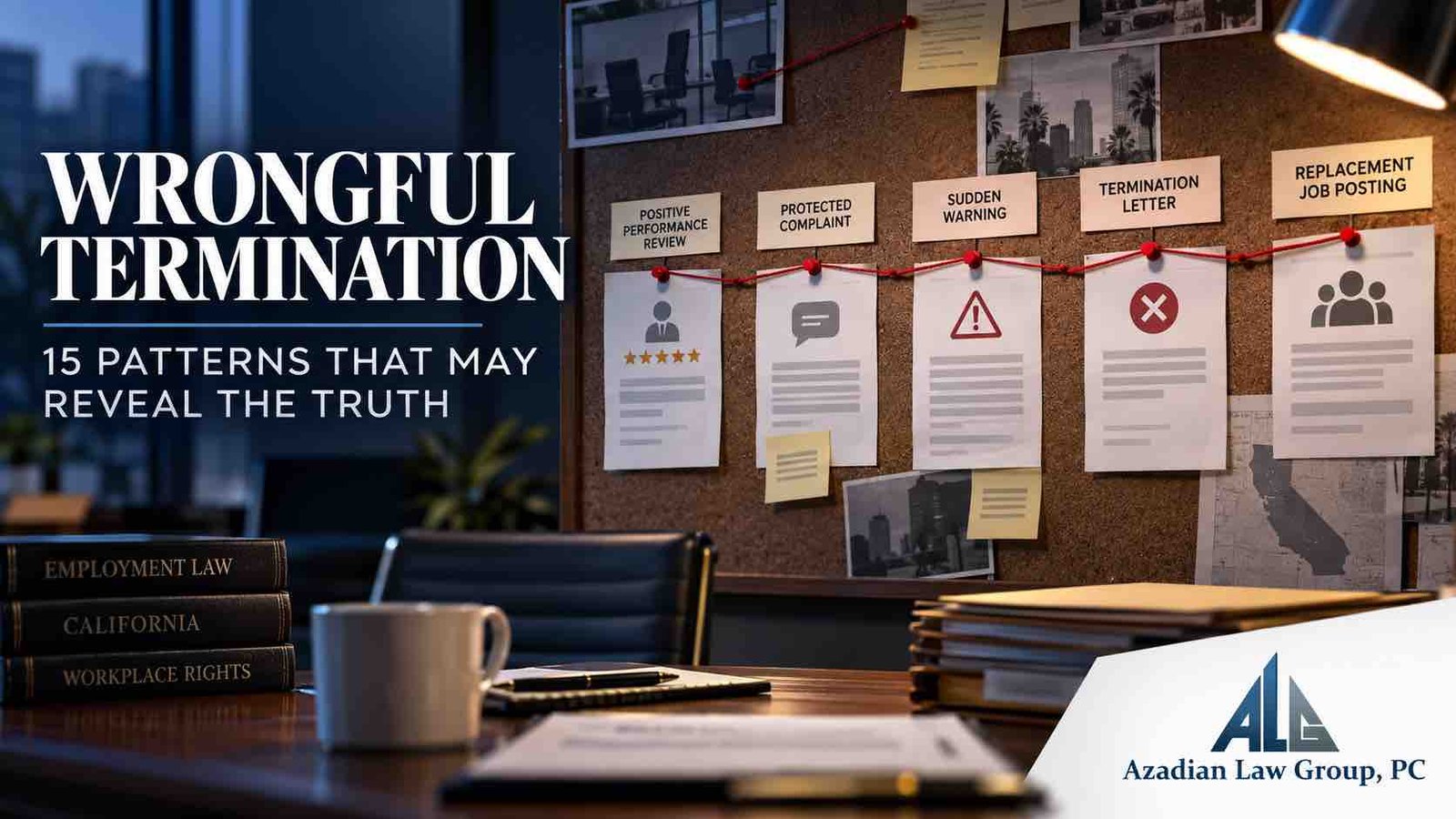
Wrongful Termination Evidence Often Appears as a Pattern
Wrongful termination evidence is rarely found in one dramatic email admitting that an employee was fired for an unlawful reason.
Employers generally do not write that someone was terminated for reporting harassment, requesting medical leave, disclosing a disability or complaining about unpaid wages. The official explanation is more likely to involve performance, attendance, restructuring, insubordination, culture fit or a supposedly neutral reduction in force.
Experienced Los Angeles wrongful termination lawyers therefore examine more than the final termination letter. They compare the employer’s explanation with the employee’s performance history, protected activities, workplace treatment, applicable policies and the sequence in which events occurred.
A pattern can become significant when an employee has years of positive reviews, engages in legally protected activity, immediately encounters new criticism and is then terminated under circumstances that do not match how comparable employees were treated.
This guide identifies 15 recurring employment patterns that may help California workers recognize when an employer’s stated reason deserves closer examination.
What Qualifies as Wrongful Termination in California?
Wrongful termination does not simply mean that a firing was harsh, mistaken or unfair.
California generally follows the rule of at-will employment. Unless an agreement or recognized legal protection provides otherwise, an employer can ordinarily terminate an employee for a lawful reason—or even for a reason that appears poorly considered.
A termination may become legally wrongful when it violates:
- California or federal anti-discrimination laws
- Whistleblower and retaliation protections
- Medical- or family-leave laws
- Disability-accommodation requirements
- Wage-and-hour protections
- An employment contract
- A fundamental public policy expressed in law
The evidence required depends on the particular claim. In many discrimination and retaliation cases, an employee attempts to show that the employer’s stated explanation was not the genuine reason for the decision.
This is commonly described as evidence of pretext.
Pretext may be shown through suspicious timing, changing explanations, unequal discipline, departures from company policy, factual errors or contradictions between the employer’s explanation and its own records.
Azadian Law Group’s guide to California termination laws explains the difference between an unfair firing and a termination that may violate California law.
Wrongful Termination Evidence at a Glance
| Employment pattern | Possible concern | Evidence that may matter |
|---|---|---|
| Positive reviews followed by sudden criticism | Retaliation or discrimination | Reviews, awards, complaints and warnings |
| Accommodation request followed by termination | Disability discrimination | Medical restrictions and accommodation records |
| Medical leave followed by position elimination | Leave retaliation | Leave approval, organization charts and job postings |
| Harassment complaint followed by a PIP | Workplace retaliation | Complaint, PIP, prior reviews and comparator evidence |
| Wage complaint followed by reduced hours | Labor Code retaliation | Schedules, pay records and written complaints |
| Whistleblower becomes the investigation target | Whistleblower retaliation | Original report and investigation timeline |
| Pregnancy disclosure followed by changed duties | Pregnancy discrimination | Assignments, comments and termination records |
| Older employee replaced by a younger worker | Age discrimination | Comments, qualifications and replacement evidence |
| Promotion withdrawn after a complaint | Retaliation | Promotion discussions and complaint records |
| Work injury followed by attendance discipline | Disability, leave or claim retaliation | Restrictions, attendance records and policies |
| Employee refuses suspected unlawful conduct | Whistleblower or public-policy termination | Instructions, objections and witness accounts |
| Investigation witness later disciplined | Participation-based retaliation | Interview dates and subsequent discipline |
| Remote accommodation followed by productivity claims | Disability discrimination or pretext | Productivity data and accommodation records |
| Layoff selects protected employees disproportionately | Discrimination in a reduction in force | Selection criteria and workforce data |
| Algorithmic score leads to termination | Automated discrimination or inaccurate data | System inputs, scores, audits and human review |
These patterns are not automatic proof of unlawful conduct. They are starting points for a fact-specific investigation.
Pattern 1: Positive Reviews, Protected Complaint and Sudden Performance Problems
One of the most recognizable retaliation patterns begins with a documented history of satisfactory or excellent work.
The employee then reports discrimination, harassment, unpaid wages, safety concerns or another suspected violation. Soon afterward, the employee receives their first serious criticism, written warning or performance improvement plan.
The sequence may look like this:
- Consistently positive evaluations
- A legally protected workplace complaint
- A noticeable change in the manager’s behavior
- New or exaggerated performance accusations
- A written warning or performance improvement plan
- Termination
The timing alone does not prove retaliation. An employer may discover genuine performance problems after an employee complains.
The pattern becomes more significant when the criticism contradicts prior evaluations, involves minor conduct previously tolerated or applies standards that were not imposed on comparable employees.
Relevant evidence may include performance reviews, awards, productivity reports, complaint emails, meeting invitations, disciplinary records and communications showing when the decision-maker learned about the complaint.
Employees who experience a sudden change after speaking up should also examine whether the conduct may qualify as workplace retaliation under California law.
Pattern 2: Disability Accommodation Request Followed by Increased Scrutiny
An employee may perform successfully for years before requesting an accommodation for a physical disability, mental-health condition or medical restriction.
After the request, the employee may suddenly encounter:
- Micromanagement
- Frequent performance meetings
- Criticism connected with medical limitations
- Unrealistic deadlines
- Removal of important responsibilities
- Pressure to take leave or resign
- Termination for performance or attendance
California’s Fair Employment and Housing Act generally requires covered employers to engage in a timely, good-faith interactive process and consider reasonable accommodation for qualified employees.
An accommodation request does not shield someone from legitimate discipline. However, an employer cannot manufacture a performance case because an accommodation is inconvenient or because management would prefer not to deal with an employee’s restrictions.
Accommodation requests, doctors’ notes, HR communications, proposed alternatives and proof that similar arrangements were allowed for other employees may become important evidence.
Employees experiencing this sequence can learn more about disability discrimination and reasonable accommodation in California.
Pattern 3: Medical Leave Followed by a Supposed Position Elimination
Another recurring pattern involves an employee who requests or takes protected medical or family leave and then learns that their position no longer exists.
A genuine restructuring may occur while an employee is away. Protected leave does not guarantee immunity from every legitimate business decision.
The explanation may deserve closer examination when:
- The position appeared secure before the leave request.
- The elimination decision was made immediately after leave was requested.
- The employee’s duties continued under a different title.
- A replacement was hired before or shortly after the termination.
- The employer cannot identify a genuine operational change.
- Managers complained about the inconvenience or duration of the leave.
- Comparable employees who did not take leave were retained.
The wording used by the employer is less important than what happened to the work. A position may not have been meaningfully eliminated if its essential duties continued and were transferred intact to another employee.
Relevant evidence may include the leave request, approval records, organization charts, internal announcements, staffing plans, job postings and communications discussing coverage of the employee’s responsibilities.
Pattern 4: Harassment Complaint Followed by a Performance Improvement Plan
A performance improvement plan, commonly called a PIP, can be a legitimate attempt to help an employee improve.
It can also be used to create a paper trail supporting a termination decision management has already made.
A suspicious sequence may involve:
- An employee reports sexual harassment or discrimination.
- Human Resources begins an investigation.
- The accused manager remains responsible for evaluating the employee.
- The employee is placed on a PIP shortly afterward.
- The PIP contains vague, subjective or impossible objectives.
- Management ignores evidence that the employee met the stated goals.
- The employee is terminated at the end of the process.
The PIP should be compared with the employee’s prior reviews, written job duties, measurable results and the treatment of employees who did not complain.
Evidence that managers planned the termination before the improvement period ended may be especially significant. So may evidence showing that the employer changed the PIP requirements or refused to identify what successful completion would require.
The Equal Employment Opportunity Commission explains that complaining about suspected discrimination and participating in an employment-discrimination investigation can constitute protected activity. The EEOC’s retaliation guidance also recognizes that retaliation may involve more than termination.
Pattern 5: Wage Complaint Followed by Reduced Hours and Termination
Retaliation does not always begin with immediate termination.
An employee who asks about unpaid overtime, missed meal periods, illegal deductions or inaccurate wage statements may first experience reduced hours, less-profitable assignments or removal from preferred shifts.
The employer may eventually rely on the consequences of that reduced schedule—such as lower production, limited availability or alleged attendance issues—to justify termination.
Potential evidence includes:
- Written complaints about unpaid wages
- Time records and wage statements
- Schedules before and after the complaint
- Messages discussing the employee’s request for payment
- Records showing how other employees were scheduled
- Disciplinary notices issued after the wage dispute
The California Labor Commissioner investigates retaliation connected with numerous labor rights. Its Retaliation Complaint Investigation Unit explains that California employees and applicants may exercise protected labor rights without retaliation or discrimination.
Pattern 6: The Whistleblower Becomes the Target of the Investigation
An employee reports suspected fraud, false billing, safety violations, legal noncompliance or other misconduct. Instead of meaningfully investigating the concern, the employer begins investigating the reporting employee.
Management may suddenly examine the employee’s:
- Emails
- Expense reports
- Time records
- Communication style
- Past workplace disagreements
- Compliance with minor policies
An employer may investigate genuine misconduct by a reporting employee. The concern arises when the investigation appears designed to discredit or punish the person who raised the original issue.
Important questions include:
- Was the reported misconduct independently investigated?
- Who decided to investigate the reporting employee?
- Did that investigation begin only after the report?
- Were other employees accused of comparable conduct investigated?
- Did managers express anger or concern about the report?
- Was the employee’s report discussed during the termination process?
California Labor Code Section 1102.5 may protect employees who disclose information they reasonably believe reveals a violation of state or federal law.
The protection may apply to certain internal reports made to a person with authority to investigate or correct the suspected violation. Employees experiencing punishment after reporting misconduct can review the firm’s guidance from a Los Angeles whistleblower lawyer.
Pattern 7: Pregnancy Disclosure Followed by Changed Responsibilities
Pregnancy discrimination can begin before an employee requests or takes leave.
After disclosing a pregnancy, an employee may be excluded from major assignments, client relationships, travel opportunities or leadership responsibilities. Management may claim that it is helping the employee or anticipating future availability.
The employee may later be told:
- The role is no longer essential.
- Client relationships have moved elsewhere.
- The department has functioned without them.
- The employee no longer appears committed.
- A restructuring requires the position to be eliminated.
Evidence may include statements concerning motherhood, childcare, travel, physical capability or future commitment. Comparisons with employees who took other forms of leave may also be relevant.
Not every change in responsibility constitutes discrimination. The complete record must show whether pregnancy influenced an adverse decision.
The timing of the disclosure, the identity of the people who knew about it and the reason responsibilities changed may all become important.
Pattern 8: An Older Employee Is Called Resistant to Change and Replaced by a Younger Worker
Age discrimination is often communicated through coded language rather than a direct statement about someone’s age.
An experienced employee may suddenly be described as:
- Set in their ways
- Unable to adapt
- Too traditional
- Unable to keep up with technology
- Not aligned with the company’s new energy
- Overqualified
- Too expensive
A company may lawfully expect employees of every age to meet changing job requirements. It may also make legitimate decisions involving compensation and organizational structure.
The pattern becomes more concerning when age-related language accompanies inconsistent criticism, substantially younger employees with similar performance are retained or the older employee is replaced by a younger worker performing essentially the same duties.
The replacement employee’s age does not decide the case by itself. It should be evaluated alongside qualifications, prior performance, the selection process and statements made by decision-makers.
Azadian Law Group explains these issues further in its guide to age discrimination in the Los Angeles workplace.
Pattern 9: A Promised Promotion Disappears After a Complaint
Retaliation can involve more than termination.
An employee may be considered for promotion, receive assurances about advancement or begin performing higher-level responsibilities. After reporting discrimination or supporting another worker’s complaint, the opportunity disappears.
Management may later claim:
- The position was never formally approved.
- The employee misunderstood informal discussions.
- Business priorities changed.
- Another candidate was more qualified.
- The employee demonstrated poor judgment by making the complaint.
The available evidence should distinguish an uncertain possibility from a genuinely expected promotion.
Relevant records may include draft job descriptions, compensation discussions, succession plans, calendar invitations, congratulatory messages and evidence showing that the role was ultimately awarded to someone else.
If termination follows the withdrawn promotion, the entire sequence should be evaluated rather than treating each decision as an unrelated event.
Pattern 10: Workplace Injury Followed by Attendance Discipline
An employee reports an injury, receives medical restrictions or requests time away from work. The employer later begins documenting absences or productivity problems connected with the injury.
Several protections may potentially overlap, depending on the circumstances, including disability accommodation, protected leave and workers’ compensation retaliation.
Important questions may include:
- Did the employer know the absences were connected to a medical condition?
- Did the employee request accommodation or provide restrictions?
- Were protected absences counted against the employee?
- Did the employer engage in the interactive process?
- Were non-disabled employees allowed comparable flexibility?
- Did management complain about the injury, restrictions or claim?
Attendance records should be examined carefully rather than accepted at face value. A mathematically accurate absence total can still be misleading if it improperly includes protected time.
Evidence may include attendance policies, absence codes, doctors’ notes, leave approvals, scheduling records and communications concerning the employee’s restrictions.
Pattern 11: Refusal to Perform Suspected Unlawful Conduct Becomes “Insubordination”
An employee may be directed to falsify records, ignore safety requirements, mislead a customer, alter financial information or participate in conduct the employee reasonably believes is unlawful.
After refusing or objecting, the employee is accused of insubordination, negativity or failure to follow instructions.
The label “insubordination” does not end the legal analysis.
Relevant evidence may include:
- The original instruction
- The employee’s written or verbal objection
- The law, regulation or policy identified by the employee
- Witnesses who heard the instruction
- Messages showing management’s reaction
- The timing and stated basis for termination
An employee does not necessarily need to prove that the reported conduct resulted in a criminal conviction or government enforcement action. The applicable protection, subject matter of the complaint and employee’s reasonable belief must be evaluated under the relevant law.
A calm written objection identifying the actual concern may be more useful than a heated confrontation that leaves the employer room to characterize the dispute as a personality conflict.
Pattern 12: A Witness in an Internal Investigation Later Faces Discipline
Employees who participate in workplace investigations may receive protection against retaliation.
A witness may provide information supporting a colleague’s discrimination or harassment complaint. The witness’s relationship with management then changes.
Possible warning signs include:
- Exclusion from meetings
- Removal from important assignments
- Pressure to revise or withdraw a statement
- Questions about the employee’s loyalty
- New scrutiny of performance or attendance
- Denial of promotion
- Termination during the following weeks or months
The underlying complaint does not necessarily need to succeed for retaliation protections to apply. Participating in an employment-discrimination process and reasonably opposing suspected discrimination may receive independent protection.
Evidence should establish when the employer learned about the witness’s participation, who received the witness’s information and whether those individuals influenced the later employment decision.
The firm’s California EEOC complaint guide explains why participation, agency deadlines and the nature of the original complaint must be evaluated carefully.
Pattern 13: Remote-Work Accommodation Followed by Manufactured Productivity Concerns
An employee receives permission to work remotely as a disability accommodation or temporary medical measure. The employer later claims that remote work caused poor productivity, weak communication or lack of commitment.
That explanation may be legitimate when supported by objective evidence. It becomes more questionable when:
- The employee continues meeting measurable performance targets.
- Other remote employees are not criticized similarly.
- The employer relies only on subjective visibility concerns.
- The alleged decline is not supported by contemporaneous records.
- Management rejects alternative accommodations without discussion.
- The employee is required to return despite documented restrictions.
- Termination follows immediately after the accommodation is renewed.
Employees should preserve productivity reports, accommodation approvals, team communications and records showing how remote-work policies were applied to colleagues.
An employer does not necessarily have to provide the employee’s preferred accommodation in every situation. It may still be required to participate in a good-faith process to identify an effective reasonable accommodation.
Pattern 14: A Layoff Disproportionately Selects Protected Employees
A reduction in force can be genuine and still contain unlawful individual selection decisions.
An employer may eliminate positions because of financial pressure, automation, duplication or changing business priorities. It cannot use a layoff to target workers because of age, disability, pregnancy, race, sex or protected activity.
A suspicious pattern may involve:
- Older employees selected at a substantially higher rate
- Employees on medical leave disproportionately included
- Workers who made complaints selected by the same manager
- Selection criteria changed after protected information was reviewed
- Subjective scores overriding objective performance results
- Supposedly eliminated duties transferred intact to retained employees
- Similar positions advertised shortly after the reduction
The fact that several employees were terminated does not automatically validate every selection. Each decision should be examined within the broader workforce data and the employee’s individual employment history.
Relevant evidence may include selection matrices, organization charts, job titles, ages, performance scores, manager recommendations and records identifying who was retained.
Pattern 15: An Algorithmic Score Leads to Termination Without Meaningful Human Review
Employers increasingly use software to monitor productivity, attendance, sales, communications and workplace behavior.
An automated score may appear objective while relying on incomplete, inaccurate or historically biased information.
For example, a system may:
- Treat protected medical leave as poor attendance.
- Misinterpret reduced output during an approved accommodation.
- Penalize employees whose responsibilities are difficult to quantify.
- Use historical data reflecting earlier discriminatory decisions.
- Rank workers without accounting for differences between roles.
- Produce a termination recommendation that no manager meaningfully reviews.
Relevant wrongful termination evidence may extend beyond the traditional personnel file. It may include system inputs, productivity formulas, algorithmic scores, audit results, vendor materials and communications showing how managers used an automated recommendation.
These emerging issues are examined further in Azadian Law Group’s analysis of whether an AI-influenced firing could become wrongful termination in California.
For the related issues raised when automated tools screen or rank job applicants, our AI hiring lawsuit tracker links to reviewed case documents and distinguishes allegations from court findings.
What Types of Wrongful Termination Evidence May Matter?
The most useful evidence depends on the legal theory and the employer’s stated reason.
Potentially relevant records may include:
- Performance evaluations
- Written warnings
- Performance improvement plans
- Emails and text messages involving the employee
- Protected workplace complaints
- Accommodation requests
- Medical restrictions
- Leave requests and approvals
- Pay records and work schedules
- Employee-handbook provisions
- Job descriptions
- Organization charts
- Termination notices
- Severance agreements
- Job advertisements for replacement positions
- Lawfully known information about comparable employees
- Notes identifying witnesses and relevant meetings
Employees should focus on records they already lawfully possess. They should not access former employer systems without authorization or remove trade secrets, customer information, privileged communications or confidential records belonging to other people.
Preserving evidence does not mean taking everything. A targeted and lawfully obtained record is more useful than a chaotic download that creates new problems.
How Should an Employee Build a Wrongful Termination Timeline?
A useful chronology should identify dates, events, participants, supporting records and the employer’s stated explanation.
| Date | Event | People involved | Supporting evidence | Why it may matter |
|---|---|---|---|---|
| January 12 | Positive annual evaluation | Employee and manager | Signed performance review | Documents performance before protected activity |
| February 8 | Employee reports suspected discrimination | Employee and HR | Complaint email | Establishes protected activity and employer knowledge |
| February 15 | Manager removes a major assignment | Manager and employee | Email and project record | May show changed treatment after the complaint |
| March 1 | First written warning issued | Manager and HR | Warning document | May conflict with the recent evaluation |
| March 20 | Employment terminated | Manager, HR and employee | Termination notice | Identifies the adverse action and stated reason |
Employees should distinguish facts from conclusions.
Instead of writing, “My manager retaliated against me,” identify what was said, when it occurred, who heard it and what happened afterward.
A detailed factual chronology gives an employment attorney something concrete to evaluate. A collection of conclusions without dates or supporting records does not.
What Evidence Can Weaken a Wrongful Termination Claim?
A credible analysis must consider facts supporting the employer as well as facts supporting the employee.
Evidence that may weaken a claim includes:
- Performance problems documented long before any protected activity
- Consistent enforcement of the same rule against comparable employees
- A genuine companywide reduction based on objective criteria
- Proof that the termination decision was made before the employer learned about protected activity
- Repeated warnings accompanied by meaningful opportunities to improve
- A complaint that did not involve a legally protected issue
- Serious misconduct supported by reliable contemporaneous records
- Material inconsistencies in the employee’s account
Not every suspicious sequence establishes a viable legal claim. The evidence may show that the employer handled a situation badly without acting unlawfully.
Employees should avoid altering documents, exaggerating events or coordinating inaccurate accounts with coworkers. Credibility can become one of the most valuable—or most damaging—parts of an employment case.
Does Close Timing Prove Wrongful Termination?
Close timing can support an inference of retaliation, but timing alone is not always enough.
A termination occurring days after a protected complaint may appear more suspicious than one occurring years later. The employer may nevertheless have a documented and independently supported reason for the decision.
Timing becomes more meaningful when combined with:
- Proof that the decision-maker knew about the protected activity
- Hostile or retaliatory statements
- Changing explanations
- Unequal discipline
- Departure from established policy
- Contradictions within the employer’s records
- Evidence that the decision was accelerated after the complaint
The EEOC identifies suspiciously close timing, retaliatory statements, comparative evidence and evidence that an employer’s stated reason is false as facts that may support a retaliation claim.
Can an Employer Fire Someone Who Made a Protected Complaint?
Yes, when the employer has a genuine, lawful and non-retaliatory reason that would have resulted in termination regardless of the complaint.
Protected activity is not permanent immunity from discipline.
However, an employer cannot use an invented performance problem, selectively enforced rule or sham restructuring to punish an employee for exercising protected rights.
The relevant issue is not merely whether the employer can articulate a lawful-sounding explanation. The issue may be whether that explanation honestly motivated the decision, matches the available records and was applied consistently.
This is why experienced Los Angeles employment lawyers examine both the employer’s official reason and the evidence surrounding how, when and by whom the decision was made.
Can an Employee Request Their Personnel File After Termination?
California employees and former employees may have rights to inspect or receive copies of certain personnel records relating to their performance or grievances.
Payroll records are governed by separate requirements.
A personnel file may contain:
- Performance reviews
- Written warnings
- Attendance records
- Disciplinary documents
- Employee acknowledgements
- Records concerning promotion or termination
The personnel file may not contain every relevant record. Internal management messages, investigation documents, decision matrices and communications involving legal counsel may be maintained elsewhere or subject to different rules.
An employee should therefore avoid assuming that the personnel file represents the employer’s complete decision-making record.
What Should an Employee Do After a Suspicious Termination?
Employees who believe they may have been wrongfully terminated should consider taking measured steps:
- Write a chronology promptly. Memories fade, and the order of events may become important.
- Preserve lawfully possessed records. Keep relevant documents already stored in personal accounts or files.
- Save termination and severance documents. Do not rely on a verbal summary.
- Record the employer’s explanation. Note whether different decision-makers provided different reasons.
- Identify potential witnesses. Record names and the events each person directly observed.
- Request appropriate employment records. California employees may have rights involving certain personnel and payroll records.
- Avoid restricted systems. Do not attempt to log in after authorization has ended.
- Avoid public accusations. Social-media posts can complicate evidence, confidentiality and future employment.
- Preserve job-search records. Applications, interviews and replacement earnings may become relevant to damages.
- Check every potential deadline. Different claims may involve different administrative and court deadlines.
- Have a severance agreement reviewed before signing. The release may cover claims the employee has not yet recognized.
Internal appeals, severance negotiations and promises that an employer will reconsider generally should not be assumed to pause every external filing deadline.
Frequently Asked Questions About Wrongful Termination Evidence
What Is the Strongest Evidence of Wrongful Termination?
There is no single strongest document for every case. Direct statements revealing an unlawful motive can be powerful, but many cases depend on circumstantial evidence such as suspicious timing, inconsistent explanations, comparative treatment, policy deviations and contradictions between the employer’s explanation and its records.
Can Positive Performance Reviews Help Prove Wrongful Termination?
Positive reviews may be relevant when an employer later claims that long-standing performance problems caused the termination. Their value depends on their timing, the issues evaluated and whether legitimate performance concerns arose afterward.
Is a Performance Improvement Plan Proof That an Employer Planned to Fire Me?
No. A PIP can be a legitimate corrective measure. It becomes more suspicious when issued immediately after protected activity, when its requirements are vague or impossible, or when management disregards evidence that the employee satisfied its objectives.
Can a Coworker Help Prove a Wrongful Termination Case?
A coworker may provide relevant testimony about statements, workplace practices, comparative treatment or events leading to the termination. Firsthand knowledge is generally more useful than workplace rumor or speculation.
Can an Employer Change Its Reason for Firing an Employee?
An employer may clarify or supplement an explanation as additional information becomes available. Materially inconsistent or shifting explanations may nevertheless support an argument that the stated reason was not genuine.
Does Being Replaced Prove Wrongful Termination?
No. Employers replace lawfully terminated employees every day. Replacement evidence becomes more meaningful when the employer claimed that the position was eliminated or when the replacement circumstances support a particular discrimination theory.
Can Text Messages Be Used as Wrongful Termination Evidence?
Potentially. Text messages may document complaints, manager reactions, discriminatory remarks, accommodation discussions or inconsistent explanations. Their usefulness depends on authenticity, context and how they were obtained.
Should an Employee Secretly Record Workplace Conversations?
Employees should obtain legal advice before recording private or confidential communications. California generally requires the consent of all parties before recording a confidential communication, and an unlawful recording can create serious legal complications.
Does an Employee Need Direct Proof of Discrimination?
Not necessarily. Employment claims are frequently supported by circumstantial evidence. Timing, comparator evidence, workplace remarks, statistical patterns and proof that the employer’s explanation is unworthy of belief may collectively become relevant.
How Quickly Should an Employee Speak With an Attorney?
Promptly. Wrongful termination, discrimination, whistleblower, wage and administrative claims can have different requirements and deadlines. Employees should not assume that a company investigation, internal appeal or severance discussion extends those deadlines.
Speak With a Los Angeles Employment Lawyer About Your Evidence
A termination letter rarely tells the complete story.
The most important wrongful termination evidence may appear in the sequence connecting an employee’s performance history, protected activity, management’s response and the employer’s final explanation.
The Los Angeles employment lawyers at Azadian Law Group represent employees—not employers—in serious wrongful termination, retaliation, discrimination, whistleblower and workplace-rights disputes throughout California.
The firm examines employment timelines, performance records, complaints, disciplinary documents, comparator evidence and changing employer explanations to determine whether an apparently lawful decision may be concealing an unlawful motive.
If you were fired after reporting misconduct, requesting accommodation, taking protected leave or asserting another workplace right, contact Azadian Law Group or call 213-229-9031.
This article is provided for informational purposes only and does not constitute legal advice. Every employment matter depends on its specific facts, evidence and applicable deadlines.


Related Blog Posts
Losing a job is difficult enough. Receiving an invoice afterward for a signing bonus, training program, or recruiting payment can...
Read MoreYour Los Angeles employer announces a return-to-office deadline. You explain that a medical condition makes the new schedule difficult and...
Read MoreAn employer tells you a performance system recommended your termination. When you ask whether a person reviewed it, HR answers:...
Read MoreTypes of Cases Handle By Employment Lawyers in Los Angeles, CA
The following presents an overview of the broad range of employment law cases that our employment attorneys are experienced at overseeing and favorably resolving.
Wrongful Termination
Wrongful Termination Lawyers in Los Angeles, CA Attorneys at Azadian Law Group who have filed wrongful termination lawsuits acknowledge that unfair termination can significantly impact an employee’s life. It can…
Age Discrimination
Age Discrimination Lawyers in Los Angeles, CA Azadian Law Group, PC regularly represents clients throughout Los Angeles, CA, who are the victims of age discrimination in the workplace. At Azadian…
Pregnancy Discrimination
Pregnancy Discrimination Lawyer in Los Angeles, CA At Azadian Law Group, PC, our pregnancy discrimination lawyer in Los Angeles, regularly represents clients who are the victims of pregnancy discrimination in…
Sexual Harassment
Sexual Harassment Attorney in Los Angeles, CA The Los Angeles Sexual Harassment Lawyers at Azadian Law Group, PC, know that in today’s modern era, some people often make the mistake of…
Racial Discrimination
Racial Discrimination Lawyers in Los Angeles, CA Azadian Law Group, PC regularly represents clients throughout Los Angeles who are the victims of racial discrimination at work. The Los Angeles Race…
Disability Discrimination
When a Medical Condition Becomes a Workplace Problem, You Have Rights Most employees never expect a health condition to place their career at risk. Yet every day across Los Angeles,…
Praise from Our Clients
Lui H

Arpi Agdere
Tofi
Aracelis Feria
Ivy Gamboa
Jillian Dunlap
Greg Wayne
Elizabeth Eromosele
Steve G
Lisa Galvan
Artur Aleksanyan
Delight Dinopoulos
George Margaros
Chelsea Pham
Trevor Pal-Freeman
Patricio Garza
Taylor
Ashley Londerman
Marissa Zapanta
Nuria Coronado
Barbara Villalobos
Irene Golub
Joshua Butler
J Mo
Employees We Represent in Employment Law Cases
At Azadian Law Group, we represent employees throughout Los Angeles and California who have experienced workplace violations. Our attorneys handle employment law matters including wrongful termination, workplace discrimination, retaliation, harassment, wage and hour violations, and whistleblower protection.
Employees often face unlawful treatment after reporting misconduct, requesting medical leave, or asserting their legal rights at work. Our firm investigates employment law violations and advocates for workers seeking accountability, compensation, and fair treatment under California and federal employment law.

Step 1
Explore our comprehensive range of legal services to find the specialized support you need.
Step 2
Arrange a free initial meeting with our experts to discuss your legal situation.
Step 3
Receive a custom strategy specially created for your case by our legal experts.
Call Us Now 213-229-9031
Tell Us Your Story
Speak out for justice. Your story can be the start of a new chapter of workplace fairness.
