Fired After a Performance Improvement Plan in Los Angeles? What Your Records Can Show
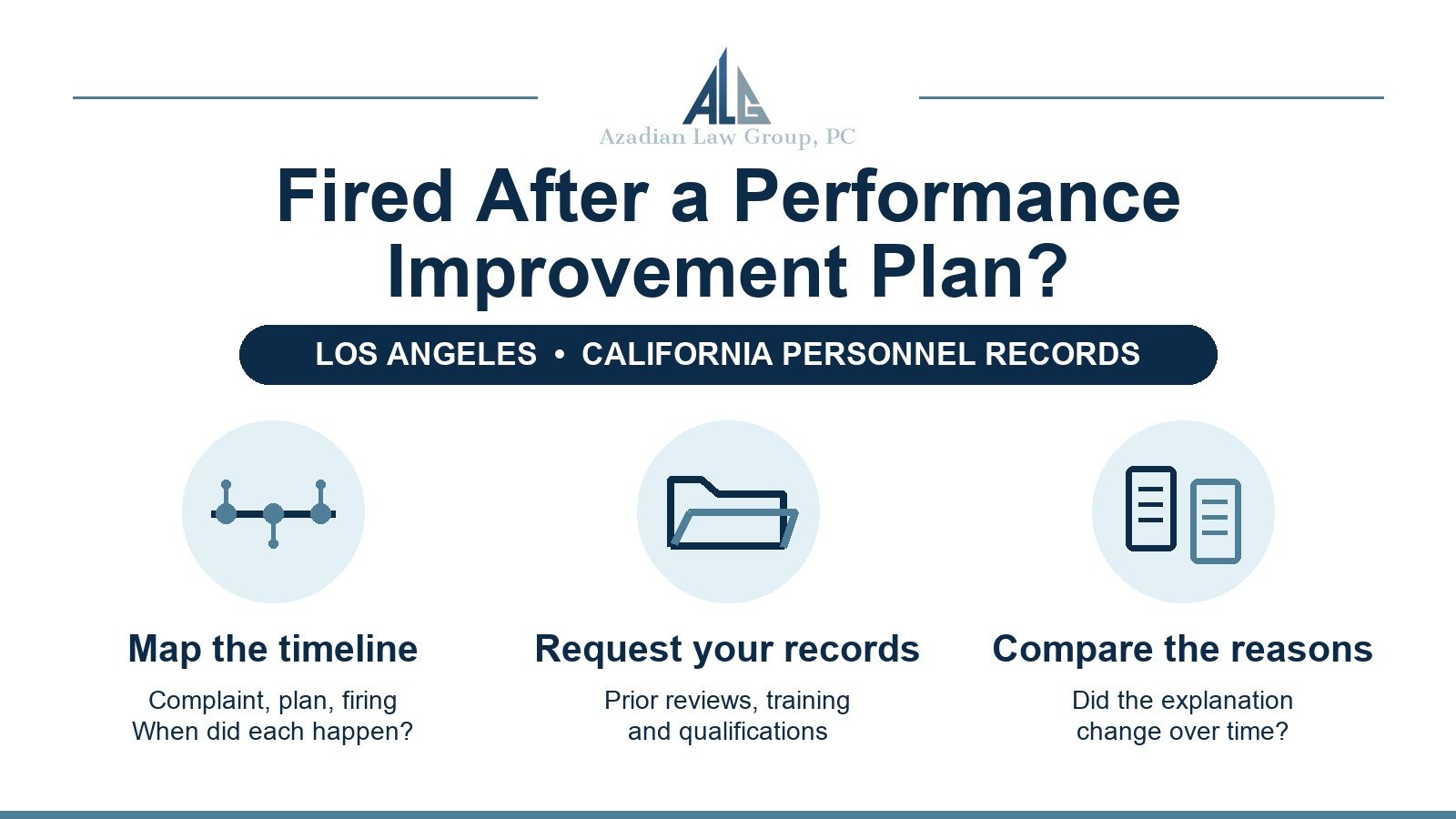
On Monday, your manager tells you your numbers look good. On Friday, HR puts you on a performance improvement plan. A month later, you lose your job. If you were fired after a performance improvement plan in Los Angeles, start with a question you can answer from records. What did the company expect of you, and when did those expectations change?
A performance improvement plan, often called a PIP, can document real problems and give you a chance to address them. It can also give an employer a paper trail for a decision it had already made. California’s 2026 personnel-records update gives workers another place to look for evidence, especially when the dispute concerns training or qualifications.
When can being fired after a performance improvement plan be wrongful?
Most California employment is at will. An employer can generally end employment for ordinary performance reasons. Even an unfair evaluation or a manager’s mistake may fall short of an unlawful firing. What matters is whether the employer acted for an unlawful reason, such as discrimination, retaliation for protected activity, or a reason that violates a fundamental public policy.
Start with what happened shortly before the PIP. Did you report discrimination to HR, flag what you reasonably believed was a legal violation, or take protected medical leave? Which decision-makers knew about it, and when? A short gap can matter, especially when records show that the company changed how it evaluated your work. Timing by itself leaves important questions open.
For example, imagine a Koreatown clinic coordinator reports unpaid overtime on February 4. Her supervisor puts her on a 30-day plan on February 11 and counts the same approved schedule changes as attendance problems. HR fires her before the first progress meeting. The dates, approvals and missing check-in give her specific facts to investigate. If the employer had documented the same attendance concerns before the wage complaint, those earlier records would matter too. This example is hypothetical.
What records matter if you were fired after a performance improvement plan?
Build a timeline with four dates: the earliest performance concern you can verify, any protected request or report, the date you received the PIP, and the date the company told you it was ending your employment. Add the people involved and the documents that support each entry. If a date is approximate, say so in your notes.
- Before the plan. Compare the allegations with earlier evaluations, coaching notes, awards and measurable results. A positive overall review can coexist with problems in one part of the job. Look for records about the same task the plan criticizes.
- During the plan. Record each target, deadline and promised resource. Did the target change? Did the company cancel a training session or turn off access to a tool you needed? Did your manager acknowledge work you finished?
- At termination. Write down the reason you heard and keep any written notice. A shift from missed targets to a different reason can matter when the explanations conflict. Keep the exact wording where you have it.
- After termination. Preserve lawful records of severance, final pay and benefits. If you see a public job posting that looks like your old role, save the date and listing so you can compare actual duties.
For more examples of how a stated reason can break down against the documents, see California wrongful termination evidence patterns.
What California’s 2026 personnel-records update can help you check
California Labor Code section 1198.5 generally allows current and former employees to request inspection or copies of personnel records relating to their performance or a grievance concerning them. The employer generally has 30 calendar days after receiving a written request, subject to statutory exceptions and a limited written extension. The Labor Commissioner’s personnel-file guidance explains how the process works.
Effective January 1, 2026, SB 513 expressly includes education and training records among personnel records under section 1198.5. If the employer maintains those records, they must include specified details, such as the training provider, duration, skills covered and any resulting credential or qualification. This matters if your PIP says you skipped required instruction or lacked a qualification the employer’s own records say you earned.
You can keep a written request short. For example: “I’m requesting a copy of my personnel records under California Labor Code section 1198.5, including records concerning my performance, any grievances concerning me, and my education or training records. Please confirm receipt and let me know how you will provide the copies.” Keep proof of delivery and a copy of the request.
A personnel file may leave gaps. It may lack project-level metrics, earlier versions of a plan or messages exchanged among decision-makers. Keep documents you already possess lawfully. Avoid accessing company systems after your permission ends or forwarding confidential customer or coworker information. Make a note of relevant records you can no longer access.
What if a dashboard supplied the performance score?
Ask what the score measures and what it leaves out. A warehouse dashboard might count idle time while missing a safety stop. A support dashboard might count closed tickets without showing how many required escalation. Note the reporting window, whether the manager could correct errors, and what happened when you raised a specific discrepancy. Keep any explanation you already received about how the score was calculated.
In addition, write down who had the final say. A score may come from software, but a manager may still choose which scores count, which exceptions to allow and whether to end employment. The firm’s guide to what counts as wrongful termination in California explains how those choices can fit into a broader claim. If the employer instead calls the dismissal a reduction in force, see how to evaluate a layoff for possible age discrimination.
What to do if you’re still on the plan or just lost your job
If you are still working, ask for specific examples and measurable criteria. Follow up after meetings with short, accurate summaries. If leave or a disability accommodation affects a deadline, raise it through the appropriate channel. The Los Angeles guide to remote-work accommodation and termination explains what records can matter when an accommodation is part of the story.
If you were fired after a performance improvement plan, write down the sequence while it is fresh. Keep the plan, the employer’s reason, and whatever you lawfully have that shows your performance or protected activity. Check filing deadlines promptly. The California Civil Rights Department’s complaint process applies to certain employment discrimination and retaliation claims. Wage complaints, whistleblower claims and other theories can follow different routes and deadlines. A personnel-records request generally does not pause the clock.
Azadian Law Group represents employees. If your plan followed a complaint, leave request or another protected event, a Los Angeles wrongful termination lawyer can review the dates, the performance records and the reasons you were given. Bring the records you have and list anything that is missing.
This article provides general information about California employment law.


Related Blog Posts
Your supervisor says you’re being let go for low productivity. You ask which shifts you fell short on. They point...
Read MoreA fraudulent email. A missing payment. A termination letter. When an employee is fired after a phishing scam, the financial...
Read MoreLosing a job is difficult enough. Receiving an invoice afterward for a signing bonus, training program, or recruiting payment can...
Read MoreTypes of Employment Cases We Handle.
The following presents an overview of the broad range of employment law cases that our employment attorneys are experienced at overseeing and favorably resolving.
Wrongful Termination
Wrongful Termination Lawyers in Los Angeles, CA Attorneys at Azadian Law Group who have filed wrongful termination lawsuits acknowledge that unfair termination can significantly impact an employee’s life. It can…
Age Discrimination
Age Discrimination Lawyers in Los Angeles, CA Azadian Law Group, PC regularly represents clients throughout Los Angeles, CA, who are the victims of age discrimination in the workplace. At Azadian…
Pregnancy Discrimination
Pregnancy Discrimination Lawyer in Los Angeles, CA At Azadian Law Group, PC, our pregnancy discrimination lawyer in Los Angeles, regularly represents clients who are the victims of pregnancy discrimination in…
Sexual Harassment
Sexual Harassment Attorney in Los Angeles, CA The Los Angeles Sexual Harassment Lawyers at Azadian Law Group, PC, know that in today’s modern era, some people often make the mistake of…
Racial Discrimination
Racial Discrimination Lawyers in Los Angeles, CA Azadian Law Group, PC regularly represents clients throughout Los Angeles who are the victims of racial discrimination at work. The Los Angeles Race…
Disability Discrimination
When a Medical Condition Becomes a Workplace Problem, You Have Rights Most employees never expect a health condition to place their career at risk. Yet every day across Los Angeles,…
Praise from Our Clients
A“

QT
RT
KM
BM
HM
bS
kj
SM
TM
FL
kr
TP
CF
WW
JA
RM
RC
VM
JS
TH
SD
RM
AC
W
kn
AO
DN
KW
TP
RS
L
D
la
JG
DP
RK
HL
TP
sr
sl
PD
SS
SS
JB
JA
AR
CG
LH
YU
MS
TA
NS
aa
RC
AR
mp
IG
N
JJ
Kd
GA
aa
GB
RT
MM
PP
PA
DV
T
AW
CW
SM
TC
SC
hh
KK
DB
S
SM
VV
K&
PG
JL
SS
AC
MS
DS
DM
ZM
CA
AF
GC
jg
GN
AG
A
KG
EC
s
MZ
m
LD
PW
PD
CH
TA
KM
PZ
CA
rc
FA
JA
MJ
SM
kr
LH
BJ
DG
JJ
ES
WW
VS
TH
VB
GA
DM
LS
SM
AS
wm
MH
DA
TP
LA
DR
MM
D
RG
WR
Employees We Represent in Employment Law Cases
At Azadian Law Group, we represent employees throughout Los Angeles and California who have experienced workplace violations. Our attorneys handle employment law matters including wrongful termination, workplace discrimination, retaliation, harassment, wage and hour violations, and whistleblower protection.
Employees often face unlawful treatment after reporting misconduct, requesting medical leave, or asserting their legal rights at work. Our firm investigates employment law violations and advocates for workers seeking accountability, compensation, and fair treatment under California and federal employment law.

Step 1
Explore our comprehensive range of legal services to find the specialized support you need.
Step 2
Arrange a free initial meeting with our experts to discuss your legal situation.
Step 3
Receive a custom strategy specially created for your case by our legal experts.
Call Us Now 213-229-9031
Tell Us Your Story
Speak out for justice. Your story can be the start of a new chapter of workplace fairness.
