Fired After a Phishing Scam: When Could a Dismissal Be Wrongful?
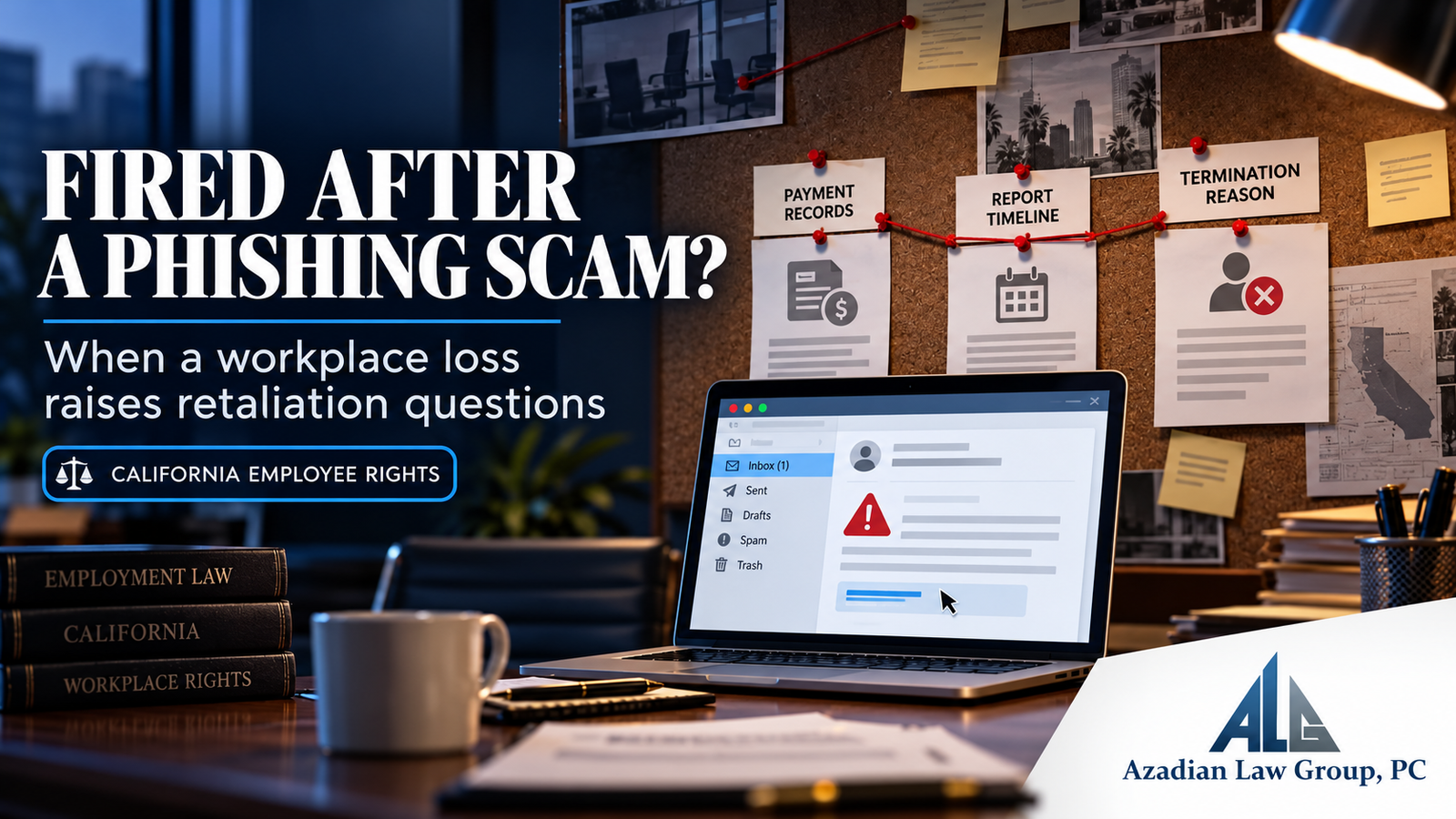
A fraudulent email. A missing payment. A termination letter.
When an employee is fired after a phishing scam, the financial loss can dominate the conversation. But an employment dispute may turn on a different set of questions: Who actually authorized the payment? What did the employee report? And when did management decide to end the employment relationship?
A recent dispute involving a New Jersey chief financial officer illustrates why the employer’s explanation and the employee’s account must both be examined. For California workers, the issue is whether a dismissal violates a legal protection—not simply whether the employer assigned blame unfairly.
What Happened in the Pemberton CFO Dispute?
According to The Philadelphia Inquirer’s October 27, 2026 report, former Pemberton Township CFO Candice Pennewell sued after her dismissal. The township attributes its decision to performance and leadership concerns involving a $195,660 phishing loss.
Pennewell disputes responsibility. The report describes allegations that she was on leave when others approved the payment and that her firing followed reports of suspected ethics and spending violations. She seeks reinstatement and back pay. The township denies retaliation and says it will defend the case.
These are competing accounts reported about litigation, not findings establishing who was responsible or whether the dismissal was unlawful. California law does not govern this New Jersey dispute. The discussion below explains how similar circumstances could raise employment-law questions for California workers.
Can an Employer Fire You After a Phishing Scam in California?
Potentially, yes. California generally follows at-will employment, subject to contracts and legal exceptions. A genuine performance failure, violation of payment procedures, or failure to carry out supervisory responsibilities may support a lawful dismissal. An employer does not necessarily have to give an at-will employee another chance. The California Department of Industrial Relations explains the general at-will rule.
However, a financial loss does not give an employer permission to retaliate against a protected whistleblower, discriminate, or disregard applicable contractual rights.
Being incorrectly blamed is not automatically enough to establish wrongful termination. The legal analysis must connect the decision to an unlawful reason or another enforceable protection. A Los Angeles wrongful termination lawyer can examine that connection alongside the employer’s evidence.
When Could a Financial-Mistake Explanation Raise Retaliation Concerns?
Consider an illustrative situation: a finance employee reports suspected unlawful vendor billing. Management knows about an earlier fraudulent transfer but takes no disciplinary action. Shortly after the report, that same transfer becomes the reason for immediate dismissal.
That sequence deserves investigation. It does not, by itself, establish retaliation. Management may have obtained new evidence, completed a genuine investigation, or already decided to terminate the employee before the report.
Useful questions include:
- Did the employee report a suspected legal violation, or only disagree with a business decision?
- Did the people involved in the firing know about the report?
- When did the investigation begin, and what changed afterward?
- Was discipline already being considered before the report?
- Did the explanation change between the investigation and termination meeting?
- Were comparable employees subject to the same standards?
The objective is to reconstruct the decision using records created at the time and test both sides’ explanations against those records.
California Whistleblower Protection Can Cover Internal Financial Reports
California Labor Code section 1102.5 protects qualifying disclosures of reasonably suspected legal violations. Protection can extend to reports to government or law enforcement, a supervisor, or an employee authorized to investigate or correct the issue. The Labor Commissioner’s whistleblower notice explains these protections for public and private employees.
Not every accounting disagreement qualifies. The employee’s reasonable belief, the information disclosed, and the recipient matter. For example, reporting suspected unlawful billing presents a different question from saying that a vendor is too expensive.
Reporting suspected violations as part of an employee’s ordinary job duties can also be protected, as section 1102.5 provides. A finance or compliance role does not, by itself, remove whistleblower protection.
Azadian Law Group’s Los Angeles whistleblower lawyer guide explains how the subject and recipient of a disclosure can affect the analysis.
A Real Performance Concern Does Not End the California Analysis
An employee may have made a mistake and also engaged in protected whistleblowing. Those facts can coexist.
Under Labor Code section 1102.6, the employee must first show, by a preponderance of the evidence, that protected whistleblowing contributed to the adverse action. The employer then must establish by clear and convincing evidence that it would have taken the same action for legitimate, independent reasons even without the protected activity.
The California Supreme Court confirmed this framework in Lawson v. PPG Architectural Finishes, Inc. Identifying a plausible performance concern alone does not resolve that analysis.
For a phishing-related dismissal, that means examining both the employee’s responsibilities and the evidence showing why the employer acted when it did.
Four Evidence Questions After a Phishing-Related Firing
| Question | Records to examine | Why it matters |
|---|---|---|
| Who approved or supervised the payment? | Approval logs, assigned duties, verification procedures, coverage arrangements | Helps separate direct authorization from oversight responsibilities |
| What concern did the employee raise? | Complaint emails, meeting notes, identified laws or regulations, recipients | Helps determine whether a report involved protected activity |
| When was termination decided? | Investigation milestones, meeting invitations, draft notices, decision communications | Helps distinguish the decision date from the date it was announced |
| Was the explanation applied consistently? | Prior reviews, warnings, policies, lawfully available information about comparable employees | Helps test whether the stated standard matches actual practice |
Being away from the office may matter, but it does not automatically resolve responsibility. Someone may have delegated authority, approved a payment remotely, or held supervisory duties. Equally, a senior title alone does not establish that the employee personally approved a transfer.
For a broader explanation of how records fit together, see our guide to wrongful termination evidence patterns.
What Should Employees Do Next?
Write a dated account of the incident, the concern you reported, the employer’s response, and the termination meeting. Separate what you personally observed from what someone else told you.
Preserve relevant records you lawfully possess. Do not access former employer systems without permission or take confidential customer data, privileged communications, or other restricted material. An attorney can advise how additional records should be requested and preserved.
Keep the termination notice and any severance proposal. Review deadlines promptly, particularly if you worked for a public agency or were covered by an employment agreement or union contract. The applicable process depends on the claim and employment relationship.
Frequently Asked Questions
Does falling for a scam automatically make a firing lawful?
No. A genuine mistake may support discipline, but the employer must still comply with applicable employment protections. The reason for the decision and the surrounding evidence matter.
Does reporting the scam automatically make me a protected whistleblower?
Not necessarily. Reporting a cybersecurity incident is not automatically the same as making a qualifying disclosure of suspected employer legal violations. The content, recipient, and circumstances of the report need review.
Can a manager be dismissed even if someone else sent the payment?
Possibly. Supervisory duties and compliance obligations may be relevant. The analysis should identify the actual responsibilities and evidence rather than assume personal authorization from a job title.
Does a firing soon after a complaint prove retaliation?
Close timing may be relevant, but it does not establish every element of a claim. Decision-maker knowledge, the decision timeline, and legitimate independent reasons also require examination.
Discuss a Suspicious Dismissal With Azadian Law Group
If you were blamed for a financial incident after reporting suspected unlawful conduct, the approval records and complaint timeline may tell different parts of the story.
Azadian Law Group represents employees in Los Angeles and throughout California. Request a free case review to discuss your dismissal, the concerns you reported, and the records available for review.
This article provides general information about California employment law. The New Jersey dispute is discussed as reported litigation, not as a determination of liability. Individual rights, procedures, and deadlines depend on the facts.


Related Blog Posts
Losing a job is difficult enough. Receiving an invoice afterward for a signing bonus, training program, or recruiting payment can...
Read MoreYour Los Angeles employer announces a return-to-office deadline. You explain that a medical condition makes the new schedule difficult and...
Read MoreThe closure of the Pavilions supermarket on East California Boulevard in Pasadena is a reminder of how quickly a workplace...
Read MoreTypes of Employment Cases We Handle.
The following presents an overview of the broad range of employment law cases that our employment attorneys are experienced at overseeing and favorably resolving.
Wrongful Termination
Wrongful Termination Lawyers in Los Angeles, CA Attorneys at Azadian Law Group who have filed wrongful termination lawsuits acknowledge that unfair termination can significantly impact an employee’s life. It can…
Age Discrimination
Age Discrimination Lawyers in Los Angeles, CA Azadian Law Group, PC regularly represents clients throughout Los Angeles, CA, who are the victims of age discrimination in the workplace. At Azadian…
Pregnancy Discrimination
Pregnancy Discrimination Lawyer in Los Angeles, CA At Azadian Law Group, PC, our pregnancy discrimination lawyer in Los Angeles, regularly represents clients who are the victims of pregnancy discrimination in…
Sexual Harassment
Sexual Harassment Attorney in Los Angeles, CA The Los Angeles Sexual Harassment Lawyers at Azadian Law Group, PC, know that in today’s modern era, some people often make the mistake of…
Racial Discrimination
Racial Discrimination Lawyers in Los Angeles, CA Azadian Law Group, PC regularly represents clients throughout Los Angeles who are the victims of racial discrimination at work. The Los Angeles Race…
Disability Discrimination
When a Medical Condition Becomes a Workplace Problem, You Have Rights Most employees never expect a health condition to place their career at risk. Yet every day across Los Angeles,…
Praise from Our Clients
A“

QT
RT
KM
BM
HM
bS
kj
SM
TM
FL
kr
TP
CF
WW
JA
RM
RC
VM
JS
TH
SD
RM
AC
W
kn
AO
DN
KW
TP
RS
L
D
la
JG
DP
RK
HL
TP
sr
sl
PD
SS
SS
JB
JA
AR
CG
LH
YU
MS
TA
NS
aa
RC
AR
mp
IG
N
JJ
Kd
GA
aa
GB
RT
MM
PP
PA
DV
T
AW
CW
SM
TC
SC
hh
KK
DB
S
SM
VV
K&
PG
JL
SS
AC
MS
DS
DM
ZM
CA
AF
GC
jg
GN
AG
A
KG
EC
s
MZ
m
LD
PW
PD
CH
TA
KM
PZ
CA
rc
FA
JA
MJ
SM
kr
LH
BJ
DG
JJ
ES
WW
VS
TH
VB
GA
DM
LS
SM
AS
wm
MH
DA
TP
LA
DR
MM
D
RG
WR
Employees We Represent in Employment Law Cases
At Azadian Law Group, we represent employees throughout Los Angeles and California who have experienced workplace violations. Our attorneys handle employment law matters including wrongful termination, workplace discrimination, retaliation, harassment, wage and hour violations, and whistleblower protection.
Employees often face unlawful treatment after reporting misconduct, requesting medical leave, or asserting their legal rights at work. Our firm investigates employment law violations and advocates for workers seeking accountability, compensation, and fair treatment under California and federal employment law.

Step 1
Explore our comprehensive range of legal services to find the specialized support you need.
Step 2
Arrange a free initial meeting with our experts to discuss your legal situation.
Step 3
Receive a custom strategy specially created for your case by our legal experts.
Call Us Now 213-229-9031
Tell Us Your Story
Speak out for justice. Your story can be the start of a new chapter of workplace fairness.
