12 Common Wage and Hour Violations California Employees Should Know in 2026
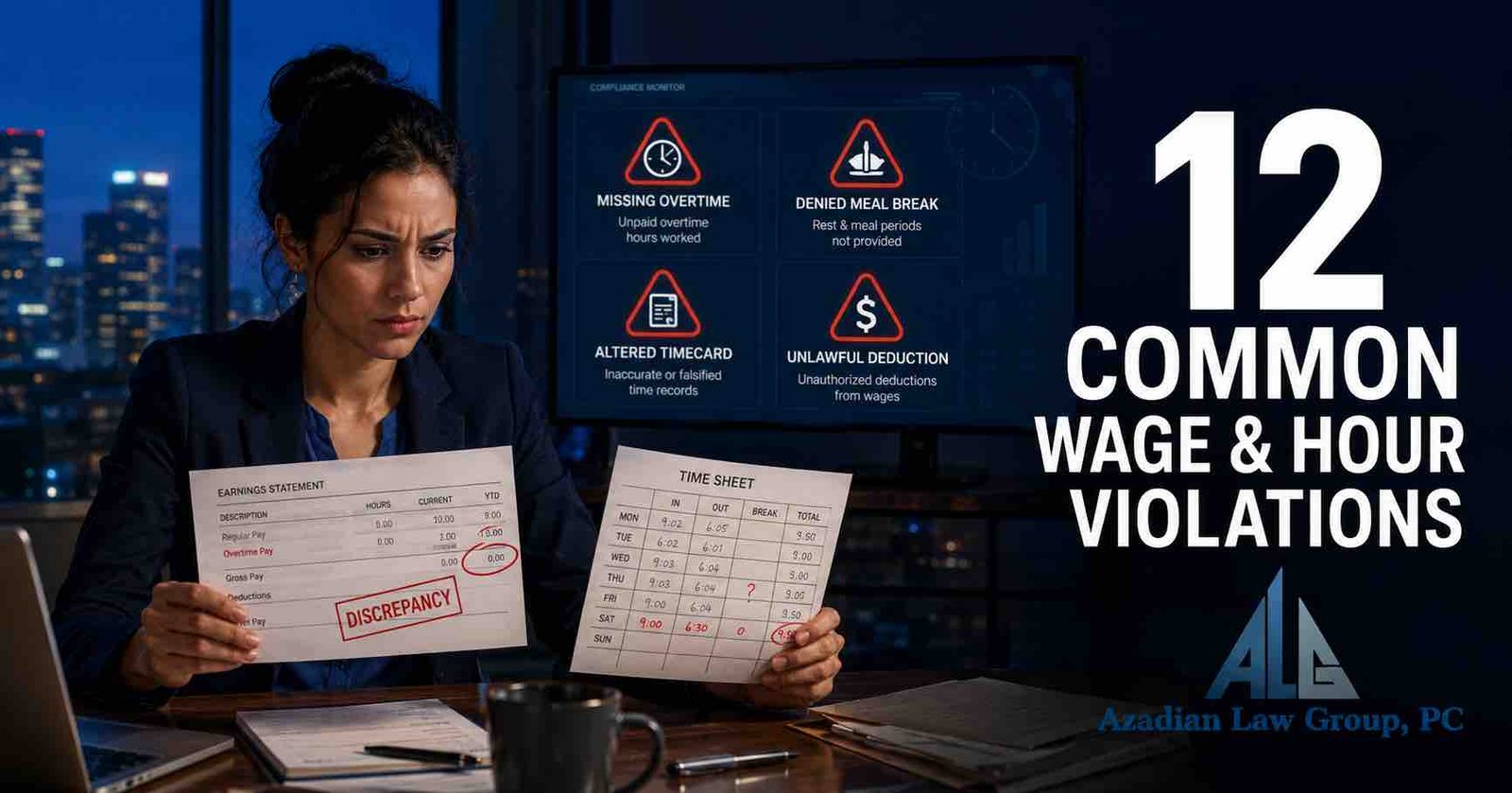
Most employees know when a paycheck is missing. Wage theft becomes harder to recognize when the paycheck arrives on time but does not include every hour, premium, commission or reimbursement the employee earned.
An employer might automatically deduct a meal period that was never provided, call an employee “salaried” to avoid overtime, require after-hours messages or alter a timecard by only a few minutes each day. Individually, these practices can look minor. Repeated across months or years, they can cost an employee thousands of dollars.
California provides workers with some of the country’s strongest wage protections. Those protections mean little, however, when employees cannot recognize the warning signs.
What Is a Wage and Hour Violation?
A wage and hour violation occurs when an employer fails to properly pay or protect an employee under applicable labor laws.
Common violations include:
| Violation | Common warning sign |
|---|---|
| Unpaid overtime | Working more than eight hours without overtime pay |
| Off-the-clock work | Performing tasks before clocking in or after clocking out |
| Missed meal periods | Automatic deduction despite working through lunch |
| Missed rest breaks | Workload makes taking a break practically impossible |
| Minimum-wage violations | Effective hourly pay falls below the applicable rate |
| Employee misclassification | Job title says “manager,” but duties do not |
| Illegal deductions | Pay reduced for shortages, damage or business costs |
| Unpaid expenses | Employee pays for necessary work expenses |
| Commission violations | Earned commissions are delayed or withheld |
| Late final wages | Terminated employee does not receive all earned wages |
| Inaccurate wage statements | Pay stub omits hours, rates or deductions |
| Retaliation | Hours or employment are threatened after a pay complaint |
Not every payroll mistake creates the same claim or remedy. The employee’s classification, industry, location, wage order and actual work can all affect the analysis.
1. Unpaid Overtime
Most nonexempt California employees must receive overtime at one-and-a-half times their regular rate of pay when they work:
- More than eight hours in a workday;
- More than 40 hours in a workweek; or
- More than six consecutive days in a workweek, subject to applicable rules.
Double time may be required after more than 12 hours in a workday or after eight hours on the seventh consecutive workday.
Overtime is not always calculated from the employee’s base hourly wage. Certain nondiscretionary bonuses, commissions, shift differentials and other compensation may need to be included in the regular rate.
Common unpaid-overtime schemes include:
- Removing hours from employee timecards;
- Averaging hours across two workweeks;
- Paying straight time for overtime hours;
- Excluding bonuses from the regular rate;
- Calling employees “managers” without examining their duties; and
- Refusing payment because overtime was not approved in advance.
An employer may enforce a legitimate overtime-approval policy, but the California Labor Commissioner explains that employees must generally be paid for work the employer knew or should have known was performed.
Employees who suspect an overtime shortage can learn more from a Los Angeles unpaid overtime lawyer.
2. Misclassifying Employees as Exempt
A salary and impressive job title do not automatically eliminate an employee’s overtime rights.
California’s executive, administrative and professional exemptions generally require both a minimum salary and qualifying job duties. In 2026, the salary threshold for many of these exemptions is $70,304 per year. Earning that amount satisfies only the salary component.
A supposed manager may still be nonexempt when most of the work involves serving customers, operating equipment, stocking products or performing the same routine duties as hourly employees.
Warning signs include:
- Little genuine authority over hiring or termination;
- No meaningful discretion over important business matters;
- Spending most working time on nonmanagerial tasks;
- Receiving a managerial title primarily to avoid overtime; or
- Having pay docked in ways inconsistent with salaried status.
Employee classification depends on actual work—not merely the title printed on a business card.
3. Misclassifying Employees as Independent Contractors
Some businesses classify workers as independent contractors to avoid minimum wage, overtime, meal periods, rest breaks, payroll taxes, expense reimbursement and other employee protections.
A written contract describing someone as an independent contractor does not conclusively determine legal status. Neither does payment through a mobile application or a Form 1099.
Relevant factors can include the hiring entity’s control, whether the worker performs work within the usual course of the company’s business and whether the worker operates an independently established business. Different tests and exceptions can apply depending on the occupation and claim.
The California Labor Commissioner allows workers who believe they were misclassified to file a wage claim so the agency can evaluate whether an employment relationship existed.
4. Working Off the Clock
Off-the-clock work occurs when an employee performs compensable tasks outside recorded working time.
Examples include:
- Starting equipment or required software before clocking in;
- Reviewing assignments before a shift;
- Cleaning or closing a workplace after clocking out;
- Responding to calls, emails or messages at home;
- Completing paperwork during an unpaid period;
- Passing through required security or inspection procedures; and
- Waiting for a manager to release the employee after the shift.
An employer cannot simply instruct employees to “finish the work” while refusing to record the time needed to complete it.
Modern monitoring and payroll platforms can also create new forms of unpaid work. Our article on AI, automated timekeeping and wage theft examines how algorithms can erase working time, automatically deduct breaks or reject legitimate hours.
5. Missed or Interrupted Meal Periods
Many nonexempt California employees are entitled to an uninterrupted, duty-free 30-minute meal period when working more than five hours. A second meal period may be required when an employee works more than ten hours. Limited waiver rules can apply.
A meal period may be noncompliant when:
- It begins too late;
- It lasts less than 30 minutes;
- The employee must remain on duty;
- The employee must answer calls or monitor messages;
- An automatic deduction occurs despite the employee working; or
- Workload or staffing effectively prevents the employee from taking it.
A timecard showing a meal deduction does not prove the employee received a compliant meal period.
The California Labor Commissioner’s meal-period guidance explains that an employee must be paid when an employer knows or has reason to know the employee worked during the meal period. Additional premium pay may be available for a noncompliant meal period, depending on the circumstances.
Learn more about the rights enforced by a Los Angeles meal and rest break lawyer.
6. Denied Rest Breaks
California generally requires authorized and permitted paid rest periods based on the length of the employee’s workday. For many employees, this means a net ten-minute rest period for every four hours worked or major fraction thereof.
Rest breaks should ordinarily be separate from meal periods. Requiring an employee to remain productive throughout the break can defeat its purpose.
Common violations include:
- Chronic understaffing that makes breaks impossible;
- Productivity quotas that punish employees for pausing work;
- Requiring employees to remain on call;
- Making employees perform small tasks during breaks;
- Combining rest breaks into one longer break without legal justification; and
- Requiring employees to clock out for paid rest periods.
A written break policy does not necessarily establish compliance. What matters is whether employees were actually authorized and permitted to take legally compliant breaks.
7. Paying Less Than the Applicable Minimum Wage
California’s statewide minimum wage is $16.90 per hour in 2026 for employers of every size. The City of Los Angeles minimum wage increased to $18.42 per hour on July 1, 2026.
Some cities and industries require still higher rates. Covered fast-food and healthcare employees, for example, may be governed by separate wage requirements.
A minimum-wage violation can occur even when the pay stub lists the correct hourly rate. If an employee performs unpaid setup work, works through automatically deducted meal periods or pays unreimbursed business expenses, the effective rate can fall below the required minimum.
Our updated California minimum wage guide for 2026 explains statewide and Los Angeles rates, exemptions and industry-specific rules.
8. Unlawful Payroll Deductions
California generally limits when an employer can deduct money from an employee’s wages.
Lawful deductions can include taxes, legally required withholdings and certain deductions voluntarily authorized by the employee. Other deductions require closer scrutiny.
Potential problems include deductions for:
- Cash shortages;
- Customer walkouts;
- Broken equipment;
- Lost merchandise;
- Required uniforms or tools;
- Ordinary business losses; and
- Damage not caused by the employee’s dishonest or intentionally wrongful conduct.
The legality of a deduction can depend on why it occurred, what the employee authorized and whether the employer is attempting to shift an ordinary business cost onto workers.
An employee who notices an unfamiliar deduction should request an explanation and preserve the relevant pay stub and authorization documents.
9. Failing to Reimburse Necessary Business Expenses
California employees may be entitled to reimbursement for necessary expenditures incurred while performing their work.
Depending on the job, reimbursable expenses can involve:
- Mileage and vehicle use;
- Personal cellphone service;
- Internet service used for remote work;
- Required tools or equipment;
- Business travel;
- Uniform maintenance; and
- Supplies purchased for the employer’s benefit.
Remote employees can be affected when an employer expects them to use personal phones, computers or internet access without reimbursement.
Whether an expense was necessary and how much must be reimbursed can depend on the facts. Employees should preserve receipts, mileage records, policies and communications showing that the employer required or knew about the expense.
10. Withholding Earned Commissions or Bonuses
Commission disputes often arise when an employee closes a sale but the employer delays payment, changes the plan after the work was performed or claims the employee forfeited the commission by leaving the company.
A lawful written commission agreement should explain how commissions are calculated and when they are earned.
Employees should watch for:
- Retroactive changes to commission terms;
- Unexplained chargebacks;
- Missing sales from commission reports;
- Delayed payments;
- Disputes over post-termination commissions;
- Bonuses described as “discretionary” despite objective requirements; and
- Failure to include qualifying commissions or bonuses in overtime calculations.
The exact point at which a commission becomes earned depends heavily on the written plan and applicable law. Preserve every version of the commission agreement, sales records and employer communications.
11. Late or Missing Final Wages
When an employee is discharged in California, earned and unpaid wages are generally due immediately. When an employee resigns, the timing can depend on whether the employee gave at least 72 hours’ notice.
Final compensation may include:
- Regular wages;
- Overtime;
- Earned commissions;
- Accrued and unused vacation;
- Meal or rest-period premiums; and
- Other compensation legally due.
A willful failure to timely pay final wages can potentially support waiting-time penalties. The penalty analysis depends on the circumstances, including whether wages were actually due and whether a genuine dispute existed.
Employees should carefully review their final pay stub and compare it with their schedule, time records, vacation balance and commission documents.
12. Inaccurate or Incomplete Wage Statements
California employers generally must provide itemized wage statements containing required payroll information.
Employees should be able to identify:
- Gross and net wages;
- Total hours worked, when required;
- Applicable hourly rates;
- The number of hours worked at each rate;
- Deductions;
- The pay-period dates;
- The employee’s identifying information; and
- The employer’s legal name and address.
An inaccurate wage statement can hide other violations. Missing hours may conceal off-the-clock work, while an incorrect employer name can create confusion about which company is responsible for payment.
Review every pay stub rather than assuming payroll software is accurate.
Retaliation for Reporting Wage Violations
California employers generally may not fire, demote, threaten, transfer, discipline or reduce an employee’s hours because the employee made a good-faith complaint about unpaid wages or exercised protected Labor Code rights.
Retaliation can be direct, such as a supervisor openly threatening termination. It can also be disguised behind sudden performance criticism, undesirable assignments or an unexplained reduction in scheduled hours.
The California Labor Commissioner’s retaliation unit investigates complaints involving termination, suspension, reduced pay, reduced hours, discipline and other adverse treatment.
Employees should preserve:
- Their original wage complaint;
- Time and payroll records;
- Responses from management or human resources;
- Performance reviews before and after the complaint;
- Scheduling changes;
- Disciplinary notices; and
- A timeline of what happened.
Employees punished after raising a wage concern can speak with a Los Angeles workplace retaliation attorney about the circumstances.
What Evidence Can Help Prove a Wage Claim?
Employees do not need to solve the entire case before requesting legal advice. Preserving available evidence can make the underlying pattern easier to evaluate.
Useful records may include:
- Pay stubs;
- Timecards;
- Work schedules;
- Employment agreements;
- Commission or bonus plans;
- Emails and text messages;
- System login and logout records;
- Meal-period records;
- Expense receipts;
- Mileage logs;
- Disciplinary notices; and
- Personal notes showing actual hours worked.
Keep only records you can lawfully access. Do not enter restricted systems, remove confidential company material without authorization or alter employer records.
Employees can also keep a personal log of start times, finish times, interrupted breaks and after-hours work. The California Labor Commissioner recommends that workers track their time and pay even though employers are responsible for maintaining accurate records.
How Azadian Law Group Investigates Wage-and-Hour Violations
Azadian Law Group, PC represents employees in individual wage disputes and complex cases involving widespread payroll practices.
A meaningful wage investigation goes beyond reading the final total on a pay stub. Depending on the case, our attorneys may compare:
- Timecards against schedules and electronic activity;
- Recorded meal periods against workplace communications;
- Job titles against actual daily duties;
- Bonuses and commissions against overtime calculations;
- Payroll deductions against employee authorizations;
- Expense policies against costs employees personally paid; and
- Wage complaints against later discipline or termination.
The goal is to determine what the employee actually worked, what the employer knew and whether the payroll records tell the complete story.
Frequently Asked Questions
Can my employer refuse to pay overtime because it was not approved?
An employer may enforce a policy requiring advance approval, but employees generally must still be paid for compensable work the employer knew or should have known they performed.
Am I exempt from overtime because I receive a salary?
Not necessarily. Receiving a salary satisfies neither the minimum salary requirement nor the duties test by itself. The employee’s compensation and actual responsibilities must meet a valid exemption.
Can my employer automatically deduct 30 minutes for lunch?
A payroll system may record scheduled meal periods, but an automatic deduction does not prove a compliant meal occurred. If the employer knew or should have known the employee worked during that time, compensation may be owed.
Can I agree to receive less than the California minimum wage?
California’s minimum-wage obligation generally cannot be waived through a private agreement between an employer and employee.
What if my employer changed my timecard?
Preserve both the original record and edited version if you can lawfully access them. Schedule records, messages, system activity and personal time logs may help show when work actually occurred.
How long do I have to bring a wage claim?
Deadlines depend on the type of violation, remedy and legal procedure involved. Employees should seek guidance promptly rather than assume every wage claim has the same filing period.
Speak With a Los Angeles Wage and Hour Lawyer
Wage theft is not always one dramatic missing paycheck. More often, it is a pattern: ten minutes removed here, a meal deducted there, a commission delayed or an employee classified incorrectly month after month.
Azadian Law Group, PC represents California employees facing unpaid overtime, off-the-clock work, missed breaks, illegal deductions, unreimbursed expenses, misclassification and retaliation.
If your payroll records do not match the work you performed, contact an experienced Los Angeles wage and hour lawyer or call 213-229-9031 for a free consultation.
This article provides general information and is not legal advice. Wage laws, exemptions, remedies and filing deadlines depend on the employee, industry, location and specific facts.


Related Blog Posts
Your timecard shows a 30-minute lunch. Your phone shows a supervisor asking you to finish an order during that same...
Read MoreAI, Automation and Wage Theft: California Employee Rights in 2026 Artificial intelligence is no longer limited to futuristic laboratories or...
Read MoreLos Angeles startups often promise flexibility, rapid growth, meaningful equity and the chance to build something from the ground up....
Read MoreTypes of Cases Handle By Employment Lawyers in Los Angeles, CA
The following presents an overview of the broad range of employment law cases that our employment attorneys are experienced at overseeing and favorably resolving.
Wrongful Termination
Wrongful Termination Lawyers in Los Angeles, CA Attorneys at Azadian Law Group who have filed wrongful termination lawsuits acknowledge that unfair termination can significantly impact an employee’s life. It can…
Age Discrimination
Age Discrimination Lawyers in Los Angeles, CA Azadian Law Group, PC regularly represents clients throughout Los Angeles, CA, who are the victims of age discrimination in the workplace. At Azadian…
Pregnancy Discrimination
Pregnancy Discrimination Lawyer in Los Angeles, CA At Azadian Law Group, PC, our pregnancy discrimination lawyer in Los Angeles, regularly represents clients who are the victims of pregnancy discrimination in…
Sexual Harassment
Sexual Harassment Attorney in Los Angeles, CA The Los Angeles Sexual Harassment Lawyers at Azadian Law Group, PC, know that in today’s modern era, some people often make the mistake of…
Racial Discrimination
Racial Discrimination Lawyers in Los Angeles, CA Azadian Law Group, PC regularly represents clients throughout Los Angeles who are the victims of racial discrimination at work. The Los Angeles Race…
Disability Discrimination
When a Medical Condition Becomes a Workplace Problem, You Have Rights Most employees never expect a health condition to place their career at risk. Yet every day across Los Angeles,…
Praise from Our Clients
Lui H

Arpi Agdere
Tofi
Aracelis Feria
Ivy Gamboa
Jillian Dunlap
Greg Wayne
Elizabeth Eromosele
Steve G
Lisa Galvan
Artur Aleksanyan
Delight Dinopoulos
George Margaros
Chelsea Pham
Trevor Pal-Freeman
Patricio Garza
Taylor
Ashley Londerman
Marissa Zapanta
Nuria Coronado
Barbara Villalobos
Irene Golub
Joshua Butler
J Mo
Employees We Represent in Employment Law Cases
At Azadian Law Group, we represent employees throughout Los Angeles and California who have experienced workplace violations. Our attorneys handle employment law matters including wrongful termination, workplace discrimination, retaliation, harassment, wage and hour violations, and whistleblower protection.
Employees often face unlawful treatment after reporting misconduct, requesting medical leave, or asserting their legal rights at work. Our firm investigates employment law violations and advocates for workers seeking accountability, compensation, and fair treatment under California and federal employment law.

Step 1
Explore our comprehensive range of legal services to find the specialized support you need.
Step 2
Arrange a free initial meeting with our experts to discuss your legal situation.
Step 3
Receive a custom strategy specially created for your case by our legal experts.
Call Us Now 213-229-9031
Tell Us Your Story
Speak out for justice. Your story can be the start of a new chapter of workplace fairness.
