How to File a Wrongful Termination Claim in Los Angeles
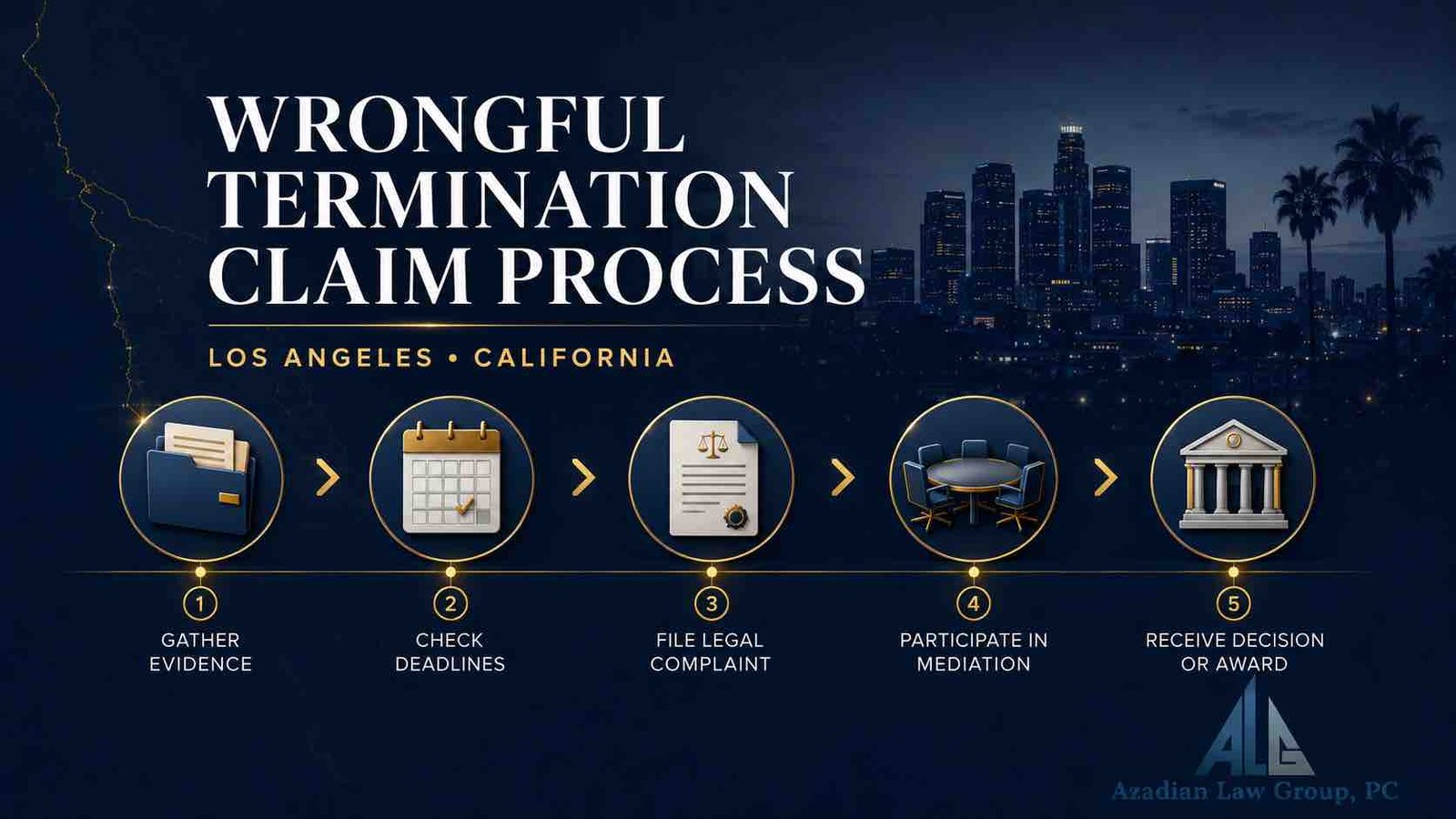
How to File a Wrongful Termination Claim in Los Angeles
Filing a wrongful-termination claim is not a single form or one universal process. The correct path depends on why the employee was fired, which laws may have been violated, whether an administrative complaint is required, whether an arbitration agreement applies, and which deadlines control the claims.
In practical terms, the process usually begins with an attorney evaluating the facts and evidence. It may then involve an agency complaint, a right-to-sue notice, pre-lawsuit negotiations, a civil complaint or arbitration demand, discovery, mediation, motions, and—if the dispute does not resolve—a trial or arbitration hearing.
Employees considering a claim can consult Azadian Law Group’s Los Angeles wrongful termination lawyers about the facts, available evidence, and deadlines that may apply. This guide provides general information and does not predict how any particular case will proceed.
What Makes a Termination Potentially Unlawful?
California employment is generally presumed to be at will. That means an employer may ordinarily end an employment relationship without proving good cause. At-will employment does not, however, authorize a firing based on an unlawful reason.
A termination may support one or more legal claims when it is connected to:
- Discrimination based on a protected characteristic such as race, disability, age, sex, pregnancy, religion, national origin, sexual orientation, gender identity, or medical condition.
- Retaliation for reporting discrimination, harassment, wage violations, safety concerns, fraud, patient-care problems, or other suspected unlawful conduct.
- A request for reasonable accommodation or protected medical or family leave.
- Whistleblowing, refusing to participate in suspected illegal activity, or cooperating with an investigation.
- Exercising a statutory right, serving on a jury, discussing wages, or engaging in another protected activity.
- A violation of an employment agreement or an established public policy.
An employee who is uncertain whether the employer’s explanation is credible can begin with the firm’s guide to warning signs of wrongful termination. A disappointing, harsh, or poorly managed firing is not automatically illegal; the central question is whether evidence connects the decision to a prohibited reason.
The Wrongful-Termination Claim Process at a Glance
| Stage | What Usually Happens | Why It Matters |
|---|---|---|
| Initial evaluation | The facts, documents, witnesses, contracts, and deadlines are reviewed. | This identifies viable legal theories and the proper forum. |
| Evidence preservation | Lawfully retained records are organized and a detailed timeline is created. | Contemporaneous evidence can expose timing, unequal treatment, or pretext. |
| Administrative filing | A CRD or EEOC complaint may be filed when discrimination laws require exhaustion. | Missing an agency deadline can jeopardize statutory claims. |
| Pre-lawsuit resolution | Counsel may communicate with the employer or explore settlement. | Some disputes resolve before formal litigation, but no outcome is guaranteed. |
| Lawsuit or arbitration | A complaint or arbitration demand states the claims, facts, and requested relief. | This formally begins the contested proceeding. |
| Discovery | The parties exchange documents, written answers, and deposition testimony. | Discovery tests each side’s explanation and uncovers evidence. |
| Mediation and motions | The parties may negotiate while the court or arbitrator addresses legal issues. | A case may resolve, narrow, or continue toward a hearing. |
| Trial or arbitration hearing | Witnesses testify and evidence is presented to the decision-maker. | A judge, jury, or arbitrator determines liability and any recoverable relief. |
Not every case passes through every stage. Some matters resolve during an agency investigation or early negotiation. Others are dismissed, compelled to arbitration, narrowed by motions, settled during discovery, or tried.
Step 1: Evaluate the Legal Theory Before Filing
“Wrongful termination” describes many different legal theories rather than one all-purpose claim. A lawyer may evaluate discrimination, retaliation, whistleblower protection, leave interference, breach of contract, wage-related retaliation, and discharge in violation of public policy.
The theory matters because it controls the required elements, potential defendants, filing route, available remedies, and deadlines. For example, a discriminatory firing may require analysis under California’s Fair Employment and Housing Act and federal law. The firm’s workplace-discrimination guidance explains how protected status, unequal treatment, timing, and the employer’s stated reason may fit together.
A firing after an internal report of suspected fraud or illegality may instead involve California whistleblower protections. The firm’s analysis of the Wells Fargo whistleblower-retaliation allegations illustrates why decision-maker knowledge and the sequence of events can be important.
Step 2: Build a Reliable Timeline
Create a chronological record beginning before the workplace conflict. Include positive reviews, complaints, leave or accommodation requests, changes in treatment, new discipline, investigations, termination meetings, and post-termination explanations.
Record:
- The date, participants, and substance of each important conversation.
- When the employer learned about a protected complaint or condition.
- When criticism, exclusion, reduced duties, or write-ups began.
- Who participated in the termination decision.
- Every reason the employer gave for the firing.
- Whether comparable employees were treated differently.
Timing can be persuasive, but timing alone rarely tells the whole story. A useful chronology connects dates to documents and witnesses. The detailed guide on evidence that may prove wrongful termination explains how performance records, messages, complaint history, comparator evidence, and shifting explanations can reinforce one another.
Step 3: Preserve Evidence Without Taking Improper Material
Preserve records that you lawfully possess, including offer letters, agreements, policies, reviews, schedules, pay records, complaint emails, accommodation paperwork, leave notices, disciplinary documents, termination letters, and severance offers.
Keep complete messages with dates, participants, and context. Do not alter files, enter company systems after access ends, forward trade secrets, remove privileged material, or retain confidential patient, customer, or coworker records merely because they might seem useful. Evidence gathered improperly can create separate legal and ethical problems.
California Labor Code section 1198.5 generally allows current and former employees to request inspection or a copy of personnel records relating to performance or a grievance. The statute generally requires an employer to make covered records available within 30 calendar days after receiving a written request, subject to its terms and exceptions.
Step 4: Review Contracts, Policies, and Arbitration Terms
An offer letter, employment agreement, commission plan, collective-bargaining agreement, handbook acknowledgment, or arbitration agreement may change the procedural analysis.
An employment contract may contain a promised term, a “for cause” requirement, notice provisions, severance rights, bonus language, or a choice-of-law clause. The firm’s discussion of employment contracts in termination cases provides context for why the actual language matters.
An arbitration agreement does not necessarily eliminate statutory employee rights. It may determine where and how the dispute is decided. Counsel should review formation, scope, signatures, delegation language, governing rules, fees, and any applicable exemptions before choosing a filing strategy.
Step 5: Identify Every Deadline
There is no single California wrongful-termination deadline. Different claims may have different administrative and court filing periods, and special rules may apply to government employees, union workers, federal employees, minors, or claims involving public entities.
| Possible Filing | General Timing Issue | Important Qualification |
|---|---|---|
| California CRD intake | Generally within three years of the last alleged FEHA violation. | A right-to-sue notice is generally required before bringing covered FEHA claims in court. |
| Lawsuit after a CRD right-to-sue notice | The notice generally states a one-year period to file the civil action. | Earlier or different deadlines may control other claims arising from the same facts. |
| EEOC charge | Federal law generally uses 180 days, often extended to 300 days where a state or local agency enforces a parallel law. | Federal employees and certain claims follow different procedures. |
| Public-policy wrongful discharge | A two-year limitations period commonly applies to this tort theory. | Do not assume that the same period governs discrimination, contract, wage, or statutory retaliation claims. |
The California Civil Rights Department states that an employment intake generally must be submitted within three years of the last harm. The EEOC explains its separate federal charge deadlines. These sources provide general rules, but a limitations analysis should be completed immediately because waiting for the longest possible date is risky.
Step 6: Decide Whether an Agency Filing Is Required
Claims under FEHA generally require an administrative complaint and right-to-sue notice before a private lawsuit is filed. An employee may ask CRD to investigate or may seek an immediate right-to-sue notice. Those are strategic alternatives, not interchangeable paperwork choices.
Federal discrimination claims typically require an EEOC charge before suit. A charge may be cross-filed in some circumstances, but employees should not assume that contacting one organization automatically perfects every state and federal claim.
Other legal theories may permit a direct civil action or follow a different administrative route. That is why the legal theory must be identified before a form is submitted. Selecting inaccurate allegations, defendants, dates, or requested relief can complicate later proceedings.
Step 7: Consider Pre-Lawsuit Negotiation
Depending on the facts, counsel may contact the employer before filing a lawsuit. A communication may identify the dispute, request preservation of evidence, seek records, respond to a severance offer, or explore resolution.
Pre-lawsuit negotiation is not mandatory in every case and is not always strategically appropriate. It also does not automatically pause a filing deadline. Employees should not let informal discussions, internal appeals, or assurances from HR cause a deadline to expire.
Employees facing the immediate aftermath of termination can use the firm’s separate post-termination action plan to organize documents, review severance terms, and avoid common preservation mistakes while the legal route is assessed.
Step 8: File the Civil Complaint or Arbitration Demand
A civil complaint identifies the parties, alleges material facts, states legal claims, and requests available relief. It should be grounded in evidence and drafted with the elements of each claim in mind. Overloading a complaint with unsupported conclusions does not make a case stronger.
After filing, the plaintiff must serve the defendants according to procedural rules. The defendants may answer, challenge the pleadings, seek to compel arbitration, or raise defenses. The court will usually establish deadlines and hold a case-management conference.
If an enforceable arbitration agreement covers the dispute, the claim may proceed through an arbitration provider instead of a public court. The demand, arbitrator-selection process, discovery rules, motion practice, hearing, and review rights may differ from civil litigation.
Step 9: Exchange Evidence Through Discovery
Discovery is the formal process through which each side obtains relevant information. It may include:
- Requests for documents and electronically stored information.
- Written interrogatories and requests for admission.
- Depositions of the employee, supervisors, HR personnel, decision-makers, and witnesses.
- Subpoenas for records held by third parties.
- Expert analysis concerning damages, employability, or other disputed issues.
Discovery can reveal who made the decision, whether company policies were followed, how comparator employees were treated, and whether the employer’s explanation changed. It also allows the employer to examine the employee’s allegations, mitigation efforts, medical claims when placed at issue, and claimed damages.
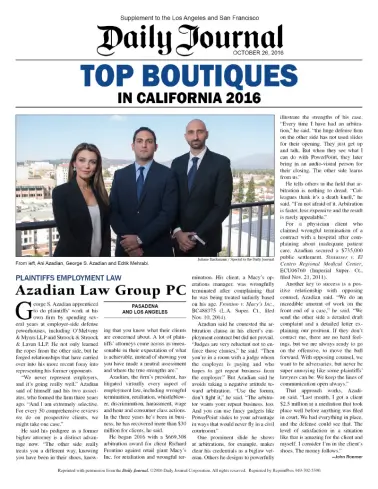
Published results illustrate how detailed evidence can shape a case. In Azadian Law Group’s reported $669,308 Macy’s retaliation matter, the account discusses the employee’s complaint, performance improvement, subsequent documentation, and termination. Every case is fact-specific, and a prior result does not guarantee another outcome.
Step 10: Participate in Mediation and Motion Practice
Many employment disputes are mediated. A neutral mediator helps the parties evaluate risk and explore a negotiated resolution but ordinarily does not impose an outcome. Mediation may occur before filing, early in litigation, after key depositions, or near trial.
The parties may also bring motions addressing the pleadings, discovery disputes, evidence, arbitration, or whether some or all claims can be decided without trial. Surviving a motion does not mean the employee has won; losing one disputed issue does not always end the entire case.
Settlement decisions should consider the evidence, recoverable damages, litigation risk, delay, tax consequences, confidentiality language, reference terms, payment structure, and the employee’s personal priorities—not merely the first dollar figure offered.
Step 11: Prepare for Trial or an Arbitration Hearing
If the matter does not resolve, the parties prepare exhibits, witnesses, expert testimony, motions concerning evidence, and arguments. In court, a judge or jury may decide the claims depending on the issues and applicable rights. In arbitration, the arbitrator generally decides both liability and relief.
The public account of Azadian Law Group’s $9,957,411.17 wrongful-termination arbitration award shows that arbitration can involve extensive factual findings and substantial disputed damages. It should not be treated as a valuation formula: results depend on the evidence, claims, parties, decision-maker, and losses proven in the individual case.
What Compensation May Be Available?
Potential remedies depend on the claims and proof. They may include:
- Back pay for lost wages and benefits.
- Front pay or reinstatement where legally available and appropriate.
- Compensation for emotional distress under qualifying claims.
- Contract damages, unpaid compensation, interest, or statutory penalties where supported.
- Punitive damages when the governing legal requirements are satisfied.
- Attorney’s fees and costs when authorized by statute or agreement.
- Injunctive or other nonmonetary relief in appropriate matters.
Employees generally should make reasonable efforts to reduce wage losses by seeking suitable work. Keep a job-search log showing applications, interviews, networking, recruiter communications, offers, and reasons an opportunity did not proceed. New earnings usually affect the calculation of wage loss rather than automatically destroying the claim.
How Long Does a Wrongful-Termination Case Take?
There is no dependable universal timeline. Duration may depend on:
- Whether an agency investigates before a lawsuit is filed.
- The number of parties, witnesses, and claims.
- The volume of electronic evidence.
- Whether arbitration is disputed.
- Court or arbitrator availability.
- Discovery disagreements and motion practice.
- Whether the parties pursue early or later mediation.
- Appeals or post-hearing proceedings.
A straightforward matter may resolve relatively early, while a heavily contested case can take much longer. Promises of a fast settlement should be viewed skeptically because neither side controls every procedural event.
Common Mistakes That Can Harm a Claim
- Waiting because HR says an internal appeal is still being reviewed.
- Assuming every wrongful-termination theory has the same deadline.
- Signing a broad severance release without understanding it.
- Deleting messages, editing screenshots, or losing original metadata.
- Taking confidential company information the employee has no right to possess.
- Posting detailed accusations, evidence, or negotiation positions online.
- Contacting coworkers in a way that could appear threatening or coercive.
- Failing to document efforts to find comparable employment.
- Exaggerating facts instead of maintaining a precise, consistent account.
When disability accommodation or protected leave is part of the chronology, the firm’s episode on being fired after requesting a disability accommodation provides additional context about protected requests and the employment decisions that may follow.
Frequently Asked Questions
Do I Have to File With CRD Before Suing?
Covered FEHA claims generally require an administrative complaint and right-to-sue notice before a private civil action. Other wrongful-termination theories may follow different procedures, so the answer depends on the claims—not simply the label “wrongful termination.”
Can I File a Claim Without Direct Proof of Discrimination or Retaliation?
Potentially. Direct admissions are uncommon. Circumstantial evidence may include suspicious timing, inconsistent explanations, unequal treatment, departures from policy, a sudden negative record after protected activity, and decision-maker knowledge.
Will My Case Automatically Go to Trial?
No. A case may be investigated by an agency, negotiated, mediated, dismissed, compelled to arbitration, resolved through motion practice, settled, tried, or heard by an arbitrator. The route depends on the claims, agreements, evidence, and litigation decisions.
Can I Bring a Claim if I Was an At-Will Employee?
Yes, when the firing violated a statute, contract, or recognized public policy. At-will employment permits many lawful terminations, including some that feel unfair, but it does not authorize discrimination, retaliation, or other prohibited reasons.
Should I Wait for the Employer to Send My Personnel File?
No. A records request may be useful, but it should not delay deadline analysis or legal advice. Important records may also exist outside the personnel file, including emails, messaging platforms, payroll systems, investigation files, and decision-maker communications.
Speak With Azadian Law Group About the Filing Process
The strength of a wrongful-termination case usually turns on careful legal classification, credible evidence, protected deadlines, and a consistent account—not on how unfair the firing feels in isolation. Early review can help identify which records to preserve and whether an agency filing, lawsuit, arbitration demand, or negotiated approach is appropriate.
Azadian Law Group, PC represents employees in Los Angeles and throughout California. Employees may request a confidential consultation to discuss the circumstances surrounding a termination. Prior results do not guarantee a similar outcome, and this article is general information rather than legal advice.


Related Blog Posts
Wrongful Termination Evidence Often Appears as a Pattern Wrongful termination evidence is rarely found in one dramatic email admitting that...
Read MoreOracle Layoffs Raise New Questions for California Employees Oracle has reportedly begun another round of layoffs in the United States,...
Read MoreArtificial intelligence has already started screening resumes, measuring productivity, writing performance reviews, and recommending layoffs. Now it has reportedly helped...
Read MoreTypes of Cases Handle By Employment Lawyers in Los Angeles, CA
The following presents an overview of the broad range of employment law cases that our employment attorneys are experienced at overseeing and favorably resolving.
Wrongful Termination
Wrongful Termination Lawyers in Los Angeles, CA Attorneys at Azadian Law Group who have filed wrongful termination lawsuits acknowledge that unfair termination can significantly impact an employee’s life. It can…
Age Discrimination
Age Discrimination Lawyers in Los Angeles, CA Azadian Law Group, PC regularly represents clients throughout Los Angeles, CA, who are the victims of age discrimination in the workplace. At Azadian…
Pregnancy Discrimination
Pregnancy Discrimination Lawyer in Los Angeles, CA At Azadian Law Group, PC, our pregnancy discrimination lawyer in Los Angeles, regularly represents clients who are the victims of pregnancy discrimination in…
Sexual Harassment
Sexual Harassment Attorney in Los Angeles, CA The Los Angeles Sexual Harassment Lawyers at Azadian Law Group, PC, know that in today’s modern era, some people often make the mistake of…
Racial Discrimination
Racial Discrimination Lawyers in Los Angeles, CA Azadian Law Group, PC regularly represents clients throughout Los Angeles who are the victims of racial discrimination at work. The Los Angeles Race…
Disability Discrimination
When a Medical Condition Becomes a Workplace Problem, You Have Rights Most employees never expect a health condition to place their career at risk. Yet every day across Los Angeles,…
Praise from Our Clients
A“

QT
RT
KM
BM
HM
bS
kj
SM
TM
FL
kr
TP
CF
WW
JA
RM
RC
VM
JS
TH
SD
RM
AC
W
kn
AO
DN
KW
TP
RS
L
D
la
JG
DP
RK
HL
TP
sr
sl
PD
SS
SS
JB
JA
AR
CG
LH
YU
MS
TA
NS
aa
RC
AR
mp
IG
N
JJ
Kd
GA
aa
GB
RT
MM
PP
PA
DV
T
AW
CW
SM
TC
SC
hh
KK
DB
S
SM
VV
K&
PG
JL
SS
AC
MS
DS
DM
ZM
CA
AF
GC
jg
GN
AG
A
KG
EC
s
MZ
m
LD
PW
PD
CH
TA
KM
PZ
CA
rc
FA
JA
MJ
SM
kr
LH
BJ
DG
JJ
ES
WW
VS
TH
VB
GA
DM
LS
SM
AS
wm
MH
DA
TP
LA
DR
MM
D
RG
WR
Employees We Represent in Employment Law Cases
At Azadian Law Group, we represent employees throughout Los Angeles and California who have experienced workplace violations. Our attorneys handle employment law matters including wrongful termination, workplace discrimination, retaliation, harassment, wage and hour violations, and whistleblower protection.
Employees often face unlawful treatment after reporting misconduct, requesting medical leave, or asserting their legal rights at work. Our firm investigates employment law violations and advocates for workers seeking accountability, compensation, and fair treatment under California and federal employment law.

Step 1
Explore our comprehensive range of legal services to find the specialized support you need.
Step 2
Arrange a free initial meeting with our experts to discuss your legal situation.
Step 3
Receive a custom strategy specially created for your case by our legal experts.
Call Us Now 213-229-9031
Tell Us Your Story
Speak out for justice. Your story can be the start of a new chapter of workplace fairness.
