Wells Fargo Whistleblower Retaliation: What California Employees Should Know
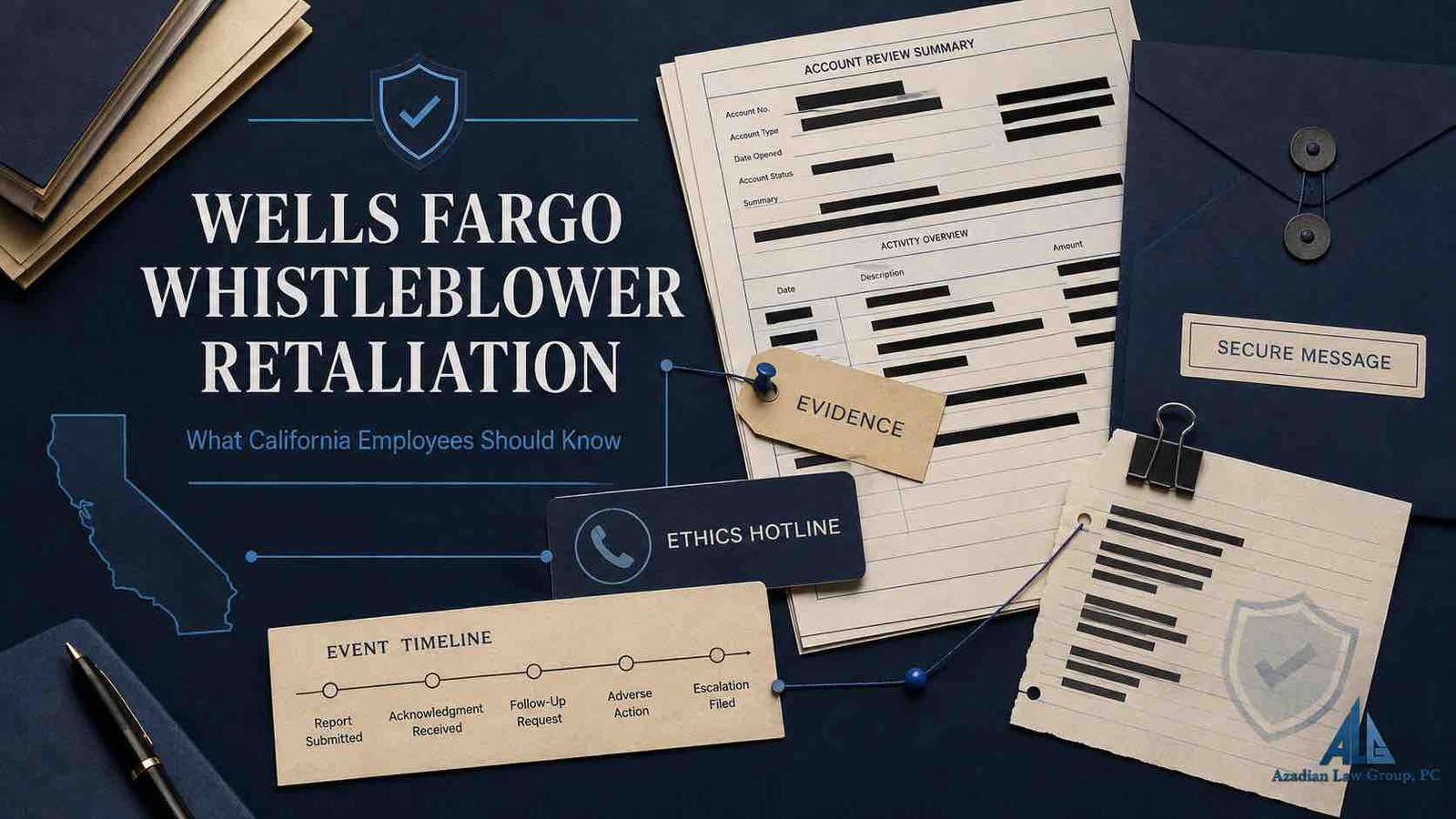
In 2016, the Wells Fargo unauthorized-accounts scandal raised a question that reaches far beyond banking: what happens when employees warn an employer about suspected misconduct and are punished instead of protected?
Azadian Law Group, PC announced an employment-law investigation into reports that Wells Fargo employees were terminated after complaining about unauthorized customer accounts and aggressive sales practices. The original announcement was news coverage from that period, not a court judgment finding that every reported termination was unlawful.
The story remains important because it shows how whistleblower retaliation can operate. An employee may report misconduct, receive a completely different explanation for discipline, and then struggle to prove that the report—not the supposed performance problem—caused the termination.
This updated article explains the underlying scandal, the legal principles that may protect California employees, the evidence that can reveal pretext, and the practical steps a worker should take after reporting suspected wrongdoing.
What Was the Wells Fargo Unauthorized-Accounts Scandal?
The Consumer Financial Protection Bureau reported in 2016 that Wells Fargo employees had secretly opened deposit and credit-card accounts for customers without their knowledge or consent. According to the CFPB, sales targets and compensation incentives encouraged employees to boost sales figures by opening accounts and transferring funds from authorized accounts.
The CFPB stated that the bank’s own analysis identified more than two million deposit and credit-card accounts that may not have been authorized. The agency announced a $100 million penalty, while the Office of the Comptroller of the Currency and the City and County of Los Angeles imposed additional penalties. The CFPB’s official enforcement summary remains available at Wells Fargo Bank, N.A.
The scandal generated regulatory investigations, consumer claims, employee complaints, congressional scrutiny, and intense public attention. It also produced reports that some workers had raised concerns about sales practices and later faced termination, discipline, or difficulty obtaining new employment.
A regulatory finding about customer accounts does not automatically prove that a particular employee was retaliated against. Each employee’s report, decision-maker, timeline, job duties, performance record, and stated reason must be examined separately.
Why Did Azadian Law Group Announce an Investigation?
Azadian Law Group’s original announcement addressed reports involving Wells Fargo workers who allegedly complained about unauthorized accounts and were then terminated. The announcement invited affected employees to contact the firm so their individual circumstances could be evaluated.
The purpose of an investigation is to gather facts—not to announce that liability has already been established. A responsible employment-law review asks:
- What did the employee report?
- To whom was the report made?
- Did the employee reasonably believe the conduct violated a law or regulation?
- Who knew about the report?
- How soon did discipline or termination follow?
- What reason did the employer give?
- Was that reason supported by records created before the report?
- Were other employees who engaged in similar conduct treated differently?
The 2016 announcement provides historical context for understanding whistleblower retaliation and wrongful termination; it does not indicate that the firm is conducting a current investigation.
What Is Whistleblower Retaliation?
Whistleblower retaliation occurs when an employer takes an adverse action because an employee reported, disclosed, or refused to participate in conduct the employee reasonably believed was unlawful.
Adverse actions can include:
- Termination or nonrenewal of employment.
- Demotion or reduction in pay.
- Loss of important accounts, shifts, assignments, or commissions.
- Unfavorable scheduling or transfer.
- Threats, harassment, or intimidation.
- A sudden performance-improvement plan.
- Blacklisting or damaging employment records.
- Pressure to resign.
California Labor Code section 1102.5 is a major state whistleblower protection. The statute can protect qualifying disclosures to a government agency, law enforcement, a supervisor, or another person with authority to investigate or correct the suspected violation. The current statutory text is available through the California Legislative Information website.
The exact elements depend on the subsection and facts. A worker should not assume that every complaint is legally protected or that the word “whistleblower” automatically wins a case.
Can an Employee Be Protected for Reporting Misconduct Internally?
Yes, potentially. A report does not always have to be made to a government agency. California law may protect a report to a supervisor or another person with authority to investigate or correct the suspected violation, depending on the facts.
An employee’s job title does not decide the issue. A bank teller, branch manager, compliance employee, medical worker, accountant, salesperson, or executive may have protection if the legal requirements are met.
The report should communicate more than a personal disagreement with a quota or management style. Stronger reports identify a suspected legal, regulatory, safety, consumer-protection, or financial violation and explain the facts supporting that concern.
Examples may include:
- Opening customer accounts without authorization.
- Falsifying records to meet a sales or performance goal.
- Misrepresenting products, fees, or financial terms.
- Pressuring employees to violate customer-protection rules.
- Destroying or altering compliance records.
- Concealing complaints from regulators.
- Submitting false information to a government agency.
The report’s substance, recipient, timing, and the employee’s reasonable belief all matter.
What Is the Difference Between a Complaint and Protected Whistleblowing?
An employee may complain about a low bonus, an unfair quota, a rude supervisor, or an undesirable schedule without necessarily reporting a legal violation. Those concerns may still be important, but they do not automatically qualify as whistleblower activity.
A protected disclosure generally involves information the employee reasonably believes shows a violation of a federal, state, or local law or regulation. The employee does not always need to prove that the violation ultimately occurred. The focus may include what the employee knew, what was reported, and why the belief was reasonable at the time.
The distinction can be difficult in heavily regulated workplaces. A complaint that sounds like a sales dispute may actually report consumer fraud. A complaint about a staffing shortage may also identify a patient-safety violation. Context matters more than a single label.
How Could Retaliation Be Hidden Behind a Performance Reason?
Employers rarely write “terminated for reporting misconduct” in a personnel file. Retaliation may be disguised as poor performance, attendance, insubordination, policy violations, or a reduction in force.
Potential signs of pretext include:
- Positive performance reviews before the report followed by sudden criticism afterward.
- A performance plan based on vague or previously accepted conduct.
- Different explanations from a supervisor, human resources, and the employer’s lawyers.
- Discipline imposed by the person whose conduct was reported.
- Rules enforced against the reporting employee but ignored for others.
- Documents created only after the employee raised concerns.
- A termination unusually close to the report.
- Management statements suggesting that the employee was disloyal or a troublemaker.
- A position described as eliminated even though substantially similar work continues.
- Negative information placed in a regulatory or employment record after the report.
None of these facts automatically proves retaliation. Their value comes from how they fit together with the complete timeline and decision-making process.
Why Timing Matters in a Wells Fargo-Style Retaliation Case
Timing can support an inference that the report influenced the decision. A termination two days after a compliance complaint may raise different questions from a termination following a documented performance process that began months earlier.
Timing is not conclusive. An employer may have been considering discipline before the complaint, or an unrelated event may have required immediate action. The important questions include:
- When did the employee first raise the concern?
- When did each decision-maker learn about it?
- When did criticism or discipline begin?
- Was the decision already under review?
- Did the employer accelerate the process after the report?
- Did the employer preserve records showing when the decision was made?
Employees should create a dated timeline instead of relying on memory. Include meetings, calls, messages, reports, disciplinary events, schedule changes, and termination communications.
What Evidence Can Support a Whistleblower Retaliation Claim?
The most useful evidence often shows three things: the protected report, the employer’s knowledge, and the connection between the report and the adverse action.
Potential evidence includes:
- Emails or messages reporting suspected misconduct.
- Ethics-hotline confirmation numbers and follow-up communications.
- Compliance reports, audit materials, or safety complaints.
- Notes identifying who attended the report meeting.
- Performance reviews before and after the report.
- Disciplinary notices and performance-improvement plans.
- Sales, productivity, scheduling, and attendance records.
- Policy manuals and training materials.
- Evidence that comparable employees were treated differently.
- Termination notices and severance agreements.
- Regulatory complaints or agency correspondence.
- Names of witnesses with firsthand knowledge.
Preserve records lawfully. Do not access restricted systems after your employment ends, download trade secrets, take customer information, or remove confidential records you are not authorized to keep. Ask an attorney how to preserve sensitive evidence safely.
For a broader checklist, read what evidence can prove wrongful termination in California.
What If the Employer Says the Employee Violated Policy?
A company may discipline an employee for an actual policy violation even when the employee previously made a protected report. The existence of protected activity does not create immunity from legitimate discipline.
The question is whether the policy explanation is genuine and whether the same rule was applied consistently. Consider:
- Was the policy clear and known before the incident?
- Did managers previously approve or tolerate the conduct?
- Were comparable workers disciplined for the same violation?
- Did the employer investigate all relevant facts?
- Did the person accused of misconduct control the investigation?
- Did the employer change its explanation later?
- Was the policy enforced more severely after the report?
A real policy violation can coexist with unlawful retaliation. An employer may have a legitimate concern but still impose an unlawful punishment because the employee complained.
Can an Employer Fire an Employee for Refusing to Break the Law?
Potentially protected conduct can include refusing to participate in conduct the employee reasonably believes would violate the law. Examples may include refusing to falsify a customer record, mislead a consumer, conceal a safety issue, or submit inaccurate information to a regulator.
The employee should clearly communicate the legal or regulatory concern and preserve the response. A vague refusal may be misunderstood as insubordination, while a factual explanation can help show why the refusal was connected to protected conduct.
The precise legal theory depends on the statute, industry, employer, and facts. Do not assume that every workplace instruction creates a whistleblower claim.
Do Federal Whistleblower Laws Also Matter?
They may. Financial-industry employees can have protections under federal laws, including statutes administered through the Occupational Safety and Health Administration or other agencies. The applicable law may depend on the employer, subject of the report, reporting channel, and timing.
Federal administrative deadlines can be short. An employee should identify all potentially applicable laws rather than filing under one theory and assuming every deadline is identical.
California employees can review the Labor Commissioner’s retaliation-complaint guidance for one state administrative route. That page does not replace advice about federal claims, court deadlines, arbitration, or other procedures.
What About Damage to a Worker’s Professional Record?
Financial-industry employees may face employment records, licensing records, or industry reports that affect future opportunities. A worker who reports misconduct may fear that the employer will describe the separation as dishonesty, policy violations, or participation in the wrongdoing.
Potential issues include:
- Whether the employer’s record is accurate.
- Whether the employee had an opportunity to challenge it.
- Whether the report was omitted from the employer’s explanation.
- Whether the record was created or changed after protected activity.
- Whether prospective employers relied on the information.
- Whether a contract or industry process governs correction.
Wrongful termination, retaliation, defamation, interference, and regulatory-record disputes are separate legal issues. A damaging record may be evidence of retaliation, but it does not automatically establish every possible claim.
Can a Layoff Still Be Retaliatory?
Yes, potentially. Employers may conduct legitimate reductions in force, but a layoff can still be unlawful if an employee was selected because of protected activity.
Examine:
- Who selected the employee?
- What criteria were established and when?
- Were the criteria objective and consistently applied?
- Were employees who did not report concerns retained?
- Did the company refill the role or transfer the duties?
- Did the layoff follow a complaint or investigation?
Calling a termination a “reorganization” does not end the analysis. The genuine business reason and the employee-selection process must both be reviewed.
What Should a Wells Fargo Employee Do After Reporting Misconduct?
Employees should act carefully and preserve the record before the situation escalates.
- Write a private chronology of the suspected misconduct and every report.
- Record the names and roles of people who received or discussed the report.
- Keep lawful copies of relevant emails, policies, reviews, and notices.
- Save ethics-hotline confirmation details.
- Follow up in factual, professional language.
- Do not exaggerate, speculate, threaten, or make unsupported public accusations.
- Do not alter, delete, or manufacture records.
- Do not access restricted systems after termination.
- Review any severance or release agreement before signing.
- Track job-search efforts, lost wages, and replacement earnings.
- Seek legal advice before resigning when possible.
- Ask about every possible filing deadline immediately.
The wrongful-termination warning-sign guide explains how timing, shifting explanations, comparators, and pretext fit together.
Should an Employee Report Internally or Externally?
There is no universal answer. Internal reporting may give the employer an opportunity to correct the issue and may create a record. External reporting may be appropriate when internal channels are compromised, the law requires a particular agency process, or the employee faces an urgent risk.
The employee should understand the reporting requirements before acting. Some laws protect specific disclosures to specific recipients. Other laws may require an administrative charge before a lawsuit. Confidentiality, privilege, customer information, and anti-retaliation protections also require careful handling.
An attorney can help evaluate the reporting channel without deciding facts that have not yet been investigated.
What Compensation May Be Available?
Potential remedies vary by claim and proof. They may include:
- Back pay and lost benefits.
- Front pay or future wage loss.
- Compensation for emotional distress.
- Reinstatement in an appropriate case.
- Statutory penalties.
- Punitive damages when legally available.
- Attorney’s fees and costs where authorized.
- Correction of inaccurate employment information in appropriate circumstances.
The value of a claim cannot be determined from the employer’s size or the seriousness of the public scandal alone. Causation, mitigation, credibility, documentation, contract terms, and the applicable statute all matter.
How Long Does a Whistleblower Retaliation Claim Take?
There is no predictable timeline. An administrative complaint may involve an intake process and investigation. A lawsuit may involve discovery, motions, mediation, arbitration, or trial. A settlement can occur at any point, but settlement terms may be confidential and should not be described as a public finding of liability.
Employees should not delay simply because the employer appears to be investigating internally. Internal review does not automatically pause every statute of limitations or administrative deadline.
What Is the Main Lesson From the Wells Fargo Employee Reports?
The central lesson is simple: a company’s compliance culture is tested by how it treats the employee who raises the warning, not only by the policy printed in its handbook.
For an employee, the strongest case is rarely built from outrage alone. It is built from a clear report, a reasonable belief, employer knowledge, a documented timeline, inconsistent explanations, comparator evidence, and proof of financial or personal harm.
For an employer, the lesson is equally practical: investigate reports independently, preserve records, separate the reporting employee from the accused decision-maker when appropriate, apply policies consistently, and document legitimate reasons before discipline occurs.
Frequently Asked Questions
Can I be fired for reporting unauthorized customer accounts?
Potentially protected reporting may exist when the employee reasonably believes the conduct violates a law or regulation. The exact protection depends on what was reported, to whom, the employee’s knowledge, and the applicable statute. A company may still discipline legitimate misconduct unrelated to the report.
Do I need proof that a crime actually occurred?
Not always. Some whistleblower protections focus on whether the employee reasonably believed the disclosed information showed a legal violation. The employee still needs a credible factual basis for the belief, and the claim must satisfy the requirements of the particular law.
Is being fired two weeks after a report enough?
Close timing may support an inference of retaliation, but it is rarely enough by itself. The employer’s knowledge, prior performance, shifting explanations, comparator evidence, and investigation quality can strengthen or weaken the claim.
Can I sue if the employer called me dishonest?
Possibly, but a defamation or interference claim has different elements from a retaliation claim. The exact statement, audience, truth, privilege, and resulting harm must be evaluated. Do not assume that every negative employment reference is legally actionable.
Should I sign a severance agreement after making a report?
Read it carefully before signing. A release may waive retaliation, discrimination, wage, contract, or other claims and may impose continuing obligations. The agreement’s deadline can be important.
Speak With a California Whistleblower-Retaliation Attorney
If you reported suspected fraud, unauthorized accounts, falsified records, safety problems, consumer harm, or another legal violation and then faced discipline or termination, preserve the timeline before important evidence disappears.
Azadian Law Group, PC represents employees in Los Angeles and throughout California in whistleblower retaliation, wrongful termination, discrimination, and employment-contract disputes.
Contact Azadian Law Group or call 213-229-9031 to request a confidential case evaluation.
This article provides general information and is not legal advice. The Wells Fargo-related reports described in historical news coverage were allegations and investigations, not a finding that every employee termination was unlawful. Laws, procedures, and deadlines can change, and every matter depends on its specific facts. Contacting the firm or reading this article does not create an attorney-client relationship.


Related Blog Posts
Losing a job is difficult enough. Receiving an invoice afterward for a signing bonus, training program, or recruiting payment can...
Read MoreYour Los Angeles employer announces a return-to-office deadline. You explain that a medical condition makes the new schedule difficult and...
Read MoreWrongful Termination Evidence Often Appears as a Pattern Wrongful termination evidence is rarely found in one dramatic email admitting that...
Read MoreTypes of Cases Handle By Employment Lawyers in Los Angeles, CA
The following presents an overview of the broad range of employment law cases that our employment attorneys are experienced at overseeing and favorably resolving.
Wrongful Termination
Wrongful Termination Lawyers in Los Angeles, CA Attorneys at Azadian Law Group who have filed wrongful termination lawsuits acknowledge that unfair termination can significantly impact an employee’s life. It can…
Age Discrimination
Age Discrimination Lawyers in Los Angeles, CA Azadian Law Group, PC regularly represents clients throughout Los Angeles, CA, who are the victims of age discrimination in the workplace. At Azadian…
Pregnancy Discrimination
Pregnancy Discrimination Lawyer in Los Angeles, CA At Azadian Law Group, PC, our pregnancy discrimination lawyer in Los Angeles, regularly represents clients who are the victims of pregnancy discrimination in…
Sexual Harassment
Sexual Harassment Attorney in Los Angeles, CA The Los Angeles Sexual Harassment Lawyers at Azadian Law Group, PC, know that in today’s modern era, some people often make the mistake of…
Racial Discrimination
Racial Discrimination Lawyers in Los Angeles, CA Azadian Law Group, PC regularly represents clients throughout Los Angeles who are the victims of racial discrimination at work. The Los Angeles Race…
Disability Discrimination
When a Medical Condition Becomes a Workplace Problem, You Have Rights Most employees never expect a health condition to place their career at risk. Yet every day across Los Angeles,…
Praise from Our Clients
Lui H

Arpi Agdere
Tofi
Aracelis Feria
Ivy Gamboa
Jillian Dunlap
Greg Wayne
Elizabeth Eromosele
Steve G
Lisa Galvan
Artur Aleksanyan
Delight Dinopoulos
George Margaros
Chelsea Pham
Trevor Pal-Freeman
Patricio Garza
Taylor
Ashley Londerman
Marissa Zapanta
Nuria Coronado
Barbara Villalobos
Irene Golub
Joshua Butler
J Mo
Employees We Represent in Employment Law Cases
At Azadian Law Group, we represent employees throughout Los Angeles and California who have experienced workplace violations. Our attorneys handle employment law matters including wrongful termination, workplace discrimination, retaliation, harassment, wage and hour violations, and whistleblower protection.
Employees often face unlawful treatment after reporting misconduct, requesting medical leave, or asserting their legal rights at work. Our firm investigates employment law violations and advocates for workers seeking accountability, compensation, and fair treatment under California and federal employment law.

Step 1
Explore our comprehensive range of legal services to find the specialized support you need.
Step 2
Arrange a free initial meeting with our experts to discuss your legal situation.
Step 3
Receive a custom strategy specially created for your case by our legal experts.
Call Us Now 213-229-9031
Tell Us Your Story
Speak out for justice. Your story can be the start of a new chapter of workplace fairness.
