Sports Announcer’s ESPN Wrongful-Termination Case: What California Employees Can Learn
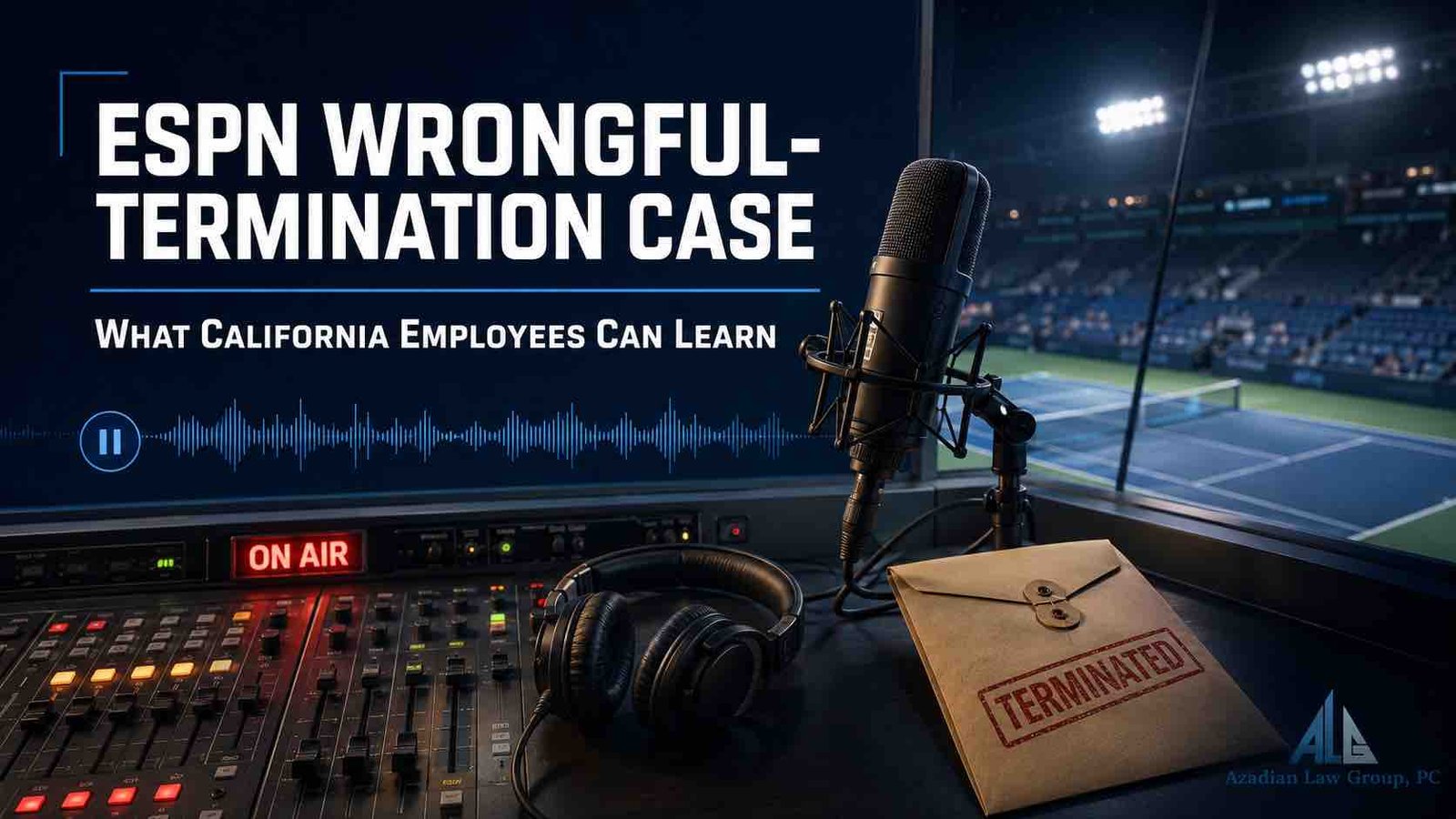
One word during a live broadcast triggered public outrage, ended a veteran commentator’s assignment, and led to a wrongful-termination lawsuit against one of the world’s best-known sports networks. The dispute involving tennis commentator Doug Adler and ESPN remains a useful lesson for California employees whose careers are placed at risk by an accusation, a viral post, or pressure on an employer to act immediately.
The story is not proof that every controversial firing is illegal. California employers may have broad authority to discipline employees for workplace conduct, public statements, or reputational concerns. A legally actionable termination generally requires something more, such as a contractual violation, discrimination, retaliation, or a discharge that violates a fundamental public policy.
The Adler case also has an important ending missing from many early reports: the parties later settled their dispute. No trial verdict established that ESPN unlawfully terminated Adler. That distinction matters whenever a pending accusation is transformed into an evergreen legal article.
What Happened Between Doug Adler and ESPN?
Doug Adler was a former professional tennis player and an experienced tennis commentator. During ESPN’s coverage of a January 2017 Australian Open match between Venus Williams and Stefanie Voegele, Adler used a phrase while describing Williams’ aggressive movement toward the net.
Some listeners understood Adler to have used the word “gorilla,” creating immediate criticism because Williams is Black. Adler maintained that he said “guerrilla,” referring to an aggressive style or tactic. The two words sound alike, and the controversy rapidly expanded through social media.
ESPN removed Adler from his remaining Australian Open assignments. According to an ESPN statement reported by the Associated Press, the network said he should have been more careful in his word selection and had apologized. Adler later filed a lawsuit in Los Angeles Superior Court.
The lawsuit alleged that Adler had been wrongfully terminated, unfairly branded as racist, and deprived of future broadcasting opportunities. Those were allegations, not judicial findings. ESPN did not publicly concede that the termination was unlawful.
What Did Doug Adler Allege in His Lawsuit?
Public reporting and the filed complaint described several legal theories, including:
- Wrongful termination of employment.
- Breach of the implied covenant of good faith and fair dealing.
- Intentional interference with prospective economic relations.
- Intentional infliction of emotional distress.
- Negligent infliction of emotional distress.
Adler maintained that “guerrilla” was a recognized term used to describe aggressive tennis tactics. His complaint reportedly pointed to prior uses of similar language in tennis, including a well-known advertising campaign.
He also alleged that the public controversy harmed his professional reputation and caused him to lose other broadcasting opportunities. In a specialized career built on credibility and public trust, reputational damage can affect earnings beyond the loss of one assignment.
It is important to describe these statements accurately. Filing a complaint begins a case; it does not prove the allegations. A defendant may dispute liability, causation, damages, employment status, contractual obligations, and the meaning of the events.
How Did the ESPN Wrongful-Termination Case End?
The dispute did not end with a public trial verdict. In February 2019, media reports stated that Adler and ESPN had amicably resolved the case. Media reports did not disclose the financial terms of the resolution.
The Los Angeles Times reported that ESPN confirmed the dispute had been amicably resolved and expressed an intention to hire Adler for future tennis events. Other outlets reported that the resolution included a monetary component, but the complete settlement terms were private.
Because the case settled, the resolution did not create a court ruling establishing that ESPN violated California wrongful-termination law. It also did not produce a public defense verdict clearing every disputed decision. Settlement closes a dispute without necessarily resolving each factual or legal question through adjudication.
Why Does This Case Still Matter to California Employees?
The facts illustrate a modern employment problem: an employer may face intense public pressure before it has time to conduct a careful investigation. Social media can turn an ambiguous statement into a global controversy within hours. The employer may believe immediate action is necessary to protect its workforce, audience, clients, or reputation.
That pressure does not automatically make a termination unlawful. It also does not erase contracts, anti-discrimination laws, retaliation protections, or an employer’s obligation to act consistently with enforceable promises.
The practical questions include:
- What did the employee actually say or do?
- What evidence did the employer review?
- Did the employer allow the employee to respond?
- Was the decision governed by a written contract?
- Did the employer follow the termination provisions in that contract?
- Were similar incidents treated consistently?
- Did discrimination, retaliation, or another prohibited reason influence the decision?
- Did the employer communicate anything false that independently harmed the employee’s career?
The answers determine whether a controversial firing is merely harsh, contractually improper, defamatory, discriminatory, retaliatory, or otherwise actionable.
Is Firing Someone Because of Social-Media Pressure Illegal?
Not necessarily. Private employers generally have substantial discretion to respond to conduct they believe damages the organization’s reputation or conflicts with workplace standards. California’s at-will rule often permits termination for a reason that is unfair, mistaken, or unpopular, provided the reason is not prohibited by law and no enforceable agreement limits the employer’s discretion.
Public pressure can still be relevant evidence. It may show why the employer acted quickly, what information decision-makers considered, and whether the company performed a genuine investigation. But speed, unfairness, or online criticism alone does not automatically create a wrongful-termination claim.
A stronger legal issue may exist when:
- The employer violated a written or implied employment agreement.
- The controversy was used as a pretext for discrimination.
- The employee was treated differently because of a protected characteristic.
- The employee’s statement involved legally protected activity.
- The employer retaliated against the employee for reporting suspected unlawful conduct.
- The employer made separate false factual statements that damaged the employee’s professional reputation.
- The employer selectively enforced a policy against one employee while protecting comparable employees.
For the broader legal framework, review what constitutes wrongful termination in California.
At-Will Employment Does Not Answer Every Question
California Labor Code section 2922 creates a general presumption of at-will employment when the parties have not specified a term. In broad terms, either party may ordinarily end an at-will relationship without proving good cause.
That rule has important limits. An employer cannot lawfully fire someone because of a protected characteristic, in retaliation for protected activity, in violation of an enforceable contract, or for a reason that contravenes a fundamental public policy.
The employee’s status also matters. A broadcaster, executive, athlete, physician, salesperson, or other professional may work under a negotiated agreement that defines the term, renewal rights, compensation, grounds for termination, notice requirements, dispute process, and post-termination obligations.
Before assuming that “at will” ends the discussion, examine:
- The signed employment agreement.
- Offer letters and amendments.
- Compensation and bonus agreements.
- Union or collective-bargaining provisions.
- Termination-for-cause language.
- Notice and cure provisions.
- Morals clauses or conduct policies.
- Arbitration and choice-of-law terms.
- Renewal and nonrenewal provisions.
Our related guide explains how California at-will employment affects wrongful-termination claims.
Why the Employment Contract May Be Central
In many high-profile professions, the most important issue is not whether the employer had a good public-relations reason to act. It is whether the agreement permitted that action.
A contract may allow termination only for defined cause. It may require written notice, an investigation, an opportunity to cure, or payment through the end of the term. Another contract may grant the company broad discretion when conduct brings the organization into public disrepute.
The exact wording matters. A court or arbitrator may need to determine:
- Whether the alleged conduct fell within the contractual definition of cause.
- Whether the employer followed required procedures.
- Whether the employer acted in good faith.
- Whether a morals clause was sufficiently broad and enforceable.
- Whether the worker was an employee or independent contractor.
- What compensation remained due after termination.
- Whether reputational harm affected other contractual relationships.
Employees should preserve the complete signed agreement and every amendment. A partial screenshot or unsigned draft may omit the clause that controls the dispute. Read more about employment contracts in wrongful-termination cases.
Does an Employer Have to Conduct a Fair Investigation?
California law does not impose one universal investigation procedure on every private employer before every at-will termination. A company can sometimes make a mistaken decision without creating a viable wrongful-termination claim.
Still, the quality of an investigation may become important evidence. An employer that interviews witnesses, preserves recordings, reviews context, applies policy consistently, and gives the employee an opportunity to respond may be better positioned to show a good-faith decision.
An investigation may appear less credible when the employer:
- Decides the outcome before interviewing the employee.
- Ignores readily available recordings or documents.
- Relies entirely on viral commentary from people without firsthand knowledge.
- Changes its explanation after the employee challenges the decision.
- Applies standards differently to comparable employees.
- Allows a biased decision-maker to control the process.
- Creates supporting documents after the termination.
A weak investigation does not independently prove discrimination or retaliation. It can, however, support an argument that the stated explanation is unworthy of belief when combined with other evidence of an unlawful motive.
When Can a False Accusation Support a Legal Claim?
Being falsely accused is not automatically wrongful termination. An employer may rely on incorrect information or reach a bad conclusion without violating a specific law.
A false accusation becomes more significant when it is connected to another legal theory. Examples include:
- The accusation appeared only after the employee reported harassment or illegal conduct.
- Comparable employees were not investigated or disciplined for similar allegations.
- A decision-maker fabricated evidence to hide discrimination.
- The employer knowingly communicated a false factual claim to third parties.
- The allegation was used to avoid contractual termination protections.
- The employer’s explanation changed as contradictory evidence emerged.
Employees facing this problem can review whether they may have a claim after being fired because of false accusations.
Could Discrimination or Retaliation Be Hidden Behind a Controversy?
Yes, depending on the evidence. A public controversy can be a genuine reason for discipline, or it can provide cover for a decision motivated by discrimination or retaliation.
California’s Fair Employment and Housing Act generally prohibits covered employers from making termination decisions because of protected characteristics and from retaliating against qualifying protected activity. Government Code section 12940 contains major employment protections, while the California Civil Rights Department provides public guidance on employment discrimination.
Potential signs of pretext include:
- Protected activity shortly before the controversy.
- Discriminatory comments by a decision-maker.
- Different consequences for employees outside the protected group.
- Positive performance history followed by sudden criticism.
- An employer exaggerating conduct it previously tolerated.
- A termination decision made before the investigation began.
- Inconsistent accounts of who made the decision and why.
The practical checklist in How Do I Know If I Was Wrongfully Terminated? explains how to organize these facts into a coherent timeline.
What If the Employee Has a Disability?
A separate issue may arise when the employee has a qualifying physical or mental disability. California law may require a covered employer to avoid disability discrimination, provide reasonable accommodation absent undue hardship, and participate in a timely, good-faith interactive process.
Federal law also prohibits covered employers from making employment decisions because of disability when the employee is qualified to perform the essential functions of the job with or without reasonable accommodation. The Equal Employment Opportunity Commission’s disability guidance explains that disability cannot lawfully be the reason for an adverse decision when the applicable requirements are met.
Protection does not excuse unrelated misconduct or eliminate essential job requirements. The analysis may depend on whether the employer knew about the disability, whether an accommodation was requested or apparent, whether the conduct was disability-related, and whether accommodation would have been reasonable.
The Adler dispute was not publicly resolved through a disability-discrimination verdict. Any discussion of disability law should therefore be treated as a broader California employment-law lesson, not as a finding about ESPN’s liability in that case.
What Evidence Matters After a High-Profile Firing?
Public controversies generate enormous volumes of commentary but often leave the central employment evidence scattered. Employees should preserve records they already possess lawfully and organize them by date.
Potentially useful evidence includes:
- The complete employment or independent-contractor agreement.
- Audio, video, or transcripts of the disputed statement when lawfully available.
- Communications showing how the employer initially understood the event.
- Requests for an explanation and the employer’s responses.
- Policies governing public statements, conduct, discipline, and investigations.
- Earlier performance reviews and renewal communications.
- Comparable incidents involving other workers.
- Internal complaints or protected activity preceding the controversy.
- Termination notices and severance proposals.
- Lost assignments, rejected applications, and other mitigation records.
- Accurate copies of public statements made by the employer.
- A private chronology identifying witnesses and decision-makers.
Do not access restricted systems after termination or take trade secrets, privileged communications, or confidential records you are not entitled to retain. The guide to evidence of wrongful termination in California explains how ordinary workplace records can reveal timing, knowledge, comparators, and pretext.
Can Reputational Damage Be Part of the Case?
Reputational harm may be economically devastating for people who work in broadcasting, entertainment, medicine, law, finance, technology, or other reputation-dependent fields. One public accusation can affect future assignments, referrals, licensing, and professional relationships.
That does not mean every loss is legally recoverable. The employee must connect the harm to a recognized claim and prove causation and damages. Relevant questions may include:
- What exactly did the employer communicate?
- Was the statement fact or opinion?
- Was it true, substantially true, privileged, or disputed?
- Who received it?
- Did a prospective employer rely on it?
- Can lost opportunities be documented rather than assumed?
- Does the employment agreement limit or define public communications?
Wrongful termination, breach of contract, interference, and defamation are distinct legal theories with different elements and defenses. Harmful publicity does not automatically satisfy all of them.
What Should an Employee Do When a Workplace Incident Goes Viral?
An emotional response can make a difficult situation worse. Employees should slow the process down where possible and protect the record.
- Preserve the complete recording or context lawfully, not only a short viral clip.
- Write a private chronology while events are fresh.
- Keep employment agreements, policies, evaluations, and relevant communications.
- Respond factually and avoid speculation.
- Do not delete or alter relevant evidence.
- Avoid attacking coworkers, customers, reporters, or the employer online.
- Do not disclose confidential or privileged company information.
- Ask for the employer’s concerns and decision in writing when appropriate.
- Review any apology, resignation, release, or severance document before signing.
- Seek timely legal advice about contracts, claims, and deadlines.
Public silence is not an admission. In many cases, a careful factual record is more useful than a rapid online defense.
Does a Settlement Mean the Employee Won?
Not necessarily. A settlement means the parties agreed to resolve the dispute. It may reflect litigation risk, legal expense, privacy, business priorities, reputational concerns, evidentiary uncertainty, or a combination of factors.
A settlement generally does not establish liability unless the agreement expressly includes an admission, which many agreements do not. It also does not mean the employee’s allegations lacked merit. The safest description is factual: identify what was alleged, what the defendant publicly said, and how the dispute ended.
In Adler’s case, public reporting stated that the dispute was amicably resolved. The private terms should not be presented as known facts unless supported by an authoritative public record.
What Can California Employees Learn From the Adler Case?
The lasting lesson is not that employers can never act under public pressure. It is that a viral controversy does not replace legal analysis.
Employees and counsel still need to examine:
- Employment status and governing contracts.
- The complete context of the disputed conduct.
- The employer’s investigation and stated reason.
- Consistency with the treatment of comparable employees.
- Possible discrimination or retaliation.
- Public statements and resulting professional harm.
- Evidence of lost compensation and opportunities.
- Applicable contractual and statutory deadlines.
Online outrage moves fast. Employment law moves through evidence, contracts, statutes, credibility, and procedure. Those are very different systems, and confusing them can distort both the employer’s decision and the employee’s response.
Can My Employer Fire Me for Something I Said?
Sometimes. A private employer may have broad authority to discipline speech that violates policy, reveals confidential information, threatens others, disrupts operations, or harms legitimate business interests. Protection may exist when the speech involves discrimination complaints, whistleblowing, wage discussions, concerted activity, political activity protected by state law, or another legally protected subject.
The location, audience, content, policy, contract, and connection to the job all matter. The First Amendment generally restricts government action; it does not automatically prevent a private employer from responding to employee speech.
Can an Employer Fire Me Because Customers Complain?
An employer may often consider customer or audience complaints. However, customer preference does not excuse unlawful discrimination. Complaints may also be unreliable, biased, incomplete, or based on protected characteristics. The employer’s response should be evaluated together with applicable contracts, policies, comparator evidence, and anti-discrimination law.
Is a Bad Investigation Enough for a Wrongful-Termination Lawsuit?
Usually not by itself. A careless investigation may show unfairness or poor management without establishing an unlawful reason. It becomes more important when it supports an inference that the employer’s explanation was pretext for discrimination, retaliation, or a contractual violation.
Can an Independent Contractor Sue for Wrongful Termination?
The answer depends on classification, contract language, and the legal claim. Some statutory protections apply specifically to employees, while contract and business-tort claims may apply differently. A worker labeled an independent contractor may also contend that the classification does not reflect the actual relationship. This analysis requires the complete agreement and working facts.
How Long Do I Have to Challenge a Termination?
There is no single deadline covering every dispute. Contract claims, discrimination claims, retaliation claims, defamation claims, government claims, and arbitration demands may follow different limitation periods and prefiling procedures. Some deadlines can be surprisingly short. Obtain advice based on the specific claim and termination date rather than relying on a general article.
Speak With a California Wrongful Termination Attorney
If you lost your job after a viral accusation, public controversy, internal complaint, accommodation request, protected leave, or workplace investigation, the public explanation may reveal only part of the story. The employment agreement, investigation record, decision timeline, comparator evidence, and employer communications can be critical.
Azadian Law Group, PC represents employees in Los Angeles and throughout California in wrongful-termination, retaliation, discrimination, whistleblower, and employment-contract disputes.
Contact Azadian Law Group or call 213-229-9031 to request a confidential case evaluation.
This article provides general information and is not legal advice. Allegations described from a lawsuit are not findings of liability. Laws, procedural rules, and deadlines can change, and every matter depends on its specific facts. Prior results and settlements do not guarantee a similar outcome.


Related Blog Posts
Losing a job is difficult enough. Receiving an invoice afterward for a signing bonus, training program, or recruiting payment can...
Read MoreYour Los Angeles employer announces a return-to-office deadline. You explain that a medical condition makes the new schedule difficult and...
Read MoreWrongful Termination Evidence Often Appears as a Pattern Wrongful termination evidence is rarely found in one dramatic email admitting that...
Read MoreTypes of Cases Handle By Employment Lawyers in Los Angeles, CA
The following presents an overview of the broad range of employment law cases that our employment attorneys are experienced at overseeing and favorably resolving.
Wrongful Termination
Wrongful Termination Lawyers in Los Angeles, CA Attorneys at Azadian Law Group who have filed wrongful termination lawsuits acknowledge that unfair termination can significantly impact an employee’s life. It can…
Age Discrimination
Age Discrimination Lawyers in Los Angeles, CA Azadian Law Group, PC regularly represents clients throughout Los Angeles, CA, who are the victims of age discrimination in the workplace. At Azadian…
Pregnancy Discrimination
Pregnancy Discrimination Lawyer in Los Angeles, CA At Azadian Law Group, PC, our pregnancy discrimination lawyer in Los Angeles, regularly represents clients who are the victims of pregnancy discrimination in…
Sexual Harassment
Sexual Harassment Attorney in Los Angeles, CA The Los Angeles Sexual Harassment Lawyers at Azadian Law Group, PC, know that in today’s modern era, some people often make the mistake of…
Racial Discrimination
Racial Discrimination Lawyers in Los Angeles, CA Azadian Law Group, PC regularly represents clients throughout Los Angeles who are the victims of racial discrimination at work. The Los Angeles Race…
Disability Discrimination
When a Medical Condition Becomes a Workplace Problem, You Have Rights Most employees never expect a health condition to place their career at risk. Yet every day across Los Angeles,…
Praise from Our Clients
Lui H

Arpi Agdere
Tofi
Aracelis Feria
Ivy Gamboa
Jillian Dunlap
Greg Wayne
Elizabeth Eromosele
Steve G
Lisa Galvan
Artur Aleksanyan
Delight Dinopoulos
George Margaros
Chelsea Pham
Trevor Pal-Freeman
Patricio Garza
Taylor
Ashley Londerman
Marissa Zapanta
Nuria Coronado
Barbara Villalobos
Irene Golub
Joshua Butler
J Mo
Employees We Represent in Employment Law Cases
At Azadian Law Group, we represent employees throughout Los Angeles and California who have experienced workplace violations. Our attorneys handle employment law matters including wrongful termination, workplace discrimination, retaliation, harassment, wage and hour violations, and whistleblower protection.
Employees often face unlawful treatment after reporting misconduct, requesting medical leave, or asserting their legal rights at work. Our firm investigates employment law violations and advocates for workers seeking accountability, compensation, and fair treatment under California and federal employment law.

Step 1
Explore our comprehensive range of legal services to find the specialized support you need.
Step 2
Arrange a free initial meeting with our experts to discuss your legal situation.
Step 3
Receive a custom strategy specially created for your case by our legal experts.
Call Us Now 213-229-9031
Tell Us Your Story
Speak out for justice. Your story can be the start of a new chapter of workplace fairness.
