Dress Code or Discrimination? What AB 2563 Means for Pasadena Workers
Your manager says your work is good, but you need to look “more feminine” before meeting clients. Or you’re told that your clothes aren’t “what people expect” from someone in your role. Then the client meetings stop, your shifts change, or a promotion goes to someone else.
It’s reasonable to wonder whether this is dress code discrimination or a workplace rule your employer can enforce. California protects employees from discrimination tied to sex, gender identity, and gender expression. A rule about appearance needs to be considered alongside what the employer said, how it treated other workers, and what happened to your job.
A new California law, AB 2563, makes this a timely question. For employees considering a conversation with a Pasadena discrimination lawyer, the useful starting point is the actual workplace decision—not whether HR used the word “discrimination.”
What does AB 2563 clarify about sex discrimination?
Governor Newsom approved AB 2563 on September 30, 2026. The law establishes consistent language across California codes about sex discrimination, including treatment based on how closely someone conforms to sex or gender stereotypes. It also addresses gender identity, gender expression, sexual orientation, pregnancy, and other specified characteristics.
One detail deserves attention: the Legislature expressly describes the bill as a clarification of existing law, not an expansion or contraction of existing rights and responsibilities. Employees shouldn’t read the headlines as meaning they had no protection before this legislation.
For a workplace dispute, the question remains concrete. Did an employer judge your ability to do the job, or did expectations about how a person of your sex or gender should look or behave influence the decision? Our page on gender discrimination in Pasadena explains related employment concerns.
Can an employer still have a dress code?
Yes. AB 2563 doesn’t turn every disagreement about clothes into a lawsuit. Uniforms, protective equipment, hygiene requirements, and other legitimate workplace rules can serve real business needs.
But calling something a dress code doesn’t end the inquiry. The California Civil Rights Department’s workplace guidance explains that employers must enforce dress requirements without discrimination and allow employees to dress consistently with their gender identity and expression. Business necessity and the way a rule operates matter.
Compare a requirement to wear protective shoes around equipment with an instruction to change your appearance because a manager thinks women should look a certain way. Those explanations raise different questions. So does a policy that appears neutral on paper but is enforced against only one employee.
When “professionalism” deserves a closer look
Words such as “professional,” “polished,” and “client-ready” aren’t automatically discriminatory. They can describe genuine expectations. Problems arise when those words conceal a standard tied to protected characteristics instead of the work.
Consider these hypothetical examples, which are illustrations rather than reports of actual cases:
- A promotion discussion changes direction. A supervisor praises an employee’s results but says she needs to be less assertive and more ladylike to lead the team.
- A uniform rule becomes selective. Employees wear comparable clothing, but only a worker whose appearance challenges gender expectations receives warnings.
- A client preference becomes an employment decision. A manager removes someone from an assignment after comments about the employee’s gender expression.
Each example needs context. What were the job requirements? Who made the decision? Were there earlier concerns? What explanation did the company give, and does it match the records? A troubling comment can be important evidence without proving the entire claim by itself.
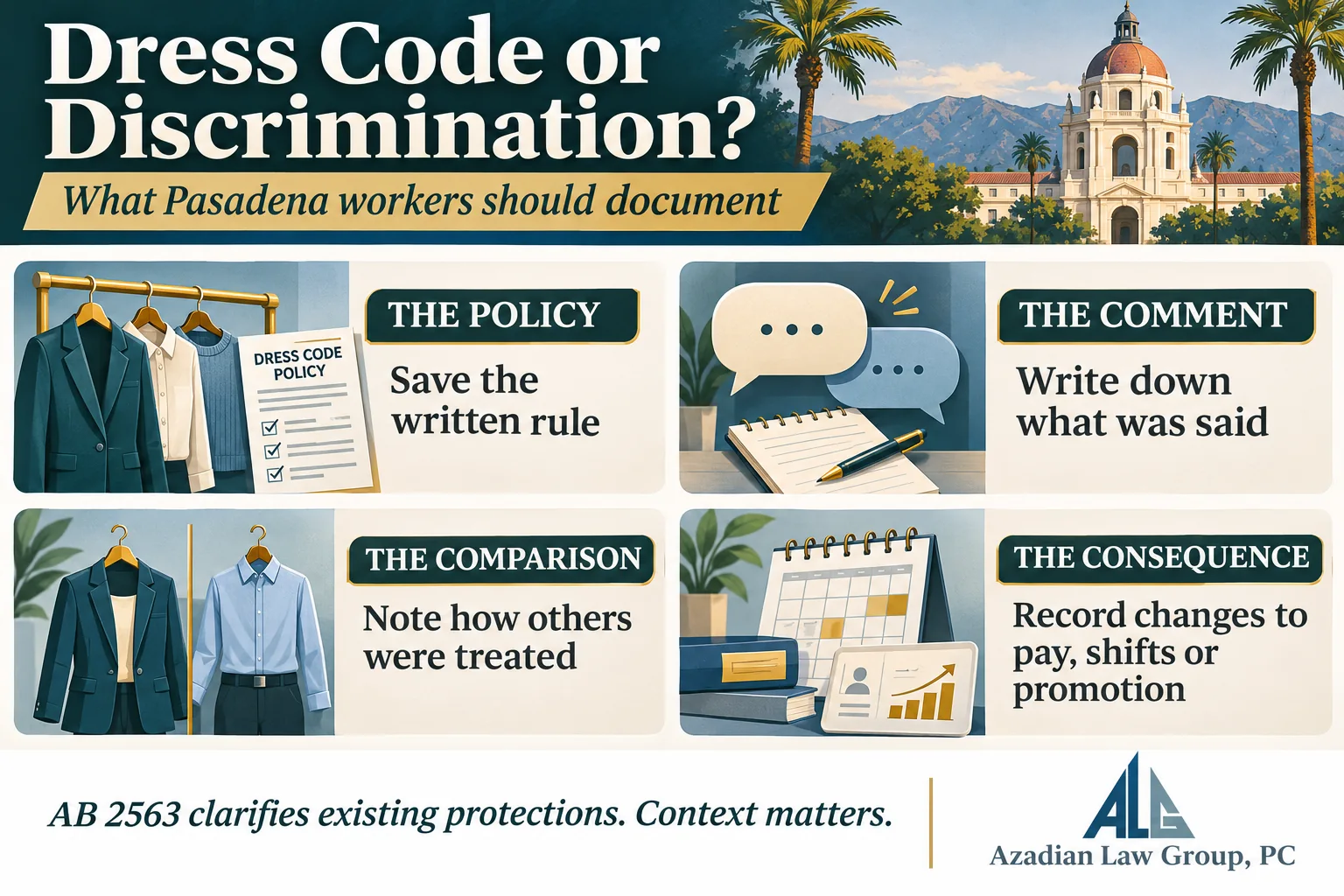
What should you document if you suspect dress code discrimination?
Try to preserve the details while they’re fresh. A short, accurate account is more useful than a long account built from guesses.
- Save the rule. Keep the dress policy, handbook section, or written instruction you’re allowed to retain. Note whether the employer changed it.
- Record the conversation. Write down the date, people present, and words you remember. Mark anything you’re paraphrasing rather than presenting it as an exact quote.
- Identify a fair comparison. Note workers with similar duties, supervisors, and circumstances. Explain what was similar and what was different.
- Keep the employment records. Reviews, schedules, pay records, warnings, and promotion messages may show what changed.
- Track your complaint and the response. Keep a copy of what you reported, who received it, and what the employer did afterward.
You don’t need to secretly record a conversation or take confidential files to create a useful timeline. Preserve lawful copies of your own records. If relevant material is in a work account you can no longer access, tell your attorney what exists and where it was kept.
Discrimination, harassment, and retaliation are different questions
An appearance-related dispute may involve a denied promotion or reduced hours. Repeated insults may raise a separate harassment issue. A negative response to a protected complaint can raise retaliation concerns.
California’s employment discrimination guidance explains that FEHA’s discrimination protections generally cover employers with five or more employees, while its harassment protections reach smaller workplaces too. Coverage, exceptions, and the conduct involved still need review.
If comments have become a regular part of the workday, read about hostile work environment concerns. If you lost your job, the related Pasadena wrongful termination analysis asks why the employer actually ended your employment. Timing matters, but timing alone doesn’t establish an unlawful motive.
Questions Pasadena employees often ask
Do I have to be fired before I can raise a concern?
No. Discrimination can affect assignments, compensation, advancement, or other employment decisions. Write down the specific change instead of waiting for a termination to make the situation feel serious enough.
What if the comment was made only once?
The speaker, context, and connection to an employment decision matter. A single remark is not automatically a complete claim, but it may help explain a later decision. Preserve it accurately rather than dismissing it or overstating it.
Should I wait for HR to finish investigating?
You can cooperate with an investigation and seek advice about your rights at the same time. Don’t assume an internal complaint pauses a legal filing deadline. The deadline depends on the claim and circumstances.
What should I bring to a consultation?
Bring the policy, a timeline, relevant messages, and records showing the effect on your job. Include facts that support the employer’s explanation too. An honest picture makes it easier to evaluate your options.
Get advice about the decision behind the comment
You don’t have to arrive with a legal label for what happened. Explain the rule, what was said, and what changed at work. Azadian Law Group represents employees in workplace disputes and can review those facts with you. You can request a consultation to discuss your situation.
Information checked November 16, 2026. This article provides general information, not legal advice about a particular workplace dispute.


Related Blog Posts
Artificial intelligence is no longer limited to answering questions, writing emails, or helping companies automate repetitive work. Today, AI is...
Read MoreWhen a California jury steps up and delivers a $103 million age discrimination verdict, the whole employment law world stops...
Read MoreIn the last 48 hours, Los Angeles has found itself at the center of a storm—again. Following a series of...
Read MoreTypes of Employment Cases We Handle.
The following presents an overview of the broad range of employment law cases that our employment attorneys are experienced at overseeing and favorably resolving.
Wrongful Termination
Wrongful Termination Lawyers in Los Angeles, CA Attorneys at Azadian Law Group who have filed wrongful termination lawsuits acknowledge that unfair termination can significantly impact an employee’s life. It can…
Age Discrimination
Age Discrimination Lawyers in Los Angeles, CA Azadian Law Group, PC regularly represents clients throughout Los Angeles, CA, who are the victims of age discrimination in the workplace. At Azadian…
Pregnancy Discrimination
Pregnancy Discrimination Lawyer in Los Angeles, CA At Azadian Law Group, PC, our pregnancy discrimination lawyer in Los Angeles, regularly represents clients who are the victims of pregnancy discrimination in…
Sexual Harassment
Sexual Harassment Attorney in Los Angeles, CA The Los Angeles Sexual Harassment Lawyers at Azadian Law Group, PC, know that in today’s modern era, some people often make the mistake of…
Racial Discrimination
Racial Discrimination Lawyers in Los Angeles, CA Azadian Law Group, PC regularly represents clients throughout Los Angeles who are the victims of racial discrimination at work. The Los Angeles Race…
Disability Discrimination
When a Medical Condition Becomes a Workplace Problem, You Have Rights Most employees never expect a health condition to place their career at risk. Yet every day across Los Angeles,…
Praise from Our Clients
A“

QT
RT
KM
BM
HM
bS
kj
SM
TM
FL
kr
TP
CF
WW
JA
RM
RC
VM
JS
TH
SD
RM
AC
W
kn
AO
DN
KW
TP
RS
L
D
la
JG
DP
RK
HL
TP
sr
sl
PD
SS
SS
JB
JA
AR
CG
LH
YU
MS
TA
NS
aa
RC
AR
mp
IG
N
JJ
Kd
GA
aa
GB
RT
MM
PP
PA
DV
T
AW
CW
SM
TC
SC
hh
KK
DB
S
SM
VV
K&
PG
JL
SS
AC
MS
DS
DM
ZM
CA
AF
GC
jg
GN
AG
A
KG
EC
s
MZ
m
LD
PW
PD
CH
TA
KM
PZ
CA
rc
FA
JA
MJ
SM
kr
LH
BJ
DG
JJ
ES
WW
VS
TH
VB
GA
DM
LS
SM
AS
wm
MH
DA
TP
LA
DR
MM
D
RG
WR
Employees We Represent in Employment Law Cases
At Azadian Law Group, we represent employees throughout Los Angeles and California who have experienced workplace violations. Our attorneys handle employment law matters including wrongful termination, workplace discrimination, retaliation, harassment, wage and hour violations, and whistleblower protection.
Employees often face unlawful treatment after reporting misconduct, requesting medical leave, or asserting their legal rights at work. Our firm investigates employment law violations and advocates for workers seeking accountability, compensation, and fair treatment under California and federal employment law.

Step 1
Explore our comprehensive range of legal services to find the specialized support you need.
Step 2
Arrange a free initial meeting with our experts to discuss your legal situation.
Step 3
Receive a custom strategy specially created for your case by our legal experts.
Call Us Now 213-229-9031
Tell Us Your Story
Speak out for justice. Your story can be the start of a new chapter of workplace fairness.
