Laid Off Because of AI? What SB 951 Means for Pasadena Workers
The meeting lasts ten minutes. Your position is being eliminated, HR says, because new software can handle the work. A severance agreement arrives before you’ve had time to think about your last paycheck.
If that sounds familiar, an AI layoff notice may leave you with two immediate questions: can the company do this, and what should you check before signing anything?
An AI-related layoff isn’t automatically unlawful. California’s SB 951 adds information requirements to certain covered layoff notices when AI or other automation substantially causes job displacement. Separate rules may also protect your wages, benefits, and right to be free from discrimination or retaliation.
For Pasadena workers, the first step is to separate those issues. A Pasadena employment lawyer can review the notice, the reason for the layoff, and any proposed release together.
What is California’s new AI layoff notice law?
Governor Newsom signed SB 951 on September 30, 2026, as part of California’s workplace technology legislation. The Governor’s signing announcement identifies it as the technological displacement notice law.
The law’s notice changes take effect January 1, 2027. They build on California’s Worker Adjustment and Retraining Notification Act, usually called Cal-WARN. They don’t create a notice entitlement for every individual whose work involves AI.
Under the chaptered SB 951 text, the additional disclosures apply when an employer must give a covered mass-layoff, relocation, or termination notice and AI or other automated technology causes the event in whole or substantial part by replacing or automating positions.
The dates matter. If you’re reviewing a November 2026 layoff, don’t assume a requirement taking effect in 2027 governed the earlier notice. Existing Cal-WARN requirements and other employment protections still deserve attention.
Does every Pasadena layoff require 60 days’ notice?
No. Cal-WARN has coverage rules and exceptions. The Employment Development Department’s WARN guidance is a useful starting point for the state and federal frameworks.
Under the California definitions, a covered establishment generally is an industrial or commercial facility, or part of one, that employs or employed at least 75 people during the preceding 12 months. A mass layoff generally involves at least 50 employees at a covered establishment within 30 days. The statute also defines which employees count and separately addresses relocations and the cessation of operations.
Those details make a difference. A company-wide headcount alone may not resolve establishment coverage. A single dismissal is not automatically a Cal-WARN “termination,” which refers to the cessation or substantial cessation of operations at a covered establishment. And the state and federal laws don’t use identical tests.
For that reason, give counsel the work location, approximate headcounts, separation dates, and any announcements about other affected teams. It’s fine if you don’t know every answer. Don’t fill in missing numbers with guesses.
What should a covered technology-displacement notice explain?
SB 951 requires additional details beyond a vague statement that the business is becoming more efficient. For covered events, the notice must identify:
- The number of affected layoffs substantially attributable to AI or automation, along with job classifications or occupations and work locations.
- The functions performed by displaced workers that technology will automate.
- The category or type of technology substantially responsible for the displacement.
The notice must also carry a technology-displacement statement at the top. That makes the explanation easier to identify, but the label alone doesn’t tell you whether the employer met every requirement.
Compare the notice with what your team was told. Did the company describe an automated customer-support rollout, a scheduling system, or a tool taking over particular administrative tasks? Keep the actual messages. You don’t need to prove how the software works before asking whether the stated reason matches the documents.
Replacing a role with AI is different from using AI to choose who leaves
These situations often get mixed together. In one, technology replaces job functions. In another, the employer uses a scoring system to decide which employees to dismiss. A workplace can involve both.
This article focuses on displacement notices. Our separate explanation of California’s No Robo Bosses Act discusses automated employment decisions and human review.
The distinction also matters when evaluating a discrimination concern. If a selection score penalized protected medical leave, for example, the fact that a computer generated the score wouldn’t answer the underlying employment-law question. The inputs, criteria, and actual decisions would need review. Our Pasadena discrimination page covers related issues.
Five things to check before signing a severance agreement
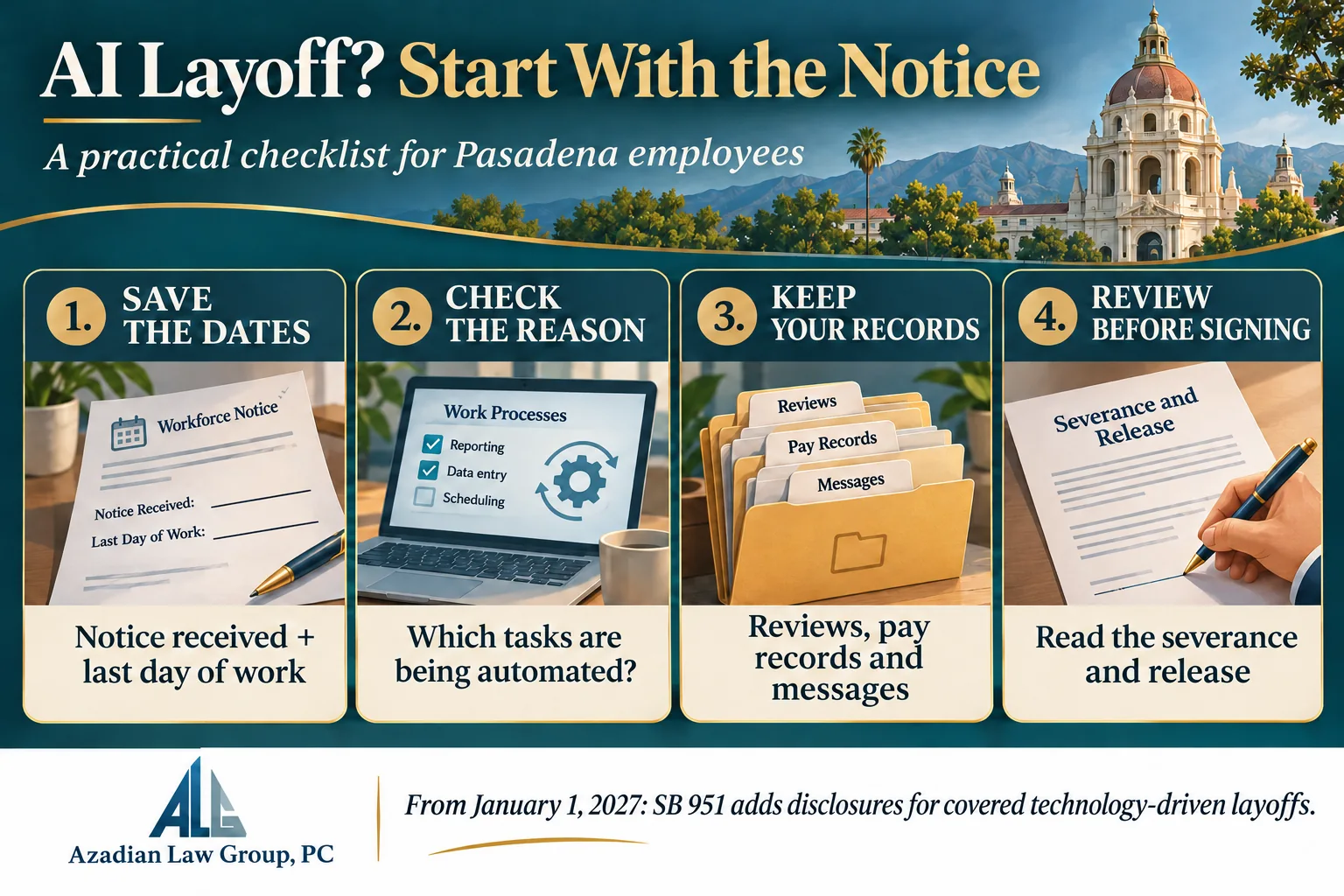
- The timeline. Save the date you received notice, your last working day, your employment end date, and any payment schedule. These dates may differ.
- The explanation. Keep the notice and company announcements. Note whether HR changed the reason from performance to restructuring or automation.
- The money. Separate wages already earned from additional severance. Ask for a written breakdown of what each payment covers.
- The release. Identify which claims the agreement asks you to waive and any confidentiality, repayment, or other continuing obligations.
- The response deadline. Keep the full agreement and accompanying email. Ask about the time available for review rather than assuming every agreement follows the same schedule.
A severance offer doesn’t, by itself, establish that the employer complied with notice requirements or resolve every potential claim. A Pasadena severance negotiation lawyer can help assess the proposed terms alongside the circumstances of your departure.
Build a useful record without taking company files
Start with documents you can lawfully keep: your notice, agreement, pay records, reviews, and messages sent to you. Add a simple timeline of complaints, leave requests, accommodation discussions, or discipline that may be relevant.
Don’t download customer data, coworkers’ personnel records, or confidential technical material to investigate the AI system. If something important remains in a company account, describe it to your lawyer. The goal is to preserve evidence without creating a separate dispute.
If you believe the layoff explanation concealed retaliation or another unlawful reason, our guide to wrongful termination in Pasadena explains why the surrounding sequence can matter.
Questions about AI layoffs in Pasadena
Does SB 951 prohibit employers from replacing jobs with technology?
No. Its displacement-notice provisions require information for covered events. Whether a particular layoff violates another law is a separate question.
What if only a few people lost their jobs?
The Cal-WARN mass-layoff threshold may not be met, but that doesn’t dispose of other employment issues. Wages, contracts, protected leave, discrimination, and retaliation require their own analysis.
Does a missing notice guarantee compensation?
No. Coverage, exceptions, dates, the content of any notice, and available remedies must be evaluated. A short or incomplete notice is a reason to investigate, not a promise of recovery.
What if I already signed the agreement?
Keep a complete copy and seek advice about its terms and any applicable deadlines. Don’t assume all rights disappeared, or that every waiver is ineffective. The wording and circumstances matter.
Have the notice and agreement reviewed together
You shouldn’t have to work out the legal meaning of an automation announcement while trying to replace your income. Bring the documents and a straightforward account of what happened. Azadian Law Group can review your workplace concerns and explain potential next steps. Contact the firm to discuss your situation.
Information checked November 16, 2026. This article provides general information, not legal advice. SB 951’s new notice requirements take effect January 1, 2027.


Related Blog Posts
While you’re deciding on an attorney for your wrongful termination or employment discrimination lawsuit, here are 5 questions you should...
Read MoreMost employment in California functions under the terms of at-will employment law. The at-will employment law aims to ensure employees...
Read MoreTo file an EEOC complaint in California, an employee generally begins through the EEOC Public Portal, completes an inquiry and...
Read MoreTypes of Employment Cases We Handle.
The following presents an overview of the broad range of employment law cases that our employment attorneys are experienced at overseeing and favorably resolving.
Wrongful Termination
Wrongful Termination Lawyers in Los Angeles, CA Attorneys at Azadian Law Group who have filed wrongful termination lawsuits acknowledge that unfair termination can significantly impact an employee’s life. It can…
Age Discrimination
Age Discrimination Lawyers in Los Angeles, CA Azadian Law Group, PC regularly represents clients throughout Los Angeles, CA, who are the victims of age discrimination in the workplace. At Azadian…
Pregnancy Discrimination
Pregnancy Discrimination Lawyer in Los Angeles, CA At Azadian Law Group, PC, our pregnancy discrimination lawyer in Los Angeles, regularly represents clients who are the victims of pregnancy discrimination in…
Sexual Harassment
Sexual Harassment Attorney in Los Angeles, CA The Los Angeles Sexual Harassment Lawyers at Azadian Law Group, PC, know that in today’s modern era, some people often make the mistake of…
Racial Discrimination
Racial Discrimination Lawyers in Los Angeles, CA Azadian Law Group, PC regularly represents clients throughout Los Angeles who are the victims of racial discrimination at work. The Los Angeles Race…
Disability Discrimination
When a Medical Condition Becomes a Workplace Problem, You Have Rights Most employees never expect a health condition to place their career at risk. Yet every day across Los Angeles,…
Praise from Our Clients
A“

QT
RT
KM
BM
HM
bS
kj
SM
TM
FL
kr
TP
CF
WW
JA
RM
RC
VM
JS
TH
SD
RM
AC
W
kn
AO
DN
KW
TP
RS
L
D
la
JG
DP
RK
HL
TP
sr
sl
PD
SS
SS
JB
JA
AR
CG
LH
YU
MS
TA
NS
aa
RC
AR
mp
IG
N
JJ
Kd
GA
aa
GB
RT
MM
PP
PA
DV
T
AW
CW
SM
TC
SC
hh
KK
DB
S
SM
VV
K&
PG
JL
SS
AC
MS
DS
DM
ZM
CA
AF
GC
jg
GN
AG
A
KG
EC
s
MZ
m
LD
PW
PD
CH
TA
KM
PZ
CA
rc
FA
JA
MJ
SM
kr
LH
BJ
DG
JJ
ES
WW
VS
TH
VB
GA
DM
LS
SM
AS
wm
MH
DA
TP
LA
DR
MM
D
RG
WR
Employees We Represent in Employment Law Cases
At Azadian Law Group, we represent employees throughout Los Angeles and California who have experienced workplace violations. Our attorneys handle employment law matters including wrongful termination, workplace discrimination, retaliation, harassment, wage and hour violations, and whistleblower protection.
Employees often face unlawful treatment after reporting misconduct, requesting medical leave, or asserting their legal rights at work. Our firm investigates employment law violations and advocates for workers seeking accountability, compensation, and fair treatment under California and federal employment law.

Step 1
Explore our comprehensive range of legal services to find the specialized support you need.
Step 2
Arrange a free initial meeting with our experts to discuss your legal situation.
Step 3
Receive a custom strategy specially created for your case by our legal experts.
Call Us Now 213-229-9031
Tell Us Your Story
Speak out for justice. Your story can be the start of a new chapter of workplace fairness.
