Meta AI Discrimination Lawsuit: Can AI Legally Decide Who Gets Fired in California?
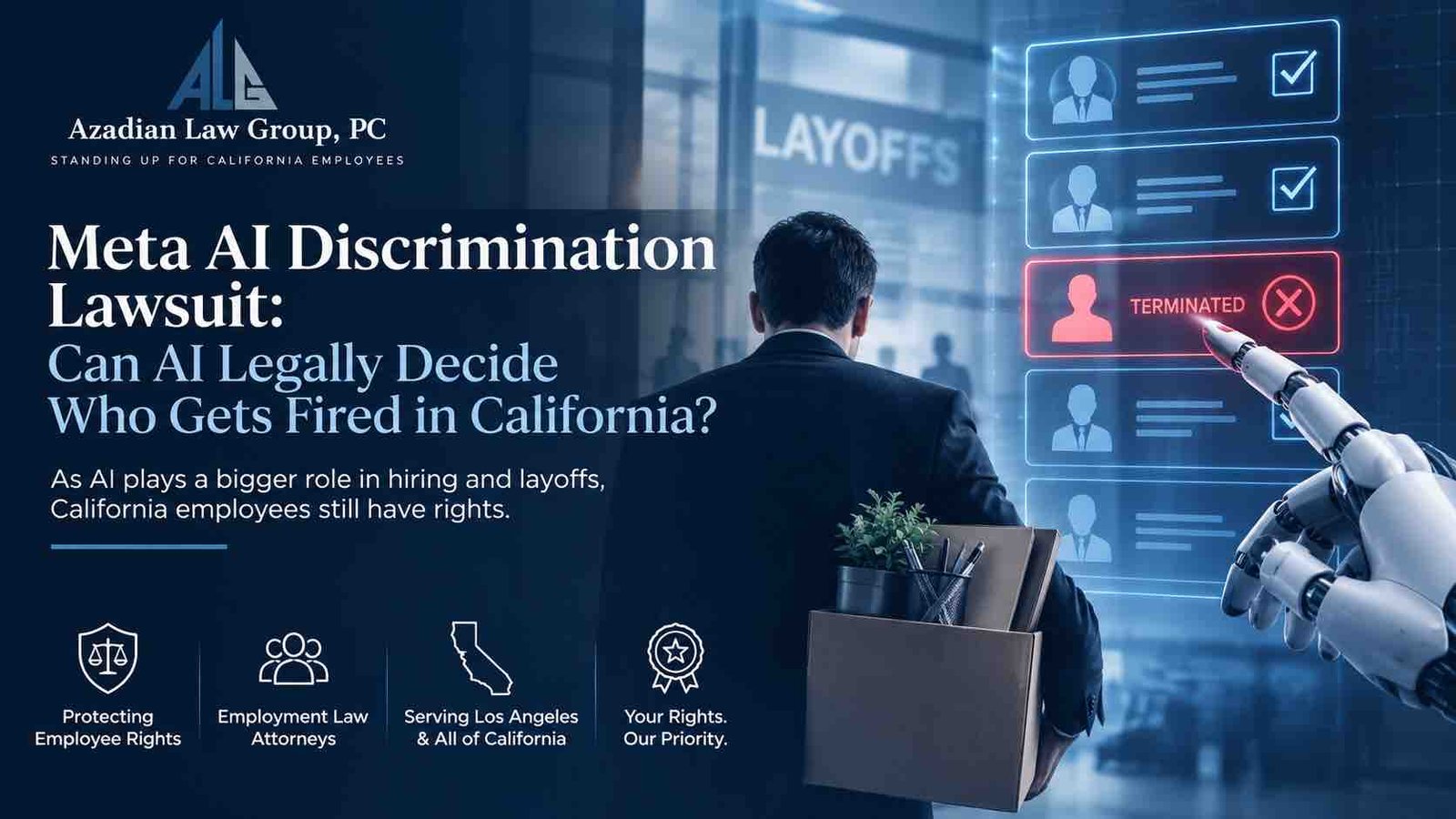
Artificial intelligence is no longer limited to answering questions, writing emails, or helping companies automate repetitive work. Today, AI is increasingly influencing workplace decisions that can shape employees’ careers—including hiring, performance evaluations, promotions, and, in some cases, layoffs.
That shift has triggered an important legal question. Can a company legally rely on artificial intelligence to decide who keeps their job and who loses it? As any experienced wrongful termination lawyer will tell you, California employers may use technology to support business decisions, but they cannot use AI in a way that results in unlawful discrimination or retaliation. When an algorithm disproportionately impacts workers in protected groups, employers may still be held legally responsible.
The question has moved from theory to the courtroom.
A recently filed federal lawsuit against Meta alleges that the company used AI-assisted performance evaluation systems during layoffs in a way that disproportionately affected employees who had taken protected leave, including medical, pregnancy, disability, parental, and family leave. While Meta disputes the allegations and maintains that managers—not AI alone—made the final employment decisions, the lawsuit has become one of the most closely watched employment cases involving artificial intelligence in the United States.
Regardless of how the litigation ultimately unfolds, the case highlights a growing concern for both employers and employees. Artificial intelligence may help organize information and identify trends, but employment decisions remain subject to the same legal standards that have governed California workplaces for decades.
For employees, the issue is straightforward: if an AI system contributes to a discriminatory termination, can the employer still be held accountable?
Under California law, the answer may be yes.
What Is the Meta AI Discrimination Lawsuit About?
According to the lawsuit, twenty-six current and former Meta employees claim the company’s layoff process relied on AI-assisted performance evaluations that unfairly disadvantaged workers who had taken legally protected leave.
The allegations suggest that employees on:
- Medical leave
- Disability leave
- Pregnancy leave
- Family leave
- Caregiver leave
received lower performance assessments because they naturally had fewer measurable work activities during their absence. Those lower ratings allegedly influenced layoff decisions.
Meta has denied that artificial intelligence independently selected employees for termination. The company maintains that managers reviewed the information and made the final employment decisions.
That distinction matters.
California law generally does not prohibit employers from using technology to assist decision-making. What the law prohibits is making employment decisions that discriminate against protected employees, regardless of whether those decisions originate from a human supervisor, a spreadsheet, or an AI system.
The legal responsibility ultimately remains with the employer.
Why This Lawsuit Matters Beyond Meta
Many people assume AI-powered employment decisions are limited to large technology companies.
In reality, artificial intelligence has quietly become part of everyday HR operations across businesses of every size.
Today’s employers increasingly use AI to:
- Screen job applicants
- Rank resumes
- Predict employee performance
- Analyze productivity
- Evaluate attendance patterns
- Recommend promotions
- Identify employees for layoffs
- Monitor workplace activity
- Generate performance summaries
Research shows that AI adoption in human resources continues to accelerate as companies search for ways to improve efficiency and reduce administrative costs. Rather than manually reviewing hundreds of employee files, employers can now receive automated rankings within minutes.
While these tools may improve efficiency, they also introduce new legal risks.
Artificial intelligence learns from historical data. If that underlying data contains hidden bias—or if an algorithm unintentionally penalizes employees for taking protected leave—the resulting recommendations may disproportionately affect certain groups even when no one intended to discriminate.
That concept is known in employment law as disparate impact.
Unlike intentional discrimination, disparate impact focuses on outcomes rather than motive. An employer may have no discriminatory intent, yet still violate employment laws if a workplace policy or technology unfairly harms a protected class of employees without sufficient business justification.
AI does not eliminate that legal analysis.
If anything, it makes it more important.
Can AI Be Biased Even If Nobody Programmed It To Be?
One of the biggest misconceptions about artificial intelligence is that computers are objective.
In reality, AI systems learn from data created by humans.
If historical employment records reflect years of unconscious bias, inconsistent performance evaluations, unequal promotion opportunities, or attendance patterns influenced by medical leave, an AI model may identify those patterns as indicators of “high performance” or “low performance.”
The algorithm isn’t making a moral judgment.
It’s identifying statistical relationships.
The problem is that statistics do not always reflect fairness.
Imagine two employees performing at the same level.
One employee worked continuously throughout the year.
The other took twelve weeks of protected medical leave following surgery.
An AI system trained primarily on productivity metrics may rank the second employee lower simply because fewer measurable work activities exist during the leave period.
From a purely mathematical perspective, the system may believe it reached a reasonable conclusion.
From a legal perspective, the outcome may raise serious questions.
California law protects employees who exercise legal rights, including taking qualifying medical leave or requesting reasonable accommodations for disabilities. If those protected activities become factors—directly or indirectly—in employment decisions, employers may face discrimination or retaliation claims.
This is one reason employment attorneys increasingly encourage companies to audit AI systems rather than assuming automated decisions are inherently neutral.
Technology can process data quickly.
It cannot determine whether an employment decision complies with California law.
California Law Still Holds Employers Responsible
Some employers mistakenly believe using artificial intelligence shifts responsibility away from management.
It does not.
Whether a termination recommendation comes from a supervisor, a consultant, or an AI platform, employers remain responsible for ensuring their decisions comply with state and federal employment laws.
California provides some of the strongest employee protections in the country.
Employers generally cannot terminate workers because they:
- Have a disability.
- Requested a reasonable accommodation.
- Took protected medical leave.
- Took pregnancy or family leave.
- Reported workplace misconduct.
- Opposed unlawful discrimination.
- Participated in workplace investigations.
- Exercised other legally protected rights.
If artificial intelligence contributes to decisions that disproportionately affect employees in these categories, employers may still be required to justify their actions under existing employment laws.
The technology may be new.
The legal principles are not.
What Should Employees Do If They Believe AI Influenced Their Termination?
Artificial intelligence rarely sends an email saying, “You were selected by an algorithm.”
Instead, employees often notice unusual patterns before or after losing their jobs.
You may have questions if:
- Your performance reviews suddenly declined without explanation.
- You were laid off shortly after returning from medical, disability, or family leave.
- Your manager couldn’t clearly explain why you were selected.
- Employees with similar roles but without protected leave kept their positions.
- HR relied heavily on dashboards, performance scores, or automated rankings during layoffs.
None of these facts alone prove discrimination. However, when combined with other evidence, they may help establish whether an employer’s decision was influenced by unlawful factors.
If something about your termination feels inconsistent or unfair, it’s worth taking the time to understand why the decision was made before assuming it was simply “bad luck.”
What Evidence Should You Preserve?
Employment cases are often won or lost based on documentation.
If you suspect your termination involved discrimination, retaliation, or an AI-assisted evaluation process, preserve as much information as possible while you still have access to it.
Helpful evidence may include:
- Performance evaluations from previous years
- Emails discussing your leave or accommodations
- Approval notices for medical, disability, or family leave
- Internal chat messages
- Performance improvement plans
- Employee handbooks or workplace policies
- Layoff announcements
- Written communications from HR
- Notes from meetings with supervisors
- Contact information for coworkers who witnessed relevant events
Avoid deleting text messages or emails, even if they seem unimportant today. Small details often become significant when viewed alongside other evidence.
AI Doesn’t Replace Employer Responsibility
Artificial intelligence may assist decision-making, but it cannot replace legal accountability.
Employers cannot avoid responsibility by blaming software.
If an AI system recommends terminating an employee because it identifies lower productivity during protected medical leave, management is still responsible for reviewing whether that recommendation complies with California law.
The same principle has long applied to recommendations made by supervisors, consultants, or outside advisors.
Technology is simply another tool.
The employer remains legally accountable for the final decision.
As AI becomes more common in human resources, companies should regularly audit automated systems for potential bias, review the factors used to evaluate employees, and ensure managers exercise meaningful human oversight instead of automatically accepting algorithmic recommendations.
Responsible employers understand that efficiency should never come at the expense of fairness.
Why the Meta Lawsuit Could Shape the Future of Employment Law
Although the Meta litigation is still in its early stages, its impact may extend well beyond a single company.
Courts are increasingly being asked to answer questions that barely existed a few years ago.
For example:
- How much influence can AI have over employment decisions?
- When does automated scoring become unlawful discrimination?
- How should employers test AI systems for hidden bias?
- What level of human review is legally required before making termination decisions?
The answers could influence how businesses across California adopt artificial intelligence in hiring, performance management, promotions, and layoffs.
For employers, the case is a reminder that innovation must be balanced with compliance.
For employees, it reinforces an important principle: workplace rights do not disappear simply because technology becomes part of the decision-making process.
California’s employment laws were written to protect workers—not algorithms.
Frequently Asked Questions
Can an employer legally use AI to decide layoffs?
Employers may use AI as a decision-support tool, but they remain legally responsible for ensuring layoff decisions do not violate California or federal employment laws. If AI contributes to discriminatory outcomes, the employer—not the software—may be held liable.
Is it illegal for AI to evaluate employee performance?
Not necessarily. Many companies use AI to analyze productivity, attendance, and performance metrics. Legal issues arise when those systems unfairly disadvantage employees based on protected characteristics or legally protected activities.
Can employees sue if AI played a role in their termination?
Potentially. If AI-assisted decisions resulted in discrimination, retaliation, or another unlawful employment action, employees may have legal claims. The specific facts of each case are critical.
Does California have stronger employee protections than many other states?
Yes. California generally provides broader workplace protections through laws such as the Fair Employment and Housing Act (FEHA), along with additional safeguards for employees who take protected leave or report unlawful conduct.
What should I do if I believe AI unfairly affected my employment?
Preserve relevant documents, avoid deleting communications, and seek legal advice as soon as possible. Early action can help protect important evidence and clarify whether your rights may have been violated.
The Bottom Line
Artificial intelligence is changing how businesses operate, but it has not changed the law.
Whether a termination decision is made by a supervisor, an executive team, or supported by sophisticated AI software, California employers remain responsible for ensuring every employment action is fair, lawful, and free from discrimination.
The Meta lawsuit serves as an important reminder that technology should enhance workplace decision-making—not undermine employee rights. As AI becomes more deeply integrated into hiring, evaluations, and layoffs, employers must carefully review automated recommendations instead of treating them as unquestionable facts.
For California employees, one principle remains constant: if you believe you were terminated because of a disability, protected leave, pregnancy, retaliation, or another protected characteristic, your legal rights deserve careful review, regardless of whether artificial intelligence was involved.
Speak With an Experienced California Wrongful Termination Lawyer
If you believe your employer relied on unfair performance metrics, AI-assisted evaluations, or discriminatory decision-making when ending your employment, obtaining legal guidance early can make a significant difference.
At Azadian Law Group, our attorneys represent California employees in cases involving wrongful termination, workplace discrimination, retaliation, disability discrimination, and violations of state and federal employment laws. We stay at the forefront of emerging workplace issues—including the growing use of artificial intelligence in employment decisions—so our clients understand their rights in an evolving workplace.
If you’ve been fired under circumstances that don’t seem fair, don’t assume an algorithm made the decision beyond challenge. Employers remain accountable under the law, and every case deserves a thorough legal evaluation.


Related Blog Posts
When a California jury steps up and delivers a $103 million age discrimination verdict, the whole employment law world stops...
Read MoreIn the last 48 hours, Los Angeles has found itself at the center of a storm—again. Following a series of...
Read MoreIn a case drawing national attention, the Phoenix Suns have found themselves at the center of a legal storm. Former...
Read MoreTypes of Cases Handle By Employment Lawyers in Los Angeles, CA
The following presents an overview of the broad range of employment law cases that our employment attorneys are experienced at overseeing and favorably resolving.
Wrongful Termination
Wrongful Termination Lawyers in Los Angeles, CA Attorneys at Azadian Law Group who have filed wrongful termination lawsuits acknowledge that unfair termination can significantly impact an employee’s life. It can…
Age Discrimination
Age Discrimination Lawyers in Los Angeles, CA Azadian Law Group, PC regularly represents clients throughout Los Angeles, CA, who are the victims of age discrimination in the workplace. At Azadian…
Pregnancy Discrimination
Pregnancy Discrimination Lawyer in Los Angeles, CA At Azadian Law Group, PC, our pregnancy discrimination lawyer in Los Angeles, regularly represents clients who are the victims of pregnancy discrimination in…
Sexual Harassment
Sexual Harassment Attorney in Los Angeles, CA The Los Angeles Sexual Harassment Lawyers at Azadian Law Group, PC, know that in today’s modern era, some people often make the mistake of…
Racial Discrimination
Racial Discrimination Lawyers in Los Angeles, CA Azadian Law Group, PC regularly represents clients throughout Los Angeles who are the victims of racial discrimination at work. The Los Angeles Race…
Disability Discrimination
When a Medical Condition Becomes a Workplace Problem, You Have Rights Most employees never expect a health condition to place their career at risk. Yet every day across Los Angeles,…
Praise from Our Clients
Lui H

Arpi Agdere
Tofi
Aracelis Feria
Ivy Gamboa
Jillian Dunlap
Greg Wayne
Elizabeth Eromosele
Steve G
Lisa Galvan
Artur Aleksanyan
Delight Dinopoulos
George Margaros
Chelsea Pham
Trevor Pal-Freeman
Patricio Garza
Taylor
Ashley Londerman
Marissa Zapanta
Nuria Coronado
Barbara Villalobos
Irene Golub
Joshua Butler
J Mo
Employees We Represent in Employment Law Cases
At Azadian Law Group, we represent employees throughout Los Angeles and California who have experienced workplace violations. Our attorneys handle employment law matters including wrongful termination, workplace discrimination, retaliation, harassment, wage and hour violations, and whistleblower protection.
Employees often face unlawful treatment after reporting misconduct, requesting medical leave, or asserting their legal rights at work. Our firm investigates employment law violations and advocates for workers seeking accountability, compensation, and fair treatment under California and federal employment law.

Step 1
Explore our comprehensive range of legal services to find the specialized support you need.
Step 2
Arrange a free initial meeting with our experts to discuss your legal situation.
Step 3
Receive a custom strategy specially created for your case by our legal experts.
Call Us Now 213-229-9031
Tell Us Your Story
Speak out for justice. Your story can be the start of a new chapter of workplace fairness.
