California Restaurant Worker Rights in 2026: Pay, Tips, Overtime and Breaks
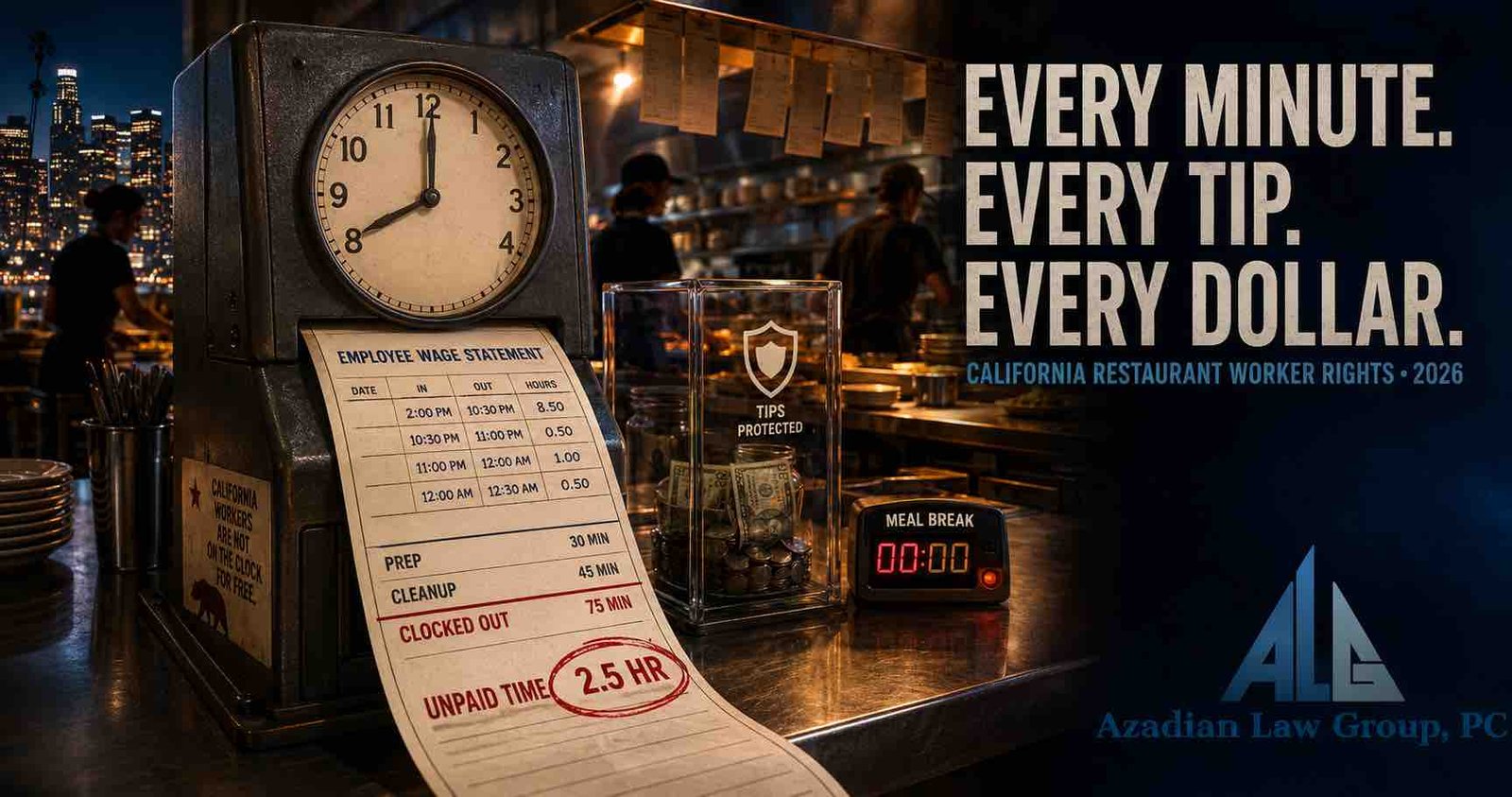
Behind every packed dining room is a workforce moving at full speed. Servers arrive before the first customer. Cooks prepare stations before service. Dishwashers remain after the doors close. Cashiers balance registers, and shift supervisors complete reports long after the final order.
Every minute spent performing that work matters.
California restaurant employees are protected by some of the strongest wage-and-hour laws in the country. Yet restaurants and fast-food establishments continue to face investigations involving unpaid overtime, stolen tips, missed breaks, off-the-clock work and inaccurate wage statements.
The short answer: California restaurant workers must generally be paid for all time they are under the employer’s control—including required preparation, closing, cleanup, meetings and training. Tips ordinarily belong to employees, and most nonexempt restaurant workers are also protected by overtime and meal-and-rest-period requirements.
Employees who believe their pay is incomplete should consider speaking with a Los Angeles wage and hour lawyer before records disappear or filing deadlines expire.
Why Was the Restaurant Industry Originally Investigated?
This page was first published after the U.S. Department of Labor announced a West Coast investigation of fast-food pay practices in 2016.
Federal investigators examined restaurants in California, Oregon and Washington for possible minimum-wage, overtime and recordkeeping violations. At that time, the Department of Labor reported recovering millions of dollars for thousands of fast-food workers through similar investigations.
That investigation is no longer new or ongoing. However, the problems it targeted have not vanished.
In September 2025, the California Labor Commissioner cited J BBQ, a Koreatown restaurant, more than $680,000 for alleged wage-theft violations affecting 48 workers. Investigators reported unpaid wages, denied meal and rest periods, and incomplete or inaccurate wage statements. Some employees were allegedly required to remain available to assist customers during their supposed lunch periods.
The enforcement action is a more relevant illustration of the risks restaurant workers continue to face in Los Angeles. Details are available in the California Labor Commissioner’s announcement.
What Minimum Wage Must California Restaurant Workers Receive in 2026?
The correct minimum wage depends on where the employee works and whether a special industry rate applies.
| Workplace | Minimum wage in 2026 |
|---|---|
| California statewide rate | $16.90 per hour |
| City of Los Angeles beginning July 1, 2026 | $18.42 per hour |
| Unincorporated Los Angeles County beginning July 1, 2026 | $18.47 per hour |
| Covered fast-food restaurant employees | At least $20.00 per hour |
The statewide rate applies unless the employee is covered by a higher local or industry-specific requirement.
The City of Los Angeles rate is based on the location where the work is performed. It is different from the rate covering unincorporated parts of Los Angeles County. A restaurant’s mailing address may say “Los Angeles” without necessarily establishing which local ordinance applies.
Workers should therefore determine whether their workplace is:
- Within the incorporated City of Los Angeles
- In an unincorporated area governed by Los Angeles County
- In another incorporated city with its own minimum wage
- Covered by California’s fast-food minimum-wage law
California’s Department of Industrial Relations confirms that the statewide minimum wage is $16.90 per hour in 2026. The Los Angeles Office of Wage Standards lists the City of Los Angeles rate, while the County provides separate information for unincorporated Los Angeles County.
Which Restaurants Are Covered by the $20 Fast-Food Minimum Wage?
Not every restaurant is covered by California’s special fast-food minimum wage.
The law generally applies to employees working at qualifying limited-service restaurants that are part of a chain with at least 60 establishments nationwide. Customers typically order and pay before consuming the food or beverages. Certain statutory exceptions may apply.
Coverage is based on the legal definition—not simply whether someone casually describes the establishment as “fast food.”
A franchise location can still be covered. California’s Labor Commissioner explains that the law may apply whether the worker is employed by the national brand, a franchisee or a licensee.
Workers can review the state’s Fast Food Minimum Wage FAQs for the detailed eligibility rules.
Can California Restaurants Use Tips to Satisfy Minimum Wage?
No. California does not allow an employer to use tips as a credit against its minimum-wage obligation.
A restaurant employee must receive the applicable minimum wage directly from the employer, with tips added on top. This is more protective than the federal tipped-wage system used in many other states.
In California:
- Tips generally belong to employees
- Owners ordinarily cannot take employees’ tips
- Managers and supervisors generally cannot keep tips left for employees
- Tips cannot be used to reduce the minimum wage
- Employers cannot deduct ordinary credit-card processing fees from tips
- A lawful tip-pooling arrangement may be permitted under certain conditions
A tip pool should not become a back door through which the restaurant keeps part of the gratuity. Employees should examine pay statements, tip reports and distribution practices if the amounts received do not match what customers appear to have left.
The California Labor Commissioner’s tips and gratuities guidance confirms that employees must receive minimum wage in addition to their tips.
Are Restaurant Employees Entitled to Overtime?
Most nonexempt California restaurant employees are entitled to overtime.
California overtime can generally apply when an employee works:
- More than eight hours in one workday
- More than 40 hours in one workweek
- Seven consecutive days in a workweek, subject to the applicable rules
- More than 12 hours in one workday, which may trigger double-time compensation
Restaurant overtime violations frequently occur when an employer:
- Pays straight time for every hour worked
- Combines two weeks and pays overtime only after 80 hours
- Records fewer hours than the employee worked
- Treats prep or cleanup work as unpaid
- Uses separate business entities for different locations
- Fails to combine hours worked at commonly controlled locations
- Calls an employee a manager without satisfying the exemption requirements
- Pays cash for overtime hours at the regular rate
- Calculates overtime without including required forms of compensation
For example, an employee might work 35 hours at one restaurant location and another 15 hours at a second location owned and controlled by the same employer. Placing the locations under different company names does not automatically eliminate the possibility that the hours must be considered together.
Employees can learn more from Azadian Law Group’s Los Angeles unpaid overtime lawyers.
Off-the-Clock Work Is Still Work
Restaurants often have work that must be performed before or after the scheduled shift.
Examples include:
- Preparing ingredients
- Setting tables
- Filling condiment containers
- Counting cash drawers
- Attending pre-shift meetings
- Putting on required equipment
- Cleaning cooking stations
- Washing the final dishes
- Taking out trash
- Completing closing checklists
- Waiting for a manager to finish locking the premises
- Responding to work messages after leaving
- Completing mandatory online training
If the employer knows or should reasonably know that an employee is performing work, the time may be compensable even when a manager did not formally approve it.
A policy stating that “unauthorized overtime will not be paid” does not necessarily allow an employer to accept the benefit of the employee’s work without compensation. The employer may address a policy violation separately, but it generally must still pay for work it permitted or knew was being performed.
What Meal Breaks Must Restaurant Workers Receive?
Most nonexempt California employees working more than five hours are entitled to an uninterrupted 30-minute meal period.
The first meal period generally must begin before the end of the employee’s fifth hour of work. Employees working more than 10 hours may be entitled to a second meal period.
A compliant off-duty meal period ordinarily requires the employer to:
- Relieve the employee of all duties
- Relinquish control over the employee
- Provide a reasonable opportunity to take an uninterrupted 30-minute break
- Avoid discouraging or preventing the break
- Allow the employee to leave the premises
Restaurant workers are not truly off duty if they must monitor customers, answer telephones, accept deliveries, watch the register or remain ready to return to work whenever the dining room gets busy.
The fact that a timekeeping system automatically deducts 30 minutes does not prove that the employee received a legally compliant meal period. Automatic deductions can actually conceal violations when employees continue working.
California’s meal-period guidance explains the applicable requirements and limited waiver rules.
What Rest Breaks Must Restaurant Workers Receive?
Most nonexempt workers must be authorized and permitted to take a paid 10-minute rest period for every four hours worked or major fraction of four hours.
A restaurant cannot lawfully replace a rest period by telling the employee to:
- Eat while working
- Stand near the register between customers
- Take a brief cigarette break
- Leave work 10 minutes early
- Combine multiple rest periods at the end of the shift
- Remain on call throughout the break
Rest periods should be genuinely duty-free. When an employer fails to provide a required rest period, the employee may be owed an additional hour of pay for that workday.
The Labor Commissioner provides additional information about California rest-period rights.
Are Restaurant Employees Owed Split-Shift Pay?
Restaurant schedules sometimes divide one workday into two shifts—for example, a lunch shift followed by an unpaid gap and then a dinner shift.
Some employees working a qualifying split shift may be entitled to a split-shift premium. Whether additional compensation is owed depends on the schedule, the applicable minimum wage and the employee’s total hourly compensation.
A normal meal period is not a split shift. A break requested by the employee for personal convenience may also be treated differently from a work schedule created by the employer.
The label placed on the schedule is not controlling. The actual reason for the interruption and how the shift was structured both matter.
Misclassifying Restaurant Workers Can Hide Multiple Violations
A restaurant may describe a worker as an independent contractor, consultant, partner or outside vendor. That description does not determine the worker’s legal status.
Dishwashers, cooks, servers, bussers, cashiers and other workers performing the restaurant’s ordinary business under its direction may be employees even if they receive a Form 1099 or signed a contractor agreement.
Misclassification can simultaneously deprive a worker of:
- Minimum wage
- Overtime
- Meal and rest periods
- Expense reimbursement
- Paid sick leave
- Workers’ compensation protection
- Unemployment benefits
Our updated guide explains how California determines whether someone is an employee or independent contractor.
What Records Should Restaurant Employees Preserve?
Restaurant employees should consider keeping personal records of:
- Actual starting and ending times
- Missed or interrupted breaks
- Work performed before clocking in
- Work performed after clocking out
- Schedules and schedule changes
- Pay statements
- Tip reports
- Tip-pool distributions
- Cash payments
- Direct deposits
- Messages from supervisors
- Photographs of posted wage notices
- Names of coworkers who observed the same practices
Employees should preserve only records they can lawfully access. They should not remove confidential customer information, personnel records belonging to coworkers or proprietary documents they have no right to possess.
California employers are responsible for maintaining accurate records, but an employee’s personal timeline can become valuable when the employer’s timekeeping system tells only half the story.
Can a Restaurant Retaliate Against a Worker Who Complains?
An employer generally may not retaliate against an employee for asserting protected wage-and-hour rights.
Potential retaliation may include:
- Firing the employee
- Removing profitable shifts
- Reducing scheduled hours
- Assigning undesirable closing shifts
- Demoting the employee
- Threatening immigration consequences
- Suddenly creating negative performance reports
- Pressuring coworkers to avoid the employee
Employees should document when they complained, what they reported, who received the complaint and what happened afterward.
A worker may have both an unpaid-wage claim and a separate retaliation or wrongful-termination claim. Close timing between a wage complaint and adverse treatment can be important, although the complete circumstances must be evaluated.
What Recent Restaurant Enforcement Cases Show
California enforcement actions demonstrate that restaurant wage violations are rarely limited to one missing paycheck.
Recent examples include:
- Koreatown restaurant: More than $680,000 in citations affecting 48 workers, involving alleged unpaid wages, denied breaks and inaccurate wage statements
- Five Wingstop locations: More than $3.1 million in citations affecting 551 workers after the Labor Commissioner alleged that separate business entities were used in ways that deprived employees of proper wages
- Three Bay Area restaurant franchises: A $2.2 million settlement securing compensation for 317 employees involving alleged minimum-wage, overtime, meal-premium, split-shift, wage-statement and tip violations
These cases show how one payroll practice can affect an entire workforce over hundreds or thousands of shifts.
Workers can also review our broader guide to common California wage-and-hour violations and our explanation of California’s expanded wage-theft enforcement system.
Frequently Asked Questions
Can a California restaurant pay servers less because they receive tips?
No. California does not permit a tip credit against the minimum wage. Employees must receive the applicable minimum wage from the employer in addition to their tips.
Is kitchen preparation before clocking in compensable?
It can be. Required preparation performed for the restaurant’s benefit generally counts as work time when the employer knew or should have known it was being performed.
Can a restaurant automatically deduct 30 minutes for lunch?
An automatic deduction does not establish that a lawful meal period occurred. If employees worked, assisted customers or remained under the employer’s control, the deduction may create unpaid wages and meal-period issues.
Are salaried restaurant managers entitled to overtime?
Possibly. Salary alone does not make an employee exempt. The employee’s compensation, actual duties, authority and time spent performing exempt work must satisfy the applicable legal test.
Can an undocumented restaurant worker file a wage claim?
California labor protections generally apply regardless of immigration status. Government wage-enforcement agencies state that workers may report wage violations without being required to establish immigration status.
What if the restaurant pays some wages in cash?
Cash payment does not remove the employer’s obligations. The restaurant must still comply with minimum-wage, overtime, recordkeeping, wage-statement and payroll requirements.
Speak With a Los Angeles Restaurant Wage Attorney
Restaurant workers keep Los Angeles moving from the first breakfast order until the final kitchen light goes dark. They deserve to receive every dollar earned during that work.
Azadian Law Group, PC represents employees in claims involving unpaid overtime, off-the-clock work, stolen tips, missed breaks, misclassification, inaccurate wage statements and workplace retaliation.
If you believe a restaurant failed to pay you properly, contact Azadian Law Group, PC for a confidential case evaluation. Call 213-229-9031 to discuss your rights and potential options.


Related Blog Posts
Your timecard shows a 30-minute lunch. Your phone shows a supervisor asking you to finish an order during that same...
Read MoreAI, Automation and Wage Theft: California Employee Rights in 2026 Artificial intelligence is no longer limited to futuristic laboratories or...
Read MoreMost employees know when a paycheck is missing. Wage theft becomes harder to recognize when the paycheck arrives on time...
Read MoreTypes of Cases Handle By Employment Lawyers in Los Angeles, CA
The following presents an overview of the broad range of employment law cases that our employment attorneys are experienced at overseeing and favorably resolving.
Wrongful Termination
Wrongful Termination Lawyers in Los Angeles, CA Attorneys at Azadian Law Group who have filed wrongful termination lawsuits acknowledge that unfair termination can significantly impact an employee’s life. It can…
Age Discrimination
Age Discrimination Lawyers in Los Angeles, CA Azadian Law Group, PC regularly represents clients throughout Los Angeles, CA, who are the victims of age discrimination in the workplace. At Azadian…
Pregnancy Discrimination
Pregnancy Discrimination Lawyer in Los Angeles, CA At Azadian Law Group, PC, our pregnancy discrimination lawyer in Los Angeles, regularly represents clients who are the victims of pregnancy discrimination in…
Sexual Harassment
Sexual Harassment Attorney in Los Angeles, CA The Los Angeles Sexual Harassment Lawyers at Azadian Law Group, PC, know that in today’s modern era, some people often make the mistake of…
Racial Discrimination
Racial Discrimination Lawyers in Los Angeles, CA Azadian Law Group, PC regularly represents clients throughout Los Angeles who are the victims of racial discrimination at work. The Los Angeles Race…
Disability Discrimination
When a Medical Condition Becomes a Workplace Problem, You Have Rights Most employees never expect a health condition to place their career at risk. Yet every day across Los Angeles,…
Praise from Our Clients
Lui H

Arpi Agdere
Tofi
Aracelis Feria
Ivy Gamboa
Jillian Dunlap
Greg Wayne
Elizabeth Eromosele
Steve G
Lisa Galvan
Artur Aleksanyan
Delight Dinopoulos
George Margaros
Chelsea Pham
Trevor Pal-Freeman
Patricio Garza
Taylor
Ashley Londerman
Marissa Zapanta
Nuria Coronado
Barbara Villalobos
Irene Golub
Joshua Butler
J Mo
Employees We Represent in Employment Law Cases
At Azadian Law Group, we represent employees throughout Los Angeles and California who have experienced workplace violations. Our attorneys handle employment law matters including wrongful termination, workplace discrimination, retaliation, harassment, wage and hour violations, and whistleblower protection.
Employees often face unlawful treatment after reporting misconduct, requesting medical leave, or asserting their legal rights at work. Our firm investigates employment law violations and advocates for workers seeking accountability, compensation, and fair treatment under California and federal employment law.

Step 1
Explore our comprehensive range of legal services to find the specialized support you need.
Step 2
Arrange a free initial meeting with our experts to discuss your legal situation.
Step 3
Receive a custom strategy specially created for your case by our legal experts.
Call Us Now 213-229-9031
Tell Us Your Story
Speak out for justice. Your story can be the start of a new chapter of workplace fairness.
