California Wage Theft Enforcement in 2026: How Local Authorities Can Protect Workers
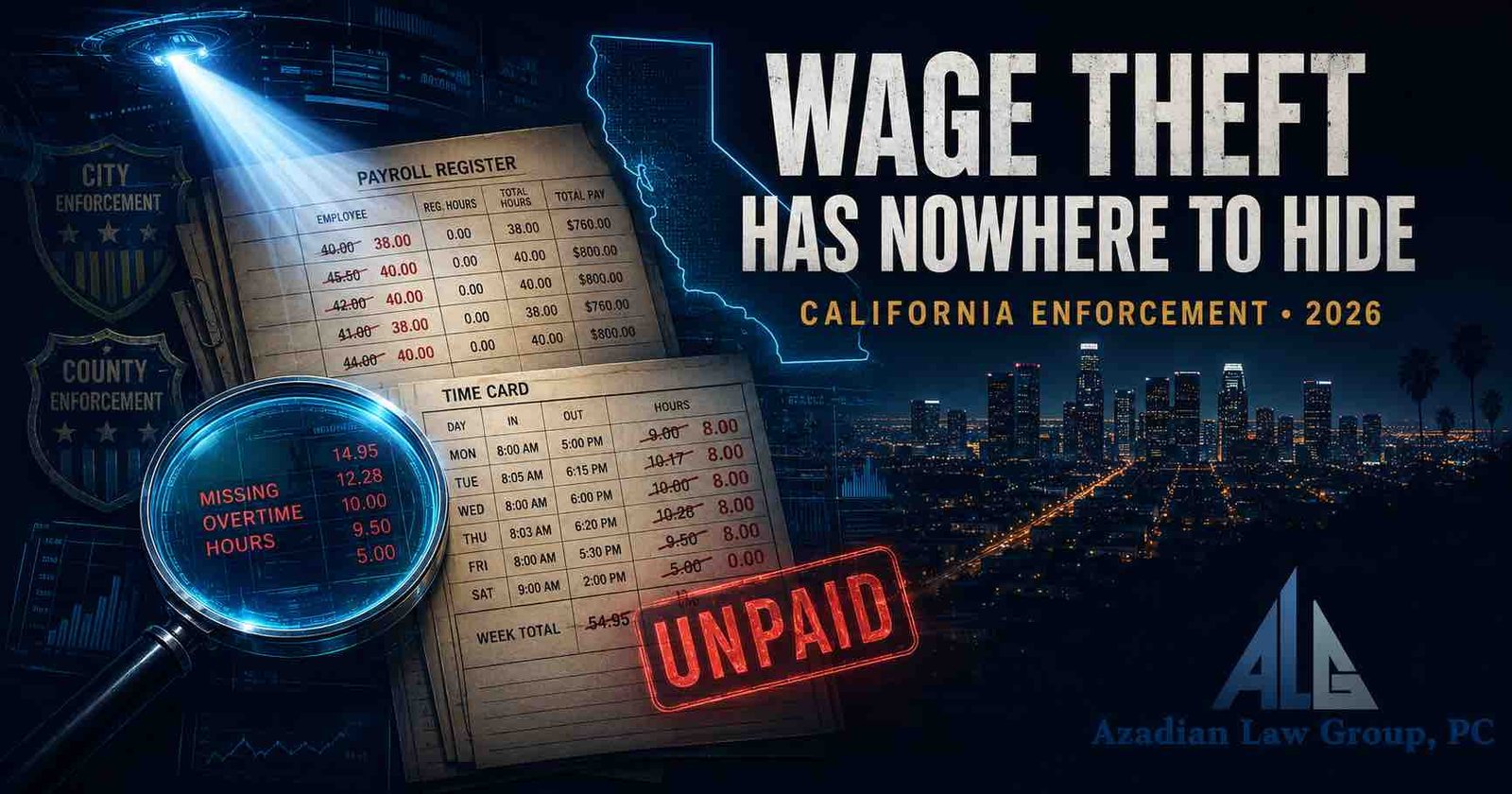
Wage theft does not always look like a missing paycheck. It can be hidden inside an altered timecard, an automatic meal-break deduction, an incorrect overtime calculation, an illegal deduction, or a job title designed to make an employee appear exempt from wage protections.
California has gradually expanded the number of government authorities capable of investigating these practices. Cities and counties can enforce local wage ordinances, while public prosecutors and the California Labor Commissioner have broader tools for pursuing violations of state labor laws.
The short answer: In 2026, wage theft may be investigated or addressed by local enforcement agencies, city attorneys, county counsel, district attorneys, the California Attorney General, or the California Labor Commissioner, depending on the violation and jurisdiction. Employees may also have the right to pursue an administrative wage claim or civil lawsuit.
Workers who believe they have been underpaid should consider speaking with an experienced Los Angeles wage and hour lawyer before evidence disappears or a filing deadline passes.
What Is Wage Theft in California?
Wage theft is a broad term describing an employer’s failure to provide wages, benefits, reimbursements, or other compensation legally owed to an employee.
It does not require someone to physically take money from a worker. In many cases, wage theft happens through a payroll policy affecting small amounts of time during every shift. Those small losses can become substantial when they continue for months or affect an entire workforce.
Common examples include:
- Paying less than the applicable state or local minimum wage
- Failing to pay overtime
- Requiring employees to work before clocking in or after clocking out
- Automatically deducting meal periods that employees did not receive
- Denying legally required meal or rest periods
- Keeping or improperly sharing employee tips
- Altering time records
- Failing to reimburse necessary business expenses
- Withholding earned commissions or bonuses
- Issuing an incomplete or inaccurate final paycheck
- Misclassifying an employee as exempt or as an independent contractor
Our guide to common wage and hour violations in California explains how these practices frequently appear in real workplaces.
How SB 1342 Strengthened Local Wage Enforcement
California enacted Senate Bill 1342 in 2016 to strengthen the ability of cities and counties to enforce local wage laws.
SB 1342 added Government Code Section 53060.4. The law allows the legislative body of a city or county to delegate subpoena authority to an appropriate local official or department head. That authority can be used when enforcing local laws and ordinances, including local wage requirements.
A subpoena may require an employer to provide evidence relevant to an investigation, such as:
- Payroll registers
- Timekeeping records
- Pay statements
- Employee schedules
- Compensation policies
- Electronic timecard data
- Records concerning deductions or reimbursements
The law mattered because passing a local minimum-wage ordinance is only half the battle. Without investigators, access to payroll evidence, and meaningful enforcement authority, a wage law can become little more than ink on paper.
When passing SB 1342, the Legislature cited historical research estimating that approximately $26.6 million in wages was taken from Los Angeles County workers every week. It also cited findings that 30% of low-wage Los Angeles workers received less than the minimum wage and 88.5% experienced some form of wage theft. Those figures should be treated as historical findings used to support the 2016 legislation—not as new 2026 statistics.
California Expanded Enforcement Again Through AB 594
SB 1342 helped local agencies investigate violations of local wage ordinances. California later went considerably further.
Assembly Bill 594, which took effect in 2024, created an alternative enforcement framework under Labor Code Sections 180 through 182. The law currently remains operative until January 1, 2029.
Under AB 594, a “public prosecutor” can include:
- The California Attorney General
- A district attorney
- A city attorney
- County counsel
- Another city or county prosecutor
These public prosecutors may independently bring civil or criminal actions for specified Labor Code violations occurring within their jurisdiction. They can also seek an injunction to stop continuing violations.
Most importantly for affected employees, money recovered by public prosecutors must generally be applied first to wages, damages, and other amounts owed to workers.
AB 594 also provides that an individual arbitration agreement cannot eliminate the enforcement authority of a public prosecutor or the Labor Commissioner. An employer may have required an employee to sign an arbitration agreement, but that agreement does not prevent public authorities from enforcing the Labor Code.
The official text of AB 594 explains the powers and limitations of this enforcement framework.
What Changed for Workers in 2026?
Another practical problem arises after a worker wins a wage claim: some employers still refuse to pay the judgment.
California Senate Bill 261 provides stronger consequences for that behavior. If a final judgment arising from unpaid wages remains unsatisfied for more than 180 days after the appeal period expires, a court may impose a civil penalty of up to three times the outstanding judgment amount, including applicable post-judgment interest.
The legislation also provides for reasonable attorneys’ fees and costs in qualifying actions brought to enforce unpaid wage judgments. Successor businesses may also face liability under specified circumstances, making it harder for an employer to escape a judgment simply by reorganizing or continuing operations through another entity.
These protections are designed to address the gap between winning a wage case and actually receiving the money awarded. The official text of SB 261 provides the complete requirements.
Does a Local Investigation Replace an Employee’s Wage Claim?
Not necessarily.
An investigation conducted by a city, county, or public prosecutor is different from an individual claim filed by an employee. A government agency may focus on widespread violations, particular industries, repeat offenders, or practices affecting numerous workers.
An employee may still have other options, including:
- Filing a wage claim with the California Labor Commissioner
- Pursuing an individual lawsuit
- Joining or bringing a wage-and-hour class action
- Pursuing available representative remedies
- Reporting violations to an appropriate local enforcement agency
- Seeking legal advice before choosing an enforcement route
The best path depends on the amount owed, the type of violation, the available records, the number of affected workers, and the applicable deadlines.
Employees can file an administrative wage claim online, by mail, by email, or in person. California’s Labor Commissioner states that these protections apply regardless of immigration status. The agency may schedule a settlement conference and, if the matter is not resolved, a wage claim hearing.
What Evidence Can Help Establish Wage Theft?
Employers are generally responsible for maintaining accurate payroll and time records. Employees should nevertheless preserve their own evidence whenever it is safe and lawful to do so.
Helpful evidence may include:
- Pay stubs and wage statements
- Personal records of starting and ending times
- Work schedules
- Emails or messages sent outside recorded hours
- Screenshots from timekeeping applications
- Commission agreements
- Bonus plans
- Expense receipts
- Mileage records
- Direct-deposit records
- Employee handbooks and compensation policies
- Communications instructing employees to work off the clock
- Names of coworkers who observed the same practices
Employees should preserve evidence without improperly accessing confidential records belonging to other workers or taking documents they have no legal right to possess.
Technology has also created new types of evidence. Login records, scheduling platforms, productivity software, delivery applications, GPS records, and electronic communications may reveal that an employee was working when the employer’s official timecard says otherwise. Our discussion of automation and wage-and-hour law examines how these systems can both conceal and expose unpaid work.
What If the Employer Calls the Worker an Independent Contractor?
A Form 1099, contractor agreement, or LLC does not automatically make someone an independent contractor under California law.
The actual working relationship matters. A worker may have been misclassified if the company controls how the work is performed, the worker performs services within the company’s usual business, or the worker does not operate an independently established business.
Misclassification can deprive workers of:
- Minimum-wage protection
- Overtime compensation
- Meal and rest periods
- Expense reimbursement
- Paid sick leave
- Workers’ compensation protection
- Unemployment benefits
- Employer payroll-tax contributions
AB 594 specifically expanded public enforcement tools relating to willful misclassification. California law may impose substantial penalties when an employer voluntarily and knowingly misclassifies an employee.
Employees can learn more in our updated guide to employee and independent-contractor classification in California.
Can an Employer Retaliate Against Someone Who Reports Wage Theft?
California employees generally have the right to raise concerns about unpaid wages and exercise protected labor rights without retaliation.
Potential retaliation may include:
- Termination
- Demotion
- Reduced hours
- Undesirable scheduling
- Pay reduction
- Suspension
- Threats or intimidation
- Fabricated performance complaints
- Exclusion from workplace opportunities
Retaliation can create a separate legal claim in addition to the underlying wage violation. Employees should document the timing of their wage complaint, the people notified, the employer’s response, and any sudden change in treatment.
A close sequence—such as an employee complaining about missing overtime and then being terminated—does not automatically prove retaliation, but it can become important evidence when considered alongside inconsistent explanations or unusual disciplinary action.
How Long Does an Employee Have to File a Wage Claim?
Deadlines depend on the specific claim.
The California Labor Commissioner currently provides the following general filing periods:
- One year for certain penalties involving bounced checks or access to payroll and personnel records
- Two years for an oral promise to pay more than minimum wage
- Three years for many minimum-wage, overtime, meal-break, rest-break, sick-leave, deduction, and reimbursement violations
- Four years for certain written-contract claims
Other claims, lawsuits, and legal theories may have different deadlines. Workers should not assume the longest period applies to their situation.
Waiting can also make a case harder to prove. Electronic records may be deleted, witnesses may leave, and memories can fade. It is generally better to evaluate the matter promptly.
Frequently Asked Questions About California Wage Theft
Who can investigate wage theft in California?
Depending on the violation, wage theft may be investigated or pursued by the California Labor Commissioner, a local wage-enforcement agency, a city attorney, district attorney, county counsel, or the California Attorney General. Employees may also pursue private legal remedies.
Can I file a wage claim if I was paid in cash?
Potentially, yes. Being paid in cash does not remove an employer’s obligation to follow minimum-wage, overtime, recordkeeping, and other employment laws.
Can undocumented workers recover unpaid wages?
California’s Labor Commissioner states that state labor protections apply to workers regardless of immigration status. Immigration-related threats may also raise serious retaliation concerns.
What if my employer did not give me time records?
An employee may still have a claim. Personal calendars, schedules, messages, login records, pay records, witness testimony, and a reasonable recollection of hours worked may become important evidence.
Is unpaid overtime considered wage theft?
Yes. Requiring a nonexempt employee to work overtime without legally required compensation is a common form of wage theft. Learn more about recovering unpaid overtime from a Los Angeles unpaid overtime lawyer.
Can an arbitration agreement stop a government investigation?
An individual arbitration agreement generally does not eliminate the enforcement authority granted to a public prosecutor or the Labor Commissioner under AB 594.
Speak With a Los Angeles Wage and Hour Attorney
California has built several layers of wage enforcement: individual wage claims, civil lawsuits, local investigations, Labor Commissioner proceedings, and public-prosecutor actions. But no enforcement system works unless the violation is identified, documented, and raised before the applicable deadline expires.
Azadian Law Group, PC represents employees—not employers—in wage-and-hour matters involving unpaid overtime, off-the-clock work, meal and rest period violations, misclassification, unpaid commissions, illegal deductions, and workplace retaliation.
If you believe your employer has failed to pay everything you earned, contact Azadian Law Group, PC for a confidential case evaluation. Call 213-229-9031 to discuss your rights and potential options.


Related Blog Posts
Your timecard shows a 30-minute lunch. Your phone shows a supervisor asking you to finish an order during that same...
Read MoreAI, Automation and Wage Theft: California Employee Rights in 2026 Artificial intelligence is no longer limited to futuristic laboratories or...
Read MoreMost employees know when a paycheck is missing. Wage theft becomes harder to recognize when the paycheck arrives on time...
Read MoreTypes of Cases Handle By Employment Lawyers in Los Angeles, CA
The following presents an overview of the broad range of employment law cases that our employment attorneys are experienced at overseeing and favorably resolving.
Wrongful Termination
Wrongful Termination Lawyers in Los Angeles, CA Attorneys at Azadian Law Group who have filed wrongful termination lawsuits acknowledge that unfair termination can significantly impact an employee’s life. It can…
Age Discrimination
Age Discrimination Lawyers in Los Angeles, CA Azadian Law Group, PC regularly represents clients throughout Los Angeles, CA, who are the victims of age discrimination in the workplace. At Azadian…
Pregnancy Discrimination
Pregnancy Discrimination Lawyer in Los Angeles, CA At Azadian Law Group, PC, our pregnancy discrimination lawyer in Los Angeles, regularly represents clients who are the victims of pregnancy discrimination in…
Sexual Harassment
Sexual Harassment Attorney in Los Angeles, CA The Los Angeles Sexual Harassment Lawyers at Azadian Law Group, PC, know that in today’s modern era, some people often make the mistake of…
Racial Discrimination
Racial Discrimination Lawyers in Los Angeles, CA Azadian Law Group, PC regularly represents clients throughout Los Angeles who are the victims of racial discrimination at work. The Los Angeles Race…
Disability Discrimination
When a Medical Condition Becomes a Workplace Problem, You Have Rights Most employees never expect a health condition to place their career at risk. Yet every day across Los Angeles,…
Praise from Our Clients
Lui H

Arpi Agdere
Tofi
Aracelis Feria
Ivy Gamboa
Jillian Dunlap
Greg Wayne
Elizabeth Eromosele
Steve G
Lisa Galvan
Artur Aleksanyan
Delight Dinopoulos
George Margaros
Chelsea Pham
Trevor Pal-Freeman
Patricio Garza
Taylor
Ashley Londerman
Marissa Zapanta
Nuria Coronado
Barbara Villalobos
Irene Golub
Joshua Butler
J Mo
Employees We Represent in Employment Law Cases
At Azadian Law Group, we represent employees throughout Los Angeles and California who have experienced workplace violations. Our attorneys handle employment law matters including wrongful termination, workplace discrimination, retaliation, harassment, wage and hour violations, and whistleblower protection.
Employees often face unlawful treatment after reporting misconduct, requesting medical leave, or asserting their legal rights at work. Our firm investigates employment law violations and advocates for workers seeking accountability, compensation, and fair treatment under California and federal employment law.

Step 1
Explore our comprehensive range of legal services to find the specialized support you need.
Step 2
Arrange a free initial meeting with our experts to discuss your legal situation.
Step 3
Receive a custom strategy specially created for your case by our legal experts.
Call Us Now 213-229-9031
Tell Us Your Story
Speak out for justice. Your story can be the start of a new chapter of workplace fairness.
