Employee or Independent Contractor in California? The 2026 Classification Guide
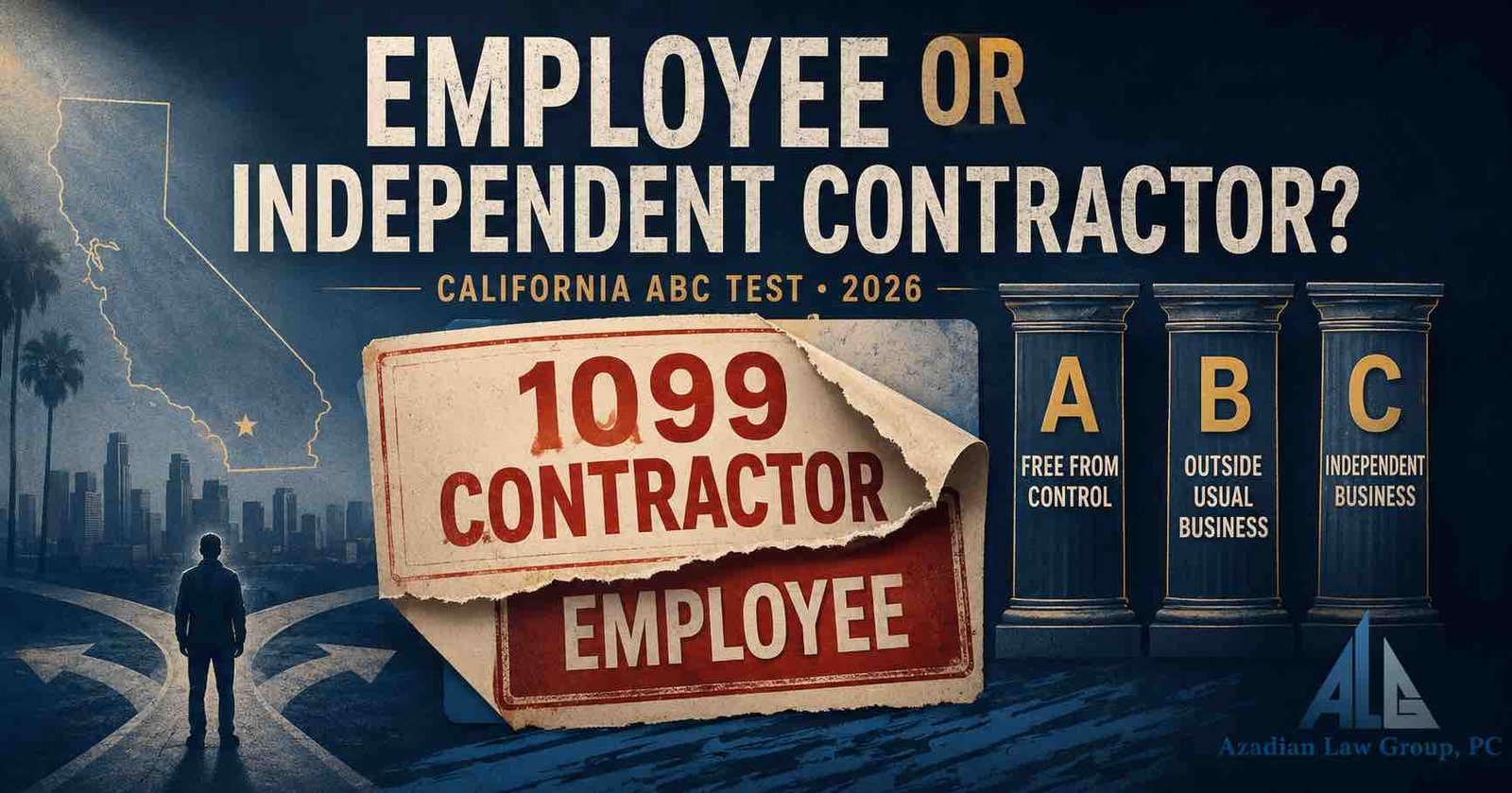
Being called an independent contractor does not necessarily make someone one.
California businesses may issue workers a Form 1099, require them to sign contractor agreements or pay them through limited liability companies. Those documents matter, but they do not conclusively determine employment status.
The actual working relationship controls.
A worker who is legally an employee may be entitled to minimum wages, overtime, meal periods, rest breaks, expense reimbursement and other protections—even when every payment was labeled “contractor compensation.”
What Is the Difference Between an Employee and an Independent Contractor?
An employee generally performs work as part of another business and receives protections imposed by employment law. A genuine independent contractor ordinarily operates a separate business and provides services on independent terms.
The distinction affects far more than taxes.
| Potential right or protection | Employee | Genuine independent contractor |
|---|---|---|
| California minimum wage | Generally yes | Generally no |
| Overtime compensation | Generally yes, unless exempt | Generally no |
| Meal and rest periods | Generally yes for covered workers | Generally no |
| Expense reimbursement | Potentially | Usually treated as a business expense |
| Payroll-tax withholding | Yes | No |
| Unemployment insurance | Potentially | Generally no |
| Workers’ compensation | Generally covered | Generally not covered as an employee |
| Itemized wage statements | Generally yes | Generally no |
Not every employee receives every protection. Exemptions and industry-specific rules may apply. But classification determines the legal framework used to evaluate those rights.
What Is California’s ABC Test?
California generally begins with a presumption that a worker is an employee. Under the ABC test, the hiring entity must establish all three of the following conditions to classify the worker as an independent contractor:
A: Freedom From Control
The worker must be free from the hiring entity’s control and direction, both under the written agreement and in actual practice.
Relevant questions can include:
- Who decides how the work is performed?
- Does the company closely supervise the worker?
- Must the worker follow detailed procedures?
- Can the worker meaningfully control the schedule?
- Does the company evaluate how—not merely whether—the work is completed?
- Can the worker reject assignments without punishment?
A contract promising independence carries limited weight when the company exercises employee-like control in practice.
B: Work Outside the Company’s Usual Business
The worker must perform work outside the usual course of the hiring entity’s business.
The California Labor Commissioner gives a useful contrast: a retail store may hire an outside plumber to repair a leak because plumbing is outside the store’s usual business. A plumbing company using plumbers to serve its customers presents a very different classification question.
This part of the test can be difficult for businesses built around large contractor workforces. When workers perform the service customers understand the company to provide, Part B deserves close examination.
C: An Independently Established Business
The worker must ordinarily be engaged in an independently established trade, occupation or business of the same nature as the work performed.
Evidence of an independent business may include:
- Serving multiple clients;
- Advertising services to the public;
- Maintaining a separate business location;
- Negotiating rates;
- Investing in equipment;
- Carrying appropriate licenses or insurance;
- Experiencing a genuine opportunity for profit or loss; and
- Continuing to operate independently when a particular contract ends.
A company cannot create an independent business for a worker simply by requiring the worker to register an LLC or obtain a business license.
If the hiring entity cannot establish any one of the three ABC elements, the worker may be treated as an employee under the ABC test.
How AB 5 Changed California Worker Classification
Assembly Bill 5 is no longer a pending “new bill.” Governor Gavin Newsom signed it in September 2019, and it took effect on January 1, 2020.
AB 5 placed the ABC test into California law after the California Supreme Court adopted the test in Dynamex Operations West, Inc. v. Superior Court.
The old version of this article described what AB 5 might do. Several years of legislation, litigation and industry-specific changes have occurred since then. In 2026, the proper question is not whether AB 5 will become law. It is which classification test applies to the worker’s particular occupation and claim.
The California Labor and Workforce Development Agency maintains current guidance explaining the ABC test and employment status.
Do All California Workers Use the ABC Test?
No. California’s classification framework includes multiple exceptions, exemptions and occupation-specific rules.
When a statutory exception to the ABC test applies, a different standard—often associated with the California Supreme Court’s decision in S.G. Borello & Sons, Inc. v. Department of Industrial Relations—may govern.
The Borello analysis considers several factors and focuses heavily on the hiring entity’s right to control the manner and means of accomplishing the work. No single factor necessarily decides every case.
Occupational and business-to-business exceptions have detailed requirements. Being part of a listed profession does not automatically establish independent-contractor status. It may only mean that a different test applies.
The analysis can involve:
- The occupation;
- Applicable professional licensing;
- The services performed;
- The contract structure;
- The worker’s business operations;
- The hiring entity’s business;
- The legal right being asserted; and
- The period when the work occurred.
Classification advice that ignores these details is usually too simplistic.
Does Signing a Contractor Agreement Make Me an Independent Contractor?
No. A written agreement is evidence, but its label does not control.
A company might require a worker to sign a document stating:
- The worker is an independent contractor;
- No employment relationship exists;
- The worker is responsible for taxes;
- No overtime will be paid; and
- The worker waives employee benefits.
Those provisions do not necessarily override California law when the actual relationship satisfies the legal test for employment.
Courts and government agencies examine how the relationship operates—not only what the company decided to call it.
Does Receiving a Form 1099 Determine My Status?
No. A Form 1099 reflects how the hiring entity reported payments. It does not conclusively establish lawful classification.
Similarly, the absence of tax withholding does not prove the worker was correctly treated as a contractor. Misclassification often creates the very payroll and tax practices the company later points to as evidence of contractor status. A circular argument is still a circle.
Does Forming an LLC Make Me an Independent Contractor?
Not automatically.
Some companies instruct workers to create an LLC before they can begin working. A business entity may be relevant to a legitimate business-to-business relationship, but forming an LLC alone does not satisfy every requirement of California’s business-to-business exception.
Relevant questions can include whether the service provider:
- Operates a genuinely separate business;
- Controls the work;
- Negotiates rates;
- Maintains its own clientele;
- Advertises independently;
- Provides its own tools;
- Can contract with other businesses; and
- Meets every applicable statutory requirement.
A paper business created solely to continue performing employee-like work may not resolve the classification problem.
Common Signs of Independent-Contractor Misclassification
No single fact determines every case. A combination of these warning signs may justify a closer review:
- The company controls when, where and how the work is performed;
- The worker performs the company’s core service;
- The worker works primarily or exclusively for one business;
- The company sets the rate without meaningful negotiation;
- The worker must personally perform all assignments;
- Supervisors monitor the worker like an employee;
- The worker uses company systems, branding or equipment;
- The company can discipline or terminate the worker for rejecting assignments;
- The relationship continues indefinitely;
- The worker does not advertise services to the public;
- The worker has no independently established clientele; or
- Employees and contractors perform substantially similar work.
A flexible schedule does not automatically establish contractor status. Many employees have flexibility while remaining subject to significant company control.
Classification Issues at Los Angeles Startups
Startups frequently rely on contractors while developing products, testing services or managing limited funding. Some of those relationships are legitimate. Others involve people working full-time inside the company’s ordinary operations while being denied employee protections.
A Los Angeles startup may call someone a consultant even though the worker:
- Attends daily staff meetings;
- Reports to a company manager;
- Uses a company email address;
- Works a continuing schedule;
- Develops the startup’s core product;
- Cannot freely serve competing clients; and
- Receives assignments through company software.
Our guide to wage-and-hour rights for Los Angeles startup employees explains related issues involving equity compensation, remote work, delayed payroll and final wages.
What About App-Based and Gig Workers?
Not every app-based worker has the same legal status.
California has enacted special provisions affecting certain app-based transportation and delivery drivers. Other gig workers may remain subject to the ABC test, the Borello standard or another occupation-specific framework.
Using an application to distribute work does not itself determine classification. Technology can manage workers as tightly as a human supervisor.
Relevant evidence may include:
- Algorithmic performance scores;
- Required acceptance rates;
- Pricing controlled by the platform;
- Restrictions on customer relationships;
- Location monitoring;
- Deactivation policies;
- Required scripts or procedures; and
- Penalties for declining assignments.
Because app-based work is governed by an evolving mix of statutes and court decisions, workers should avoid assuming that a rule applying to one platform or industry applies universally.
What Rights Can a Misclassified Employee Lose?
Misclassification can affect nearly every part of an employee’s compensation.
A worker may lose:
- Minimum wages;
- Overtime and double time;
- Meal-period premiums;
- Rest-period premiums;
- Reimbursement for business expenses;
- Itemized wage statements;
- Unemployment coverage;
- Workers’ compensation protections;
- Employer payroll-tax contributions; and
- Other employee benefits.
For example, a misclassified worker may receive a flat daily payment regardless of hours. When the employee’s actual time is reconstructed, the effective hourly rate may fall below minimum wage and create substantial overtime shortages.
Our guide to common California wage-and-hour violations explains how classification can overlap with missing wages, breaks, deductions and final-pay violations.
What Compensation Might a Misclassified Worker Recover?
Potential recovery depends on the facts, claims and applicable law. It may include:
- Unpaid minimum wages;
- Unpaid overtime;
- Meal or rest-period premiums;
- Expense reimbursement;
- Interest;
- Statutory penalties;
- Waiting-time penalties;
- Attorney’s fees and costs where authorized; and
- Other legally available relief.
Classification does not automatically establish the value of a claim. The worker’s hours, rate, records, expenses and applicable limitation periods must still be evaluated.
Employees should act promptly because different claims and remedies can have different filing deadlines.
What Evidence Can Help Establish Employee Status?
Classification cases often depend on the gap between the written contract and the real working relationship.
Useful evidence may include:
- Contractor agreements;
- Forms 1099;
- Invoices and payment records;
- Work schedules;
- Instructions from supervisors;
- Emails, text messages and workplace chats;
- Training materials;
- Company policies;
- Performance evaluations;
- Application or platform rules;
- Deactivation or disciplinary notices;
- Records of hours worked;
- Expense receipts;
- Evidence showing whether the worker served other clients; and
- Advertisements or websites relating to the worker’s business.
Preserve records you can lawfully access. Do not enter restricted systems, remove confidential material without authorization or alter company documents.
Can a Company Retaliate When a Worker Questions Classification?
A company may end a legitimate independent-contractor relationship according to its contract. A worker who is legally an employee, however, may have protections against retaliation for raising good-faith wage concerns or asserting Labor Code rights.
Potential retaliation can include:
- Termination;
- Deactivation;
- Reduced assignments;
- Lower pay;
- Threats;
- Negative reviews;
- Unfavorable scheduling; or
- Other punishment connected to the complaint.
The classification label does not necessarily decide whether retaliation protections apply. The underlying employment relationship may need to be determined first.
How Can a Misclassified Worker Challenge Their Status?
A worker may be able to file a wage claim with the California Labor Commissioner or pursue other administrative or court remedies, depending on the dispute.
The Labor Commissioner specifically advises workers who believe they were misclassified to file a wage claim so the agency can determine whether an employment relationship existed.
Before acting, workers should gather records showing:
- What work they performed;
- How the company controlled or directed it;
- Whether the work was part of the company’s business;
- Whether they operated a genuine independent business;
- How many hours they worked;
- What expenses they paid; and
- What compensation they received.
Frequently Asked Questions
Can I be an employee and still receive a Form 1099?
Yes. A company’s tax reporting does not conclusively determine legal employment status.
Am I an independent contractor if I choose my own hours?
Not necessarily. Schedule flexibility is only one fact. Control, the nature of the work and whether the worker operates an independent business may also matter.
Can my employer require me to create an LLC?
A company can structure legitimate business relationships, but requiring an LLC does not automatically transform employee-like work into independent contracting.
Does the ABC test apply to every occupation?
No. California law contains exceptions and occupation-specific provisions. A different test may apply when every requirement of an exception is satisfied.
Can a contractor receive overtime?
A genuine independent contractor generally is not covered by employee overtime protections. A worker who was misclassified may be able to recover overtime that should have been paid during the employment relationship.
Can I recover expenses I paid while misclassified?
Potentially. A worker determined to be an employee may have claims involving necessary business expenses, depending on the circumstances.
How Azadian Law Group Evaluates Classification Cases
Azadian Law Group, PC represents employees and workers who may have been improperly classified.
A meaningful classification analysis compares the paperwork against reality. Depending on the matter, our attorneys may examine:
- The hiring entity’s control;
- The company’s usual business;
- The worker’s independent operations;
- Actual job duties;
- Scheduling and supervision;
- Payment structure;
- Hours worked;
- Business expenses; and
- Treatment compared with acknowledged employees.
A 1099 can describe how the company paid someone. It does not always describe what the law requires.
Speak With a Los Angeles Wage and Hour Attorney
Misclassification can quietly deprive workers of years of wages and employment protections.
If a company labeled you an independent contractor while controlling your work like an employee, Azadian Law Group, PC can evaluate the contract, working relationship and potential unpaid compensation.
Our Los Angeles wage and hour attorneys represent workers in disputes involving misclassification, unpaid overtime, missed breaks, business expenses and other wage violations.
Contact Azadian Law Group, PC or call 213-229-9031 for a free consultation.
This article provides general information and is not legal advice. Classification tests, statutory exceptions, remedies and deadlines depend on the occupation, claim and specific facts.


Related Blog Posts
Your timecard shows a 30-minute lunch. Your phone shows a supervisor asking you to finish an order during that same...
Read MoreAI, Automation and Wage Theft: California Employee Rights in 2026 Artificial intelligence is no longer limited to futuristic laboratories or...
Read MoreMost employees know when a paycheck is missing. Wage theft becomes harder to recognize when the paycheck arrives on time...
Read MoreTypes of Cases Handle By Employment Lawyers in Los Angeles, CA
The following presents an overview of the broad range of employment law cases that our employment attorneys are experienced at overseeing and favorably resolving.
Wrongful Termination
Wrongful Termination Lawyers in Los Angeles, CA Attorneys at Azadian Law Group who have filed wrongful termination lawsuits acknowledge that unfair termination can significantly impact an employee’s life. It can…
Age Discrimination
Age Discrimination Lawyers in Los Angeles, CA Azadian Law Group, PC regularly represents clients throughout Los Angeles, CA, who are the victims of age discrimination in the workplace. At Azadian…
Pregnancy Discrimination
Pregnancy Discrimination Lawyer in Los Angeles, CA At Azadian Law Group, PC, our pregnancy discrimination lawyer in Los Angeles, regularly represents clients who are the victims of pregnancy discrimination in…
Sexual Harassment
Sexual Harassment Attorney in Los Angeles, CA The Los Angeles Sexual Harassment Lawyers at Azadian Law Group, PC, know that in today’s modern era, some people often make the mistake of…
Racial Discrimination
Racial Discrimination Lawyers in Los Angeles, CA Azadian Law Group, PC regularly represents clients throughout Los Angeles who are the victims of racial discrimination at work. The Los Angeles Race…
Disability Discrimination
When a Medical Condition Becomes a Workplace Problem, You Have Rights Most employees never expect a health condition to place their career at risk. Yet every day across Los Angeles,…
Praise from Our Clients
Lui H

Arpi Agdere
Tofi
Aracelis Feria
Ivy Gamboa
Jillian Dunlap
Greg Wayne
Elizabeth Eromosele
Steve G
Lisa Galvan
Artur Aleksanyan
Delight Dinopoulos
George Margaros
Chelsea Pham
Trevor Pal-Freeman
Patricio Garza
Taylor
Ashley Londerman
Marissa Zapanta
Nuria Coronado
Barbara Villalobos
Irene Golub
Joshua Butler
J Mo
Employees We Represent in Employment Law Cases
At Azadian Law Group, we represent employees throughout Los Angeles and California who have experienced workplace violations. Our attorneys handle employment law matters including wrongful termination, workplace discrimination, retaliation, harassment, wage and hour violations, and whistleblower protection.
Employees often face unlawful treatment after reporting misconduct, requesting medical leave, or asserting their legal rights at work. Our firm investigates employment law violations and advocates for workers seeking accountability, compensation, and fair treatment under California and federal employment law.

Step 1
Explore our comprehensive range of legal services to find the specialized support you need.
Step 2
Arrange a free initial meeting with our experts to discuss your legal situation.
Step 3
Receive a custom strategy specially created for your case by our legal experts.
Call Us Now 213-229-9031
Tell Us Your Story
Speak out for justice. Your story can be the start of a new chapter of workplace fairness.
