AI, Automation and Wage Theft: California Employee Rights in 2026
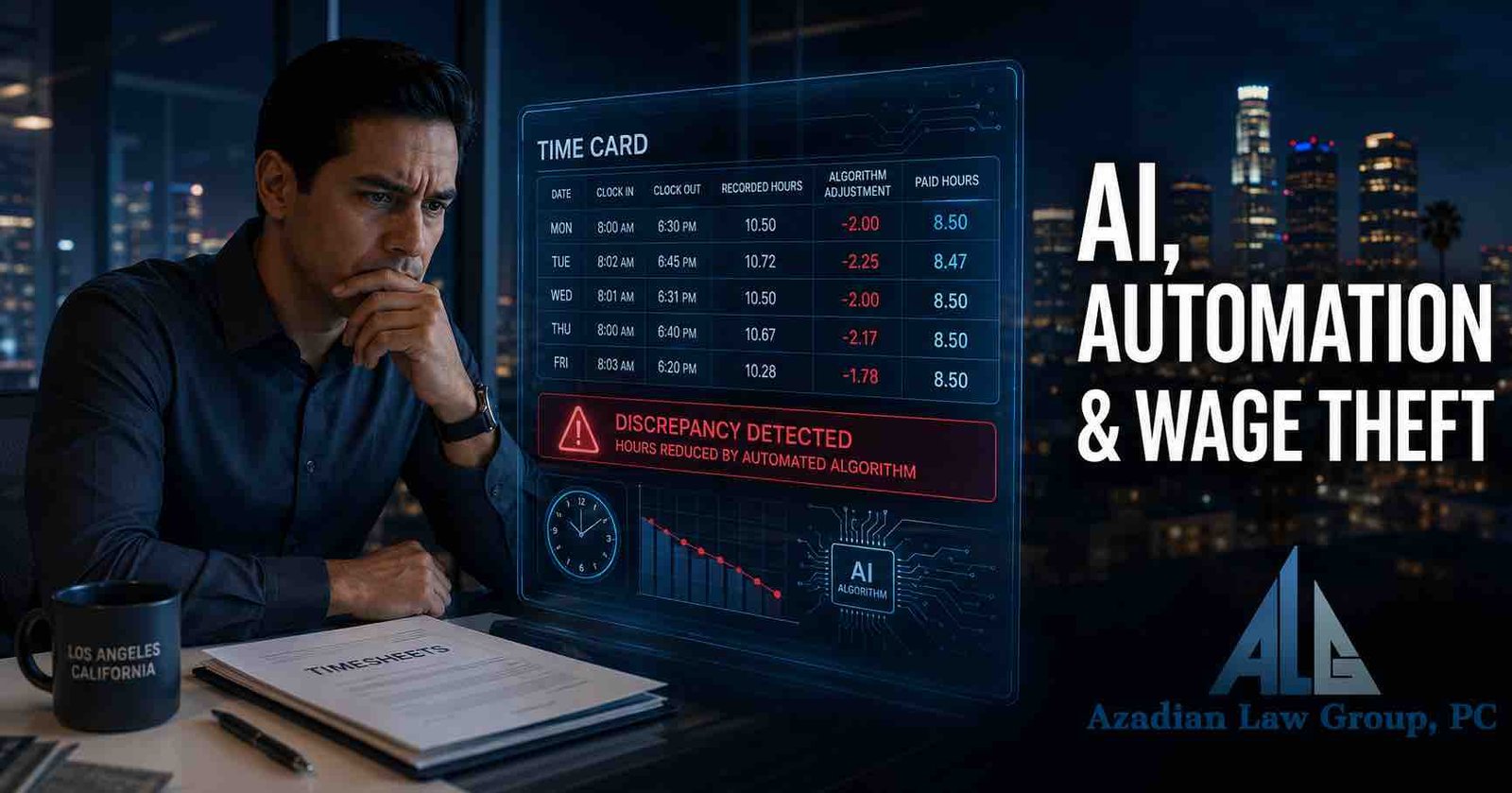
AI, Automation and Wage Theft: California Employee Rights in 2026
Artificial intelligence is no longer limited to futuristic laboratories or Silicon Valley experiments. Employers now use automated systems to schedule shifts, record working time, deduct meal periods, calculate bonuses, measure productivity and decide whether an employee’s hours should be approved.
These tools may make payroll faster, but they can also make wage theft harder to see.
A system might automatically clock employees out while they are still working, deduct a meal period that was never taken or exclude time spent logging into required software. An algorithm can make the decision, but the employer remains responsible for paying employees correctly.
Automation does not create an exception to California wage-and-hour law. If a company’s technology fails to count compensable work, incorrectly calculates overtime or pressures employees to work through breaks, the resulting underpayment may violate California law.
Can an Employer Blame Its Payroll Software for Unpaid Wages?
Generally, an employer cannot avoid its wage obligations by blaming a payroll vendor, timekeeping platform or artificial intelligence system.
California employers are responsible for maintaining accurate records and paying employees for compensable time. The California Labor Commissioner explains that employees must be paid for work an employer knew or should have known was being performed—even when the work was not formally authorized.
An automated system is ultimately a tool selected, configured and used by the employer. If that tool regularly removes time, denies legitimate hours or calculates pay incorrectly, “the software did it” is not much of a defense to the employee who was underpaid.
The legal question is not whether a human manager personally changed the employee’s time. The more important questions are:
- Did the employee perform compensable work?
- Did the employer know or have reason to know the work was being performed?
- Did the employer’s records capture all that time?
- Was the employee paid at the correct rate?
- Did the system’s design or settings consistently reduce recorded hours?
How Automated Workplace Systems Can Cause Wage Violations
| Automated practice | Potential employee problem |
|---|---|
| Time-clock rounding | Minutes worked may be reduced or erased |
| Automatic meal deductions | A meal period may be deducted even when the employee worked |
| Pre-shift login requirements | Employees may perform unpaid setup work |
| Productivity monitoring | Workers may feel pressured to skip breaks or work off the clock |
| Algorithmic scheduling | Employees may report to work but receive fewer hours than expected |
| Automated bonus calculations | Bonuses may be excluded from the overtime rate |
| Digital worker classification | Employees may be incorrectly labeled as independent contractors |
Not every automated system violates the law. The problem begins when technology causes an employee to receive less compensation or fewer workplace protections than the law requires.
Automated Timekeeping and Missing Minutes
Digital timekeeping systems are often presented as more accurate than handwritten records. That can be true—but only when the system records the employee’s actual work.
Problems arise when software automatically rounds clock-in and clock-out times, prevents employees from recording early or late work, or allows managers to reduce time entries without a clear explanation.
For example, an employee may clock in at 8:53 a.m. but the system records 9:00 a.m. The same employee may clock out at 5:07 p.m. but the system records 5:00 p.m. Fourteen minutes disappear from that workday. If the pattern continues, the missing time can add up to more than an hour each week.
The loss may become even greater when the excluded time should have been paid at an overtime rate.
Employees who notice that their timecards do not match the hours they actually worked should preserve copies of the original schedules, time entries and pay stubs. Repeated differences that consistently favor the employer deserve closer examination.
Learn more about the most frequent wage-and-hour violations affecting California employees.
Pre-Shift and Post-Shift Digital Work
Automation has created new versions of an old wage problem: requiring employees to work before clocking in or after clocking out.
Employees may be expected to:
- Start a computer and wait for required programs to load;
- Complete multifactor authentication;
- Install or update employer software;
- Review automated assignments before a shift;
- Respond to messages after clocking out;
- Upload reports or photographs at the end of a shift;
- Pass through electronically monitored security procedures; or
- Synchronize company equipment before leaving.
A few minutes may not feel significant on a single day. Across hundreds of shifts and a large workforce, however, the unpaid time can become substantial.
The California Labor Commissioner states that work an employer “suffers or permits” must be compensated when the employer knew or should have known it was occurring. A policy prohibiting unauthorized overtime does not automatically allow an employer to keep the benefit of completed work without paying for it.
Employees who regularly perform digital tasks outside their recorded shifts may have a claim for unpaid overtime in Los Angeles.
Automatic Meal-Period Deductions
Many payroll systems automatically deduct 30 minutes for a meal period. The software assumes the meal happened even when reality tells a different story.
An employee may have been required to answer calls, monitor equipment, remain available to customers or respond to a supervisor during the automatically deducted period. In other cases, workload or algorithmic productivity targets may make taking a full, uninterrupted meal period practically impossible.
An electronic record showing a meal deduction does not necessarily establish that the employee received a legally compliant, duty-free meal period.
According to the California Labor Commissioner’s meal-period guidance, when an employer knows or has reason to know that an employee is working during a meal period, the employee must be compensated for the time worked. Other remedies may also apply depending on whether the employer provided a compliant meal period.
Workers experiencing recurring automatic deductions should compare their time records against what actually happened during each shift. Our guide to Los Angeles meal and rest break violations explains these protections in greater detail.
AI Productivity Targets Can Put Breaks at Risk
Some employers use algorithms to track how many packages an employee handles, how quickly a driver completes a route, how long a customer-service representative spends on a call or how much “inactive time” appears on a computer.
Metrics are not automatically unlawful. Trouble begins when employees cannot satisfy a quota without skipping legally required breaks, working off the clock or engaging in unsafe practices.
California has enacted specific protections for certain warehouse workers. These laws address undisclosed quotas, personal work-speed data and quotas that prevent compliance with meal, rest or workplace-safety requirements. Covered employees may have rights to request information about applicable quotas and recent personal work-speed data.
More broadly, a productivity system should not punish an employee for taking a legally protected break or cause compensable work to vanish from payroll records.
Algorithmic Scheduling and Reporting-Time Issues
Automated scheduling programs can change shifts based on sales forecasts, customer traffic, weather or predicted demand. An employee may travel to work only to discover that the system reduced or cancelled the shift.
Under certain California wage orders and circumstances, an employee who reports to work but receives less than half of the expected workday may qualify for reporting-time pay. The California Labor Commissioner’s reporting-time guidance explains that eligible employees may be owed compensation when they report as scheduled but are provided too little work.
Whether reporting-time pay is required depends on the applicable wage order and facts. But an employer should not assume that an algorithmic schedule eliminates obligations that would apply if a human manager created the schedule.
Employees should save screenshots of schedules, cancellation notices and automated messages showing when shifts were added, shortened or removed.
Bonuses, Commissions and Automated Overtime Calculations
Payroll software can calculate overtime quickly, but its answer is only as accurate as the information and rules programmed into it.
California overtime is not always calculated using only the employee’s base hourly wage. Certain nondiscretionary bonuses, commissions and other forms of compensation may need to be included in the employee’s regular rate of pay.
A company might correctly identify the number of overtime hours but still underpay the employee because its system calculated time-and-a-half using an incomplete regular rate.
Employees who receive performance bonuses, production incentives, commissions, shift differentials or other variable compensation should review whether those payments affected their overtime calculation. Our 2026 guide to California overtime and double-time rules provides additional information.
Automation and Employee Misclassification
Businesses sometimes describe workers as independent contractors because they receive assignments through an application, choose from algorithmically generated shifts or communicate primarily with software.
Technology does not decide employment status.
California worker-classification questions generally examine the actual relationship between the worker and the business. Calling someone a contractor in an application or agreement does not necessarily make that classification lawful.
A misclassified worker may lose access to minimum wage, overtime, meal periods, rest breaks, expense reimbursement, payroll-tax protections and other employee rights.
The California Labor Commissioner advises workers who believe they were misclassified to submit a wage claim so the agency can determine whether an employment relationship existed. Classification disputes are fact-specific and may involve different legal tests depending on the work and industry.
Automation Does Not Change the 2026 Minimum Wage
Regardless of whether an employee is supervised by a manager, application or automated system, the employee must receive the minimum wage legally applicable to the work.
California’s statewide minimum wage is $16.90 per hour in 2026. The City of Los Angeles minimum wage increased to $18.42 per hour on July 1, 2026. Certain cities and industries require higher rates.
Our updated guide explains the California minimum wage in 2026, including Los Angeles rates, industry-specific requirements and the salary threshold affecting many exempt employees.
An automated platform cannot lawfully reduce an employee’s effective hourly rate below the applicable minimum by excluding setup time, waiting time or other compensable work.
What Evidence Can Reveal Technology-Driven Wage Theft?
Automation can make a wage case more technical, but it can also create useful electronic evidence.
Depending on the circumstances, relevant records may include:
- Timecards and edit histories;
- Payroll records and pay stubs;
- Shift schedules and change notifications;
- Computer login and logout data;
- Badge, security or building-access records;
- Application activity logs;
- Emails, text messages and workplace-chat records;
- GPS or delivery records;
- Productivity reports;
- Meal-period records;
- Bonus and commission calculations; and
- Written policies governing timekeeping and overtime.
Employees should preserve records already in their lawful possession. They should not access restricted systems, take confidential information without authorization or secretly alter employer records.
A personal record of actual start times, finish times, missed breaks and after-hours assignments can also help identify patterns.
The California Labor Commissioner recommends that workers keep track of their own time and pay, even though employers are responsible for maintaining accurate records. Employees who believe they have experienced wage theft may be able to file a wage claim, although administrative and court options can depend on the nature of the dispute.
Can an Employer Retaliate Against an Employee Who Questions Automated Pay?
California employees have the right to raise good-faith concerns about unpaid wages and other Labor Code violations without retaliation.
Potential retaliation can include:
- Termination;
- Demotion or suspension;
- Reduced pay or scheduled hours;
- Unfavorable transfers;
- Sudden discipline;
- Threats; or
- Other punishment connected to a protected complaint.
A manager may claim that an algorithm independently selected the employee for discipline, reduced hours or termination. That explanation should not automatically end the inquiry. The system’s inputs, timing, decision rules and any human involvement may need to be examined.
The California Labor Commissioner maintains a dedicated unit for workplace retaliation complaints. Employees who face adverse treatment after raising a wage concern should preserve the complaint, payroll records and timeline of what happened next.
A Los Angeles workplace retaliation attorney can evaluate whether the circumstances support a retaliation claim.
Does Automation Make a Layoff Illegal?
Not by itself.
An employer’s decision to automate work or eliminate positions does not automatically create a wage-and-hour claim. Different legal issues may arise, however, if the employer fails to pay earned wages, accrued vacation or other required compensation when employment ends.
A termination may also require closer review when the employee was selected shortly after reporting unpaid wages, challenging manipulated time records or complaining that an automated quota prevented legally required breaks.
The important distinction is between job displacement caused by legitimate business automation and an unlawful failure to pay or retaliation connected to protected activity.
How Azadian Law Group Investigates Automated Wage Violations
Azadian Law Group, PC represents employees—not employers—in California wage-and-hour disputes.
Technology-driven cases often require more than reviewing the final pay stub. Our attorneys may examine how the employer’s system was configured, whether managers changed recorded time, whether electronic activity continued outside paid hours and whether the same practice affected other workers.
The investigation may include comparing:
- Recorded time against system-access data;
- Scheduled shifts against actual work activity;
- Automatic meal deductions against employee communications;
- Bonus payments against overtime calculations;
- Job titles against actual duties; and
- Wage complaints against later discipline or termination.
A polished dashboard can still produce unlawful results. The underlying records, settings and workplace practices tell the real story.
Frequently Asked Questions About AI, Automation and Employee Pay
Is automated time-clock rounding legal in California?
The legality can depend on the system, the governing law and how the practice affects employees. A recurring practice that removes time employees actually worked can create serious wage concerns. Employers should maintain accurate records of compensable time.
Must I be paid for logging into required software before my shift?
Potentially. Required login, setup or authentication tasks may constitute compensable work when they are performed for the employer’s benefit and the employer knew or should have known they were occurring.
Can payroll automatically deduct a meal period?
A system can record scheduled meal periods, but an automatic deduction does not prove the employee received a compliant, duty-free break. Employees must be compensated for work the employer knew or should have known was performed during the deducted period.
Can my employer refuse to pay overtime because an algorithm rejected it?
An employer may enforce a policy requiring advance overtime approval, but employees generally must still be paid for compensable work the employer knew or should have known they performed.
Can an application classify me as an independent contractor?
An application can use that label, but the label does not conclusively determine legal status. The actual working relationship and applicable classification test control.
What should I do if automated records do not match my hours?
Preserve your pay stubs, schedules, messages and any time records you can lawfully access. Keep a separate record of the hours and breaks you actually worked, and consider obtaining legal guidance promptly because filing deadlines can apply.
Speak With a Los Angeles Wage and Hour Lawyer
Artificial intelligence may change how companies operate, but it does not erase an employee’s right to be paid.
If an automated timekeeping, scheduling or productivity system caused you to lose wages, overtime or legally protected breaks, Azadian Law Group, PC can evaluate the records and circumstances surrounding the underpayment.
Our Los Angeles wage and hour lawyers represent employees in disputes involving off-the-clock work, unpaid overtime, automatic meal deductions, misclassification, unlawful payroll practices and retaliation.
Contact Azadian Law Group, PC for a free consultation or call 213-229-9031.
This article provides general information and does not constitute legal advice. Wage-and-hour requirements and filing deadlines can vary according to the worker, industry, location and specific facts.


Related Blog Posts
Your timecard shows a 30-minute lunch. Your phone shows a supervisor asking you to finish an order during that same...
Read MoreMost employees know when a paycheck is missing. Wage theft becomes harder to recognize when the paycheck arrives on time...
Read MoreLos Angeles startups often promise flexibility, rapid growth, meaningful equity and the chance to build something from the ground up....
Read MoreTypes of Cases Handle By Employment Lawyers in Los Angeles, CA
The following presents an overview of the broad range of employment law cases that our employment attorneys are experienced at overseeing and favorably resolving.
Wrongful Termination
Wrongful Termination Lawyers in Los Angeles, CA Attorneys at Azadian Law Group who have filed wrongful termination lawsuits acknowledge that unfair termination can significantly impact an employee’s life. It can…
Age Discrimination
Age Discrimination Lawyers in Los Angeles, CA Azadian Law Group, PC regularly represents clients throughout Los Angeles, CA, who are the victims of age discrimination in the workplace. At Azadian…
Pregnancy Discrimination
Pregnancy Discrimination Lawyer in Los Angeles, CA At Azadian Law Group, PC, our pregnancy discrimination lawyer in Los Angeles, regularly represents clients who are the victims of pregnancy discrimination in…
Sexual Harassment
Sexual Harassment Attorney in Los Angeles, CA The Los Angeles Sexual Harassment Lawyers at Azadian Law Group, PC, know that in today’s modern era, some people often make the mistake of…
Racial Discrimination
Racial Discrimination Lawyers in Los Angeles, CA Azadian Law Group, PC regularly represents clients throughout Los Angeles who are the victims of racial discrimination at work. The Los Angeles Race…
Disability Discrimination
When a Medical Condition Becomes a Workplace Problem, You Have Rights Most employees never expect a health condition to place their career at risk. Yet every day across Los Angeles,…
Praise from Our Clients
Lui H

Arpi Agdere
Tofi
Aracelis Feria
Ivy Gamboa
Jillian Dunlap
Greg Wayne
Elizabeth Eromosele
Steve G
Lisa Galvan
Artur Aleksanyan
Delight Dinopoulos
George Margaros
Chelsea Pham
Trevor Pal-Freeman
Patricio Garza
Taylor
Ashley Londerman
Marissa Zapanta
Nuria Coronado
Barbara Villalobos
Irene Golub
Joshua Butler
J Mo
Employees We Represent in Employment Law Cases
At Azadian Law Group, we represent employees throughout Los Angeles and California who have experienced workplace violations. Our attorneys handle employment law matters including wrongful termination, workplace discrimination, retaliation, harassment, wage and hour violations, and whistleblower protection.
Employees often face unlawful treatment after reporting misconduct, requesting medical leave, or asserting their legal rights at work. Our firm investigates employment law violations and advocates for workers seeking accountability, compensation, and fair treatment under California and federal employment law.

Step 1
Explore our comprehensive range of legal services to find the specialized support you need.
Step 2
Arrange a free initial meeting with our experts to discuss your legal situation.
Step 3
Receive a custom strategy specially created for your case by our legal experts.
Call Us Now 213-229-9031
Tell Us Your Story
Speak out for justice. Your story can be the start of a new chapter of workplace fairness.
