My Manager Approved an AI-Generated Firing—Does That Count as Human Review in California?
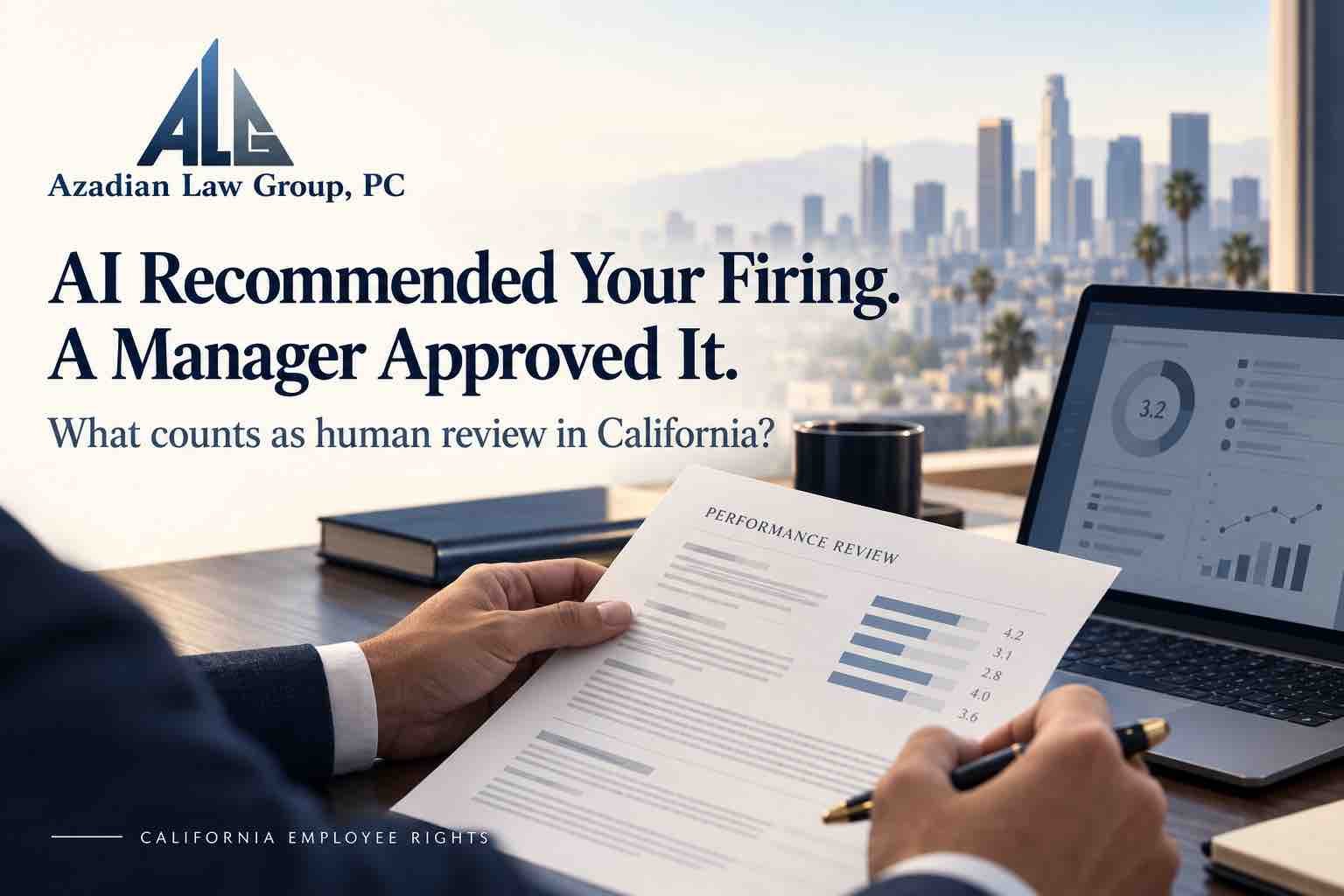
An employer tells you a performance system recommended your termination. When you ask whether a person reviewed it, HR answers: “Your manager approved the decision.”
That answer leaves an important question unresolved: What did the manager actually check? Approving a recommendation and verifying the information behind it are different actions.
California’s newly signed SB 947 addresses that distinction. Once its requirements become operative, employers will be prohibited from relying solely on an automated decision system for discipline or termination. When they primarily rely on its output, they must direct a human to corroborate the decision. A manager’s name on an approval does not, by itself, establish that this happened.
Timing matters: SB 947 was approved September 30, 2026. Its new workplace requirements become operative July 1, 2027. As of October 6, 2026, employees should not treat its future notice or data-description requirements as rights already available under that law. Existing discrimination, accommodation, leave, and retaliation protections may still apply today. Read the chaptered SB 947 text, including Labor Code sections 1522 and 1526.7.
The Short Answer: Approval Alone Does Not Tell the Whole Story
Under SB 947’s coming rules, the key questions are whether the employer relied solely or primarily on the system and, where corroboration was required, whether a person actually corroborated the decision.
The law does not prohibit every use of AI in employment. It also does not require an entirely separate investigation using only evidence collected outside the system. The final text permits corroboration using data collected or used to produce the output, or other relevant supporting information.
However, if the employer cannot corroborate the output, or the reviewer concludes it is inaccurate, incomplete, or misleading, the employer must not use that output to make the disciplinary or termination decision. These distinctions appear in the chaptered law’s section 1522(b)–(c).
For an employee, “Who approved it?” is therefore only the starting point. “What supported it?” may be the more revealing question.
What Qualifies as an Automated Decision System?
SB 947’s definition extends beyond a chatbot or a product marketed as AI. It covers computational processes derived from machine learning, statistical modeling, data analytics, or artificial intelligence that generate simplified outputs, assist or replace human discretion, and materially affect people.
A score, classification, or recommendation may fall within the definition if the other requirements are satisfied. Depending on how it operates, a tool might rank employees for discipline, classify attendance risk, or recommend termination after analyzing activity data.
The definition has exclusions, including calculators, databases, datasets, spam filters, and specified security tools. A spreadsheet or database does not automatically become a covered system just because an employer consults it. The process that generates and uses the recommendation matters. See section 1520 in the final statutory text.
Sole Reliance, Primary Reliance, and Incidental Use
These three situations should not be collapsed into one:
- Sole reliance: The automated result supplies the entire basis for the decision. SB 947 will prohibit sole reliance on an ADS for discipline or termination.
- Primary reliance: The output supplies the main basis for the decision, even if a person participates. This triggers the law’s corroboration requirement and associated notice and data-description provisions.
- Incidental use: Software plays a supporting role while other evidence drives the decision. Whether this amounts to primary reliance depends on the facts; simply touching an AI tool is not the same as primarily relying on its output.
The final text does not set a numerical percentage for primary reliance. An employee should not assume that a manager’s participation proves the decision was independent of the system. Conversely, an AI-generated summary does not prove the employer primarily relied on an ADS.
Useful evidence may include the stated reason for dismissal, the manager’s explanation, earlier reviews, the timing of a score change, and whether the same recommendation would have been made without the automated output.
What Information Can Support Human Corroboration?
Section 1522 identifies several possible sources: supervisory or managerial evaluations, personnel files, employee work product, peer reviews, and witness interviews that may include relevant online customer reviews. The list is not exhaustive.
Those sources are examples, not a requirement that every employer collect every item. They also do not establish a rule that customer reviews must always be excluded. Their relevance and reliability depend on the circumstances.
Consider the difference between checking actual work and repeating a score. A manager may verify missed deadlines against project records, examine whether the employee was assigned the work being measured, and compare the result with their own observations. A note saying “the dashboard is accurate” reveals much less if no one can explain what was checked.
Practical interpretation: Documents showing what the reviewer considered can help distinguish corroboration from an unsupported approval. SB 947 does not expressly require the specific review worksheet suggested below; it is an organizational tool for employees and their counsel.
Three Hypothetical Examples of Human Review
The following examples are fictional illustrations, not Azadian client matters or court decisions.
Example 1: A Score Penalizes Approved Leave
A productivity tool compares total output across a quarter. One employee was absent on approved medical leave, but the system treats the leave period as ordinary working time. The employee receives a low score, and the manager approves termination without checking the dates.
That scenario raises questions about whether the score reflects actual performance and whether legally protected leave was treated adversely. An approval does not answer those questions. Eligibility for leave, employer coverage, the reason for the decision, and the surrounding evidence must be evaluated.
Example 2: The Employer Verifies Performance Problems
A system flags repeated missed deadlines. Before acting, a manager checks assignments, completion records, the employee’s explanation, and relevant scheduling or accommodation information. The records support the identified problems independently of an unexplained score.
That process offers a stronger basis for corroboration. It still does not establish that every legal requirement was met or that termination was lawful. The underlying reason and any other applicable protections remain relevant.
Example 3: The Reviewer Finds a Misleading Comparison
A ranking compares employees performing different tasks. One person handles complex escalations while others complete shorter routine requests. The reviewer concludes the ranking is misleading.
Under SB 947’s coming section 1522(c), an employer must not use output found inaccurate, incomplete, or misleading to make the disciplinary or termination decision. Discovering the problem should affect how the output is used; documenting human participation alone does not resolve it.
Why an AI-Assisted Firing Can Raise Legal Issues Today
Employees do not have to wait until July 2027 to examine whether a dismissal violated existing law. California’s Civil Rights Department explains that employment discrimination protections extend to termination, and qualifying employers have obligations concerning disability accommodation and protected leave. Coverage and eligibility vary by claim. CRD employment guidance.
For example, a supposedly neutral score may warrant closer review when it reflects disability-related limitations without consideration of accommodation, or when a performance explanation changes shortly after an employee raises a protected complaint. A low score alone does not prove either discrimination or retaliation.
California’s automated-decision employment regulations have been operative since October 1, 2025. They clarify how existing antidiscrimination rules apply to automated tools. The regulations also address retention of employment records, including automated-decision data, for at least four years. Retention is different from access: a recordkeeping obligation does not give every employee an automatic right to every internal record. CRD’s announcement and summary.
If the decision involves a disability or an accommodation request, Azadian’s Los Angeles disability discrimination resource explains that area of the firm’s practice. If the timing follows a protected workplace complaint, its workplace retaliation resource may also be relevant.
What Notice and Information Will SB 947 Require?
Beginning July 1, 2027, subject to the law’s coverage and exceptions, an employer that primarily relies on an ADS for discipline or termination must provide a written postuse notice when it informs the employee of the decision.
Section 1524 requires a separate, plain-language communication in the language used for routine employee communications, delivered through an easy-to-use written method. It must identify the primary reliance on an ADS, state that a human reviewed and corroborated the output, provide a human contact and information about the employee’s data-description right, and explain the prohibition against retaliation for exercising rights under the law.
Section 1522(d) also provides a right to request a meaningful, objective description of the employee’s own data used by the system when the employer primarily used it for the decision. Other people’s personal information must be anonymized.
This is a right to a description of the employee’s own data, not a blanket right to source code, all training data, other employees’ files, or unrestricted system access. Earlier bill versions should not be used to promise broader rights than the enacted text provides.
Who Enforces the New Law, and Are There Exceptions?
SB 947 authorizes enforcement by the Labor Commissioner and a public prosecutor, and provides a $500 civil penalty per violation. It does not establish a general direct private lawsuit provision for employees under this new part. A separate discrimination, retaliation, or other employment claim may have a different enforcement route and remedies.
The statute also contains exceptions. A collective bargaining agreement can qualify only if it meets specified conditions, including an explicit waiver and protection from algorithmic management. There is a limited exception for certain ADS uses required by or reasonably necessary to comply with federal law, regulation, or binding contracts in specified aircraft, national security, military, space, or defense operations. Employment in an industry alone does not establish the exception. Review sections 1526.1 and 1526.5–1526.6 in the chaptered law.
Seven Questions to Ask After an AI-Assisted Termination
You can ask factual questions now without asserting that SB 947’s future rights already apply:
- What is the stated reason for the disciplinary or termination decision?
- Did a scoring, ranking, recommendation, or automated evaluation tool contribute to it?
- Was its output the main basis for the decision, and what other information was considered?
- Who reviewed the output, when did that happen, and what did the person check?
- What time period and activities did the score measure?
- Were approved leave, accommodations, assignment differences, or known data errors considered?
- How can I submit a factual correction or request relevant records through the appropriate process?
The answers may help organize a consultation, but an employer may not be required to answer every question immediately. A refusal is not, by itself, proof of unlawful termination.
A Factual Request You Can Adapt
Please confirm the stated reason for my termination and whether an automated scoring, ranking, or recommendation system contributed to the decision. If so, please identify the time period evaluated, whether the output was the primary basis for the decision, and what information a human reviewer considered. Please also let me know the appropriate process for requesting relevant records or submitting corrections to inaccurate information.
This is an optional information request, not a formal statutory demand, a preservation notice, or a substitute for legal advice. Its wording deliberately does not claim that SB 947’s July 2027 obligations apply to a 2026 dismissal.
Build an Evidence Timeline While the Details Are Fresh
Record the dates of positive reviews, warnings, approved leave, accommodation requests, protected complaints, score changes, and the termination meeting. Note who participated and write down the words you remember, clearly identifying recollections rather than presenting them as exact transcripts.
Keep documents you lawfully possess, such as your own reviews, notices, and communications. Preserve original files and dates where possible. Avoid accessing accounts after authorization ends, taking confidential customer information, or collecting unrelated coworkers’ records. If relevant material remains with the employer, counsel can evaluate appropriate requests and preservation steps.
For each disputed metric, complete these fields:
- Metric or recommendation: What did the system report?
- Period measured: Which dates were included?
- Missing context: Leave, assignments, accommodation, outage, or another relevant fact.
- Supporting document: What lawfully held record supports the correction?
- Human response: Who considered the issue, when, and what was said?
- Unresolved question: What remains unknown?
Do not wait for an employer’s explanation before checking filing deadlines. Different claims and procedures have different time limits. An attorney can evaluate the applicable deadlines and whether a severance agreement affects your options.
Frequently Asked Questions
Does a Manager Clicking “Approve” Satisfy SB 947?
The click alone does not establish compliance. Once SB 947 becomes operative, primary reliance on an ADS requires human corroboration. What the reviewer actually checked matters, and output that cannot be corroborated or is found inaccurate, incomplete, or misleading cannot be used for the decision.
Is SB 947 Already Operative in October 2026?
No. It was approved September 30, 2026, but the new part becomes operative July 1, 2027. Existing employment protections may apply before that date.
Does the Law Require Evidence Entirely Independent of the AI System?
No. The final text permits corroboration using data collected or used to produce the output, or other relevant supporting information. That is different from saying a human can approve the result without corroborating it.
Can I Request the AI System’s Source Code?
SB 947’s data-description provision does not create a blanket source-code entitlement. It concerns a meaningful, objective description of the employee’s own data used by an ADS when the employer primarily used the system for the decision, with protections for other people’s personal information.
Does AI Involvement Automatically Make a Firing Wrongful?
No. The role of the system, the employer’s reason, applicable protections, review process, and evidence all matter. Human participation also does not automatically make a firing lawful.
What Should I Bring to an Employment-Law Consultation?
Bring your termination notice, relevant reviews and warnings, lawfully held communications, leave or accommodation records if relevant, any severance agreement, and a dated timeline. You do not need to reconstruct the employer’s algorithm before asking an attorney to evaluate the facts.
Discuss the Decision With a Los Angeles Employment Lawyer
If you were told that a system recommended your firing and a manager approved it, focus on the reason, supporting information, and whether relevant context was overlooked. Those facts can help determine whether the decision warrants further investigation.
Azadian Law Group, PC represents employees in employment matters. Learn about the firm’s Los Angeles wrongful termination practice or contact Azadian Law Group to discuss your situation.
For related background, read AI Boss Fires Human Employee in California and Azadian’s Meta AI discrimination lawsuit article.
This article provides general information, not legal advice. The examples are hypothetical. Legal developments are addressed as of October 6, 2026; coverage, deadlines, and available claims depend on individual circumstances.


Related Blog Posts
Wrongful Termination Evidence Often Appears as a Pattern Wrongful termination evidence is rarely found in one dramatic email admitting that...
Read MoreCalifornia is witnessing one of the largest health-care labor strikes in recent history. More than 30,000 health-care workers, including nurses,...
Read MoreThe federal government has once again postponed enforcement of its TikTok divestiture mandate. Originally scheduled to force ByteDance to sell...
Read MoreTypes of Cases Handle By Employment Lawyers in Los Angeles, CA
The following presents an overview of the broad range of employment law cases that our employment attorneys are experienced at overseeing and favorably resolving.
Wrongful Termination
Wrongful Termination Lawyers in Los Angeles, CA Attorneys at Azadian Law Group who have filed wrongful termination lawsuits acknowledge that unfair termination can significantly impact an employee’s life. It can…
Age Discrimination
Age Discrimination Lawyers in Los Angeles, CA Azadian Law Group, PC regularly represents clients throughout Los Angeles, CA, who are the victims of age discrimination in the workplace. At Azadian…
Pregnancy Discrimination
Pregnancy Discrimination Lawyer in Los Angeles, CA At Azadian Law Group, PC, our pregnancy discrimination lawyer in Los Angeles, regularly represents clients who are the victims of pregnancy discrimination in…
Sexual Harassment
Sexual Harassment Attorney in Los Angeles, CA The Los Angeles Sexual Harassment Lawyers at Azadian Law Group, PC, know that in today’s modern era, some people often make the mistake of…
Racial Discrimination
Racial Discrimination Lawyers in Los Angeles, CA Azadian Law Group, PC regularly represents clients throughout Los Angeles who are the victims of racial discrimination at work. The Los Angeles Race…
Disability Discrimination
When a Medical Condition Becomes a Workplace Problem, You Have Rights Most employees never expect a health condition to place their career at risk. Yet every day across Los Angeles,…
Praise from Our Clients
Lui H

Arpi Agdere
Tofi
Aracelis Feria
Ivy Gamboa
Jillian Dunlap
Greg Wayne
Elizabeth Eromosele
Steve G
Lisa Galvan
Artur Aleksanyan
Delight Dinopoulos
George Margaros
Chelsea Pham
Trevor Pal-Freeman
Patricio Garza
Taylor
Ashley Londerman
Marissa Zapanta
Nuria Coronado
Barbara Villalobos
Irene Golub
Joshua Butler
J Mo
Employees We Represent in Employment Law Cases
At Azadian Law Group, we represent employees throughout Los Angeles and California who have experienced workplace violations. Our attorneys handle employment law matters including wrongful termination, workplace discrimination, retaliation, harassment, wage and hour violations, and whistleblower protection.
Employees often face unlawful treatment after reporting misconduct, requesting medical leave, or asserting their legal rights at work. Our firm investigates employment law violations and advocates for workers seeking accountability, compensation, and fair treatment under California and federal employment law.

Step 1
Explore our comprehensive range of legal services to find the specialized support you need.
Step 2
Arrange a free initial meeting with our experts to discuss your legal situation.
Step 3
Receive a custom strategy specially created for your case by our legal experts.
Call Us Now 213-229-9031
Tell Us Your Story
Speak out for justice. Your story can be the start of a new chapter of workplace fairness.
