Archdiocese of Los Angeles Faces Wrongful Termination Lawsuit: What California Employees Should Know
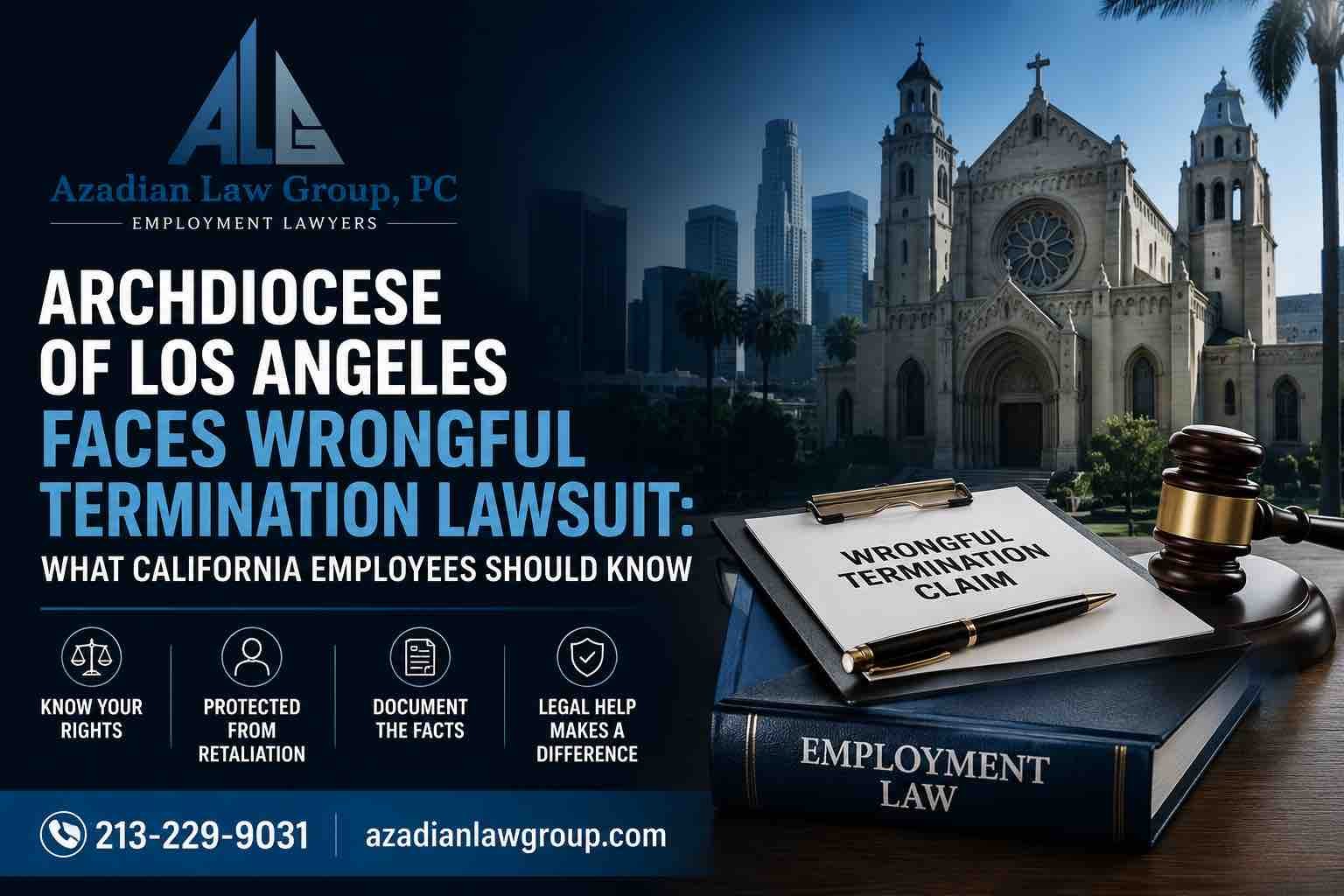
A wrongful termination lawsuit involving the Archdiocese of Los Angeles and St. Anthony High School in Long Beach is moving forward in part after a Los Angeles Superior Court judge issued a mixed ruling in the case.
The lawsuit was filed by Aaron Bryant, a former director of admissions who alleges that he was wrongfully terminated after experiencing discriminatory and retaliatory treatment at work. Among his allegations, Bryant claims that his female supervisor openly expressed a preference for replacing him with a woman.
The defendants have challenged the allegations and sought to have the claims dismissed. The case remains pending, and the allegations have not been proven at trial.
Still, the court’s latest ruling is significant for California employees because Bryant’s wrongful termination claim and one retaliation claim were allowed to proceed.
For workers in Los Angeles and throughout California, the dispute is a useful reminder of an important principle: being an at-will employee does not mean an employer can terminate someone for an unlawful reason.
What Happened in the Archdiocese of Los Angeles Wrongful Termination Case?
According to Bryant’s lawsuit, he was hired as director of admissions in August 2022.
Bryant alleges that his supervisor made comments indicating that his position would be better filled by a woman. He also claims that he was assigned manual labor on campus with a facilities manager even though those duties were unrelated to his admissions position.
Bryant reportedly documented the assignment because he believed it was punitive and part of inappropriate treatment directed toward him.
His lawsuit ultimately asserted several claims involving alleged:
- Wrongful termination
- Retaliation
- Gender harassment
- Disability discrimination
- Failure to accommodate
- Failure to engage in the interactive process
- Unreimbursed business expenses
- Intentional infliction of emotional distress
The Archdiocese and St. Anthony High School challenged the claims and argued that they were not sufficiently supported.
The defense also raised an important legal issue concerning religious organizations, arguing that certain defendants are exempt from California’s Fair Employment and Housing Act.
Judge Allows Wrongful Termination Claim to Continue
The latest ruling did not give either side a complete victory.
Los Angeles Superior Court Judge Randolph M. Hammock struck Bryant’s punitive-damages allegations and dismissed his claim concerning unreimbursed business expenses.
The judge also required Bryant to provide additional factual detail supporting several allegations, including gender harassment, disability discrimination, failure to accommodate, failure to participate in the interactive process, and one retaliation theory.
But two important parts of the lawsuit survived the challenge:
Bryant’s wrongful termination claim and another retaliation claim may continue.
That distinction matters.
A ruling allowing a claim to proceed does not mean the court has determined that wrongful termination actually occurred. It means the claim survived this stage of the defendants’ challenge and can continue through the litigation process.
What California Employees Can Learn From This Case
Most California workers have heard the phrase “at-will employment.”
It is often misunderstood.
Generally, at-will employment means that an employer or employee may end the employment relationship without having to establish traditional “cause.” But at-will employment is not permission to fire an employee for an illegal reason.
A termination may potentially violate California law when it is connected to unlawful discrimination, retaliation for protected conduct, whistleblowing, exercising certain workplace rights, or another recognized public policy.
This is why the reason behind a termination can be far more important than whether an employer simply had the ability to terminate an at-will employee.
Retaliation Can Be More Than Being Fired
One particularly useful lesson from the Bryant lawsuit is that employees should pay attention to what happens before termination.
Retaliation does not always begin with a termination letter.
Depending on the circumstances, an employee may experience a pattern that includes:
- Sudden negative performance reviews
- Unusual disciplinary actions
- Reduction of responsibilities
- Unfavorable schedule or assignment changes
- Exclusion from meetings or projects
- Demotion
- Increased scrutiny
- Threats concerning continued employment
- Assignments that appear punitive
- Termination shortly after protected activity
None of these events automatically proves retaliation.
Context matters.
But when treatment changes soon after an employee complains about discrimination, requests a legally protected accommodation, reports suspected unlawful conduct, or exercises another protected workplace right, the timing and sequence of events can become important evidence.
Documentation Can Matter in a Wrongful Termination Case
Bryant’s allegation that he documented an assignment he considered punitive highlights something employees often overlook while they are still employed.
Contemporaneous documentation can matter.
Memories fade. Managers leave. Workplace conversations are disputed. Emails disappear from employee access after termination.
An employee who believes something improper is happening should consider preserving lawful records of important events, such as dates of complaints, relevant emails or messages, performance evaluations, changes in responsibilities, written disciplinary notices, accommodation requests, and communications with HR.
Employees should not take confidential, privileged, proprietary, or other materials they are not legally entitled to possess. But keeping an accurate personal chronology of events can make it considerably easier to explain what happened later.
California Law Protects Employees From Certain Forms of Retaliation
California provides substantial protections for employees who engage in legally protected activity.
For example, California Labor Code Section 1102.5 generally prohibits employers from retaliating against workers for certain protected disclosures concerning suspected violations of local, state, or federal law.
The statute can also protect an employee who refuses to participate in conduct that the employee reasonably believes would violate applicable law.
Other California employment laws provide separate protections for employees who complain about discrimination or harassment, seek qualifying workplace accommodations, exercise protected leave rights, report wage violations, or engage in other legally protected conduct.
The precise law that applies depends heavily on what the employee did before the adverse employment action occurred.
Wrongful Termination Cases Are Often About the Employer’s Real Reason
Employers rarely write:
“We are firing you because you complained about discrimination.”
That is one reason wrongful termination cases frequently turn on circumstantial evidence.
An employer may give a legitimate reason for termination — poor performance, restructuring, attendance, misconduct, a reduction in force, or another business justification.
The legal question can become whether that explanation was genuine or whether it was a pretext masking an unlawful reason.
Evidence that may become relevant can include the timing of the termination, inconsistent explanations, treatment of comparable employees, sudden changes in performance evaluations, departures from normal company procedures, internal communications, witness testimony, and the employee’s history before engaging in protected activity.
No single fact necessarily proves wrongful termination. Often, it is the overall timeline that tells the story.
Can Men Be Victims of Workplace Gender Discrimination in California?
Yes.
California employment discrimination protections are not limited to women.
Depending on the employer and circumstances, unlawful employment decisions based on an employee’s sex or gender may violate applicable state or federal employment law regardless of whether the affected employee is male or female.
That makes the allegations in Bryant’s lawsuit noteworthy.
According to the lawsuit, Bryant alleges that his supervisor indicated his position would be better served by a woman.
Whether those allegations can ultimately be proven is for the litigation process to determine. But as a general employment-law principle, employers should not make hiring, firing, promotion, compensation, or other covered employment decisions based on unlawful gender preferences.
What About Disability Discrimination and Reasonable Accommodation?
The lawsuit also includes allegations concerning disability discrimination, failure to accommodate, and failure to engage in the interactive process.
The judge required additional factual detail for these claims, so employees should not interpret the ruling as a finding that disability discrimination occurred.
The broader issue, however, is important.
California employees with qualifying disabilities may have rights concerning reasonable workplace accommodations. Employers covered by applicable law may also have obligations to participate in a good-faith interactive process when they become aware that an employee may need an accommodation.
Termination occurring around an accommodation dispute can therefore require careful examination of the facts.
Religious Employers Can Present Additional Legal Questions
There is another reason this case is more complicated than an ordinary wrongful termination dispute.
The defendants include religious organizations.
Religious institutions can be subject to special statutory exemptions and constitutional protections in certain employment disputes. The defendants have specifically argued that religious entities involved in the case are exempt from FEHA.
Those questions can make employment cases involving churches, religious schools, and other faith-based organizations particularly fact-specific.
Employees should therefore avoid assuming that every California employment protection applies to every religious employer in exactly the same way.
At the same time, the existence of a religious exemption does not automatically resolve every possible employment claim. Different statutes, claims, job duties, and circumstances can lead to different legal analyses.
Fired After Complaining at Work? The Timeline Matters
Employees frequently contact employment lawyers with a simple question:
“I complained, and then I was fired. Is that wrongful termination?”
Sometimes it may be. Sometimes it may not.
The important questions usually include:
What did you complain about?
A general disagreement with management is different from reporting discrimination, harassment, wage violations, safety concerns, suspected illegal conduct, or another legally protected issue.
Who knew about the complaint?
It can matter whether the people involved in the termination decision knew that protected activity had occurred.
How soon did the termination happen?
Close timing may be relevant, although timing alone does not necessarily establish retaliation.
What reason did the employer give?
Changing or inconsistent explanations can deserve closer examination.
How were you treated before the complaint?
A strong employment history followed by sudden criticism after protected activity can be relevant depending on the circumstances.
These are the kinds of facts a Los Angeles wrongful termination lawyer may examine when determining whether a termination was simply unfair or potentially unlawful.
What Should California Employees Do If They Suspect Wrongful Termination?
If you believe you were fired for an unlawful reason, avoid making assumptions based solely on how unfair the decision feels.
Instead, reconstruct the facts.
Write down the timeline while events are still fresh. Preserve documents you are legally entitled to keep. Save your termination notice, relevant communications, performance reviews, complaints you submitted, and the employer’s stated explanation for the decision.
Most importantly, distinguish between unfair treatment and unlawful treatment.
California employment law does not prohibit every unfair workplace decision. A viable wrongful termination case generally requires a connection between the termination and a legally prohibited reason or protected activity.
The Bigger Lesson From the Archdiocese of Los Angeles Case
The Bryant lawsuit is still being litigated. No final determination has been made that the Archdiocese of Los Angeles, St. Anthony High School, or any other defendant wrongfully terminated or discriminated against Bryant.
That distinction is important.
But the case illustrates something California workers should understand: a termination does not happen in isolation.
What was said before the firing, what the employee reported, how management responded, whether treatment suddenly changed, what explanation was given for termination, and whether that explanation matches the employee’s actual history can all become important.
Sometimes the most revealing evidence in a wrongful termination case isn’t the termination itself.
It’s what happened in the weeks and months leading up to it.
Speak With a Los Angeles Wrongful Termination Attorney
If you were terminated after reporting discrimination, requesting an accommodation, complaining about workplace misconduct, or exercising another protected right, the circumstances surrounding your termination may deserve closer review.
Azadian Law Group, PC represents employees in Los Angeles and throughout California in wrongful termination, retaliation, discrimination, harassment, and other employment disputes.
An experienced employment attorney can review the sequence of events, determine which California employment protections may apply, and evaluate whether the employer’s stated reason for termination is consistent with the available evidence.
Every employment case is different, and past results do not guarantee a particular outcome.


Related Blog Posts
Wrongful Termination Evidence Often Appears as a Pattern Wrongful termination evidence is rarely found in one dramatic email admitting that...
Read MoreOracle Layoffs Raise New Questions for California Employees Oracle has reportedly begun another round of layoffs in the United States,...
Read MoreArtificial intelligence has already started screening resumes, measuring productivity, writing performance reviews, and recommending layoffs. Now it has reportedly helped...
Read MoreTypes of Cases Handle By Employment Lawyers in Los Angeles, CA
The following presents an overview of the broad range of employment law cases that our employment attorneys are experienced at overseeing and favorably resolving.
Wrongful Termination
Wrongful Termination Lawyers in Los Angeles, CA Attorneys at Azadian Law Group who have filed wrongful termination lawsuits acknowledge that unfair termination can significantly impact an employee’s life. It can…
Age Discrimination
Age Discrimination Lawyers in Los Angeles, CA Azadian Law Group, PC regularly represents clients throughout Los Angeles, CA, who are the victims of age discrimination in the workplace. At Azadian…
Pregnancy Discrimination
Pregnancy Discrimination Lawyer in Los Angeles, CA At Azadian Law Group, PC, our pregnancy discrimination lawyer in Los Angeles, regularly represents clients who are the victims of pregnancy discrimination in…
Sexual Harassment
Sexual Harassment Attorney in Los Angeles, CA The Los Angeles Sexual Harassment Lawyers at Azadian Law Group, PC, know that in today’s modern era, some people often make the mistake of…
Racial Discrimination
Racial Discrimination Lawyers in Los Angeles, CA Azadian Law Group, PC regularly represents clients throughout Los Angeles who are the victims of racial discrimination at work. The Los Angeles Race…
Disability Discrimination
When a Medical Condition Becomes a Workplace Problem, You Have Rights Most employees never expect a health condition to place their career at risk. Yet every day across Los Angeles,…
Praise from Our Clients
Lui H

Arpi Agdere
Tofi
Aracelis Feria
Ivy Gamboa
Jillian Dunlap
Greg Wayne
Elizabeth Eromosele
Steve G
Lisa Galvan
Artur Aleksanyan
Delight Dinopoulos
George Margaros
Chelsea Pham
Trevor Pal-Freeman
Patricio Garza
Taylor
Ashley Londerman
Marissa Zapanta
Nuria Coronado
Barbara Villalobos
Irene Golub
Joshua Butler
J Mo
Employees We Represent in Employment Law Cases
At Azadian Law Group, we represent employees throughout Los Angeles and California who have experienced workplace violations. Our attorneys handle employment law matters including wrongful termination, workplace discrimination, retaliation, harassment, wage and hour violations, and whistleblower protection.
Employees often face unlawful treatment after reporting misconduct, requesting medical leave, or asserting their legal rights at work. Our firm investigates employment law violations and advocates for workers seeking accountability, compensation, and fair treatment under California and federal employment law.

Step 1
Explore our comprehensive range of legal services to find the specialized support you need.
Step 2
Arrange a free initial meeting with our experts to discuss your legal situation.
Step 3
Receive a custom strategy specially created for your case by our legal experts.
Call Us Now 213-229-9031
Tell Us Your Story
Speak out for justice. Your story can be the start of a new chapter of workplace fairness.
