How to Prove Pregnancy Discrimination at Work in California
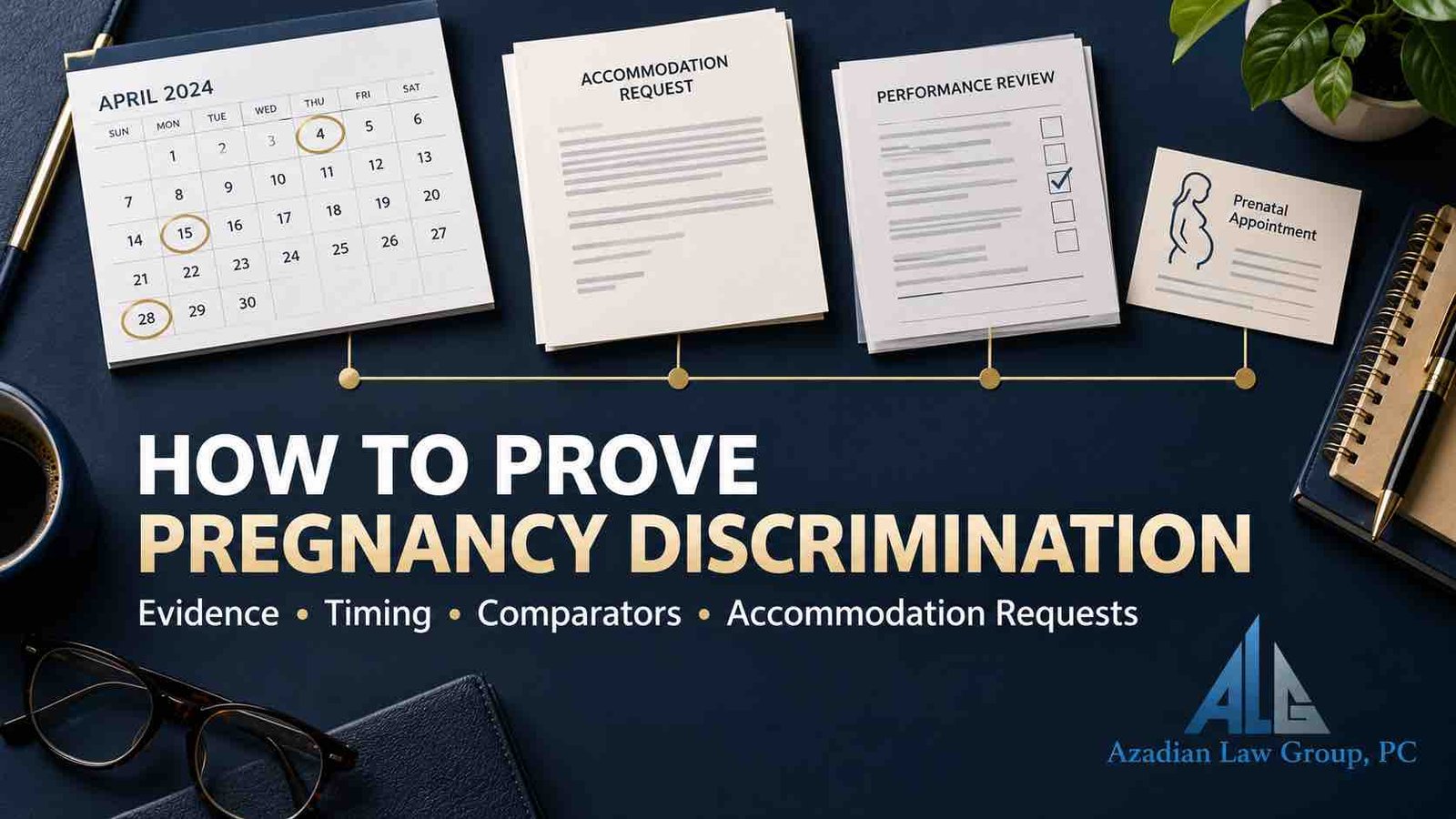
How Do You Prove Pregnancy Discrimination?
To prove pregnancy discrimination, an employee usually needs evidence that the employer knew about the pregnancy or related limitation, took a harmful employment action, and acted because of pregnancy, childbirth, a related medical condition, or the employee’s request for an accommodation or protected leave. A single document can sometimes establish that connection. More often, the proof comes from a combination of timing, statements, performance records, comparator evidence, policy departures, witness accounts, and shifting explanations.
The central question is causation. A worker does not have to prove that pregnancy was the employer’s only concern in every type of claim. However, the evidence must connect a protected condition or activity to the challenged decision under the legal standard that governs the claim.
That distinction matters because unfair treatment and illegal discrimination are not always the same. A manager may act rudely, make a poor business decision, or enforce an unreasonable policy without violating a pregnancy-protection law. The case becomes stronger when the facts show that pregnancy influenced hiring, assignments, scheduling, pay, promotion, discipline, leave, accommodation, layoff, or termination.
What Counts as Pregnancy Discrimination in California?
Pregnancy discrimination can involve current pregnancy, past pregnancy, childbirth, breastfeeding or lactation, and related medical conditions. Federal and California protections overlap, but they do not have identical coverage rules, procedures, or remedies.
California’s Fair Employment and Housing Act generally prohibits covered employers from discriminating because of sex, which includes pregnancy, childbirth, breastfeeding, and related medical conditions. California also requires covered employers to provide pregnancy-related reasonable accommodations when supported by a health care provider and to provide Pregnancy Disability Leave when the employee qualifies.
Federal law adds several protections. Title VII, as amended by the Pregnancy Discrimination Act, prohibits covered employers from treating an employee unfavorably because of pregnancy, childbirth, or related medical conditions. The Pregnant Workers Fairness Act focuses on reasonable accommodations for known limitations related to pregnancy, childbirth, or related medical conditions. In addition, the Americans with Disabilities Act may apply when a pregnancy-related impairment qualifies as a disability.
Employees who want a broader explanation of coverage can review Azadian Law Group’s guide to pregnant employee rights in California. The firm’s pregnancy-discrimination practice overview also explains how these protections can apply to workplace decisions.
The Four Questions at the Center of a Pregnancy Discrimination Case
The precise elements depend on the claim. Still, most evidence fits within four practical questions.
| Question | Evidence that may help answer it | Why it matters |
|---|---|---|
| Did the employer know? | Disclosure emails, leave forms, accommodation requests, meeting notes, scheduling messages, or visible circumstances | An employer generally cannot act because of a condition or request it did not know about. |
| Was the employee qualified or performing adequately? | Reviews, praise, metrics, attendance history, completed projects, raises, promotions, and correction of alleged problems | This evidence can challenge a claim that performance alone drove the decision. |
| Did a harmful action occur? | Termination, demotion, reduced hours, undesirable reassignment, denied promotion, discipline, forced leave, or rejected accommodation | The law focuses on employment actions and interference with protected rights, not every unpleasant interaction. |
| What connects the action to pregnancy? | Timing, comments, comparators, policy deviations, inconsistent reasons, selective enforcement, and treatment of accommodation requests | This connection often decides whether the evidence supports unlawful motive or a lawful business explanation. |
No single row automatically proves a case. The strongest analysis connects all four and tests the employer’s explanation against the full record.
Direct Evidence Can Be Powerful, but It Is Uncommon
Direct evidence openly links the decision to pregnancy. Examples may include a manager saying that a pregnant employee is no longer dependable, that motherhood will interfere with leadership, or that the company does not want to manage maternity leave. A written message tying a demotion or firing to pregnancy can carry substantial weight.
Comments about appearance, fertility, family plans, breastfeeding, medical appointments, or anticipated childcare may also matter. Their value depends on who made them, when they were made, whether the speaker influenced the decision, and how closely the statement relates to the challenged action.
Not every offensive comment proves an employment decision was discriminatory. A stray remark by someone with no role in the decision may have limited weight. In contrast, repeated comments from a supervisor who recommended termination may help show motive, especially when the remarks appear near a sudden change in treatment.
Employees should record the date, location, exact words, speaker, audience, and response as soon as possible. Contemporaneous notes often preserve details that become difficult to recall months later.
Circumstantial Evidence Often Proves What the Employer Will Not Admit
Most employers do not announce an unlawful motive. Therefore, pregnancy discrimination cases frequently rely on circumstantial evidence. The evidence allows a decision-maker to compare competing explanations and decide whether the stated reason is genuine or a pretext.
A Sudden Change After the Employer Learns About the Pregnancy
Timing can be important. Suppose an employee receives positive reviews for years, discloses a pregnancy, and then encounters criticism, reduced responsibilities, schedule changes, or discipline within days. That sequence may justify closer examination.
Timing grows more persuasive when it aligns with other facts. A new performance complaint may look different if the employer cannot identify earlier examples, ignores its normal coaching process, or praises the same work shortly before the disclosure. On the other hand, timing alone may not overcome well-documented problems that began before the employer learned about the pregnancy.
Build a date-based chronology. Include the disclosure, medical appointments, accommodation requests, leave notices, positive feedback, criticism, schedule changes, discipline, decision meetings, replacement activity, and termination. Azadian Law Group’s broader guide to evidence used to evaluate an unlawful firing explains how a chronology can connect documents that seem isolated when viewed separately.
Performance Records That Conflict With the Employer’s Story
Performance records can either support or weaken a claim. Preserve formal evaluations, emails praising work, productivity reports, sales numbers, awards, promotions, raises, attendance records, and earlier discipline. Compare those records with the explanation given for the adverse action.
An employer may still identify a legitimate issue after years of good performance. Strong prior reviews do not make later criticism impossible. Yet contradictions matter. A claim of chronic poor performance deserves scrutiny when the employer recently described the employee as exceeding expectations, cannot identify supporting examples, or applies a standard that did not govern similarly situated coworkers.
Look beyond the final termination letter. Draft reviews, edited disciplinary notices, calendar invitations, performance-improvement plans, and messages among decision-makers may reveal when the stated concern began and who shaped it.
Shifting or Inconsistent Explanations
An employer may give one reason in a meeting, another in a separation notice, and a third in response to an agency charge. Those differences do not automatically establish discrimination; several facts may contribute to one decision. However, a material shift can support an inference that the stated reason does not tell the full story.
Write down the explanation given during the meeting. Retain the termination letter, unemployment response, severance proposal, disciplinary paperwork, and later communications. Note who delivered each explanation and whether the employer previously described the same conduct differently.
Specific contradictions have more value than broad accusations. “My employer lied” is a conclusion. “The termination letter cites three absences, but the approved-leave emails cover all three dates” identifies evidence that can be tested.
Comparator Evidence: How Were Other Employees Treated?
Comparator evidence examines whether the employer treated similarly situated employees differently. A useful comparator may have the same supervisor, similar duties, comparable performance expectations, and similar alleged misconduct. The closer the circumstances, the more informative the comparison may become.
For example, evidence may show that nonpregnant employees received schedule flexibility for temporary medical restrictions while a pregnant employee did not. Another comparison may show that other workers made the same mistake but received coaching instead of termination. An employer’s willingness to modify duties for occupational injuries, while rejecting a pregnancy-related restriction without discussion, may also deserve review under the applicable accommodation law.
Avoid assuming that any coworker will qualify as a comparator. Different decision-makers, job duties, disciplinary histories, union rights, seniority, or misconduct can make the situations materially different. Record the facts you know and identify the source rather than speculating about private personnel information.
The discussion of California workplace discrimination examples shows how comparative treatment can appear across scheduling, discipline, promotion, accommodation, and termination decisions.
Accommodation Requests Can Create a Crucial Evidence Trail
Pregnancy-related limitations may call for changes such as more frequent breaks, a stool, lifting restrictions, schedule adjustments, time for health care appointments, temporary reassignment, telework, or leave. Whether a particular change is reasonable depends on the job, limitation, available alternatives, governing law, and potential hardship.
An employee does not always need to use legal terms. Clear communication that a work change is needed because of pregnancy, childbirth, or a related condition may put the employer on notice. Still, written communication reduces later disputes about what the employee requested and why.
A useful written request can identify:
- The work limitation without disclosing unnecessary medical detail.
- The change that may allow the employee to continue working.
- The expected duration, if known.
- The supporting provider note when one is appropriate and lawfully requested.
- A willingness to discuss effective alternatives.
Preserve the request, delivery confirmation, provider documentation, HR response, proposed alternatives, meeting notes, and final decision. If the employer insists on leave when another effective accommodation would allow continued work, or punishes the employee for making the request, that sequence may raise separate issues.
At the same time, employees should respond to reasonable requests for clarification and participate in the process. Silence, missed deadlines, or incomplete forms can complicate the factual record. When the requested paperwork seems excessive or intrusive, obtain legal advice before refusing it outright.
Pregnancy Disability Leave, CFRA, and FMLA Evidence
Leave rights often overlap, but employees should not treat Pregnancy Disability Leave, the California Family Rights Act, the federal Family and Medical Leave Act, and wage-replacement benefits as interchangeable.
California Pregnancy Disability Leave may provide up to four months of job-protected leave per pregnancy for an employee disabled by pregnancy, childbirth, or a related medical condition, subject to coverage and medical support requirements. CFRA may provide eligible employees with baby-bonding leave after birth. FMLA may also apply when its employer-size, tenure, hours, location, and qualifying-reason requirements are met.
The evidence should identify which leave the employee requested, what the employer designated, how much time was used, and what return-to-work rights applied. Keep eligibility notices, certifications, approval letters, benefit communications, time records, return-to-work releases, and messages about extensions.
An employee can be terminated during a leave for a legitimate reason unrelated to the leave. Protected leave is not immunity from a genuine layoff, misconduct decision, or performance action that would have occurred anyway. However, an employer may violate the law by counting protected absences against the employee, discouraging leave, refusing reinstatement without a valid basis, or using the leave request as a reason for termination.
For a deeper discussion of those distinctions, review the firm’s guide to whether an employer may fire an employee after medical leave in California.
Evidence of Retaliation After a Complaint
An employee may face retaliation after opposing pregnancy discrimination, requesting a protected accommodation, supporting a coworker’s complaint, or participating in an investigation. Retaliation evidence often follows a sequence: protected activity, employer knowledge, a negative action, and facts connecting the two.
Watch for changes that begin after the complaint. Examples include exclusion from meetings, removal of accounts, an undesirable transfer, intensified scrutiny, manufactured discipline, reduced hours, threats, or termination. Minor annoyances may not support a legal claim by themselves, but a coordinated pattern can provide context for a later material action.
Use factual language in internal complaints. Identify what happened, when, who was involved, why the conduct appears related to pregnancy or a protected request, and what resolution is sought. Ask the employer to preserve relevant records. Keep proof that HR or management received the complaint.
Do not exaggerate or add assumptions. A precise report creates a more reliable record and makes it harder for the employer to claim that no protected concern was raised.
What Evidence Should an Employee Preserve?
Start with records the employee lawfully possesses. Organize them by date and source. A simple index can identify the event, people involved, document, and why it may matter.
- Offer letters, job descriptions, policies, handbooks, and acknowledgment forms.
- Performance reviews, productivity records, awards, praise, raises, and promotions.
- Emails, texts, chat messages, and calendar invitations involving pregnancy, leave, scheduling, restrictions, performance, or discipline.
- Accommodation requests, provider notes, HR forms, interactive-process communications, and proposed alternatives.
- Leave requests, eligibility notices, approvals, denials, benefit notices, and return-to-work documents.
- Schedules, time records, pay statements, reduced-hour notices, and assignment changes.
- Disciplinary notices, performance plans, investigation communications, and written rebuttals.
- Names of witnesses and a factual description of what each person observed.
- Termination paperwork, severance offers, unemployment records, and replacement-job postings.
- A contemporaneous chronology that separates observed facts from conclusions.
Preservation has limits. Do not take attorney-client communications, trade secrets, patient files, customer data, coworker medical records, or documents the employee has no right to possess. Do not access systems after authorization ends. California also restricts recording confidential communications without the consent required by law, so an employee should obtain advice before making a secret recording.
Preserve original files when possible. Screenshots can help, but originals may retain dates, recipients, and other metadata. Avoid editing documents or combining separate conversations in a way that obscures context.
Evidence That May Look Helpful but Needs Context
Several facts commonly raise suspicion without proving the claim by themselves.
| Fact | Why it may matter | Why it may not be enough alone |
|---|---|---|
| Termination soon after pregnancy disclosure | Close timing can support causation. | The employer may have documented an earlier, unrelated reason. |
| A nonpregnant replacement | The replacement may provide comparative context. | Replacement status does not reveal the employer’s motive by itself. |
| A rude or insensitive manager | Pregnancy-related remarks can show bias. | General hostility may be unrelated to a protected characteristic. |
| Denied accommodation | The employer may have failed to consider a reasonable change. | Coverage, notice, qualification, effectiveness, and undue hardship still require analysis. |
| Positive past reviews | They may contradict a sudden performance explanation. | Legitimate performance problems can arise later. |
| Deviation from policy | Selective departures can support pretext. | A policy may allow discretion or the situations may differ. |
The goal is not to collect the largest number of documents. It is to build a reliable record that tests the employer’s explanation and connects the protected condition or request to the challenged action.
How Employers Commonly Defend Pregnancy Discrimination Claims
Employers often point to performance, attendance, restructuring, misconduct, lack of notice, inability to perform essential duties, or the unavailability of a reasonable accommodation. They may also argue that the same decision was planned before the pregnancy disclosure or that the decision-maker did not know about it.
Evidence should address those explanations directly. If the employer cites attendance, determine whether it counted approved or protected absences. If it cites performance, compare the allegations with contemporaneous records and the treatment of coworkers. If it cites restructuring, examine planning documents, selection criteria, replacement hiring, and whether the employee’s duties continued under another title.
An employee should not assume every defense is false. Credibility grows from acknowledging unfavorable facts and placing them in context. A balanced chronology helps counsel assess both strengths and weaknesses before a filing or demand makes positions harder to change.
Azadian Law Group’s guide on proving discrimination at work in California explains how pretext, comparators, and the decision-making process fit into the broader legal analysis.
When Should an Employee Report the Conduct Internally?
An internal complaint may allow the employer to correct the problem and can create evidence of notice. Review the handbook for reporting channels, then use an available channel that does not depend solely on the person accused of discrimination.
Describe concrete events. Include dates, statements, decisions, witnesses, and documents. If the concern involves an accommodation or leave, state the requested change and ask what additional information the employer reasonably needs. Save the complaint and response outside the employer’s system when doing so is lawful.
Internal reporting does not pause every external filing deadline. Nor must every employee complete an internal process before seeking advice. Urgent review may be important when termination is threatened, a severance deadline is approaching, records may disappear, or an agency deadline may expire.
CRD and EEOC Complaints Have Different Rules and Deadlines
Pregnancy discrimination claims may involve the California Civil Rights Department, the U.S. Equal Employment Opportunity Commission, or both. Agency coverage, filing deadlines, cross-filing rules, right-to-sue procedures, and the claims included in a charge can affect later litigation.
The EEOC explains that a federal discrimination charge generally must be filed within 180 days, with an extension to 300 days in qualifying jurisdictions that enforce a law prohibiting the same type of discrimination. California workers should not assume that every claim receives the longer period. California procedures may use a different deadline, and other claims can have much shorter or longer periods.
Azadian Law Group’s step-by-step guide to an EEOC complaint in California explains charge preparation, deadlines, mediation, investigation, and right-to-sue considerations. Because the chosen allegations can shape what follows, an employee should seek advice before filing when possible.
Do not wait for an internal investigation, unemployment decision, or severance negotiation to end before checking external deadlines. Those processes generally do not stop the clock automatically.
What Remedies May Be Available?
Available remedies depend on the law, employer coverage, claim, proof, and procedural history. Potential relief may include lost wages, lost benefits, reinstatement or front pay, emotional-distress damages, policy changes, reasonable accommodation, and attorney’s fees or costs where authorized. Punitive damages may be available in some cases against qualifying defendants when the required standard is met.
No remedy is automatic. Employees also have a duty to make reasonable efforts to reduce wage loss, often by seeking comparable work. Keep a job-search log, applications, rejection messages, offer records, and earnings information.
A realistic evaluation considers liability, damages, mitigation, available insurance or assets, procedural requirements, and the quality of the evidence. It should also account for facts that support the employer’s position.
Practical Steps to Take Now
- Create a chronology. Record pregnancy disclosure, requests, leave, comments, reviews, discipline, and employment decisions in date order.
- Preserve lawful records. Keep originals and identify where each record came from.
- Confirm requests in writing. Summarize accommodation and leave discussions accurately and invite correction.
- Respond to inaccurate discipline. Use a concise, factual rebuttal supported by documents.
- Identify comparators and witnesses. Record what you personally know without taking private records.
- Review severance carefully. A release may waive important claims, and the response period may be short.
- Track every deadline. Internal review does not necessarily extend an agency or court deadline.
- Seek an individualized assessment. Bring both favorable and unfavorable documents so counsel can evaluate the complete record.
Employees who prefer audio discussions can explore Azadian Law Group’s conversations about California workplace rights and employment disputes. The episodes provide general education, while a case-specific assessment requires review of the employee’s own timeline and records.
Discuss Pregnancy Discrimination Evidence With a California Employment Lawyer
Pregnancy discrimination cases often turn on details that no single email captures: when the employer learned of the pregnancy, how it handled restrictions, whether its criticism changed, how it treated comparable employees, who made the decision, and whether the stated reason matches the records.
Experienced California employment lawyers can evaluate those facts as one connected chronology. An early review may also help an employee preserve evidence, understand overlapping accommodation and leave rights, assess a severance proposal, and avoid missing a filing deadline.
If pregnancy, childbirth, a related medical condition, an accommodation request, or protected leave may have influenced a workplace decision, request a confidential case evaluation. Bring the timeline, performance history, accommodation and leave communications, medical-work restrictions, discipline, and separation documents that are available.
This article provides general educational information and does not provide legal advice. Laws, agency procedures, and deadlines can change, and the outcome of any matter depends on its specific facts.


Related Blog Posts
Losing a job is difficult enough. Receiving an invoice afterward for a signing bonus, training program, or recruiting payment can...
Read MoreYour Los Angeles employer announces a return-to-office deadline. You explain that a medical condition makes the new schedule difficult and...
Read MoreWrongful Termination Evidence Often Appears as a Pattern Wrongful termination evidence is rarely found in one dramatic email admitting that...
Read MoreTypes of Cases Handle By Employment Lawyers in Los Angeles, CA
The following presents an overview of the broad range of employment law cases that our employment attorneys are experienced at overseeing and favorably resolving.
Wrongful Termination
Wrongful Termination Lawyers in Los Angeles, CA Attorneys at Azadian Law Group who have filed wrongful termination lawsuits acknowledge that unfair termination can significantly impact an employee’s life. It can…
Age Discrimination
Age Discrimination Lawyers in Los Angeles, CA Azadian Law Group, PC regularly represents clients throughout Los Angeles, CA, who are the victims of age discrimination in the workplace. At Azadian…
Pregnancy Discrimination
Pregnancy Discrimination Lawyer in Los Angeles, CA At Azadian Law Group, PC, our pregnancy discrimination lawyer in Los Angeles, regularly represents clients who are the victims of pregnancy discrimination in…
Sexual Harassment
Sexual Harassment Attorney in Los Angeles, CA The Los Angeles Sexual Harassment Lawyers at Azadian Law Group, PC, know that in today’s modern era, some people often make the mistake of…
Racial Discrimination
Racial Discrimination Lawyers in Los Angeles, CA Azadian Law Group, PC regularly represents clients throughout Los Angeles who are the victims of racial discrimination at work. The Los Angeles Race…
Disability Discrimination
When a Medical Condition Becomes a Workplace Problem, You Have Rights Most employees never expect a health condition to place their career at risk. Yet every day across Los Angeles,…
Praise from Our Clients
Lui H

Arpi Agdere
Tofi
Aracelis Feria
Ivy Gamboa
Jillian Dunlap
Greg Wayne
Elizabeth Eromosele
Steve G
Lisa Galvan
Artur Aleksanyan
Delight Dinopoulos
George Margaros
Chelsea Pham
Trevor Pal-Freeman
Patricio Garza
Taylor
Ashley Londerman
Marissa Zapanta
Nuria Coronado
Barbara Villalobos
Irene Golub
Joshua Butler
J Mo
Employees We Represent in Employment Law Cases
At Azadian Law Group, we represent employees throughout Los Angeles and California who have experienced workplace violations. Our attorneys handle employment law matters including wrongful termination, workplace discrimination, retaliation, harassment, wage and hour violations, and whistleblower protection.
Employees often face unlawful treatment after reporting misconduct, requesting medical leave, or asserting their legal rights at work. Our firm investigates employment law violations and advocates for workers seeking accountability, compensation, and fair treatment under California and federal employment law.

Step 1
Explore our comprehensive range of legal services to find the specialized support you need.
Step 2
Arrange a free initial meeting with our experts to discuss your legal situation.
Step 3
Receive a custom strategy specially created for your case by our legal experts.
Call Us Now 213-229-9031
Tell Us Your Story
Speak out for justice. Your story can be the start of a new chapter of workplace fairness.
