How Common is Wrongful Termination?
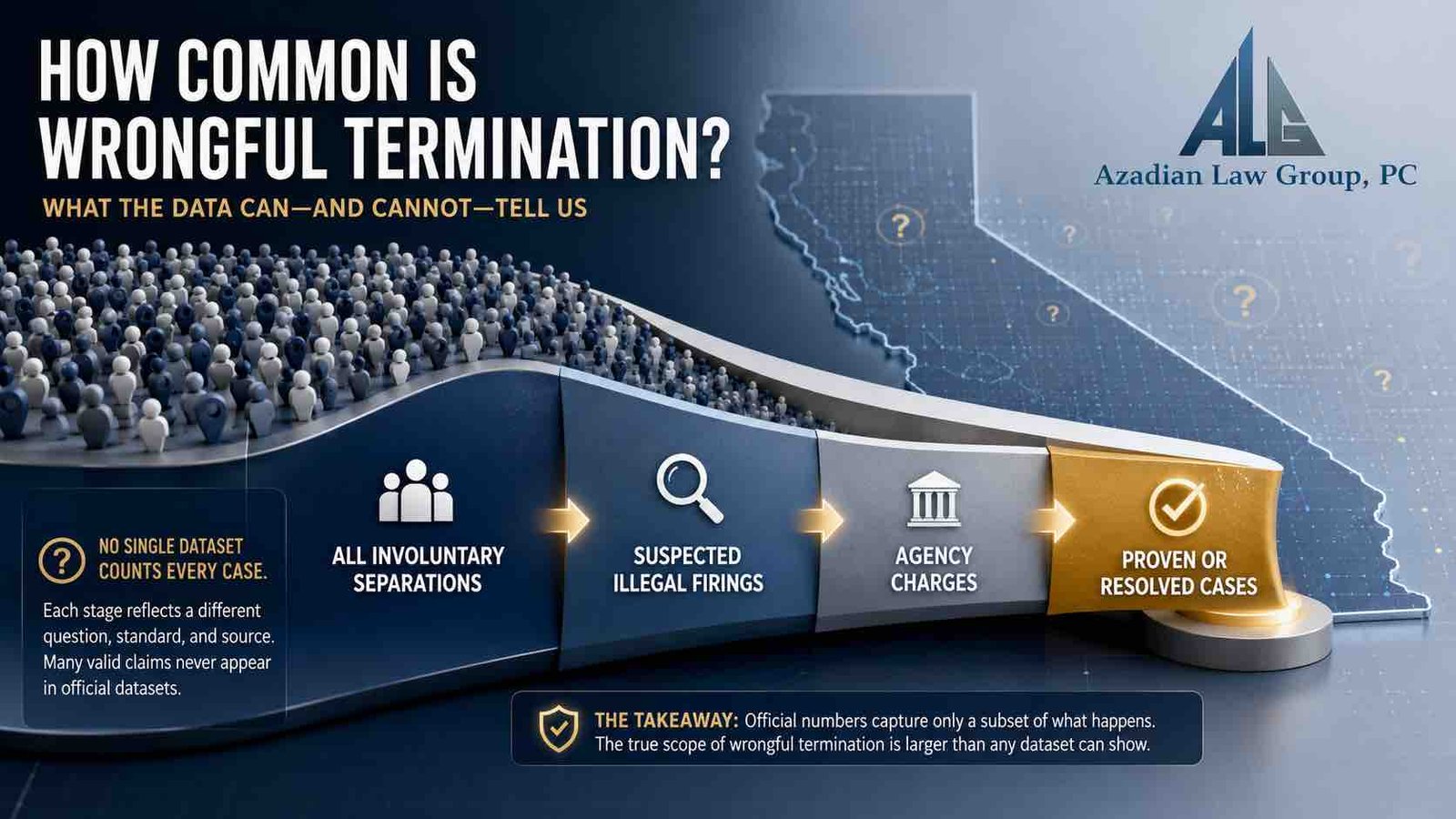
No authoritative database tells us exactly how common wrongful termination is in California or across the United States. Government labor statistics count layoffs and discharges, but they do not determine whether those employment decisions were legal. Civil-rights agencies count reported allegations within their jurisdiction, yet many complaints involve hiring, pay, promotion, harassment, accommodation, or other conduct—not only termination.
The most accurate answer is therefore nuanced: unlawful firings are serious and regularly alleged, but any universal claim that a fixed percentage of workers have been wrongfully terminated should be treated cautiously. The available numbers describe different stages of a much larger picture.
In July 2026, the U.S. Bureau of Labor Statistics estimated 1.7 million layoffs and discharges nationwide. That figure shows how frequently employers initiate separations, but it combines lawful layoffs, performance-based dismissals, seasonal terminations, business closures, and potentially unlawful firings. It is not a wrongful-termination count.
Separately, the U.S. Equal Employment Opportunity Commission processed 88,201 new discrimination charges in fiscal year 2025 and resolved 90,743 charges. Those numbers show substantial demand for federal enforcement. Still, a charge is an allegation, not a ruling, and not every charge concerns a firing.
Why Wrongful Termination Is So Difficult to Measure
“Wrongful termination” has a legal meaning. A firing is not legally wrongful merely because it was abrupt, unfair, poorly explained, or based on inaccurate information. The termination generally must violate a statute, fundamental public policy, enforceable contract, or another recognized legal protection.
That definition makes counting difficult. No government agency receives every type of employment claim. No database captures all confidential settlements, arbitration matters, internal resolutions, abandoned complaints, or workers who never report what happened. Published court decisions represent only a small slice of employment disputes.
Measurement is also complicated because one termination may support several overlapping allegations. An employee could claim disability discrimination, failure to accommodate, retaliation, interference with protected leave, and wrongful termination arising from the same separation. Counting every legal theory as a separate firing would inflate the number. Counting the matter only once would hide its complexity.
At the same time, many workers decide not to challenge a suspicious dismissal. They may fear reputational consequences, need to focus on finding work, lack records, miss a deadline, sign a release, or reasonably conclude that the available evidence is insufficient. Unreported conduct cannot appear in agency statistics.
What the Available Employment Data Actually Measures
Statistics become useful only when their scope is clear. Labor-market data, administrative charges, agency lawsuits, private lawsuits, and court judgments answer different questions.
| Data source or stage | What it measures | What it does not establish |
|---|---|---|
| BLS layoffs and discharges | Employer-initiated separations across the labor market | Whether any particular separation violated employment law |
| Internal HR complaint | A concern reported through an employer’s process | That the allegation was substantiated or fully investigated |
| EEOC or CRD filing | An allegation submitted to an administrative agency | That discrimination, retaliation, or wrongful termination occurred |
| Agency cause finding | An agency determination under its process and evidentiary record | A final court judgment binding every issue or party in all circumstances |
| Settlement | A negotiated resolution without completing trial | An admission of liability unless the agreement expressly says so |
| Verdict or judgment | A formal adjudicated outcome based on the claims and evidence presented | The prevalence of wrongful termination throughout the workforce |
The practical lesson is simple: large numbers can show that termination and workplace-rights disputes are consequential, but they cannot supply a universal “one in X workers” answer.
What Current BLS Data Tells Us About Employer-Initiated Separations
The Bureau of Labor Statistics’ Job Openings and Labor Turnover Survey tracks hires, quits, layoffs and discharges, and other separations. In July 2026, BLS estimated 1.7 million layoffs and discharges, representing a 1.0% monthly rate.
BLS defines layoffs and discharges broadly as involuntary separations initiated by an employer. The category may include layoffs with no intent to rehire, discharges for cause, terminations of permanent or short-term workers, and certain seasonal separations. It does not investigate motive or decide legality.
Therefore, multiplying a monthly figure by twelve would not produce a reliable count of unique workers or wrongful terminations. The same labor market contains hiring, rehiring, seasonal movement, multiple jobholding, and repeated transitions. Monthly estimates are useful for economic analysis, not individual legal conclusions.
Still, the scale provides context. Millions of employer-initiated separations occur over time, so even a relatively small unlawful share could affect many workers. The data just cannot identify that share.
What EEOC Data Reveals—and What It Does Not
The EEOC enforces federal laws covering discrimination based on race, color, religion, sex, national origin, age, disability, and genetic information, along with retaliation and pregnancy-related protections under applicable statutes.
In fiscal year 2025, the EEOC processed 88,201 new discrimination charges and resolved 90,743. It also reported almost $660 million in monetary relief through administrative enforcement and litigation for 17,680 individuals in private, state and local government, and federal workplaces.
Those are significant enforcement figures, but they are not a count of wrongful terminations. A charge may challenge harassment, hiring, unequal pay, promotion, accommodation, demotion, discipline, or discharge. One charge may allege multiple bases, and the filing itself does not prove that the employer violated the law.
Retaliation appeared in 54,350 fiscal year 2025 charges, or 61.6% of all charges. That percentage overlaps with other bases because one filing can allege retaliation and discrimination together. The figure reinforces how often retaliation is reported, but it does not mean 61.6% of fired workers were wrongfully terminated.
Anyone considering filing an EEOC charge in California should understand that beginning an online inquiry may not, by itself, complete a signed charge. Administrative deadlines can continue running while an employee uses an internal grievance, mediation, or another process.
Why the “One in Five Workers” Claim Should Not Be Repeated
Statistics about unfair treatment, perceived discrimination, retaliation, job loss, and legally established wrongful termination are not interchangeable. A survey may ask whether workers believe they were treated unfairly or dismissed without good cause. That experience is important, but it does not necessarily satisfy the elements of a legal claim.
Likewise, a statistic drawn from people who contacted lawyers or agencies cannot automatically represent the entire workforce. That group has already self-selected based on concern, awareness, access, and willingness to report. It may be useful for describing inquiries, but not national prevalence.
A reliable prevalence claim would need a clear definition of wrongful termination, a representative sample, verified legal facts, coverage across statutes and states, and a way to account for unreported and unresolved matters. The current public data does not meet all those requirements.
For that reason, this updated article does not replace the old percentage with another catchy number. Accuracy beats a dramatic statistic—especially when employees may use the information to make time-sensitive decisions.
What Makes a Termination Potentially Wrongful in California?
California generally follows at-will employment. An employer can often end an indefinite employment relationship without proving cause or using progressive discipline. Yet at-will authority stops where statutory, contractual, and public-policy protections begin.
The companion guide on California at-will employment and wrongful termination explains that boundary in detail. Common legal theories can include:
- Discrimination based on a protected characteristic.
- Retaliation for reporting or opposing suspected unlawful conduct.
- Whistleblower retaliation for protected disclosures or refusal to participate in illegal activity.
- Termination connected to protected medical, family, pregnancy, military, jury-duty, or other leave.
- Disability discrimination, failure to accommodate, or retaliation for requesting accommodation.
- Termination for exercising wage, safety, workers’ compensation, or other statutory rights.
- Discharge that violates an enforceable employment agreement or collective bargaining agreement.
- Termination contrary to a fundamental public policy grounded in constitutional or statutory law.
These categories depend on coverage and facts. A workplace dispute can feel deeply unfair without involving a protected reason. Conversely, an employer may use ordinary business language—performance, fit, attendance, or restructuring—to conceal an unlawful motive.
Which Wrongful-Termination Patterns Appear Most Often?
There is no definitive national ranking of wrongful-termination fact patterns. However, employee-side disputes frequently involve the intersection of a protected event and an abrupt change in treatment.
For example, an employee reports racial harassment and receives the first negative review of a successful career two weeks later. A worker requests medical leave, returns with restrictions, and is told the role has been eliminated even though the company advertises substantially similar duties. A payroll employee raises an overtime concern and is accused of disloyalty after years without discipline.
None of these scenarios proves illegality by itself. The employee’s performance, decision-maker knowledge, timing, comparative treatment, policy language, and employer explanation all matter. The strongest analysis asks what changed, who knew about the protected conduct, and whether the stated reason is consistent with contemporaneous evidence.
Common Warning Signs After a Firing
Warning signs are reasons to investigate, not shortcuts to a conclusion. Several facts pointing in the same direction are generally more meaningful than one ambiguous event.
| Warning pattern | Why it may matter | Possible lawful explanation to examine |
|---|---|---|
| Termination soon after a protected complaint | Timing may support a retaliatory connection | The decision process or documented concern began before the complaint |
| Sudden criticism after a strong history | A new paper trail may have been created to justify a decision | Job duties, leadership, metrics, or performance genuinely changed |
| Employer gives materially different reasons | Inconsistency may weaken credibility and suggest pretext | Different speakers summarized a multifactor decision differently |
| Comparable employees receive lighter discipline | Unequal enforcement may support discrimination or retaliation | The employees were not similarly situated in conduct, role, history, or decision-maker |
| Position is called eliminated but duties continue | The facts may conflict with a restructuring explanation | Duties were legitimately redistributed or redesigned |
| Biased or retaliatory remarks | Statements may reveal motive, especially from a decision-maker | The comment was remote, ambiguous, unrelated, or made by someone without influence |
The article on how to recognize a potentially wrongful termination helps employees distinguish suspicious patterns from ordinary workplace conflict.
Why Many Potential Claims Never Appear in Public Statistics
Public data naturally undercounts disputes that remain private. Employers and employees may resolve matters through confidential severance negotiations, pre-litigation settlements, private mediation, or arbitration. Published settlements may omit admissions and detailed facts.
Some employees never file because they lack evidence or do not know which law might apply. Others may discover the issue only after a replacement is announced, a witness comes forward, or the employer changes its explanation. By then, a short deadline may have expired.
There is also a selection effect in reported cases. Public verdicts often involve unusually developed evidence, high damages, or contested legal issues. They should not be treated as average outcomes. Confidential resolutions cannot be used to calculate a reliable public success rate.
Finally, an agency’s closure of a charge does not necessarily prove the employer acted lawfully. Agencies make decisions within their jurisdiction, procedures, evidence, and resource constraints. Likewise, receiving a right-to-sue notice does not establish that the employee will win in court.
What Evidence Can Help Evaluate a Suspected Wrongful Termination?
Most cases do not turn on one dramatic email. The evidence often works as a mosaic. A clear timeline may connect a complaint, management knowledge, changed treatment, inconsistent discipline, and termination.
Potentially useful records include offer letters, policies, performance reviews, objective metrics, accommodation requests, leave communications, HR complaints, disciplinary notices, schedules, pay records, termination documents, and severance agreements. Witnesses may help establish what a decision-maker said, when the employer began planning the termination, and how comparable workers were treated.
Employees should preserve only material they lawfully possess. They should not access systems after authorization ends, alter screenshots, take trade secrets, or remove privileged, medical, customer, or personnel records they are not entitled to keep.
The guide to wrongful-termination evidence in California explains how timing, comparator evidence, electronic communications, witnesses, and changing explanations can fit together.
How Often Do Wrongful-Termination Claims Succeed?
No responsible percentage can predict whether an individual claim will succeed. Outcomes vary by legal theory, evidence, employer coverage, witnesses, jurisdiction, forum, procedural history, damages, credibility, and defenses.
Agency recovery figures combine many forms of employment discrimination and resolution. Litigation statistics may reflect only cases filed or resolved by an agency, not private lawsuits. Published verdict databases tend to emphasize notable wins and may omit defense verdicts, dismissals, confidential settlements, and claims never filed.
A strong claim can also resolve without a trial. A weak claim may survive for a time without ultimately succeeding. Settlement does not necessarily mean either party admitted wrongdoing; businesses and employees may settle to control expense, uncertainty, time, and risk.
The better question is not, “What percentage of cases win?” It is, “What facts, evidence, deadlines, and defenses apply to this termination?”
What Should You Do If You Suspect Wrongful Termination?
Begin with facts rather than conclusions. Write a chronological account identifying important dates, decision-makers, protected complaints or requests, performance history, stated reasons, and witnesses. Keep the original wording of relevant messages whenever possible.
Next, preserve documents already available to you and review any severance agreement before signing. A release may affect discrimination, retaliation, wage, contract, whistleblower, and other claims. It may also create continuing confidentiality, cooperation, arbitration, or non-disparagement obligations.
Apply for unemployment benefits if appropriate, address health-insurance continuation, and track job-search efforts. Records of reasonable efforts to obtain comparable work may become relevant to wage-loss issues.
Most importantly, do not assume every claim shares the same deadline. Federal administrative periods, California Civil Rights Department filings, whistleblower statutes, contract claims, public-policy claims, arbitration rules, union procedures, and government-employer requirements can differ. The steps to take after suspected wrongful termination provide a practical starting framework.
How This Data Should Be Used
Current statistics support three defensible conclusions.
First, employer-initiated separations occur at enormous scale. Second, discrimination and retaliation generate tens of thousands of federal charges each year. Third, neither dataset identifies the percentage of firings that were legally wrongful.
That is not a weakness in the legal system; it is a measurement limitation. BLS studies labor-market movement. The EEOC administers specific federal statutes. Courts decide the disputes presented to them. Each source serves a different purpose.
A careful article should not blend those sources into a dramatic but false prevalence rate. It should help readers understand which data applies, recognize potential warning signs, and seek timely evaluation when the facts justify it.
Frequently Asked Questions About How Common Wrongful Termination Is
What percentage of firings are wrongful termination?
No authoritative national percentage exists. BLS counts layoffs and discharges without judging legality, while enforcement agencies capture only reported allegations within particular laws and jurisdictions.
Does an EEOC charge mean an employee was wrongfully terminated?
No. A charge is a signed allegation requesting agency action. It is not a judicial finding. It may concern termination or another employment action, and it can contain multiple discrimination or retaliation bases.
Are most unfair firings illegal?
No. A firing can be unfair, mistaken, inconsistent, or poorly managed without violating the law. A potentially wrongful termination generally requires an unlawful reason, violation of fundamental public policy, breach of an enforceable agreement, or another recognized protection.
Is being fired without warning wrongful termination?
Not automatically. California at-will employment often permits termination without progressive discipline or advance warning. A lack of warning may still matter when it conflicts with a contract, policy, comparative treatment, or evidence of unlawful motive.
Is retaliation a common basis for employment charges?
Yes. Retaliation appeared in 54,350 EEOC charges in fiscal year 2025, representing 61.6% of all charges. Because filings may allege multiple bases, that figure does not mean the same percentage of all workers or firings involved unlawful retaliation.
Why do many wrongful-termination cases remain invisible?
Some workers do not report, some matters resolve privately, and many disputes occur in confidential arbitration or settlement. Other employees may lack sufficient evidence, sign a release, miss a deadline, or decide not to proceed.
Can a settlement be counted as proof of wrongful termination?
Not necessarily. Settlements often resolve disputed claims without an admission of liability. Their terms may be confidential, so public data rarely provides a complete account of the allegations, evidence, or reasons for resolution.
What is the clearest warning sign of wrongful termination?
No single warning sign controls every case. A combination of protected activity, decision-maker knowledge, close timing, changing explanations, unequal discipline, biased comments, and conflicting records may justify closer review.
How long do employees have to challenge a termination?
The deadline depends on the claim and forum. Some administrative and government-employer requirements can be short. Employees should seek prompt advice rather than selecting a date from a general article.
Can a lawyer tell whether my firing was illegal?
An attorney can evaluate the available facts, documents, legal theories, deadlines, damages, and defenses. No responsible lawyer can promise an outcome before reviewing the evidence and applicable law.
Request a Review of a Potentially Unlawful Firing
Wrongful termination cannot be reduced to one national percentage. What matters to an individual employee is whether the evidence connects the firing to discrimination, retaliation, whistleblowing, protected leave, a contract, or another unlawful reason.
Experienced California wrongful termination lawyers can examine the complete timeline instead of relying on a misleading statistic.
For a conversational explanation of how protected complaints, retaliation, and dismissal can intersect, listen to Azadian Law Group’s podcast on wrongful termination and employee rights.
If you believe your employer crossed the line from unfair treatment into an unlawful termination, request a confidential evaluation or call 213-229-9031.
This article provides general educational information, not legal advice. Employment matters are fact-specific, deadlines may apply, and reading this page or contacting the firm does not create an attorney-client relationship.


Related Blog Posts
Wrongful Termination Evidence Often Appears as a Pattern Wrongful termination evidence is rarely found in one dramatic email admitting that...
Read MoreOracle Layoffs Raise New Questions for California Employees Oracle has reportedly begun another round of layoffs in the United States,...
Read MoreArtificial intelligence has already started screening resumes, measuring productivity, writing performance reviews, and recommending layoffs. Now it has reportedly helped...
Read MoreTypes of Cases Handle By Employment Lawyers in Los Angeles, CA
The following presents an overview of the broad range of employment law cases that our employment attorneys are experienced at overseeing and favorably resolving.
Wrongful Termination
Wrongful Termination Lawyers in Los Angeles, CA Attorneys at Azadian Law Group who have filed wrongful termination lawsuits acknowledge that unfair termination can significantly impact an employee’s life. It can…
Age Discrimination
Age Discrimination Lawyers in Los Angeles, CA Azadian Law Group, PC regularly represents clients throughout Los Angeles, CA, who are the victims of age discrimination in the workplace. At Azadian…
Pregnancy Discrimination
Pregnancy Discrimination Lawyer in Los Angeles, CA At Azadian Law Group, PC, our pregnancy discrimination lawyer in Los Angeles, regularly represents clients who are the victims of pregnancy discrimination in…
Sexual Harassment
Sexual Harassment Attorney in Los Angeles, CA The Los Angeles Sexual Harassment Lawyers at Azadian Law Group, PC, know that in today’s modern era, some people often make the mistake of…
Racial Discrimination
Racial Discrimination Lawyers in Los Angeles, CA Azadian Law Group, PC regularly represents clients throughout Los Angeles who are the victims of racial discrimination at work. The Los Angeles Race…
Disability Discrimination
When a Medical Condition Becomes a Workplace Problem, You Have Rights Most employees never expect a health condition to place their career at risk. Yet every day across Los Angeles,…
Praise from Our Clients
Lui H

Arpi Agdere
Tofi
Aracelis Feria
Ivy Gamboa
Jillian Dunlap
Greg Wayne
Elizabeth Eromosele
Steve G
Lisa Galvan
Artur Aleksanyan
Delight Dinopoulos
George Margaros
Chelsea Pham
Trevor Pal-Freeman
Patricio Garza
Taylor
Ashley Londerman
Marissa Zapanta
Nuria Coronado
Barbara Villalobos
Irene Golub
Joshua Butler
J Mo
Employees We Represent in Employment Law Cases
At Azadian Law Group, we represent employees throughout Los Angeles and California who have experienced workplace violations. Our attorneys handle employment law matters including wrongful termination, workplace discrimination, retaliation, harassment, wage and hour violations, and whistleblower protection.
Employees often face unlawful treatment after reporting misconduct, requesting medical leave, or asserting their legal rights at work. Our firm investigates employment law violations and advocates for workers seeking accountability, compensation, and fair treatment under California and federal employment law.

Step 1
Explore our comprehensive range of legal services to find the specialized support you need.
Step 2
Arrange a free initial meeting with our experts to discuss your legal situation.
Step 3
Receive a custom strategy specially created for your case by our legal experts.
Call Us Now 213-229-9031
Tell Us Your Story
Speak out for justice. Your story can be the start of a new chapter of workplace fairness.
