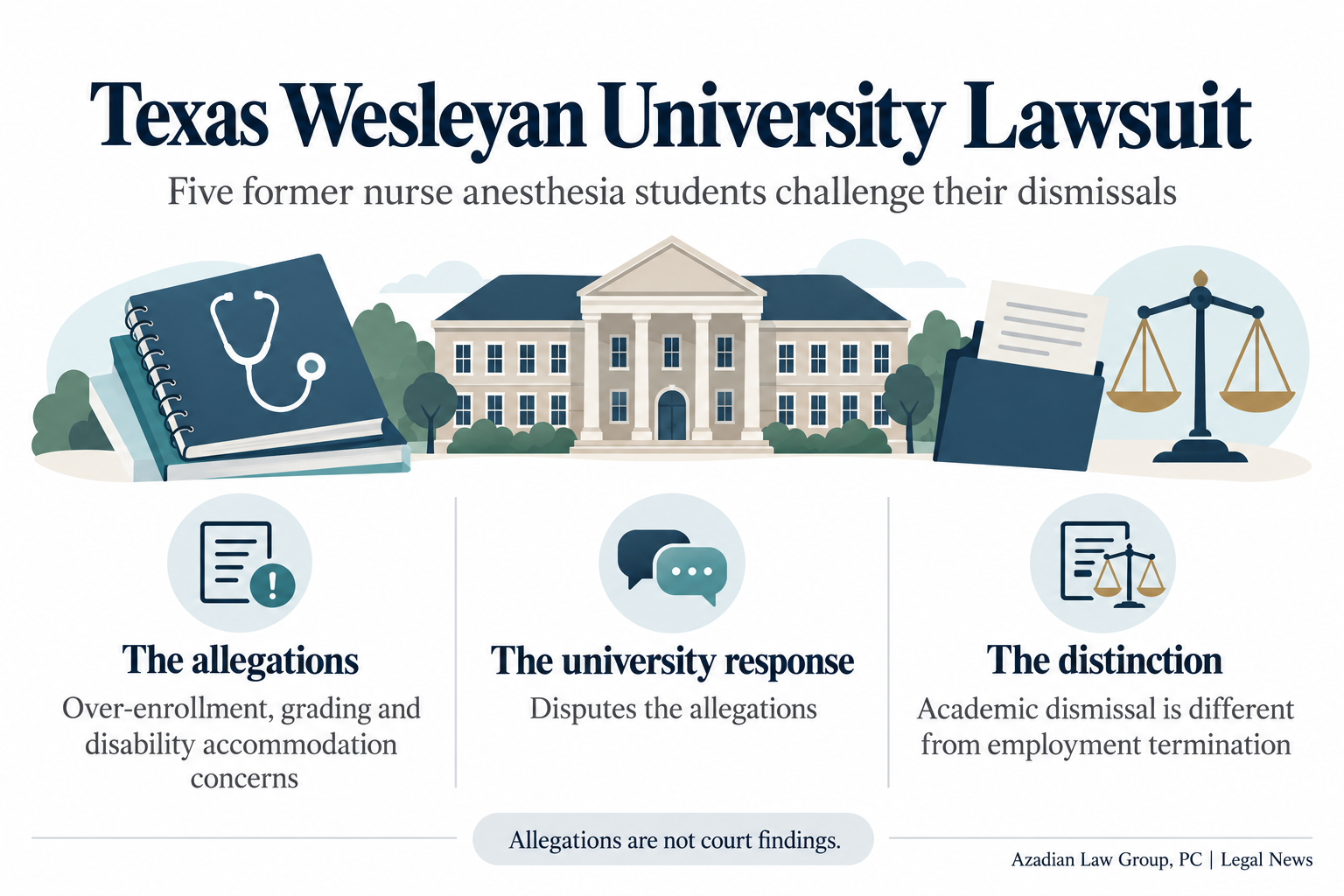
Five Former Students File Lawsuit Against Texas Wesleyan University
Getting into a demanding graduate program takes years of work. Being dismissed can leave someone trying to make sense of tuition bills, an interrupted career and a decision they believe was unfair.
Five former nurse anesthesia students at Texas Wesleyan University in Fort Worth are challenging their dismissals in court. Their dispute raises questions about academic decisions, disability-related support and the records students need to challenge an outcome.
For readers in healthcare, there is an important distinction: removal from a degree program and termination from a job involve different legal relationships. Understanding that difference helps explain what this lawsuit does—and does not—mean for California workers.
What the Former Students Allege
According to an October 29, 2026 press release describing the students’ claims, the university allegedly enrolled more students than its clinical placements could accommodate, then used first-year anatomy and physiology courses to remove students after collecting tuition. The students also challenge grading transparency, access to records during appeals and disability or medical-emergency accommodations.
The release identifies the case as Castro et al. v. Texas Wesleyan University, No. 4:26-cv-01272, in the Northern District of Texas, Fort Worth Division. It says the plaintiffs seek reinstatement and monetary relief.
How Has Texas Wesleyan Responded?
Hoodline’s coverage, citing WFAA’s reporting, says Texas Wesleyan strongly disputes the allegations and intends to respond through the legal process. The university also defended its program’s educational standards and record of preparing nurse anesthetists.
A lawsuit presents claims for a court to consider. It does not establish that a university discriminated, manipulated grades or acted unlawfully. The competing accounts should be read with that distinction in mind.
Why an Academic Dismissal Is Different From Being Fired
The word “dismissal” can be confusing. In everyday conversation, it may mean losing a job. Here, it concerns students’ continued participation in an academic program.
A student’s dispute may require examination of a university’s academic policies, enrollment terms, disability obligations and appeal procedures. An employee’s dispute requires examination of the employment relationship and the laws governing it. The fact that a course prepares someone for a job does not, by itself, make every disagreement with the school an employment claim.
That distinction matters for people who hold more than one role. Someone may be a student in one setting and a paid employee in another. A problem involving classroom testing might require a different analysis from a hospital’s decision to reduce that person’s work hours or end their employment.
Before choosing a legal route, clarify who made the decision, what relationship they had with the person affected and which opportunity was taken away. Calling every removal “wrongful termination” can obscure those facts.
Disability Support and Academic Standards Can Coexist
Graduate healthcare programs have serious responsibilities. Students must develop the knowledge and skills needed for safe patient care. Disability-related support does not mean a program must award a passing grade or disregard an essential competency.
At the same time, the U.S. Department of Education explains that qualified postsecondary students with disabilities may receive academic modifications and auxiliary aids to provide an equal opportunity to participate.
Under Section 504, institutions accepting federal financial assistance must consider appropriate academic adjustments. The Department’s postsecondary guidance also distinguishes adjustments from changes that would fundamentally alter a program or its essential requirements.
For a student, the practical question is often specific: What barrier is the disability creating, what adjustment would address it and would that adjustment preserve the skill being assessed? A request for a different testing arrangement, for example, needs to be evaluated in its actual context. It should not be assumed to require a lower standard simply because the student needs support.
Why Access to Education Records Matters
It is difficult to challenge a decision when you cannot see the information behind it. A clear explanation of how a grade was calculated can help identify whether the dispute involves arithmetic, a policy interpretation or something more substantial.
Under FERPA, covered institutions generally must allow a parent or eligible student to inspect and review education records within a reasonable time, no later than 45 days after receiving the request. The Department of Education’s records-access guidance explains that some state laws may require a shorter period.
That federal timeframe should not be confused with a university’s appeal deadline. If an appeal is due sooner, ask in writing about access to the relevant records and whether an extension is available. Do not assume that making a records request automatically pauses another deadline.
A records-access concern also does not, on its own, resolve whether the underlying academic decision was justified. The two questions may be related, but they need separate attention.
What Students Can Keep When a Dispute Develops
When someone receives upsetting news, the first instinct is often to call and ask for an explanation. That conversation can help, but a written record makes it easier to understand what happened later.
Useful materials to organize may include:
- The handbook, course syllabus and academic policies in effect during the relevant term.
- Grade notices and dated screenshots of the student’s own available records.
- Accommodation requests, supporting documentation and responses.
- Dismissal notices and explanations of the decision.
- Records requests, appeal instructions and any stated deadlines.
- A dated timeline of conversations, with a clear distinction between exact words and personal recollection.
Keep copies you are entitled to possess. Do not access another student’s account, bypass security controls or collect patient information to build a personal file.
Someone challenging an academic decision should seek advice from a lawyer who handles the relevant education or disability issues in the appropriate jurisdiction. The rules governing a Texas student dispute should not be assumed to match California employment law.
The Separate Lesson for California Healthcare Employees
A nurse, technician or other healthcare employee may face a different problem: asking for help with a medical limitation and then experiencing discipline, reduced duties or pressure to leave. Those facts call for an employment-law analysis.
The California Civil Rights Department explains that FEHA generally requires employers with five or more employees to provide reasonable accommodations for qualifying disabilities unless doing so would cause undue hardship. Employers also have obligations to engage in a timely, good-faith interactive process when the need for an accommodation arises.
Depending on the circumstances, an accommodation might involve a schedule change, equipment or leave for medical care. The answer depends on the employee’s limitations and essential job duties. A request does not automatically require approval of a particular arrangement.
Our guide to disability discrimination at work explains this separate employment context. Employees dealing specifically with time away from work can also read about medical leave rights, which may involve additional eligibility requirements.
When an Accommodation Request Is Followed by Discipline
Timing can make a situation worth examining, but it does not tell the whole story. A decision made after an accommodation request is not necessarily a decision made because of that request.
For a workplace dispute, organize the chronology before drawing a conclusion. What concerns had the employer documented before the request? What changed afterward? Who knew about the limitation? Did the explanation stay consistent?
Those questions help an attorney evaluate the available evidence without assuming that every negative review or disagreement is discriminatory. For an accessible discussion of this issue, see our episode on being fired after requesting a disability accommodation.
Questions Readers May Have
Does this lawsuit establish that the university broke the law?
No. Filing a lawsuit does not establish liability. Allegations must be evaluated through the legal process.
Does a disability prevent a school from dismissing a student?
Not automatically. Academic requirements and applicable disability protections must both be considered. An accommodation is not a guarantee of successful completion.
Can a California employee use the same legal claims as a Texas student?
Do not assume so. The location, legal relationship, decision at issue and applicable protections can differ. A lawyer needs to evaluate the person’s own circumstances.
Getting Help With a Workplace Problem in Los Angeles
Azadian Law Group represents employees in California workplace disputes. If your concern involves losing your job after requesting disability support or exercising workplace rights, a Los Angeles wrongful termination lawyer can evaluate the facts and explain the available options. You can call 213-229-9031 to discuss a potential employment matter.
This article provides general information. It does not imply that Azadian Law Group represents a party in the Texas Wesleyan lawsuit or that a court has established the reported allegations.


Related Blog Posts
Your Los Angeles employer announces a return-to-office deadline. You explain that a medical condition makes the new schedule difficult and...
Read MoreRequesting a reasonable accommodation for a disability is a protected right under both federal and California state laws. However, some...
Read MoreIn today’s rapidly evolving world, technology has become a powerful tool in addressing various forms of discrimination, including disability discrimination....
Read MoreTypes of Employment Cases We Handle.
The following presents an overview of the broad range of employment law cases that our employment attorneys are experienced at overseeing and favorably resolving.
Wrongful Termination
Wrongful Termination Lawyers in Los Angeles, CA Attorneys at Azadian Law Group who have filed wrongful termination lawsuits acknowledge that unfair termination can significantly impact an employee’s life. It can…
Age Discrimination
Age Discrimination Lawyers in Los Angeles, CA Azadian Law Group, PC regularly represents clients throughout Los Angeles, CA, who are the victims of age discrimination in the workplace. At Azadian…
Pregnancy Discrimination
Pregnancy Discrimination Lawyer in Los Angeles, CA At Azadian Law Group, PC, our pregnancy discrimination lawyer in Los Angeles, regularly represents clients who are the victims of pregnancy discrimination in…
Sexual Harassment
Sexual Harassment Attorney in Los Angeles, CA The Los Angeles Sexual Harassment Lawyers at Azadian Law Group, PC, know that in today’s modern era, some people often make the mistake of…
Racial Discrimination
Racial Discrimination Lawyers in Los Angeles, CA Azadian Law Group, PC regularly represents clients throughout Los Angeles who are the victims of racial discrimination at work. The Los Angeles Race…
Disability Discrimination
When a Medical Condition Becomes a Workplace Problem, You Have Rights Most employees never expect a health condition to place their career at risk. Yet every day across Los Angeles,…
Praise from Our Clients
A“

QT
RT
KM
BM
HM
bS
kj
SM
TM
FL
kr
TP
CF
WW
JA
RM
RC
VM
JS
TH
SD
RM
AC
W
kn
AO
DN
KW
TP
RS
L
D
la
JG
DP
RK
HL
TP
sr
sl
PD
SS
SS
JB
JA
AR
CG
LH
YU
MS
TA
NS
aa
RC
AR
mp
IG
N
JJ
Kd
GA
aa
GB
RT
MM
PP
PA
DV
T
AW
CW
SM
TC
SC
hh
KK
DB
S
SM
VV
K&
PG
JL
SS
AC
MS
DS
DM
ZM
CA
AF
GC
jg
GN
AG
A
KG
EC
s
MZ
m
LD
PW
PD
CH
TA
KM
PZ
CA
rc
FA
JA
MJ
SM
kr
LH
BJ
DG
JJ
ES
WW
VS
TH
VB
GA
DM
LS
SM
AS
wm
MH
DA
TP
LA
DR
MM
D
RG
WR
Employees We Represent in Employment Law Cases
At Azadian Law Group, we represent employees throughout Los Angeles and California who have experienced workplace violations. Our attorneys handle employment law matters including wrongful termination, workplace discrimination, retaliation, harassment, wage and hour violations, and whistleblower protection.
Employees often face unlawful treatment after reporting misconduct, requesting medical leave, or asserting their legal rights at work. Our firm investigates employment law violations and advocates for workers seeking accountability, compensation, and fair treatment under California and federal employment law.

Step 1
Explore our comprehensive range of legal services to find the specialized support you need.
Step 2
Arrange a free initial meeting with our experts to discuss your legal situation.
Step 3
Receive a custom strategy specially created for your case by our legal experts.
Call Us Now 213-229-9031
Tell Us Your Story
Speak out for justice. Your story can be the start of a new chapter of workplace fairness.
