Pasadena Pavilions Closure: What Employees Should Know About Layoffs and Wrongful Termination
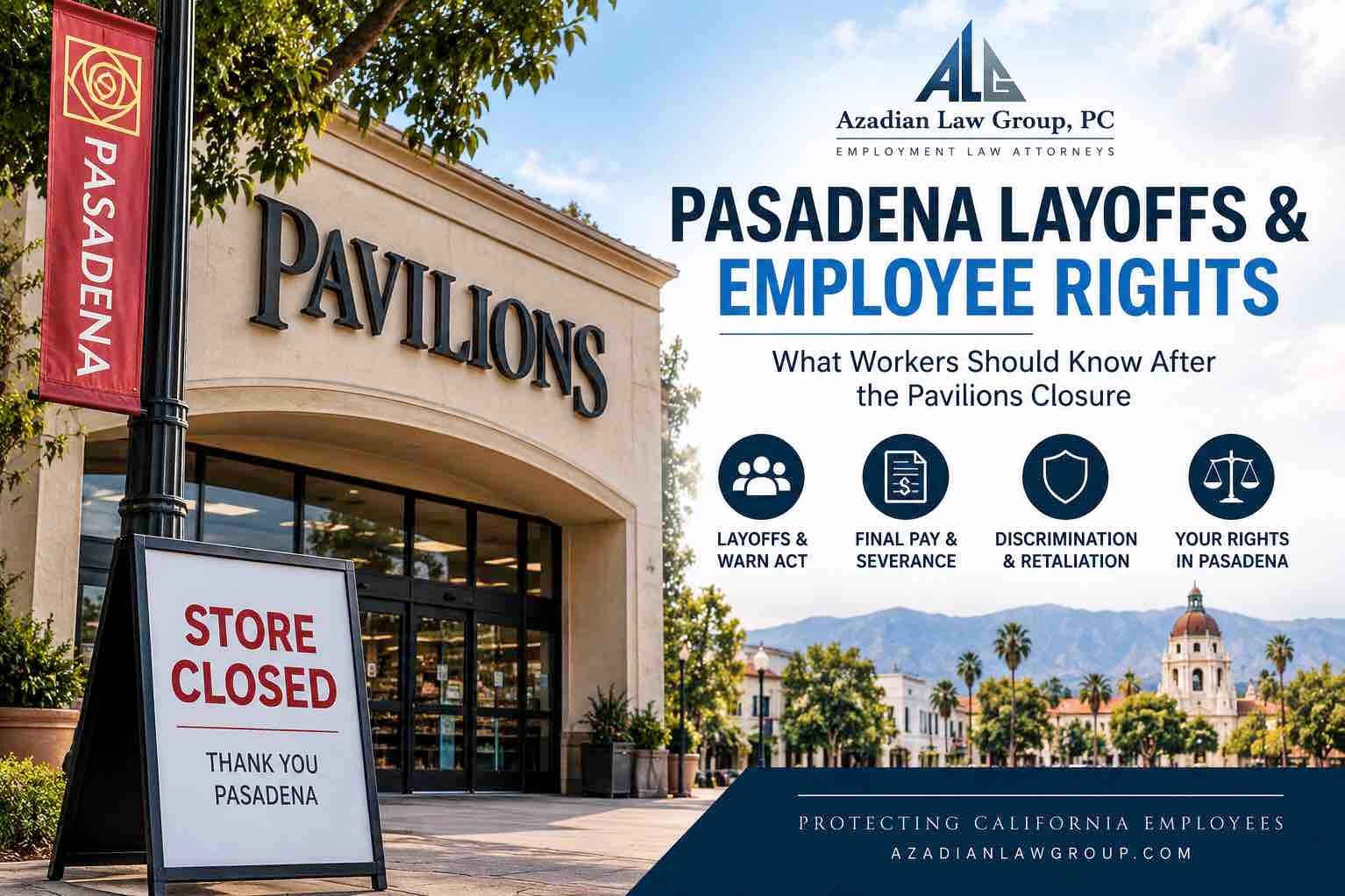
The closure of the Pavilions supermarket on East California Boulevard in Pasadena is a reminder of how quickly a workplace change can affect employees and their families.
For employees, however, the closure of a workplace raises questions that go beyond whether the business will remain open.
What happens to final wages? Can workers be transferred to another location? What if some employees are retained while others are terminated? What if an employee recently complained about discrimination, requested medical leave, reported wage violations, or asked for a disability accommodation?
A business generally has the right to close a location or reduce its workforce for legitimate reasons. That does not mean California employment laws stop applying during the process.
Employees who are uncertain about their rights can speak with a Pasadena employment lawyer about the particular circumstances surrounding a layoff or termination.
A Business Closure Is Not Automatically Wrongful Termination
One distinction is especially important.
Losing a job because an employer legitimately closes a store, eliminates a department, or reduces its workforce does not by itself establish wrongful termination.
California generally follows the principle of at-will employment, subject to important statutory, contractual, and public-policy exceptions. Employers still cannot terminate employees for prohibited reasons.
A reduction in force cannot lawfully be used as a cover for discrimination, retaliation, or another unlawful motive.
For example, additional questions may arise when an employee selected for termination had recently:
- Complained about discrimination or harassment
- Requested a reasonable accommodation
- Taken or requested protected medical or family leave
- Reported unpaid wages or overtime
- Raised workplace safety concerns
- Reported suspected unlawful conduct
- Participated in a workplace investigation
- Requested pregnancy-related accommodations
Employees who believe a layoff was actually connected to an unlawful reason can learn more about wrongful termination and employee rights in California.
The existence of a genuine layoff does not necessarily answer a different question: Why was a particular employee selected?
When a Pasadena Layoff May Raise Wrongful Termination Questions
Large employment decisions often involve groups of workers, but wrongful termination disputes frequently turn on individual facts.
Imagine that an employer eliminates 50 positions.
Most of those terminations could be entirely lawful. But suppose an employee who complained about sexual harassment two weeks earlier was selected while comparable employees were transferred to another location.
Or consider an employee with a disability who had recently requested an accommodation and was terminated while similarly situated coworkers were retained.
Those circumstances do not automatically prove unlawful conduct. They may, however, justify examining how the decision was made.
An employment attorney evaluating the situation may examine the chronology, communications, decision-makers, performance history, treatment of comparable employees, and the employer’s stated explanation.
Selection for a Layoff Can Matter as Much as the Layoff Itself
Employers sometimes have legitimate reasons to eliminate positions while still making potentially unlawful decisions about who loses those positions.
Suppose an employer needs to reduce a department from 20 employees to 10.
The reduction itself may be financially necessary.
But if employees are selected because of age, disability, race, sex, religion, or another legally protected characteristic, the legitimate need to reduce headcount does not necessarily resolve the legality of the selection process.
This is why employees should distinguish between two questions:
Why did the company reduce its workforce?
and
Why was I personally selected?
Those questions can have very different answers.
Retaliation Before a Layoff Deserves Careful Attention
Timing can become especially important in retaliation disputes.
California and federal laws protect employees from retaliation in a variety of circumstances. Depending on the law involved, protected conduct can include reporting discrimination or harassment, requesting protected leave, complaining about certain wage violations, participating in an investigation, or reporting conduct an employee reasonably believes violates the law.
If an employee is terminated shortly after engaging in protected activity during a restructuring or reduction in force, the sequence of events may deserve closer examination.
Employees facing this situation can learn more about protections against workplace retaliation.
Timing alone does not establish retaliation.
Other evidence may include:
- Statements made by supervisors or managers
- Sudden negative performance reviews
- Changes in treatment after a complaint
- Exclusion from meetings or responsibilities
- Inconsistent explanations for the termination
- Departures from established company procedures
- Different treatment of comparable employees
- Emails, messages, or internal communications concerning the decision
The broader timeline can therefore be critical when evaluating whether a termination was simply part of a legitimate layoff or potentially involved retaliation.
Transfers and Reassignments Can Also Be Relevant
When an employer operates multiple locations, employees may want to understand how transfer opportunities are offered and who receives them.
An employer is not automatically required to transfer every employee whenever a location closes. Employment policies, collective bargaining agreements, qualifications, seniority systems, and applicable laws may affect the analysis.
But inconsistent treatment can sometimes become relevant evidence in an employment dispute.
For example, questions may arise when similarly situated employees receive different treatment and the difference appears connected to protected activity or a protected characteristic.
Employees should therefore consider preserving lawfully accessible transfer notices, job postings, emails, and other communications concerning alternative positions.
California WARN Act Rights During Larger Layoffs and Closures
Some workplace closures, relocations, and mass layoffs can trigger advance-notice requirements under California’s Worker Adjustment and Retraining Notification Act, commonly known as the WARN Act.
The California Employment Development Department’s WARN guidance provides information about California WARN requirements, notices, and resources available when covered employers conduct qualifying layoffs, relocations, or terminations.
California’s WARN requirements should not be confused with the federal WARN Act. Whether either law applies depends on factors such as the employer, workforce size, nature of the employment action, and statutory requirements.
Employees should not assume that every store closure automatically creates a WARN violation.
Likewise, receiving a WARN notice does not determine whether every other aspect of a termination was lawful.
WARN rights and wrongful termination claims can involve different legal questions.
Employees and employers seeking additional information can also review the California EDD’s WARN Act frequently asked questions.
Final Paychecks After a California Termination
California has specific requirements governing final wages.
When an employer terminates an employee, earned and unpaid wages generally must be paid at the time of termination. Accrued and unused vested vacation may also need to be paid.
Other compensation can create additional questions involving:
- Commissions
- Bonuses
- Overtime
- Meal and rest period premiums
- Expense reimbursements
- Other earned compensation
Employees affected by a closure should review their final wage statements carefully rather than assuming payroll automatically calculated everything correctly.
Records should be preserved if anything appears inconsistent.
Evidence Employees Should Save After a Layoff
Employment disputes are often decided by evidence created before anyone expected litigation.
Employees should consider preserving lawfully accessible records relevant to their employment.
Potentially useful evidence can include:
- Termination or layoff notices
- WARN notices
- Performance evaluations
- Disciplinary records
- Emails and text messages
- Accommodation requests
- Leave requests
- Complaints made to HR
- Responses from supervisors or HR
- Pay stubs and wage statements
- Transfer communications
- Job descriptions
- Names of potential witnesses
Employees should not take confidential information or documents they have no legal right to possess.
The objective is to preserve legitimate employment records that may later help establish what happened and when.
Disability and Accommodation Requests Before a Layoff
Another potentially important situation involves an employee who requested workplace accommodations before being selected for termination.
California and federal disability laws can impose obligations on covered employers concerning reasonable accommodations and the interactive process.
A legitimate restructuring does not automatically erase those obligations or permit an employee to be selected for termination because of a disability.
Employees concerned about this issue can review Azadian Law Group’s information about disability discrimination and reasonable accommodation rights.
Evidence such as accommodation requests, medical restrictions, HR communications, performance evaluations, and the timing of the termination may become particularly important.
Watch for Changing Explanations
One issue that can become significant in a wrongful termination dispute is whether an employer’s explanation changes over time.
For example, an employee may initially be told:
Your position is being eliminated because the location is closing.
Later, the employer may claim that the employee was selected because of performance problems.
That does not automatically establish wrongful termination. Employers can have more than one legitimate reason for an employment decision.
But materially inconsistent explanations can be relevant when evaluating whether the employer’s stated reason accurately reflects what happened.
Evidence suggesting that a stated reason is not the actual reason for an employment decision is often discussed in employment litigation in terms of pretext.
What If Other Employees Were Offered Jobs but You Were Not?
Being denied a transfer does not automatically establish discrimination or retaliation.
There may be legitimate differences involving seniority, qualifications, job classifications, availability, collective bargaining agreements, or business needs.
But employees may reasonably want to understand the selection process when comparable coworkers were transferred and they were not.
Useful questions can include:
- Who made the transfer decisions?
- What criteria were used?
- Were those criteria documented beforehand?
- Were they applied consistently?
- Did the employer follow its existing policies?
- Were employees with similar qualifications treated differently?
- Had the employee recently engaged in protected activity?
Patterns become more meaningful when supported by evidence rather than assumptions.
What If You Were Already Having Problems With Management Before the Closure?
A closure does not erase events that occurred beforehand.
Suppose an employee had spent months requesting a disability accommodation and management allegedly complained about the employee’s restrictions.
Or an employee had reported harassment and claimed a supervisor subsequently began documenting minor performance issues.
If that employee is later terminated during a broader layoff, the closure becomes part of the factual background, but it may not answer every legal question.
The entire chronology matters.
California Employees Still Have Protections During Difficult Business Decisions
Layoffs are sometimes unavoidable.
Businesses close. Locations become unprofitable. Companies reorganize. Positions disappear.
Employment law does not generally prevent employers from making legitimate business decisions.
It does, however, place legal boundaries around how those decisions are implemented.
An employer generally cannot use a closure or reduction in force to retaliate against an employee for exercising legally protected rights or intentionally select workers for termination because of legally protected characteristics.
That distinction can be central to California employment disputes.
Questions Pasadena Employees Can Ask After Losing Their Jobs
Employees terminated during a closure or layoff may want to reconstruct what happened while events are still fresh.
Consider writing down:
- When you first learned your position was at risk
- What reason you were given for the termination
- Who communicated the decision
- Whether the explanation changed
- Whether transfers were offered
- Which comparable employees were retained or transferred
- Whether you recently complained about workplace conduct
- Whether you requested protected leave or an accommodation
- Whether your performance history changed unexpectedly
- What communications occurred immediately before the termination
A contemporaneous timeline can be far more useful than attempting to reconstruct events months later.
When Should a Pasadena Employee Speak With an Employment Lawyer?
Not every layoff requires legal action.
But employees may want legal advice when the circumstances surrounding their termination raise questions about discrimination, retaliation, protected leave, disability accommodation, unpaid wages, whistleblowing, or another protected right.
The sooner the circumstances are evaluated, the easier it may be to identify and preserve relevant evidence.
Azadian Law Group represents employees in Pasadena and throughout Los Angeles County in employment disputes involving wrongful termination, workplace retaliation, discrimination, harassment, and other alleged violations of California employment law.
Employees who believe their termination involved more than an ordinary business decision can speak with a Pasadena employment lawyer about the facts and potential legal options.
Frequently Asked Questions About Pasadena Layoffs and Wrongful Termination
Is Being Laid Off in Pasadena Considered Wrongful Termination?
Not automatically. Employers may conduct legitimate layoffs and close locations. A termination may raise wrongful termination concerns when an employee alleges they were selected for a prohibited reason such as unlawful discrimination or retaliation.
Can an Employer Terminate Me While I Have a Discrimination Complaint Pending?
An employer is not automatically prohibited from making an otherwise lawful employment decision because an employee filed a complaint. However, an employer cannot lawfully terminate an employee because the employee engaged in protected activity.
Can a Company Use a Layoff as an Excuse to Fire Someone Who Complained to HR?
A reduction in force cannot lawfully be used as a pretext for prohibited retaliation. Determining what occurred can require examining timing, selection criteria, communications, treatment of comparable employees, and other evidence.
Does My Employer Have to Transfer Me If My Pasadena Workplace Closes?
Not necessarily. Transfer rights can depend on employer policies, contracts, collective bargaining agreements, qualifications, and applicable law. How transfer opportunities are distributed can nevertheless be relevant in some discrimination or retaliation disputes.
Should I Sign a Severance Agreement Immediately?
Employees should understand what they are agreeing to before signing a severance or release. Such agreements can contain releases of legal claims and other significant provisions. Employees with concerns about their termination may want to obtain legal advice before signing.
Can I Have a Wrongful Termination Claim Even If Many Other Employees Were Also Laid Off?
Potentially. A legitimate reduction in force does not necessarily resolve whether an individual employee was selected for an independently unlawful reason. The facts surrounding the selection matter.
What Evidence Is Important in a Pasadena Wrongful Termination Case?
Potential evidence includes performance reviews, emails, text messages, HR complaints, accommodation or leave requests, termination documents, witness information, the employer’s stated reasons, and information showing how comparable employees were treated.


Related Blog Posts
Types of Cases Handle By Employment Lawyers in Los Angeles, CA
The following presents an overview of the broad range of employment law cases that our employment attorneys are experienced at overseeing and favorably resolving.
Wrongful Termination
Wrongful Termination Lawyers in Los Angeles, CA Attorneys at Azadian Law Group who have filed wrongful termination lawsuits acknowledge that unfair termination can significantly impact an employee’s life. It can…
Age Discrimination
Age Discrimination Lawyers in Los Angeles, CA Azadian Law Group, PC regularly represents clients throughout Los Angeles, CA, who are the victims of age discrimination in the workplace. At Azadian…
Pregnancy Discrimination
Pregnancy Discrimination Lawyer in Los Angeles, CA At Azadian Law Group, PC, our pregnancy discrimination lawyer in Los Angeles, regularly represents clients who are the victims of pregnancy discrimination in…
Sexual Harassment
Sexual Harassment Attorney in Los Angeles, CA The Los Angeles Sexual Harassment Lawyers at Azadian Law Group, PC, know that in today’s modern era, some people often make the mistake of…
Racial Discrimination
Racial Discrimination Lawyers in Los Angeles, CA Azadian Law Group, PC regularly represents clients throughout Los Angeles who are the victims of racial discrimination at work. The Los Angeles Race…
Disability Discrimination
When a Medical Condition Becomes a Workplace Problem, You Have Rights Most employees never expect a health condition to place their career at risk. Yet every day across Los Angeles,…
Praise from Our Clients
Lui H

Arpi Agdere
Tofi
Aracelis Feria
Ivy Gamboa
Jillian Dunlap
Greg Wayne
Elizabeth Eromosele
Steve G
Lisa Galvan
Artur Aleksanyan
Delight Dinopoulos
George Margaros
Chelsea Pham
Trevor Pal-Freeman
Patricio Garza
Taylor
Ashley Londerman
Marissa Zapanta
Nuria Coronado
Barbara Villalobos
Irene Golub
Joshua Butler
J Mo
Employees We Represent in Employment Law Cases
At Azadian Law Group, we represent employees throughout Los Angeles and California who have experienced workplace violations. Our attorneys handle employment law matters including wrongful termination, workplace discrimination, retaliation, harassment, wage and hour violations, and whistleblower protection.
Employees often face unlawful treatment after reporting misconduct, requesting medical leave, or asserting their legal rights at work. Our firm investigates employment law violations and advocates for workers seeking accountability, compensation, and fair treatment under California and federal employment law.

Step 1
Explore our comprehensive range of legal services to find the specialized support you need.
Step 2
Arrange a free initial meeting with our experts to discuss your legal situation.
Step 3
Receive a custom strategy specially created for your case by our legal experts.
Call Us Now 213-229-9031
Tell Us Your Story
Speak out for justice. Your story can be the start of a new chapter of workplace fairness.
