Legal Steps to Take After a Wrongful Termination in California
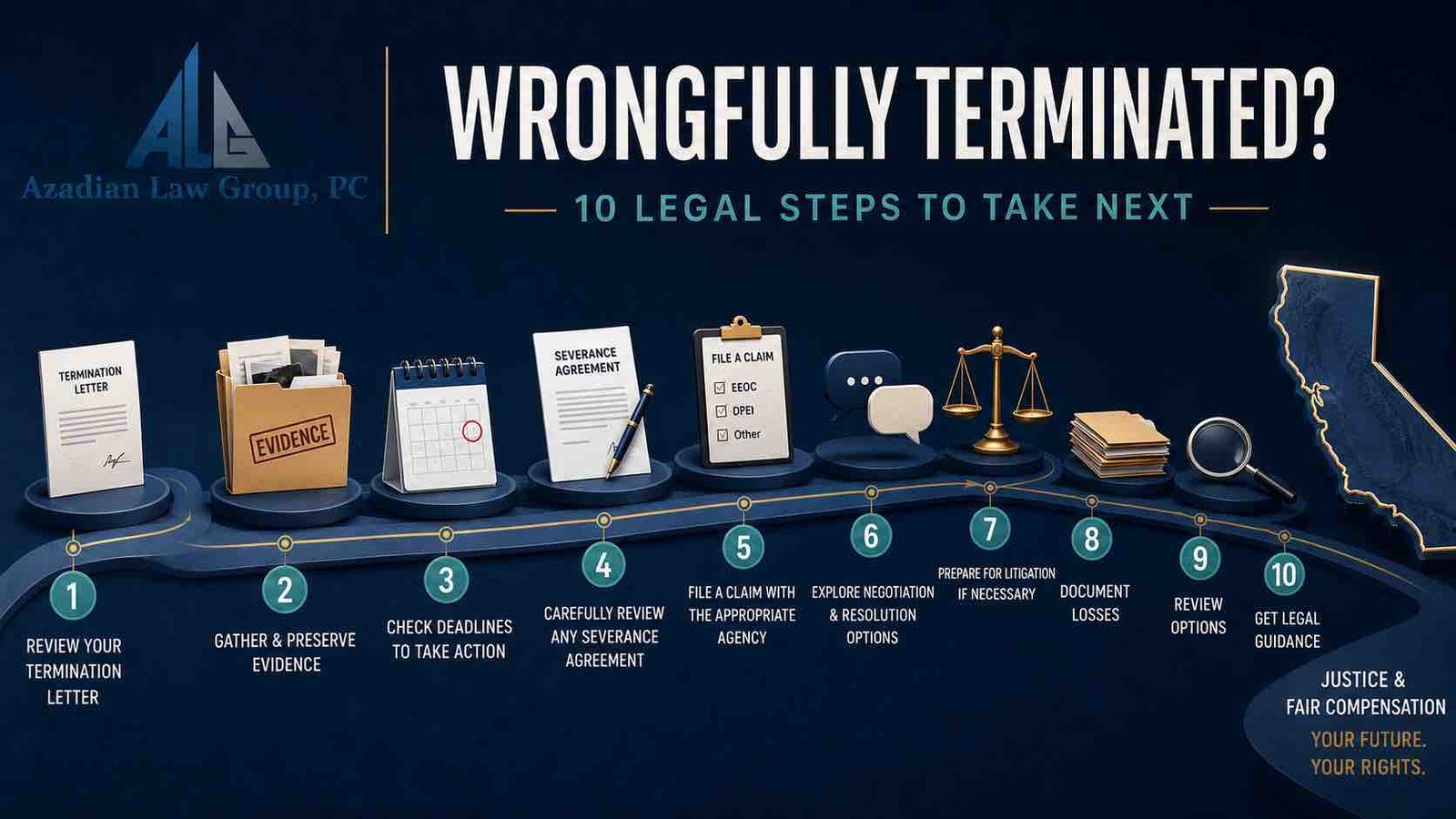
Legal Steps to Take After a Wrongful Termination in California
Losing a job can create immediate financial and emotional pressure, but the first decisions made after termination may affect the strength of a future claim. California employees should focus on preserving evidence, understanding the employer’s explanation, protecting filing deadlines, reviewing any severance agreement, and documenting efforts to find new work.
Not every unfair firing is unlawful. A potential claim usually requires evidence connecting the termination to discrimination, retaliation, whistleblowing, protected leave, wage complaints, contractual rights, or another legally prohibited reason.
Employees who need help evaluating those issues can speak with Azadian Law Group’s Los Angeles employment lawyers. The steps below provide general information and are not a substitute for advice about a specific case.
Step 1: Write Down Exactly What Happened
Create a factual timeline while events are fresh. Begin with the workplace event that may have triggered the termination, such as an HR complaint, accommodation request, medical leave, wage complaint, safety report, or objection to suspected illegal conduct.
Include:
- Dates of important conversations and meetings.
- Names and job titles of the people involved.
- What was said, who heard it, and how you responded.
- When performance criticism or discipline began.
- The employer’s exact explanation for the termination.
A timeline becomes more useful when it is supported by original records. The firm’s guide explaining what evidence may support a wrongful-termination claim provides a deeper checklist for organizing those records.
Step 2: Preserve Documents Lawfully
Save documents you are legally entitled to possess, including offer letters, employment agreements, performance reviews, pay records, complaint emails, accommodation requests, disciplinary notices, termination paperwork, and severance offers.
Preserve complete email threads and message context instead of relying only on cropped screenshots. Do not alter originals, guess passwords, enter company systems after authorization ends, or take trade secrets, privileged communications, patient records, customer information, or unrelated employee files.
Step 3: Identify the Possible Unlawful Reason
The legal theory determines which evidence and deadlines matter. Ask whether the termination followed:
- A complaint about discrimination or harassment.
- A request for disability accommodation or protected medical leave.
- A report of wage, safety, fraud, compliance, or patient-care concerns.
- Participation in an investigation.
- A refusal to engage in conduct reasonably believed to be illegal.
- The exercise of contractual or statutory workplace rights.
For example, accommodation records may be central to a disability-discrimination claim, while leave notices and medical certifications may matter in a family and medical leave dispute. Reports concerning suspected legal violations may require analysis under California whistleblower protections.
Step 4: Request and Review the Employer’s Records
The employer’s contemporaneous explanation matters. Preserve the termination letter, HR correspondence, unemployment response, final performance review, and any document describing the reason for separation.
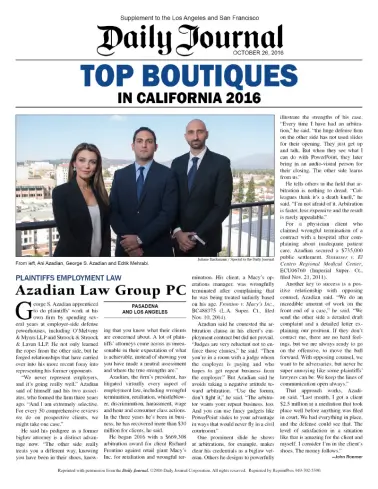
Compare those records with earlier reviews and objective metrics. In the firm’s reported $669,308 Macy’s retaliation result, the published account emphasizes the relationship between an age-discrimination complaint, objective performance improvement, continued documentation, and termination.
Step 5: Do Not Sign a Severance Agreement Immediately
A severance agreement may contain a broad release of claims. Before signing, review:
- The claims being released.
- The payment amount and timing.
- Confidentiality and non-disparagement terms.
- Reference and rehire provisions.
- Arbitration, cooperation, tax, and continuing obligations.
- Whether the agreement provides a revocation period.
Do not assume that accepting severance is always harmful or always beneficial. The answer depends on the potential claims, evidence, financial needs, and agreement language.
Step 6: Protect Administrative and Lawsuit Deadlines
Deadlines vary by claim. The California Civil Rights Department is the current name of the agency formerly known as the Department of Fair Employment and Housing. For many employment-discrimination matters, CRD states that an intake form generally must be submitted within three years of the last harm. A person seeking to file their own employment lawsuit under the state process generally must obtain a right-to-sue notice first.
Federal rules may be shorter. The EEOC explains that its ordinary 180-day charge deadline can extend to 300 days where a state or local agency enforces a law prohibiting the same type of discrimination. Different rules may apply to particular claims, employers, government workers, contracts, or arbitration agreements.
| Possible route | General timing issue | Why immediate review matters |
|---|---|---|
| California CRD employment complaint | CRD generally identifies a three-year intake deadline from the last harm | A right-to-sue notice may be required before bringing certain state discrimination claims in court |
| Federal EEOC charge | Often 180 days, potentially extended to 300 days in covered jurisdictions | Federal and state filing routes are related but not interchangeable in every situation |
| Contract, public-policy, wage, leave, or whistleblower claim | Depends on the exact statute, agreement, defendant, and facts | Assuming one universal two-year deadline can cause a claim to be lost |
| Arbitration | Agreement and statutory deadlines may both matter | The agreement may require a particular forum or filing procedure |
Never wait for the longest possible period. A lawyer should identify every potentially applicable deadline based on the actual claims.
Step 7: Consider Whether the Employer’s Reason Is Pretext
Pretext means the stated explanation may not be the real reason. Warning signs can include shifting explanations, selective policy enforcement, discipline that begins after protected activity, replacement by someone outside the protected group, or objective records that contradict the employer’s claim.
Employees who are still working but feel pressured to resign should also understand the warning signs of constructive termination before making an irreversible decision.
Step 8: Identify Witnesses Without Pressuring Them
List people who personally observed relevant comments, complaints, unequal treatment, investigation meetings, or termination discussions. Record what each witness saw or heard, not workplace rumor.
Do not ask coworkers to remove records, coordinate stories, or risk violating their own workplace obligations. A credible witness is more valuable than a rehearsed one.
Step 9: Document Your Financial Losses
Liability evidence addresses why the employer acted. Damages evidence shows what the termination caused. Preserve records concerning salary, overtime, bonuses, commissions, health benefits, retirement contributions, equity, and other compensation.
Track replacement income and job-search activity. Keep applications, interview invitations, rejection notices, recruiter communications, and pay records from new work. Reasonable efforts to obtain comparable employment may become important when calculating continuing wage loss.
Step 10: Evaluate Resolution Options
Not every dispute follows the same path. Depending on the evidence and goals, options may include a severance negotiation, attorney demand, agency filing, mediation, arbitration, or lawsuit.
The firm’s reported $9,957,411.17 physician arbitration award illustrates that arbitration can produce a final merits determination, while other matters may resolve through confidential settlement. Past results do not guarantee a similar outcome.
Does At-Will Employment Prevent a Claim?
No. At-will employment generally allows either side to end the relationship without advance notice or a traditional “good cause” reason. It does not permit an employer to terminate someone for a reason prohibited by law or public policy.
An at-will employee may still have a claim when the termination is connected to discrimination, retaliation, protected leave, whistleblowing, wage complaints, refusal to participate in unlawful conduct, or another protected right. Written and implied contractual promises may also require separate analysis.
The practical question is not simply whether the employer had power to terminate. It is whether the actual reason was lawful.
Should You Apply for Unemployment Benefits?
An employee may consider applying promptly rather than assuming that a termination for alleged misconduct automatically makes them ineligible. The unemployment process is separate from a civil employment claim, and the agency evaluates eligibility under its own standards.
Answer application questions accurately. Preserve the employer’s stated reason, agency correspondence, interview notes, and decision. Statements made during an unemployment proceeding may later be compared with other accounts of the termination.
What Changes for Government Employees?
Public employees may face special notice requirements, internal appeal procedures, civil-service rules, union agreements, or short claim-presentation deadlines. Constitutional due-process rights may also matter in some situations.
Do not assume the steps or deadlines for a private employer apply unchanged to a city, county, state, school district, public hospital, or federal agency. Prompt review is particularly important because missing an internal appeal or government-claim deadline can affect available remedies.
What If You Have an Arbitration Agreement?
An arbitration agreement may determine where and how a dispute proceeds, but it does not necessarily eliminate substantive employment rights. Preserve the signed agreement, later updates, handbook acknowledgements, opt-out notices, and any documents identifying the arbitration provider.
The enforceability and scope of an agreement can depend on its language and the surrounding facts. Employees should not assume that arbitration means they have no claim—or that every provision will automatically be enforced.
Common Mistakes After Termination
- Signing a release before understanding the claims being waived.
- Waiting because a manager promised to reconsider the decision.
- Deleting messages or altering screenshots.
- Taking confidential records unrelated to the employee’s own dispute.
- Posting allegations, recordings, or internal documents on social media.
- Contacting witnesses repeatedly or asking them to coordinate statements.
- Failing to document job-search efforts and replacement income.
- Assuming one deadline applies to every possible claim.
The safest approach is disciplined: preserve, organize, verify, and obtain advice before taking steps that cannot be reversed.
A Practical First-Week Checklist
| When | Recommended action | Common mistake to avoid |
|---|---|---|
| First 24 hours | Write the timeline and secure lawful personal records | Posting accusations on social media |
| First few days | Review termination, final-pay, benefits, and severance documents | Signing because the employer says the offer expires immediately |
| First week | Identify witnesses, damages, possible claims, and deadlines | Assuming every claim has the same filing period |
| Ongoing | Maintain job-search and replacement-income records | Failing to document reasonable mitigation efforts |
Questions Employees Commonly Ask
Should I contact HR after being terminated?
It depends on the purpose. A factual written request for records or clarification may help, but a lengthy emotional accusation can create confusion. Consider obtaining advice before sending a detailed statement.
Can I record a termination meeting?
Recording laws depend on the circumstances and location. Do not secretly record a confidential conversation without first understanding the applicable law.
Can I pursue a claim if the employer calls it a layoff?
Possibly. The label is not conclusive. The selection process, decision-maker communications, comparators, replacement activity, and changing explanations may matter.
What if I have very little evidence?
Employees often have more relevant information than they initially realize. A careful review of the timeline, HR communications, reviews, witnesses, and employer explanations may reveal useful evidence.
When Should You Speak With an Employment Lawyer?
Seek prompt advice when a termination follows a discrimination complaint, accommodation request, protected leave, wage complaint, whistleblower report, investigation participation, or refusal to engage in suspected unlawful conduct. Immediate review is especially important when a severance deadline, agency deadline, government-employer procedure, or arbitration agreement may apply.
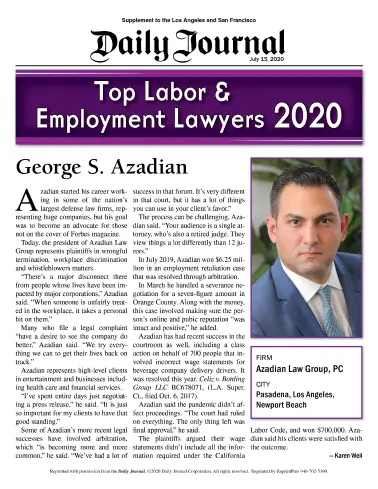
George Azadian’s answers to common employment-law questions explain why focused employee-side experience and early evidence review matter. Employees can also explore the firm’s employment-law podcast episodes or request a confidential consultation.


Related Blog Posts
Wrongful Termination Evidence Often Appears as a Pattern Wrongful termination evidence is rarely found in one dramatic email admitting that...
Read MoreOracle Layoffs Raise New Questions for California Employees Oracle has reportedly begun another round of layoffs in the United States,...
Read MoreArtificial intelligence has already started screening resumes, measuring productivity, writing performance reviews, and recommending layoffs. Now it has reportedly helped...
Read MoreTypes of Cases Handle By Employment Lawyers in Los Angeles, CA
The following presents an overview of the broad range of employment law cases that our employment attorneys are experienced at overseeing and favorably resolving.
Wrongful Termination
Wrongful Termination Lawyers in Los Angeles, CA Attorneys at Azadian Law Group who have filed wrongful termination lawsuits acknowledge that unfair termination can significantly impact an employee’s life. It can…
Age Discrimination
Age Discrimination Lawyers in Los Angeles, CA Azadian Law Group, PC regularly represents clients throughout Los Angeles, CA, who are the victims of age discrimination in the workplace. At Azadian…
Pregnancy Discrimination
Pregnancy Discrimination Lawyer in Los Angeles, CA At Azadian Law Group, PC, our pregnancy discrimination lawyer in Los Angeles, regularly represents clients who are the victims of pregnancy discrimination in…
Sexual Harassment
Sexual Harassment Attorney in Los Angeles, CA The Los Angeles Sexual Harassment Lawyers at Azadian Law Group, PC, know that in today’s modern era, some people often make the mistake of…
Racial Discrimination
Racial Discrimination Lawyers in Los Angeles, CA Azadian Law Group, PC regularly represents clients throughout Los Angeles who are the victims of racial discrimination at work. The Los Angeles Race…
Disability Discrimination
When a Medical Condition Becomes a Workplace Problem, You Have Rights Most employees never expect a health condition to place their career at risk. Yet every day across Los Angeles,…
Praise from Our Clients
Lui H

Arpi Agdere
Tofi
Aracelis Feria
Ivy Gamboa
Jillian Dunlap
Greg Wayne
Elizabeth Eromosele
Steve G
Lisa Galvan
Artur Aleksanyan
Delight Dinopoulos
George Margaros
Chelsea Pham
Trevor Pal-Freeman
Patricio Garza
Taylor
Ashley Londerman
Marissa Zapanta
Nuria Coronado
Barbara Villalobos
Irene Golub
Joshua Butler
J Mo
Employees We Represent in Employment Law Cases
At Azadian Law Group, we represent employees throughout Los Angeles and California who have experienced workplace violations. Our attorneys handle employment law matters including wrongful termination, workplace discrimination, retaliation, harassment, wage and hour violations, and whistleblower protection.
Employees often face unlawful treatment after reporting misconduct, requesting medical leave, or asserting their legal rights at work. Our firm investigates employment law violations and advocates for workers seeking accountability, compensation, and fair treatment under California and federal employment law.

Step 1
Explore our comprehensive range of legal services to find the specialized support you need.
Step 2
Arrange a free initial meeting with our experts to discuss your legal situation.
Step 3
Receive a custom strategy specially created for your case by our legal experts.
Call Us Now 213-229-9031
Tell Us Your Story
Speak out for justice. Your story can be the start of a new chapter of workplace fairness.
