Mercola to Pay Up to $5.3M to Settle FTC False Advertising Case Related to Indoor Tanning Systems
What Was the Mercola FTC Settlement About?
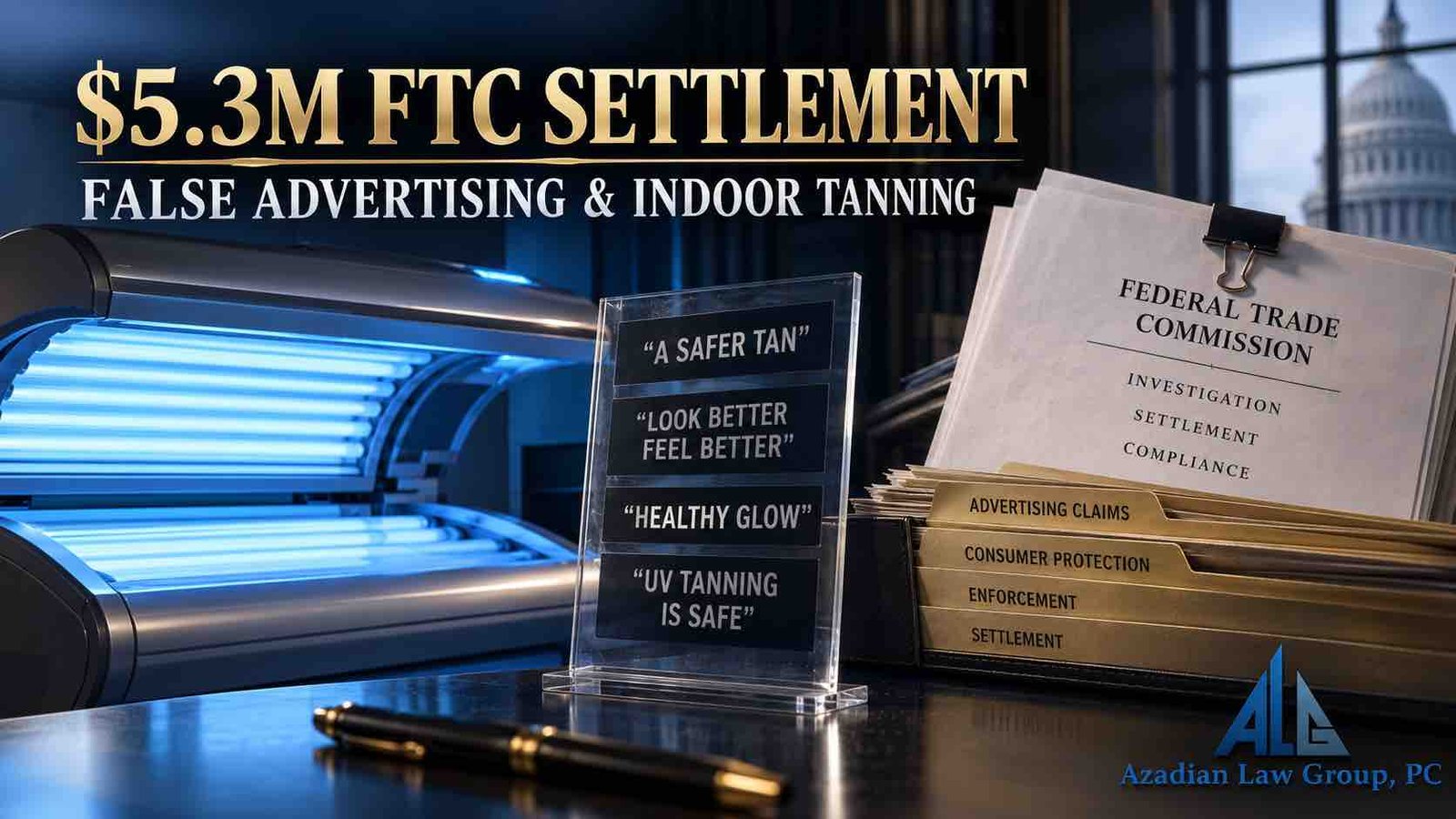
The Mercola FTC settlement arose from advertisements for indoor tanning equipment sold under names including D-Lite, Sun Splash, Sun Splash Renew, Vitality, Vitality Refresh, and Vitality D-Lite. According to the FTC, the marketing went far beyond ordinary product promotion. It allegedly made health and safety representations that consumers could reasonably understand as scientifically supported.
The FTC challenged claims suggesting that the tanning systems were safe, could reduce the risk of certain cancers, and could improve the appearance of users’ skin. The government also alleged that consumers were told the systems had received independent support without being adequately informed that Mercola had paid the organization associated with an endorsement.
This was a federal consumer-protection enforcement action. It was not a jury verdict finding every allegation true, and it was not a private class-action judgment. The settlement resolved the government’s allegations through an agreed court order without the need for a trial on the merits.
| Case detail | What the record shows |
|---|---|
| Agency | Federal Trade Commission |
| Defendants | Dr. Joseph Mercola, Mercola.com, LLC, and Mercola.com Health Resources, LLC |
| Announcement date | April 14, 2016 |
| Financial component | $5,334,067 for refunds and administration of the refund program |
| Products involved | Mercola-brand indoor tanning systems |
| Major nonmonetary remedy | Permanent prohibition on marketing or selling indoor tanning systems |
| Legal theory | Allegedly deceptive or unsubstantiated advertising and inadequate disclosure of a paid endorsement relationship |
What Claims Did the FTC Challenge?
Health advertising can influence decisions involving both money and physical safety. That is why a marketer generally needs reliable evidence before making objective representations about disease prevention, health outcomes, or product safety.
The FTC alleged that Mercola’s advertising conveyed several deceptive messages, including claims or implications that:
- The Food and Drug Administration had determined that indoor tanning systems were safe.
- Indoor tanning could reduce a person’s risk of developing cancer.
- The systems could improve skin clarity, tone, texture, or youthfulness.
- A seemingly independent organization recommended the systems.
- The material financial connection behind that endorsement did not need to be disclosed.
The exact legal question was not simply whether an advertisement used one incorrect sentence. Regulators consider the overall message a reasonable consumer would take from the words, images, qualifications, endorsements, and omitted information. An advertisement can therefore be deceptive because of an express statement, an implied claim, or the failure to reveal an important fact.
Consumers can learn more about these principles through Azadian Law Group’s overview of false advertising and misleading consumer claims.
Why the Alleged FDA Safety Message Was Significant
An advertiser’s reference to a government regulator can add enormous credibility to a product claim. Consumers may reasonably interpret statements involving the FDA as confirmation that an agency reviewed the relevant science and affirmatively approved the product as safe for the advertised use.
The FTC alleged that the challenged marketing misrepresented the FDA’s position. The distinction matters: regulatory treatment of a product is not automatically an official declaration that every use is safe. Businesses must take care not to convert a limited regulatory fact into a broader government endorsement.
That lesson reaches well beyond tanning equipment. Similar issues may arise when advertisements use phrases such as “FDA registered,” “meets government standards,” “clinically proven,” or “doctor recommended.” Each phrase must be accurate in context and must not create a larger, unsupported impression.
Why Cancer-Prevention Claims Require Strong Evidence
A representation that a consumer product can prevent or reduce the risk of cancer is an objective health claim. It is not merely an opinion or advertising puffery. Consumers are entitled to expect that such a representation rests on competent evidence appropriate to the seriousness of the claim.
The FTC emphasized the known health risks associated with ultraviolet exposure from indoor tanning. Against that background, an unsupported message that tanning could reduce cancer risk was especially consequential: it could cause consumers to view a known risk as a health benefit.
The broader rule is straightforward. The more specific, measurable, and medically significant an advertising claim becomes, the more important it is for the advertiser to possess reliable substantiation before disseminating it. A disclaimer placed elsewhere cannot necessarily cure a prominent and misleading headline.
The Paid Endorsement Problem
The FTC also alleged that Mercola promoted a recommendation from the Vitamin D Council without adequately disclosing that Mercola had paid the organization. A financial relationship can affect how consumers evaluate an endorsement. Someone who believes a recommendation is independent may give it more weight than one known to be sponsored.
Material connections can include:
- Direct payments;
- Free products or services;
- Affiliate commissions;
- Employment or ownership relationships;
- Family or personal relationships; and
- Other benefits capable of affecting the endorser’s credibility.
A disclosure should be clear, conspicuous, and close enough to the endorsement for an ordinary consumer to notice and understand it. Hiding the relationship in fine print, behind an inconspicuous link, or on a separate page may not correct the overall impression.
What Did the Settlement Require?
The settlement combined monetary relief with conduct restrictions. The monetary portion required $5,334,067 to fund refunds and administer the refund program for eligible purchasers. Contemporary notices contemplated refunds that varied according to the product purchased and the consumer’s circumstances.
The order also imposed important nonmonetary requirements. The defendants were permanently prohibited from marketing or selling indoor tanning systems. They were restricted from making misrepresentations about the health benefits, efficacy, safety, or performance of products and from misrepresenting tests, studies, research, endorsements, or government approval. They were also required to disclose material connections with endorsers.
Those restrictions are crucial. A settlement is not meaningful merely because money changes hands. Injunctive provisions are designed to prevent repetition of the alleged conduct and establish enforceable standards for future advertising.
For the FTC’s original account and case documents, review the agency’s official discussion of the Mercola indoor tanning settlement.
Is the Original Mercola Refund Program Still Open?
Consumers should not assume that the historical refund process remains available. The settlement and refund notices date to 2016, and the claim process described at that time was governed by specified notices, documentation requirements, and deadlines.
Anyone searching for a refund today should confirm the current status through an official FTC source rather than sending personal information to an unofficial website or responding to an unsolicited message. Government agencies do not require people to pay an upfront fee to receive a legitimate settlement refund.
This article explains the enforcement action and its continuing legal lessons; it does not represent that a current Mercola refund claim period is open.
FTC Enforcement Is Different From a Private Consumer Lawsuit
The FTC acts to protect the public and enforce federal consumer-protection law. The agency can investigate advertising, seek court orders, negotiate settlements, and pursue monetary or injunctive relief where authorized. Individual consumers do not control an FTC enforcement case in the same way private plaintiffs control their own litigation.
A private consumer action is different. Depending on the facts and applicable law, a consumer may allege that deceptive advertising caused an economic loss and may seek individual or classwide relief. The available claim, deadline, proof, and remedy depend on the transaction, the jurisdiction, and the specific representation at issue.
Azadian Law Group explains related California protections on its consumer rights practice page. The firm has also discussed its own Starbucks price-switching class action settlement, which illustrates how private consumer litigation differs from government enforcement.
What Evidence Can Matter in a False Advertising Dispute?
Misleading claims can disappear quickly after a complaint, investigation, or website update. Consumers who believe an advertisement caused them financial harm should preserve evidence before it changes.
Potentially useful material may include:
- Screenshots or saved copies of the advertisement;
- The complete webpage, not only the headline;
- Product packaging and written instructions;
- Receipts, invoices, order confirmations, and payment records;
- Emails, text messages, and customer-service communications;
- The date and place where the representation appeared;
- Records showing what the consumer paid or lost;
- Copies of refund requests and the company’s response; and
- Evidence showing why the representation mattered to the purchasing decision.
Preserving the full context is important. A cropped screenshot may omit a qualification, while a later version of the page may no longer display the original wording.
What Consumers and Businesses Can Learn From the Case
The Mercola matter remains instructive because it combines several recurring advertising-law problems in one enforcement action.
| Advertising issue | Practical lesson |
|---|---|
| Health and disease claims | Possess reliable substantiation before making the claim, not after a regulator asks for it. |
| Government references | Do not turn registration, classification, or regulatory status into a broader claim of government approval or safety. |
| Scientific language | Accurately describe what research establishes and avoid overstating limited findings. |
| Endorsements | Disclose payments and other material connections clearly and near the endorsement. |
| Overall net impression | Evaluate the complete message conveyed by text, images, omissions, and placement. |
| Consumer records | Keep copies of the advertisement and proof of purchase because online claims can change. |
Another useful comparison is the firm’s analysis of a $40 million FTC false advertising settlement involving dietary-supplement claims. Consumers can also review the historical rise in reports discussed in FTC consumer complaint statistics.
Frequently Asked Questions About the Mercola FTC Settlement
How much was the Mercola FTC settlement?
The settlement required $5,334,067 for consumer refunds and administration of the refund program. It also included substantial restrictions on future conduct, including a permanent prohibition on marketing or selling indoor tanning systems.
Did a court find Mercola liable after a trial?
No. The matter was resolved through a stipulated settlement and court order. The FTC alleged deceptive conduct, while the agreement resolved the claims without a trial deciding every allegation.
What products were involved?
The matter involved Mercola-brand indoor tanning systems sold under names that included D-Lite, Sun Splash, Sun Splash Renew, Vitality, Vitality Refresh, and Vitality D-Lite.
Why was the endorsement disclosure important?
The FTC alleged that consumers were not adequately informed of a paid relationship associated with an endorsement. A financial connection can affect the weight consumers give a recommendation and may therefore require clear disclosure.
Can a business say that a product is FDA approved or safe?
Only if the statement is accurate, properly supported, and not misleading in context. A business should not transform limited regulatory status into a broader representation that the government has endorsed the product or found every advertised use safe.
Is the 2016 Mercola refund program still accepting claims?
Consumers should not assume it is. The refund process was created years ago and was subject to notices and deadlines. Current status should be confirmed directly through official FTC resources.
Does every misleading advertisement create a class action?
No. A class action requires additional procedural and factual elements, including sufficiently similar claims among the proposed class members. Whether a private claim exists depends on the advertisement, reliance or causation requirements, economic harm, deadlines, and applicable law.
Speak With a Los Angeles Consumer Rights Attorney
False advertising can cause widespread financial harm when the same misleading message reaches many consumers. The details matter: what was promised, what was omitted, what evidence supported the claim, why the representation influenced the purchase, and what loss followed.
Azadian Law Group, PC evaluates potential consumer and class-action matters involving misleading representations and unfair business practices. To discuss a potential claim, contact Azadian Law Group or call 213-229-9031 for a confidential consultation.
This article is provided for general informational purposes and does not constitute legal advice. Past results do not guarantee a similar outcome.


Related Blog Posts
In another major win for California consumers, George S. Azadian and Ani Azadian have recently settled a price-switching class action...
Read MoreLunada Biomedical, Inc. (Lunada) has recently agreed to pay a $40 million settlement to resolve a federal false advertising case...
Read MoreIn 2015, federal authorities received at least 3 million complaints from consumers regarding allegedly illegal business practices, according to a...
Read MoreTypes of Cases Handle By Employment Lawyers in Los Angeles, CA
The following presents an overview of the broad range of employment law cases that our employment attorneys are experienced at overseeing and favorably resolving.
Wrongful Termination
Wrongful Termination Lawyers in Los Angeles, CA Attorneys at Azadian Law Group who have filed wrongful termination lawsuits acknowledge that unfair termination can significantly impact an employee’s life. It can…
Age Discrimination
Age Discrimination Lawyers in Los Angeles, CA Azadian Law Group, PC regularly represents clients throughout Los Angeles, CA, who are the victims of age discrimination in the workplace. At Azadian…
Pregnancy Discrimination
Pregnancy Discrimination Lawyer in Los Angeles, CA At Azadian Law Group, PC, our pregnancy discrimination lawyer in Los Angeles, regularly represents clients who are the victims of pregnancy discrimination in…
Sexual Harassment
Sexual Harassment Attorney in Los Angeles, CA The Los Angeles Sexual Harassment Lawyers at Azadian Law Group, PC, know that in today’s modern era, some people often make the mistake of…
Racial Discrimination
Racial Discrimination Lawyers in Los Angeles, CA Azadian Law Group, PC regularly represents clients throughout Los Angeles who are the victims of racial discrimination at work. The Los Angeles Race…
Disability Discrimination
When a Medical Condition Becomes a Workplace Problem, You Have Rights Most employees never expect a health condition to place their career at risk. Yet every day across Los Angeles,…
Praise from Our Clients
Lui H

Arpi Agdere
Tofi
Aracelis Feria
Ivy Gamboa
Jillian Dunlap
Greg Wayne
Elizabeth Eromosele
Steve G
Lisa Galvan
Artur Aleksanyan
Delight Dinopoulos
George Margaros
Chelsea Pham
Trevor Pal-Freeman
Patricio Garza
Taylor
Ashley Londerman
Marissa Zapanta
Nuria Coronado
Barbara Villalobos
Irene Golub
Joshua Butler
J Mo
Employees We Represent in Employment Law Cases
At Azadian Law Group, we represent employees throughout Los Angeles and California who have experienced workplace violations. Our attorneys handle employment law matters including wrongful termination, workplace discrimination, retaliation, harassment, wage and hour violations, and whistleblower protection.
Employees often face unlawful treatment after reporting misconduct, requesting medical leave, or asserting their legal rights at work. Our firm investigates employment law violations and advocates for workers seeking accountability, compensation, and fair treatment under California and federal employment law.

Step 1
Explore our comprehensive range of legal services to find the specialized support you need.
Step 2
Arrange a free initial meeting with our experts to discuss your legal situation.
Step 3
Receive a custom strategy specially created for your case by our legal experts.
Call Us Now 213-229-9031
Tell Us Your Story
Speak out for justice. Your story can be the start of a new chapter of workplace fairness.
