California Minimum Wage in 2026: What Los Angeles Workers Need to Know
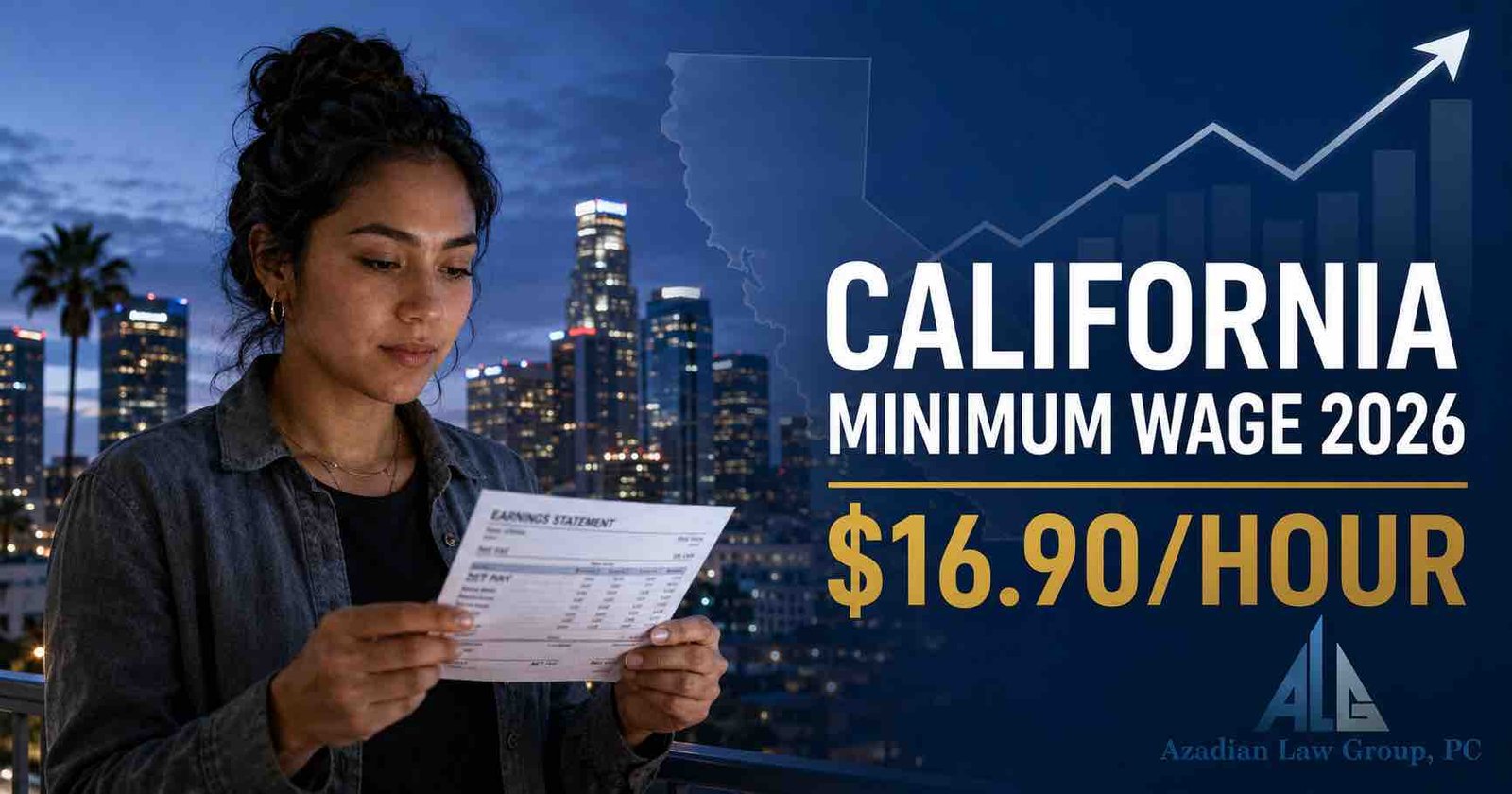
California’s statewide minimum wage is $16.90 per hour in 2026, but many employees must be paid more because local or industry-specific wage rules apply. In the City of Los Angeles, the minimum wage increased from $17.87 to $18.42 per hour on July 1, 2026.
That is a dramatic change from 2016, when California’s minimum wage first reached $10 per hour. Over the last decade, the statewide rate has increased by 69%. Yet minimum-wage violations have not disappeared. Some employers still underpay workers, require unpaid off-the-clock work, improperly classify employees as exempt, or retaliate when someone questions their paycheck.
Understanding the correct wage is the first step. Determining whether an employee has actually been paid everything owed can require a closer look at hours, location, job duties, bonuses, time records and local wage rules.
What Is the California Minimum Wage in 2026?
Effective January 1, 2026, California’s minimum wage is $16.90 per hour for employers of every size.
The old distinction between employers with 25 or fewer employees and those with 26 or more employees no longer controls the statewide rate. Unless a valid exemption or a different wage rule applies, workers employed by small and large businesses are entitled to the same statewide minimum.
According to the California Department of Industrial Relations, most employees must receive at least the state minimum wage for every hour worked. An employee generally cannot waive this right or privately agree to work for less.
| Location or requirement | 2026 minimum rate |
|---|---|
| California statewide minimum wage | $16.90 per hour |
| City of Los Angeles through June 30, 2026 | $17.87 per hour |
| City of Los Angeles beginning July 1, 2026 | $18.42 per hour |
| California exempt-employee salary threshold | $70,304 annually |
| Federal minimum wage | $7.25 per hour |
The federal minimum remains much lower than California’s rate. When federal, state and local laws overlap, the rule providing the greater protection will generally control.
What Is the Los Angeles Minimum Wage in 2026?
Employees covered by the City of Los Angeles Minimum Wage Ordinance must receive at least $18.42 per hour beginning July 1, 2026. From January 1 through June 30, the applicable city rate was $17.87.
Los Angeles adjusts its minimum wage annually based on inflation. The current and historical rates are published by the Los Angeles Office of Wage Standards.
The Los Angeles rate is based on where the employee performs work—not simply where the employer’s headquarters are located. An employee may be covered when performing at least two hours of work within the geographic boundaries of the City of Los Angeles during a particular week.
This distinction matters because a mailing address that says “Los Angeles” does not always mean the workplace is legally within the City of Los Angeles. Unincorporated areas and neighboring cities can have different wage requirements.
How California’s Minimum Wage Changed From 2016 to 2026
When this article was originally published, California’s minimum wage had just increased from $9 to $10 per hour. Los Angeles was beginning a series of scheduled increases intended to bring local wages to $15.
That milestone has long since passed.
California’s statewide minimum wage reached $15.50 in 2023, increased to $16 in 2024, reached $16.50 in 2025 and rose to $16.90 in 2026. Beginning January 1, 2027, the statewide rate is scheduled to increase again to $17.40 per hour.
In Los Angeles, the citywide rate increased from $10.50 in 2016 to $18.42 in July 2026—an increase of more than 75% over ten years.
The numbers have changed, but the basic principle has not: an employer must identify and follow the highest minimum wage that legally applies to the employee’s work.
Some California Workers Are Entitled to More Than $16.90
The statewide minimum is only the starting point. Several California cities and counties maintain higher local minimum wages. Certain industries also operate under separate wage laws.
For example, covered fast-food employees have been subject to a higher industry minimum wage since April 2024. Certain healthcare employees may also qualify for higher wage rates, although the applicable amount can depend on the type of healthcare facility and other statutory details.
Other specialized rules may affect hotel workers, employees of government contractors and workers covered by collective bargaining agreements.
Because these laws overlap, payroll cannot always be handled with one statewide number. The worker’s physical location, employer, industry, job duties and applicable ordinance all matter.
Does the 2026 Minimum Wage Change the Salary Required for Exempt Employees?
Yes. California’s minimum wage also affects the salary threshold for employees classified under the executive, administrative or professional exemptions.
In 2026, an employee generally must earn a salary of at least $70,304 per year—equivalent to twice the statewide minimum wage for full-time employment—to satisfy the salary component of these exemptions.
But salary alone does not make someone exempt.
The employee must also satisfy the applicable duties test. Giving someone a “manager,” “supervisor” or “administrator” title does not eliminate overtime rights when the employee’s actual work is primarily nonexempt.
Misclassification frequently occurs when an employee receives a fixed salary but has little genuine authority, performs the same work as hourly employees, or spends most of the workday on routine production or customer-service duties.
Minimum Wage and Overtime Are Different Rights
Paying the correct hourly minimum does not excuse an employer from paying overtime.
Most nonexempt California employees are entitled to time-and-a-half when they work:
- More than eight hours in a workday;
- More than 40 hours in a workweek; or
- More than six consecutive days in a workweek, subject to the applicable rules.
Double-time requirements can apply after more than 12 hours in a workday and in certain seventh-day situations. Exemptions and valid alternative workweek schedules may change the analysis.
Overtime must usually be calculated from the employee’s “regular rate of pay,” which can include more than the base hourly rate. Nondiscretionary bonuses, commissions and other compensation may need to be included.
An employee earning $18.42 per hour can still be underpaid if overtime was calculated incorrectly.
Common Minimum-Wage Violations in Los Angeles
Minimum-wage violations are not always obvious on a pay stub. An employer may appear to pay the correct hourly rate while quietly excluding compensable work time.
Common warning signs include:
- Requiring employees to perform tasks before clocking in or after clocking out;
- Automatically deducting meal periods even when employees continue working;
- Asking employees to answer work messages while off the clock;
- Altering or rounding time records in a way that consistently reduces paid time;
- Paying a flat daily rate that falls below the minimum after all hours are counted;
- Misclassifying employees as independent contractors;
- Treating salaried employees as exempt without examining their actual duties;
- Failing to include bonuses or commissions in the overtime rate;
- Making unlawful payroll deductions; or
- Failing to pay all wages owed after termination or resignation.
Small amounts add up. Fifteen unpaid minutes each workday can become more than 60 unpaid hours over a year. When the missing time also creates overtime, the difference can become considerably larger.
Can an Employer Use Tips to Satisfy California’s Minimum Wage?
No. California does not allow employers to use a worker’s tips as a credit against the minimum wage.
A tipped employee must receive the full applicable minimum wage from the employer in addition to eligible tips. This differs from federal law and the rules used in several other states.
Employers also cannot rely on a worker’s consent to justify a lower rate. California’s minimum-wage protections generally cannot be waived by a private agreement.
What Should Employees Do if They Are Being Underpaid?
Employees who suspect wage theft should begin by preserving records they can lawfully access. Useful evidence may include:
- Pay stubs;
- Timecards and schedules;
- Employment agreements;
- Wage notices;
- Commission or bonus plans;
- Emails and text messages about work hours;
- Personal notes showing actual start and finish times; and
- Records of complaints made to a supervisor or human resources.
Do not access restricted systems or remove confidential documents without authorization. Employees should preserve records already in their lawful possession and consider obtaining advice before confronting an employer or signing a release.
A California worker may be able to file a wage claim with the Labor Commissioner or pursue a claim in court, depending on the circumstances. Potential recovery can include unpaid wages and, where legally available, interest, penalties, liquidated damages, costs or attorney’s fees.
Deadlines vary according to the type of claim. Waiting too long can result in part or all of a claim being lost.
Can an Employer Retaliate Against an Employee Who Questions Their Pay?
An employer generally may not fire, demote, threaten, reduce someone’s hours or otherwise retaliate because the employee complained about unpaid wages, questioned overtime, filed a wage claim or asserted protected workplace rights.
Retaliation is often disguised as something else. An employee may suddenly receive negative reviews, schedule changes or discipline shortly after raising a payroll concern. Timing, shifting explanations and inconsistent treatment can become important evidence.
Employees who experience adverse treatment after making a wage complaint should document the sequence of events and preserve relevant communications.
Frequently Asked Questions About California’s 2026 Minimum Wage
Is California’s minimum wage $16.90 everywhere?
The statewide minimum is $16.90, but workers may be entitled to a higher local or industry-specific rate. The City of Los Angeles rate increased to $18.42 on July 1, 2026.
Does the California minimum wage apply to part-time employees?
Generally, yes. Part-time and temporary employees are usually protected by the same minimum-wage requirements as full-time employees unless a specific exemption applies.
Are minors entitled to the same minimum wage?
California generally does not establish a lower minimum wage simply because an employee is under 18. Limited rules can apply to qualifying learners during their first 160 hours of work.
Am I exempt from overtime because I receive a salary?
Not necessarily. An employer must satisfy both the salary and duties requirements of a valid exemption. Job titles and salary payments alone do not determine exempt status.
Can I recover wages for work performed from home?
Potentially. Remote work can be compensable when the employer knew or should have known the work was being performed. Emails, messages, system records and assignments may help establish the time worked.
What if my employer says overtime was not authorized?
An employer may discipline an employee for violating a legitimate overtime policy, but that does not automatically allow the employer to refuse payment for work it knew or should have known was performed.
Speak With a Los Angeles Wage and Hour Attorney
Every paycheck represents time an employee cannot get back. When an employer fails to count that time accurately or applies the wrong wage rate, the loss can continue quietly for months or years.
Azadian Law Group, PC represents California employees in matters involving unpaid wages, overtime, employee misclassification, off-the-clock work, meal and rest periods, unlawful deductions and workplace retaliation.
If you believe you were paid less than the 2026 minimum wage or denied other compensation, contact an experienced Los Angeles wage and hour lawyer to discuss your rights and available options.
This article provides general information and is not legal advice. Wage laws and filing deadlines can vary depending on the worker, location, industry and specific facts.


Related Blog Posts
AI, Automation and Wage Theft: California Employee Rights in 2026 Artificial intelligence is no longer limited to futuristic laboratories or...
Read MoreMost employees know when a paycheck is missing. Wage theft becomes harder to recognize when the paycheck arrives on time...
Read MoreLos Angeles startups often promise flexibility, rapid growth, meaningful equity and the chance to build something from the ground up....
Read MoreTypes of Cases Handle By Employment Lawyers in Los Angeles, CA
The following presents an overview of the broad range of employment law cases that our employment attorneys are experienced at overseeing and favorably resolving.
Wrongful Termination
Wrongful Termination Lawyers in Los Angeles, CA Attorneys at Azadian Law Group who have filed wrongful termination lawsuits acknowledge that unfair termination can significantly impact an employee’s life. It can…
Age Discrimination
Age Discrimination Lawyers in Los Angeles, CA Azadian Law Group, PC regularly represents clients throughout Los Angeles, CA, who are the victims of age discrimination in the workplace. At Azadian…
Pregnancy Discrimination
Pregnancy Discrimination Lawyer in Los Angeles, CA At Azadian Law Group, PC, our pregnancy discrimination lawyer in Los Angeles, regularly represents clients who are the victims of pregnancy discrimination in…
Sexual Harassment
Sexual Harassment Attorney in Los Angeles, CA The Los Angeles Sexual Harassment Lawyers at Azadian Law Group, PC, know that in today’s modern era, some people often make the mistake of…
Racial Discrimination
Racial Discrimination Lawyers in Los Angeles, CA Azadian Law Group, PC regularly represents clients throughout Los Angeles who are the victims of racial discrimination at work. The Los Angeles Race…
Disability Discrimination
When a Medical Condition Becomes a Workplace Problem, You Have Rights Most employees never expect a health condition to place their career at risk. Yet every day across Los Angeles,…
Praise from Our Clients
A“

QT
RT
KM
BM
HM
bS
kj
SM
TM
FL
kr
TP
CF
WW
JA
RM
RC
VM
JS
TH
SD
RM
AC
W
kn
AO
DN
KW
TP
RS
L
D
la
JG
DP
RK
HL
TP
sr
sl
PD
SS
SS
JB
JA
AR
CG
LH
YU
MS
TA
NS
aa
RC
AR
mp
IG
N
JJ
Kd
GA
aa
GB
RT
MM
PP
PA
DV
T
AW
CW
SM
TC
SC
hh
KK
DB
S
SM
VV
K&
PG
JL
SS
AC
MS
DS
DM
ZM
CA
AF
GC
jg
GN
AG
A
KG
EC
s
MZ
m
LD
PW
PD
CH
TA
KM
PZ
CA
rc
FA
JA
MJ
SM
kr
LH
BJ
DG
JJ
ES
WW
VS
TH
VB
GA
DM
LS
SM
AS
wm
MH
DA
TP
LA
DR
MM
D
RG
WR
Employees We Represent in Employment Law Cases
At Azadian Law Group, we represent employees throughout Los Angeles and California who have experienced workplace violations. Our attorneys handle employment law matters including wrongful termination, workplace discrimination, retaliation, harassment, wage and hour violations, and whistleblower protection.
Employees often face unlawful treatment after reporting misconduct, requesting medical leave, or asserting their legal rights at work. Our firm investigates employment law violations and advocates for workers seeking accountability, compensation, and fair treatment under California and federal employment law.

Step 1
Explore our comprehensive range of legal services to find the specialized support you need.
Step 2
Arrange a free initial meeting with our experts to discuss your legal situation.
Step 3
Receive a custom strategy specially created for your case by our legal experts.
Call Us Now 213-229-9031
Tell Us Your Story
Speak out for justice. Your story can be the start of a new chapter of workplace fairness.
