10 Subtle (and Not-So-Subtle) Signs of Workplace Discrimination in California — And What to Do Next
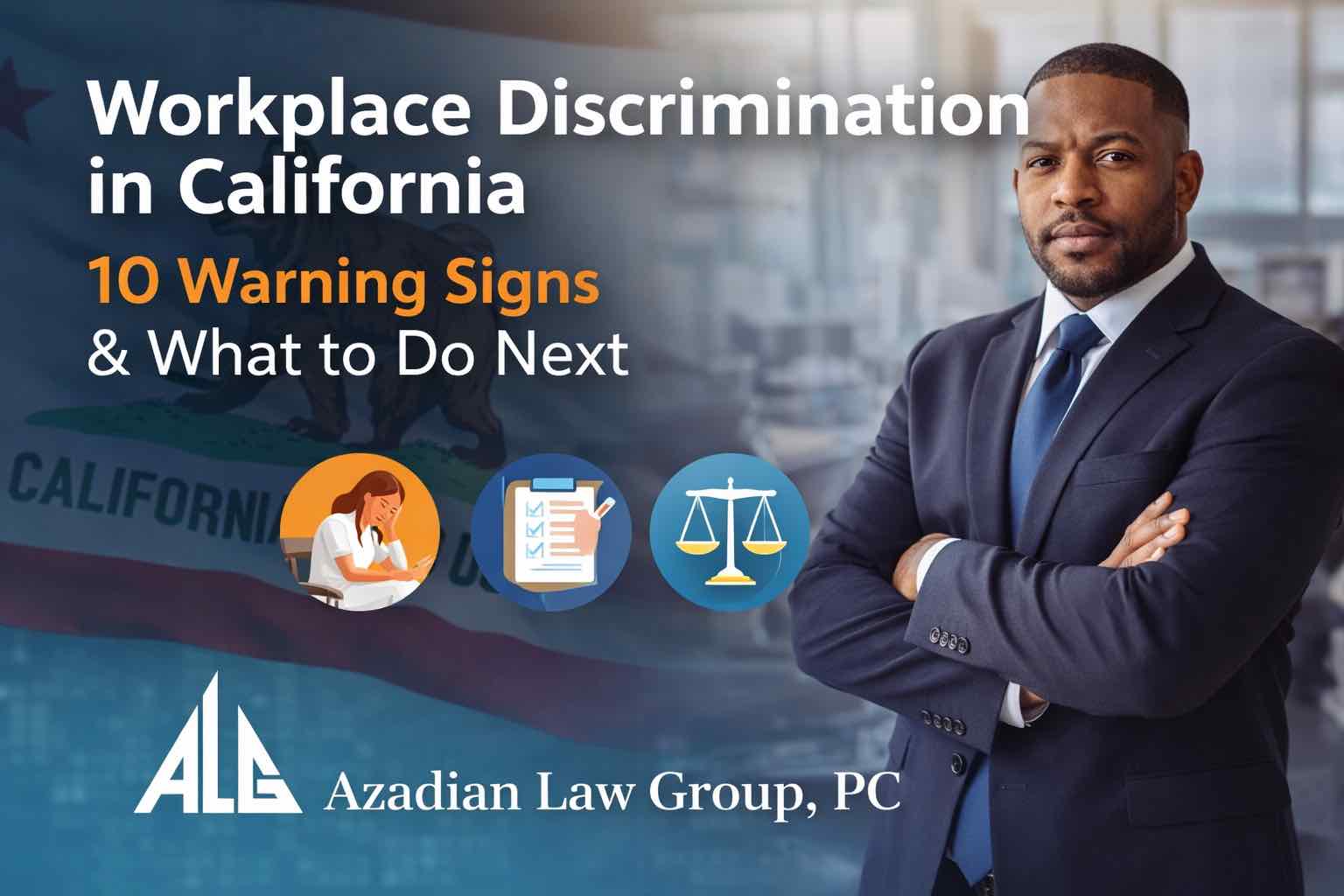
Workplace discrimination isn’t always loud. Sometimes it’s subtle. Systemic. Quiet. And that’s what makes it dangerous.
In California — one of the most employee-protective states in the country — thousands of workers still experience discrimination every year. According to the U.S. Equal Employment Opportunity Commission (EEOC), tens of thousands of discrimination charges are filed annually nationwide. California consistently ranks among the top states for employment-related claims due to its size and strong worker protections.
But here’s the real issue: Many employees don’t realize what they’re experiencing is unlawful.
At Azadian Law Group, PC, we’ve represented employees across California who initially questioned themselves before recognizing the pattern. If something feels off at work, it probably deserves a closer look. Let’s break it down clearly.
What Workplace Discrimination Actually Means in California
Workplace discrimination occurs when an employer treats an employee unfairly because of a protected characteristic under California or federal law.
Under the California Fair Employment and Housing Act (FEHA) and federal laws enforced by the Equal Employment Opportunity Commission, employees are protected from discrimination based on:
- Race
- Sex / Gender
- Sexual Orientation
- Gender Identity / Expression
- Religion
- Age (40+)
- Disability
- Medical Condition
- Marital Status
- Military / Veteran Status
- National Origin
- Pregnancy
California’s protections are broader than federal law — and in many cases, more powerful.
10 Signs You May Be Experiencing Discrimination at Work
Not all discrimination looks like blatant harassment. Sometimes it’s patterns. Sometimes it’s silence. Sometimes it’s policy manipulation.
Here are the signs we see most often:
- 1. Inappropriate Jokes, Comments, or “Casual” Remarks
Repeated comments about race, age, gender, religion, disability, or background — even disguised as jokes — can create a hostile work environment.
You don’t have to be the direct target for it to be illegal. If the environment becomes intimidating or offensive, that matters.
- 2. Lack of Diversity in Hiring or Leadership
If leadership consistently reflects only one demographic group despite qualified diverse candidates, it may signal discriminatory hiring or promotion practices.
Pattern evidence matters in discrimination claims.
- 3. “Role Ruts” — Certain Groups Stuck in Certain Positions
Are certain employees consistently placed in support roles while others advance into leadership? Are promotions tied to “culture fit” instead of performance metrics?
That can signal systemic bias.
- 4. Being Passed Over for Promotion Despite Strong Qualifications
If a less-qualified employee is promoted and you suspect the decision was influenced by age, race, gender, disability, or another protected category, that may be unlawful discrimination.
Documentation becomes critical here.
5. Interview Questions That Cross Legal Lines
Questions about:
- Family plans
- Religious practices
- Medical history
- Age Citizenship (beyond work authorization)
These can violate anti-discrimination laws if they influence hiring decisions.
- 6. Unfair Performance Reviews That Don’t Match Reality
A sudden drop in evaluations after disclosing a pregnancy, medical condition, or complaint? That’s often how employers build a paper trail to justify termination.
Courts look closely at timing.
- 7. Hostile or Unequal Communication
If a supervisor speaks to you harshly while speaking respectfully to others performing the same job, and the difference appears tied to a protected characteristic — that’s not just personality conflict.
It may be discrimination.
- 8. Selective Discipline
If rules are enforced strictly against you but loosely against others for similar conduct, that inconsistency can be powerful evidence.
Consistency is legally important.
- 9. Being Told You Can’t Discuss Salary
Under federal law (National Labor Relations Act), most employees have the right to discuss wages.
Employers sometimes restrict salary discussions to hide pay disparities.
Pay discrimination remains one of the most litigated workplace issues in California.
- 10. Denial of Reasonable Accommodations
Under the Americans with Disabilities Act and California law, employers must provide reasonable accommodations unless it creates undue hardship.
That includes:
- Modified schedules
- Remote work adjustments
- Medical leave
- Assistive equipment
Flat-out refusal without engaging in the interactive process can violate the law.
What the Data Tells Us
Workplace discrimination isn’t rare:
- Retaliation is consistently the most common EEOC charge nationwide.
- Disability discrimination claims remain among the top categories filed each year.
- California courts see some of the highest employment litigation rates in the country.
Many cases involve subtle patterns rather than obvious misconduct.
What To Do If You Suspect Discrimination
Before filing a lawsuit, there are strategic steps to take.
- 1. Document Everything Save emails. Keep performance reviews. Write down dates and witnesses. Evidence wins cases.
- 2. Review Your Company’s Internal Complaint Process California employers are required to maintain anti-discrimination policies. Filing internally can establish a legal record.
- 3. Watch for Retaliation If your employer suddenly changes treatment after you complain, that may be an additional legal violation.
- 4. File a Charge With the EEOC or California Civil Rights Department In most cases, you must file an administrative complaint before filing a lawsuit. The EEOC may issue a “Notice of Right to Sue.”
Deadlines matter. Waiting too long can eliminate your claim.
FAQs
- What Does Workplace Discrimination Actually Look Like?
It looks like unequal treatment tied to a protected characteristic.
Sometimes it’s termination.
Sometimes it’s demotion.
Sometimes it’s subtle exclusion that builds over time.
Intent doesn’t have to be openly stated for discrimination to exist.
- How Do I Know If I Have a Case?
If:
- You’re treated differently than similarly situated coworkers
- The treatment relates to a protected class
- There’s documentation or witnesses
- You may have grounds to move forward.
Every situation is fact-specific.
Why Acting Quickly Matters
Discrimination doesn’t just harm income — it affects mental health, career trajectory, and long-term earning potential.
California law is powerful — but only if deadlines are met and evidence is preserved.
How Azadian Law Group, PC Can Help
At Azadian Law Group, PC, we focus exclusively on representing employees in complex workplace disputes across California.
We understand:
- FEHA claims
- Wrongful termination
- Retaliation
- Hostile work environment
- Failure to accommodate
- Wage and hour violations
We approach every case strategically — not emotionally. Employers often have legal teams protecting them from day one. You deserve the same level of representation.
If you believe you are experiencing discrimination at work, you don’t have to navigate it alone.
Schedule a Confidential Consultation
Workplace discrimination thrives in silence. Legal clarity restores power. If something feels wrong, it’s worth asking questions.
Contact Azadian Law Group, PC today to understand your rights, your options, and your next move.


Related Blog Posts
When a California jury steps up and delivers a $103 million age discrimination verdict, the whole employment law world stops...
Read MoreIn the last 48 hours, Los Angeles has found itself at the center of a storm—again. Following a series of...
Read MoreIn a case drawing national attention, the Phoenix Suns have found themselves at the center of a legal storm. Former...
Read MoreTypes of Cases Handle By Employment Lawyers in Los Angeles, CA
The following presents an overview of the broad range of employment law cases that our employment attorneys are experienced at overseeing and favorably resolving.
Wrongful Termination
Wrongful Termination Lawyers in Los Angeles, CA Attorneys at Azadian Law Group who have filed wrongful termination lawsuits acknowledge that unfair termination can significantly impact an employee’s life. It can…
Age Discrimination
Age Discrimination Lawyers in Los Angeles, CA Azadian Law Group, PC regularly represents clients throughout Los Angeles, CA, who are the victims of age discrimination in the workplace. At Azadian…
Pregnancy Discrimination
Pregnancy Discrimination Lawyer in Los Angeles, CA At Azadian Law Group, PC, our pregnancy discrimination lawyer in Los Angeles, regularly represents clients who are the victims of pregnancy discrimination in…
Sexual Harassment
Sexual Harassment Attorney in Los Angeles, CA The Los Angeles Sexual Harassment Lawyers at Azadian Law Group, PC, know that in today’s modern era, some people often make the mistake of…
Racial Discrimination
Racial Discrimination Lawyers in Los Angeles, CA Azadian Law Group, PC regularly represents clients throughout Los Angeles who are the victims of racial discrimination at work. The Los Angeles Race…
Disability Discrimination
Disability Discrimination Attorneys in Los Angeles, CA There is a misconception that disabled people do not want to work or that disabled individuals simply cannot or will not be as…
Praise from Our Clients
NN

H
JB
TA
IG
GB
T
hh
K&
DS
jg
s
CH
FA
BJ
TH
AS
TP
JA
DR
MM
D
RG
WR
CP
PG
DM
GN
MZ
TA
JA
DG
VB
wm
sr
AR
NS
N
RT
AW
KK
JL
ZM
AG
m
KM
MJ
JJ
GA
MH
sl
CG
aa
JJ
MM
CW
DB
SS
CA
A
LD
PZ
SM
ES
DM
DA
PD
LH
RC
Kd
PP
SM
S
AC
AF
KG
PW
CA
kr
WW
LS
TP
SS
YU
AR
GA
PA
TC
SM
MS
GC
EC
PD
rc
LH
VS
SM
LA
SS
MS
mp
aa
DV
SC
VV
WW
RC
TH
AC
AO
TP
D
JG
RK
A“
RT
BM
bS
SM
FL
TP
JA
VM
SD
W
DN
RS
la
DP
HL
QT
KM
HM
kj
TM
kr
CF
RM
JS
RM
kn
KW
L
Employees We Represent in Employment Law Cases
At Azadian Law Group, we represent employees throughout Los Angeles and California who have experienced workplace violations. Our attorneys handle employment law matters including wrongful termination, workplace discrimination, retaliation, harassment, wage and hour violations, and whistleblower protection.
Employees often face unlawful treatment after reporting misconduct, requesting medical leave, or asserting their legal rights at work. Our firm investigates employment law violations and advocates for workers seeking accountability, compensation, and fair treatment under California and federal employment law.

Step 1
Explore our comprehensive range of legal services to find the specialized support you need.
Step 2
Arrange a free initial meeting with our experts to discuss your legal situation.
Step 3
Receive a custom strategy specially created for your case by our legal experts.
Call Us Now 213-229-9031
Tell Us Your Story
Speak out for justice. Your story can be the start of a new chapter of workplace fairness.
