Wrongful Termination and Employee Rights Under the Americans with Disabilities Act (ADA)
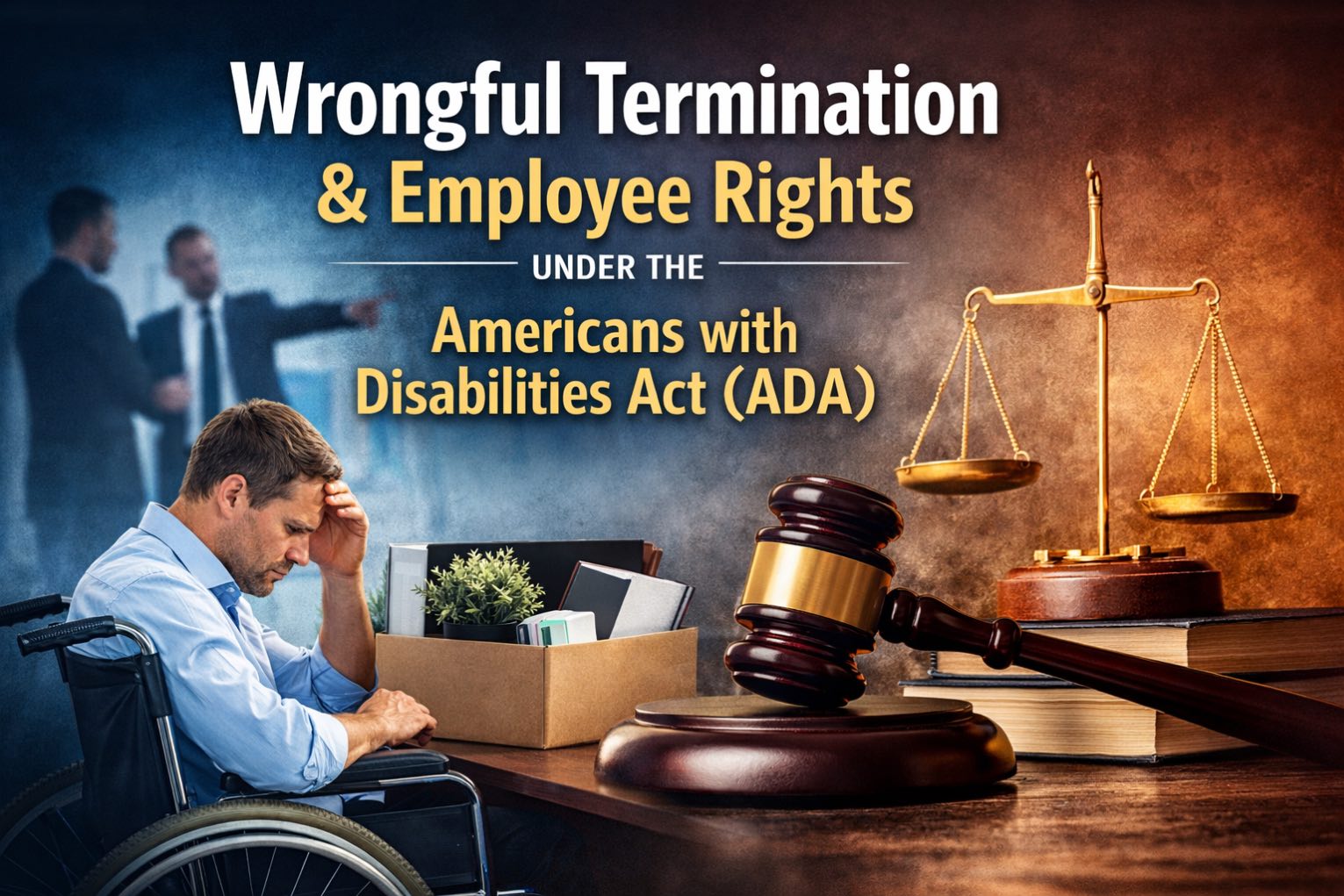
Wrongful Termination and Employee Rights Under the ADA
If an employer fires you because of a disability, a perceived disability, a request for reasonable accommodation, or a disability-related complaint, the termination may violate the Americans with Disabilities Act (ADA) and California law.
A lawful case is not established by timing alone. The key questions are whether you were qualified for the job, whether an accommodation could have allowed you to perform its essential functions, and whether disability-related facts influenced the decision. California employees may have overlapping federal and state protections. The Los Angeles disability discrimination lawyers at Azadian Law Group can help evaluate how those laws fit the facts.
What the ADA Protects
The ADA generally protects qualified employees with a physical or mental impairment that substantially limits a major life activity, employees with a record of such an impairment, and employees whom the employer regards as having one. Protection can apply when an employee is managing a condition successfully, has episodic symptoms, or has not used the word “disability.” Employers usually need enough information to understand that a work-related limitation exists and that support may be needed. California’s Fair Employment and Housing Act (FEHA) often provides broader coverage than the federal baseline, but coverage, exemptions, and filing rules depend on the employer, job, and facts.
ADA, FEHA, and California Leave Rights
The ADA is a federal anti-discrimination law, while FEHA is California’s primary workplace disability-discrimination law. A claim may involve both, but their definitions, procedures, and remedies are not identical. Medical leave can be an accommodation, but leave is not unlimited and does not automatically prevent termination. An employer generally must assess whether a reasonable, predictable leave period would permit a return to work without creating undue hardship. Separate job-protection rules may arise under the Family and Medical Leave Act (FMLA), the California Family Rights Act (CFRA), pregnancy-disability rules, workers’ compensation laws, or company policy. See Azadian’s medical leave lawyer page and FMLA lawyer page for related issues.
When Termination After a Medical Issue May Be Illegal
Firing an employee shortly after an accommodation request, medical disclosure, or complaint can be evidence of discriminatory or retaliatory motive, especially when the employer changes its explanation. Refusing to discuss workable accommodations, demanding unnecessary medical details, applying a policy inconsistently, or replacing an employee while saying the position is being eliminated can support an inference of pretext. An employer may still take action for legitimate reasons, including documented misconduct or inability to perform essential functions after a good-faith accommodation process. The facts and evidence determine whether the stated reason is genuine.
Reasonable Accommodation and the Interactive Process
Possible accommodations can include modified schedules, assistive technology, ergonomic equipment, temporary restructuring of nonessential tasks, remote or hybrid work when feasible, leave for treatment, or reassignment to a vacant position in limited circumstances. An accommodation does not require an employer to eliminate an essential job function, lower a consistently applied performance standard, create a new job, or accept an indefinite absence. The interactive process should be a timely, good-faith exchange about essential functions, limitations, possible accommodations, and workable alternatives. A breakdown caused by the employer may matter even if the first requested accommodation was not the only option.
ADA and FEHA Coverage: Important Differences
| Question | ADA | California FEHA |
|---|---|---|
| Typical employer coverage | Generally employers with 15 or more employees, subject to statutory rules. | Generally employers with 5 or more employees for disability discrimination, subject to exceptions. |
| Accommodation duty | Requires reasonable accommodation for a qualified individual unless it creates undue hardship. | Requires reasonable accommodation and a good-faith interactive process, often with broader state-law protections. |
| Medical inquiries | Limits disability-related questions and medical examinations and requires confidentiality. | Uses its own restrictions and confidentiality rules that may overlap with federal protections. |
| Enforcement route | Usually begins with an EEOC charge before a federal lawsuit. | May involve a CRD complaint or a right-to-sue process, depending on the claim and election. |
This comparison is a starting point, not a substitute for checking the employer’s size, worksite, dates, and exact legal theory.
Examples of Potentially Unlawful ADA Termination
Potential warning patterns include an employee disclosing multiple sclerosis and requesting a predictable treatment schedule, then being terminated after a supervisor complains about the “medical problem.” Another example is an employee with a hearing impairment requesting captioning while HR refuses to discuss alternatives and later cites “poor communication.” A worker returning from approved medical leave may be replaced after the employer refuses to review doctor-recommended modified duties. Likewise, unusual write-ups, shift cuts, or termination soon after reporting disability-based comments may support a retaliation theory. These facts do not automatically establish liability; they identify patterns that deserve review of policies, communications, comparators, and the stated reason.
Examples That May Be Lawful
Termination may be lawful when an employer documents that an employee cannot perform an essential safety duty after considering effective accommodations, when a fixed leave period ends without a reasonably foreseeable return and additional leave creates a documented hardship, or when serious unrelated misconduct is treated consistently. A genuine department closure made before a disclosure or leave request may also be legitimate. Even then, discriminatory comments, inconsistent explanations, or failure to engage in the interactive process can change the analysis.
How Employers Defend ADA Wrongful-Termination Claims
Common defenses are that the employee was not qualified even with accommodation, the request would remove an essential function or create an unmitigated safety threat, or the decision was based on documented misconduct, unrelated attendance, or a genuine reduction in force. Employers may also argue that the decision-maker lacked knowledge of the disability or protected activity, or that the employee declined workable alternatives. These defenses are tested against the timeline and business records. A conclusory statement that the employee was “not a fit” is less persuasive than contemporaneous, consistent documentation.
Accommodation Requests: Practical Wording
Put the request in writing and identify the work limitation, the adjustment that may help, and the expected duration if known. For example: “Because of a medical limitation, I am having difficulty with prolonged standing. I am requesting a temporary seated-work option and a discussion of other reasonable accommodations.” You do not need to disclose every diagnosis or provide a complete medical history. Share information reasonably needed to explain the limitation and accommodation, and ask why any broader medical record is necessary.
Medical Records, Privacy, and Personnel Files
Medical information obtained through an accommodation process should generally be kept separately from ordinary personnel records and disclosed only to people with a legitimate need to know. Keep copies of what you provided and note who received it. Request personnel records, performance reviews, disciplinary notices, accommodation correspondence, and the written termination reason. California employees may have additional rights to inspect personnel records under state law. For a broader records strategy, review the firm’s wrongful-termination warning signs guide.
Agency Charges and Lawsuit Timing
Deadlines are usually measured from the discriminatory or retaliatory act, not from the date you finish collecting evidence or negotiate severance. For many private-sector ADA claims, the EEOC charge deadline is 180 days and may be extended to 300 days in a state with a qualifying fair-employment agency. Exact rules vary by claim and location. California claims may use the CRD process and different right-to-sue procedures, and filing with one agency does not automatically preserve every claim. An agency charge should be accurate, specific, and consistent with later filings. The EEOC’s public portal provides current filing access.
Settlement Agreements and Severance Releases
A severance agreement may waive ADA, FEHA, wage, retaliation, or other claims in exchange for payment. The release language matters more than the document’s title. Check review and revocation deadlines, confidentiality, cooperation, non-disparagement, return-of-property terms, and any age-discrimination waiver. Preserve the original agreement and every revision, and have counsel value the release against lost wages, benefits, emotional distress, fees, litigation risk, and the strength of the evidence before signing.
Building a Strong Case Timeline
| Date | Event to record | Why it may matter |
|---|---|---|
| Before disclosure | Performance reviews, attendance, awards, discipline, and job duties. | Shows baseline performance and whether the stated reason appeared later. |
| Disclosure or request | Who was told, what limitation was described, and what accommodation was requested. | Establishes protected knowledge and the employer’s response. |
| Interactive process | Meetings, forms, medical requests, alternatives, and delays. | Shows whether both sides explored a workable accommodation. |
| Adverse action | Warnings, schedule changes, investigation, suspension, or termination. | Connects the protected activity to the alleged harm. |
| After termination | Severance, replacement hiring, comparable jobs, and mitigation efforts. | Helps evaluate damages and possible pretext. |
Questions to Ask During an Initial Consultation
- What exactly did the employer know, and when did each decision-maker learn it?
- What was the requested accommodation, and did anyone discuss alternatives?
- Which job functions were essential, and what written description existed before the dispute?
- Were other employees treated differently for similar attendance, performance, or conduct issues?
- Did the employer’s explanation change between the termination meeting, severance letter, unemployment response, and agency filing?
- Is there an arbitration agreement, collective-bargaining agreement, internal appeal, or pending agency charge?
ADA Retaliation and Interference
Retaliation may include termination, demotion, schedule cuts, exclusion, discipline, threats, or intensified scrutiny after an employee requests accommodation, opposes disability discrimination, files a charge, or participates in an investigation. You do not need to prove the underlying discrimination claim to show retaliation, but you do need evidence connecting the protected activity to the adverse action. Keep the wording of your request and the employer’s response; a simple written message explaining a medical limitation can be important context.
What Employees Must Prove
| Issue | What the evidence should show |
|---|---|
| Covered disability or perception | A medical condition, history, or employer belief that affected a major life activity or workplace treatment. |
| Qualification | You could perform essential functions with or without a reasonable accommodation. |
| Protected request or activity | You requested accommodation, used protected leave, opposed discrimination, or participated in a complaint. |
| Adverse action | Termination, forced resignation, demotion, suspension, or another materially harmful action. |
| Causation or pretext | Timing, statements, shifting explanations, comparator evidence, policy deviations, or records linking the decision to disability-related facts. |
Evidence to Preserve Before It Disappears
- Save accommodation requests, medical-certification instructions, doctor notes, leave approvals, attendance records, performance reviews, warnings, termination notices, severance documents, and relevant texts or emails.
- Keep the job description and identify which duties were essential. Note what you performed successfully before and after the accommodation request.
- Write a dated timeline of disclosures, requests, meetings, discipline, comments, and termination. Include witnesses and the exact words used when possible.
- Preserve evidence lawfully. Do not remove confidential client information, trade secrets, or protected patient data from an employer’s systems.
- Azadian’s guide on evidence that can prove wrongful termination in California can help organize the record.
What to Do After a Disability-Related Termination
- Request the termination reason and relevant personnel records in writing. Avoid signing a release or separation agreement before you understand the claims and deadlines.
- Apply for replacement work and document mitigation efforts, medical expenses, lost benefits, and other financial effects.
- Consider an intake with the California Civil Rights Department (CRD), the Equal Employment Opportunity Commission (EEOC), or both. Which agency is appropriate depends on the statute and facts.
- Federal ADA charges are commonly subject to a 180-day deadline, often extended to 300 days where a state or local agency enforces a similar law. California deadlines can differ, so confirm the controlling deadline promptly with counsel and the agency.
- Read Azadian’s practical checklist for the legal steps after a wrongful termination.
Potential Remedies
Depending on the claim, remedies may include back pay, front pay, lost benefits, emotional-distress damages, reinstatement or a comparable position, reasonable-accommodation relief, punitive damages where legally available, and attorney’s fees. Damages can be reduced when an employee does not make reasonable efforts to find comparable work, and some claims may be limited by arbitration agreements, statutory caps, or administrative prerequisites. A settlement or severance payment may affect the value and timing of claims, so get advice before accepting money in exchange for a release.
Common Questions About ADA Wrongful Termination
- Can my employer fire me while I am on medical leave?
Possibly, but the decision cannot be based on disability, protected activity, or a refusal to consider a reasonable accommodation. A legitimate elimination or documented performance reason may still be lawful. - Do I have to say “ADA” to request an accommodation?
No. You should give enough information to communicate that a medical limitation affects work and that an adjustment may be needed. - Can an employer ask for medical documentation?
In appropriate circumstances, an employer may request limited documentation needed to verify the disability or accommodation need. Broad or unrelated requests may be improper. - Is a denied accommodation automatically wrongful termination?
No. The proposed accommodation, essential functions, alternatives, and undue-hardship evidence matter. A denial may be unlawful if the employer skipped a good-faith analysis or relied on discriminatory assumptions. - Can I bring both ADA and California claims?
Often, yes, but each claim has its own coverage, exhaustion, deadline, and remedy rules. A lawyer can map the claims before a filing deadline expires. - Where can I discuss my situation?
Employees who believe a disability disclosure, accommodation request, or medical leave contributed to their termination can request a review of the disability-related employment decision. Bring the accommodation communications, medical documentation, job description, performance records, and termination paperwork.Azadian Law Group also discusses accommodations, retaliation, and related California protections through its disability and workplace-rights podcast.
Talk With an Employment Lawyer Promptly
Disability-related termination cases are fact-specific and deadline-sensitive. Bring the timeline, job description, accommodation communications, medical documentation, discipline records, termination paperwork, and any agreement you were asked to sign. This article is general information, not legal advice or a prediction about any individual case.


Related Blog Posts
Losing a job is difficult enough. Receiving an invoice afterward for a signing bonus, training program, or recruiting payment can...
Read MoreYour Los Angeles employer announces a return-to-office deadline. You explain that a medical condition makes the new schedule difficult and...
Read MoreWrongful Termination Evidence Often Appears as a Pattern Wrongful termination evidence is rarely found in one dramatic email admitting that...
Read MoreTypes of Cases Handle By Employment Lawyers in Los Angeles, CA
The following presents an overview of the broad range of employment law cases that our employment attorneys are experienced at overseeing and favorably resolving.
Wrongful Termination
Wrongful Termination Lawyers in Los Angeles, CA Attorneys at Azadian Law Group who have filed wrongful termination lawsuits acknowledge that unfair termination can significantly impact an employee’s life. It can…
Age Discrimination
Age Discrimination Lawyers in Los Angeles, CA Azadian Law Group, PC regularly represents clients throughout Los Angeles, CA, who are the victims of age discrimination in the workplace. At Azadian…
Pregnancy Discrimination
Pregnancy Discrimination Lawyer in Los Angeles, CA At Azadian Law Group, PC, our pregnancy discrimination lawyer in Los Angeles, regularly represents clients who are the victims of pregnancy discrimination in…
Sexual Harassment
Sexual Harassment Attorney in Los Angeles, CA The Los Angeles Sexual Harassment Lawyers at Azadian Law Group, PC, know that in today’s modern era, some people often make the mistake of…
Racial Discrimination
Racial Discrimination Lawyers in Los Angeles, CA Azadian Law Group, PC regularly represents clients throughout Los Angeles who are the victims of racial discrimination at work. The Los Angeles Race…
Disability Discrimination
When a Medical Condition Becomes a Workplace Problem, You Have Rights Most employees never expect a health condition to place their career at risk. Yet every day across Los Angeles,…
Praise from Our Clients
Lui H

Arpi Agdere
Tofi
Aracelis Feria
Ivy Gamboa
Jillian Dunlap
Greg Wayne
Elizabeth Eromosele
Steve G
Lisa Galvan
Artur Aleksanyan
Delight Dinopoulos
George Margaros
Chelsea Pham
Trevor Pal-Freeman
Patricio Garza
Taylor
Ashley Londerman
Marissa Zapanta
Nuria Coronado
Barbara Villalobos
Irene Golub
Joshua Butler
J Mo
Employees We Represent in Employment Law Cases
At Azadian Law Group, we represent employees throughout Los Angeles and California who have experienced workplace violations. Our attorneys handle employment law matters including wrongful termination, workplace discrimination, retaliation, harassment, wage and hour violations, and whistleblower protection.
Employees often face unlawful treatment after reporting misconduct, requesting medical leave, or asserting their legal rights at work. Our firm investigates employment law violations and advocates for workers seeking accountability, compensation, and fair treatment under California and federal employment law.

Step 1
Explore our comprehensive range of legal services to find the specialized support you need.
Step 2
Arrange a free initial meeting with our experts to discuss your legal situation.
Step 3
Receive a custom strategy specially created for your case by our legal experts.
Call Us Now 213-229-9031
Tell Us Your Story
Speak out for justice. Your story can be the start of a new chapter of workplace fairness.
