How Employers Can Reduce Legal Risks of Age Bias—and What California Employees Should Know
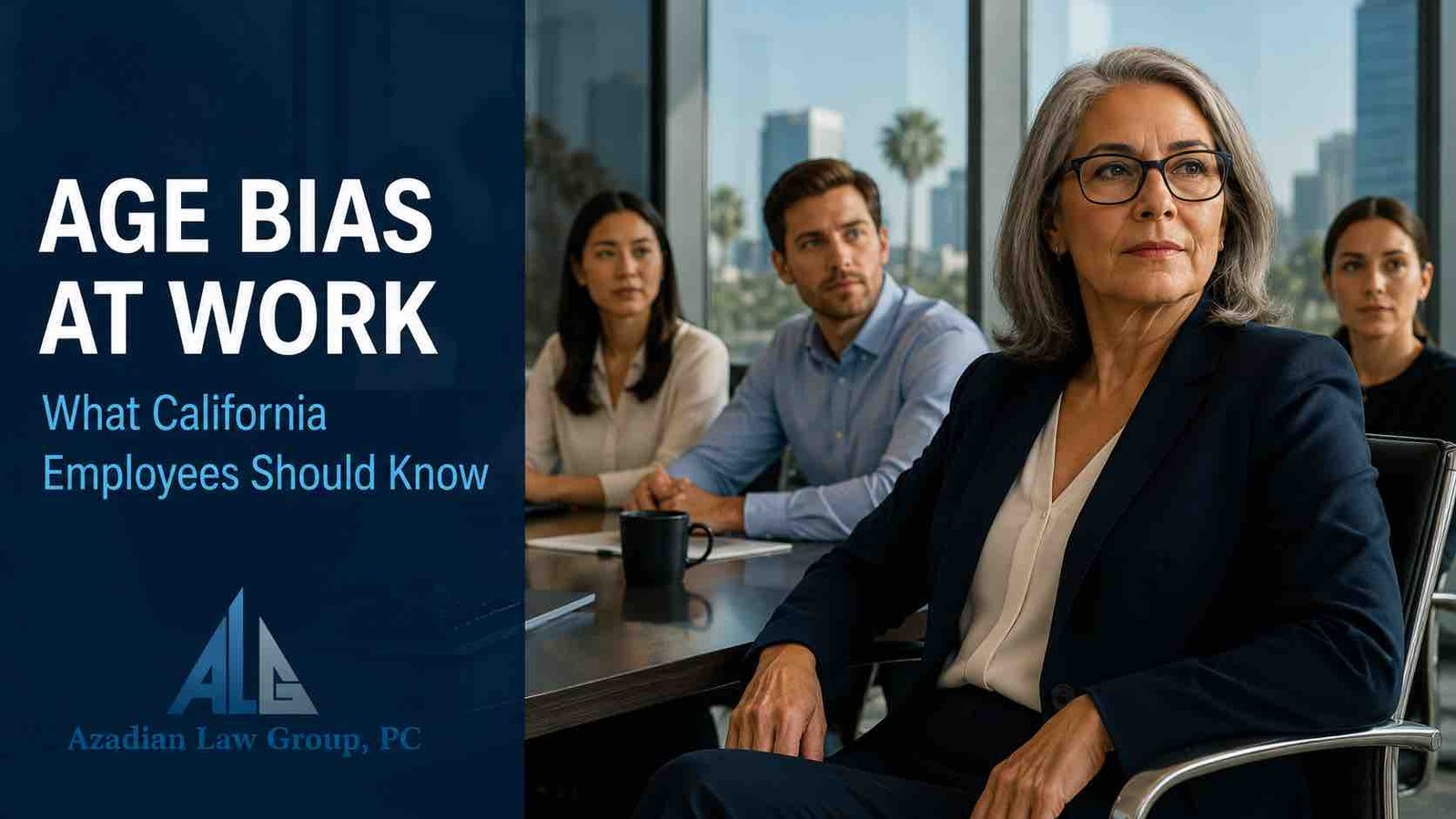
Age discrimination is rarely announced with a direct statement such as, “You are too old for this job.” It more often develops through coded comments, shifting expectations, unexplained exclusion, pressure to retire, or a supposed restructuring that repeatedly disadvantages experienced workers.
Responsible employers reduce that risk by using consistent standards, documenting legitimate decisions and responding seriously to employee complaints. Those safeguards also give workers a practical benchmark. When an employer ignores them, the departures may help an employee understand whether an adverse decision deserves closer examination.
California employees who believe age influenced a demotion, layoff, denied promotion or termination can speak with Azadian Law Group’s Los Angeles employment lawyers. A careful review of the chronology, decision-makers, documents and treatment of comparable employees can help separate an unfair decision from a potentially unlawful one.
Age Bias at Work in California: The Short Answer
Age bias occurs when assumptions about age influence workplace treatment or employment decisions. It can affect recruiting, hiring, training, compensation, assignments, promotions, performance reviews, layoffs, severance negotiations and termination.
The federal Age Discrimination in Employment Act, commonly called the ADEA, generally protects applicants and employees who are age 40 or older. The ADEA generally applies to employers with at least 20 employees.
California’s Fair Employment and Housing Act provides additional protection. The California Civil Rights Department explains that FEHA generally prohibits covered employers with five or more employees from discriminating because an applicant or employee is age 40 or older. Coverage, legal standards and available claims can differ, so an employee should not assume that the federal and California rules are identical.
Why an Employer’s Prevention Practices Matter to Employees
An anti-discrimination policy does not automatically prove that a company follows the law. Still, an employer’s procedures can reveal what should have happened before a consequential decision was made.
For example, an employer may claim that a layoff used neutral performance criteria. If managers changed those criteria after selecting the employees, ignored positive evaluations, or retained substantially younger workers with similar records, the gap between the stated process and the actual process may matter.
The same is true when an employee complains. A policy may promise a prompt and impartial investigation, but the company may interview no witnesses, preserve no records and discipline the person who reported the problem. That contrast does not establish liability by itself. It can, however, become relevant evidence when combined with timing, comments and inconsistent explanations.
Seven Safeguards Responsible Employers Should Use
1. Use objective criteria before making the decision
Promotion, discipline and layoff criteria should be defined before managers know which employees will be affected. Vague labels such as “energy,” “culture fit,” “fresh thinking” or “future potential” can conceal subjective assumptions about age.
Employees should compare the announced criteria with the employer’s actual conduct. Were the same standards applied to everyone? Did the employer rely on measurable work, or did the explanation depend on stereotypes that favored younger workers?
2. Audit layoffs and reorganizations for patterns
A legitimate reorganization can still be implemented unlawfully. Employers should examine who was selected, who remained, whether eliminated positions were recreated, and whether the process disproportionately affected older workers.
Employees rarely have access to the complete workforce data. They can still record what they lawfully know: names, approximate ages, job titles, experience levels, selection criteria and whether younger employees assumed the same duties.
3. Evaluate performance consistently
Performance standards should not change because an employee reaches a particular age, receives a new younger supervisor or becomes eligible for retirement. Sudden criticism after years of positive reviews deserves context, especially when younger coworkers are excused for comparable conduct.
Our guide to subtle signs of age discrimination explains how shifting expectations, exclusion and coded remarks may fit together over time.
4. Remove age-coded language from workplace decisions
Some comments refer directly to age. Others rely on proxies. References to being “overqualified,” “set in your ways,” “not a digital native,” “too expensive,” “old school,” or lacking “youthful energy” may be relevant when made by a decision-maker near an adverse action.
Context matters. A stray comment by someone uninvolved in the decision may carry less weight than repeated statements from the supervisor selecting employees for termination. Employees should record the words used, date, location, speaker and witnesses as soon as possible.
5. Provide equal access to training and advancement
Employers should not assume that experienced employees are uninterested in new technology, leadership programs or long-term assignments. Denying training and then criticizing the employee for lacking newly required skills can create a self-fulfilling record.
Watch for patterns in who receives mentorship, high-visibility assignments, client opportunities and succession planning. A single missed opportunity may have many explanations. Repeated exclusion concentrated among older employees can raise a different question.
6. Investigate complaints without retaliation
The EEOC explains that federal law prohibits retaliation against a person for opposing age discrimination or participating in an age-discrimination proceeding. California law also prohibits retaliation for protected activity under FEHA.
A complaint does not require perfect legal wording. An employee may report that younger coworkers receive better assignments, that a manager repeatedly pressures older workers to retire, or that a layoff appears to target people over 40. The content of the complaint, the employer’s knowledge and what happened afterward all matter.
7. Review severance agreements carefully
Older employees are often presented with releases during layoffs. Federal law imposes specific requirements on waivers of ADEA claims. Depending on whether the offer concerns one employee or a group termination program, the employee may be entitled to a specified consideration period, particular disclosures and a seven-day revocation period.
The EEOC’s severance-waiver guidance explains these federal requirements. Employees should not assume that a release is valid—or invalid—without reviewing the actual language and circumstances.
Employer Safeguards and Employee Warning Signs
| Workplace decision | Responsible safeguard | Warning sign employees may notice |
|---|---|---|
| Hiring | Job-related qualifications and consistent interview questions | Requests for age information, graduation-year screening or repeated preference for “young” candidates |
| Promotion | Written selection criteria applied equally | Experienced worker is called “overqualified” while a substantially younger employee receives the role |
| Performance review | Stable metrics supported by documented examples | Standards change suddenly after age-related remarks or retirement questions |
| Training | Equal access to technology and leadership development | Older workers are denied training and later criticized for lacking new skills |
| Layoff | Predefined criteria and an age-impact review | Long-tenured workers are selected while younger employees inherit the same duties |
| Complaint | Prompt, impartial investigation and protection against retaliation | New scrutiny, exclusion, discipline or termination follows the report |
| Severance | Clear waiver language, required disclosures and adequate review time | Pressure to sign immediately or incomplete information during a group layoff |
What Evidence Can Help Show Age Discrimination?
Age-discrimination cases are often proven through circumstantial evidence. No single fact must carry the entire case. The question is whether the combined evidence supports a reasonable inference that age influenced the decision.
Potentially useful evidence includes:
- Age-related remarks, retirement questions or coded comments from decision-makers
- Positive reviews followed by sudden undocumented criticism
- Different discipline for younger employees who engaged in similar conduct
- Removal from meetings, accounts, training or leadership opportunities
- Replacement by a substantially younger employee
- Layoff patterns affecting experienced workers while their duties remain
- Changing explanations given during termination, unemployment proceedings or agency filings
- Emails, messages, evaluations, organizational charts and job postings
- A written complaint followed by unusually close timing or new scrutiny
Employees should preserve only material they possess lawfully. They should not enter restricted systems, take privileged communications, download trade secrets or remove confidential files they are not entitled to keep. Our broader guide explains how workplace discrimination may be proven in California without encouraging unlawful evidence collection.
Age Bias Can Affect Women Differently
Age does not operate in isolation. An older woman may encounter overlapping assumptions about age, gender, appearance, caregiving or leadership. A decision can therefore require analysis under more than one protected category.
The firm’s article on age and gender discrimination affecting older women examines why some employees experience a combined form of bias that is not captured by looking at age or sex alone.
What If the Employer Calls It a Restructuring?
A restructuring is not automatically discriminatory. Businesses can eliminate positions, change priorities and reduce costs for legitimate reasons. But the label does not end the inquiry.
Employees should examine who made the selections, when the criteria appeared, whether the position was truly eliminated and who performed the work afterward. A company may say that an older employee’s compensation was too high, yet keep younger workers in comparable roles and then advertise substantially similar duties. Compensation can be a legitimate consideration, but it cannot simply become a substitute for age.
Patterns from real disputes can help employees recognize these issues without assuming every allegation was proven. The firm’s discussion of the Hollywood Chamber age-discrimination allegations illustrates how leadership changes, coded language, health issues and termination timing may intersect.
What Should an Employee Do After Noticing Age Bias?
Start with a private chronology. Record dates, statements, witnesses, performance history, changes in responsibility, complaints and the employer’s responses. Preserve relevant records already in your lawful possession.
If you report the concern internally, be factual. Identify the conduct, explain why you believe age may be affecting workplace treatment and keep proof that the employer received the complaint. Avoid exaggeration, threats or public accusations that may distract from the underlying facts.
Do not rush to sign a severance agreement. Review deadlines carefully, continue documenting job-search efforts and seek advice before evidence disappears or a filing period expires.
How Long Does an Employee Have to Act?
There is no single deadline for every age-discrimination matter. The correct deadline can depend on the employer, claim, forum and whether the employee works for a private company, public entity or federal agency.
The California Civil Rights Department states that an employment-discrimination complaint generally must be filed within three years of the alleged discriminatory act. Federal administrative deadlines may be much shorter. Federal employees follow a separate process and generally must contact an EEO counselor promptly.
Employees should not calculate a deadline from a general article alone. Waiting can affect both legal rights and the availability of evidence.
Frequently Asked Questions About Age Bias at Work
What age is protected from workplace age discrimination?
The ADEA and California FEHA generally protect applicants and employees who are age 40 or older. Different employer-coverage requirements and legal standards may apply under federal and California law.
Is asking when I plan to retire illegal?
A retirement question is not automatically unlawful. Its significance depends on who asked, how often it happened, the context and whether an adverse decision followed. Repeated pressure from a decision-maker can be relevant evidence.
Can my employer replace me with another worker who is also over 40?
Potentially. The fact that a replacement is also over 40 does not automatically defeat a claim. The relative age difference, surrounding comments, comparative treatment and other evidence may still matter.
Does a younger supervisor prove age discrimination?
No. A supervisor’s age alone proves nothing. The analysis focuses on conduct, statements, decision-making, comparative treatment and the employer’s stated reasons.
Is age discrimination illegal during a layoff?
Yes. An employer may conduct a legitimate reduction in force, but it cannot select employees because of age or use neutral-looking criteria as a pretext for age discrimination.
Can I be retaliated against for reporting age discrimination?
The law generally prohibits retaliation for opposing age discrimination or participating in a protected complaint process. Evidence may include decision-maker knowledge, timing, new scrutiny, inconsistent discipline and changing explanations.
Should I sign an age-discrimination waiver in a severance agreement?
Do not assume the waiver is routine. ADEA waivers must satisfy specific federal requirements, and the agreement may release additional claims. Consider obtaining advice before the signing deadline.
Speak With an Age-Discrimination Attorney
An employer’s failure to follow best practices does not automatically establish age discrimination. Likewise, a polished policy does not erase evidence that age influenced a decision. The complete chronology matters.
Azadian Law Group represents employees in age-discrimination, retaliation, disability, leave and wrongful-termination disputes. Employees can review the firm’s age-discrimination practice, listen to its California employment-rights podcast discussion, or request a confidential consultation.
This article provides general information and is not legal advice. Employment laws and filing deadlines can change, and every matter depends on its specific facts. Reading this article or contacting the firm does not create an attorney-client relationship.


Related Blog Posts
Age discrimination has long been a quiet issue in workplaces across the United States, but recent developments are bringing it...
Read MoreWhen a California jury steps up and delivers a $103 million age discrimination verdict, the whole employment law world stops...
Read MoreSubtle Signs of Age Discrimination at Work in California Age discrimination is not always announced through an obvious insult or...
Read MoreTypes of Cases Handle By Employment Lawyers in Los Angeles, CA
The following presents an overview of the broad range of employment law cases that our employment attorneys are experienced at overseeing and favorably resolving.
Wrongful Termination
Wrongful Termination Lawyers in Los Angeles, CA Attorneys at Azadian Law Group who have filed wrongful termination lawsuits acknowledge that unfair termination can significantly impact an employee’s life. It can…
Age Discrimination
Age Discrimination Lawyers in Los Angeles, CA Azadian Law Group, PC regularly represents clients throughout Los Angeles, CA, who are the victims of age discrimination in the workplace. At Azadian…
Pregnancy Discrimination
Pregnancy Discrimination Lawyer in Los Angeles, CA At Azadian Law Group, PC, our pregnancy discrimination lawyer in Los Angeles, regularly represents clients who are the victims of pregnancy discrimination in…
Sexual Harassment
Sexual Harassment Attorney in Los Angeles, CA The Los Angeles Sexual Harassment Lawyers at Azadian Law Group, PC, know that in today’s modern era, some people often make the mistake of…
Racial Discrimination
Racial Discrimination Lawyers in Los Angeles, CA Azadian Law Group, PC regularly represents clients throughout Los Angeles who are the victims of racial discrimination at work. The Los Angeles Race…
Disability Discrimination
When a Medical Condition Becomes a Workplace Problem, You Have Rights Most employees never expect a health condition to place their career at risk. Yet every day across Los Angeles,…
Praise from Our Clients
Lui H

Arpi Agdere
Tofi
Aracelis Feria
Ivy Gamboa
Jillian Dunlap
Greg Wayne
Elizabeth Eromosele
Steve G
Lisa Galvan
Artur Aleksanyan
Delight Dinopoulos
George Margaros
Chelsea Pham
Trevor Pal-Freeman
Patricio Garza
Taylor
Ashley Londerman
Marissa Zapanta
Nuria Coronado
Barbara Villalobos
Irene Golub
Joshua Butler
J Mo
Employees We Represent in Employment Law Cases
At Azadian Law Group, we represent employees throughout Los Angeles and California who have experienced workplace violations. Our attorneys handle employment law matters including wrongful termination, workplace discrimination, retaliation, harassment, wage and hour violations, and whistleblower protection.
Employees often face unlawful treatment after reporting misconduct, requesting medical leave, or asserting their legal rights at work. Our firm investigates employment law violations and advocates for workers seeking accountability, compensation, and fair treatment under California and federal employment law.

Step 1
Explore our comprehensive range of legal services to find the specialized support you need.
Step 2
Arrange a free initial meeting with our experts to discuss your legal situation.
Step 3
Receive a custom strategy specially created for your case by our legal experts.
Call Us Now 213-229-9031
Tell Us Your Story
Speak out for justice. Your story can be the start of a new chapter of workplace fairness.
