Age Discrimination At The Hollywood Chamber Of Commerce
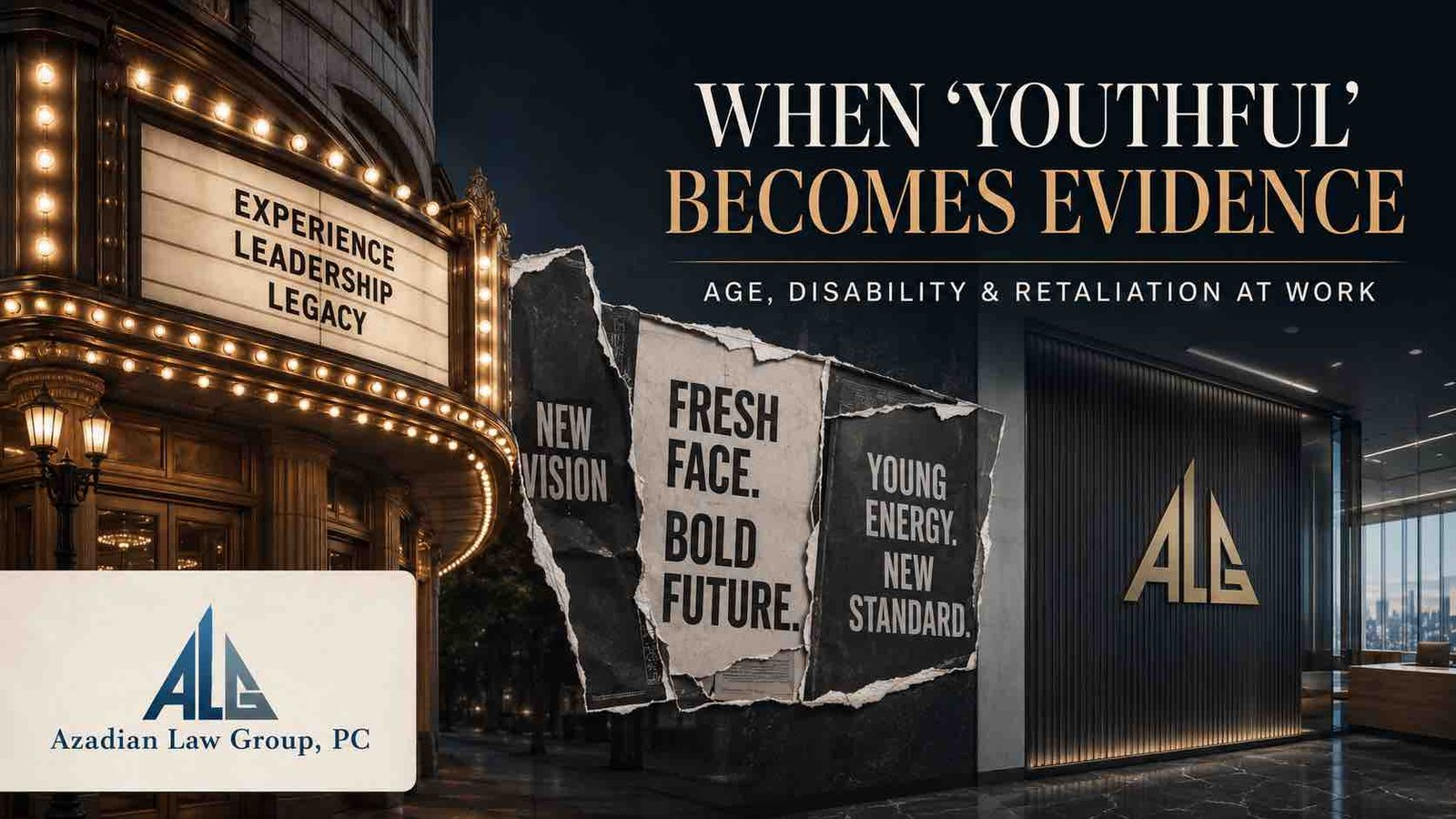
A request for a “younger,” “fresher,” or more “modern” workplace image does not automatically prove age discrimination. However, that language can become important evidence when it is connected to decisions that disadvantage employees age 40 or older. Timing, decision-makers, prior performance, medical-leave requests, changing explanations, and the treatment of younger workers all matter.
A 2019 lawsuit against the Hollywood Chamber of Commerce illustrates how those facts may overlap. Former communications director Marlene Panoyan alleged that a leadership transition brought an emphasis on a more “youthful and hip” culture, followed by age- and disability-related mistreatment, retaliation, and termination after she sought sick leave. Those were allegations in a complaint, not findings established by this article.
Public reporting confirms that Panoyan filed the lawsuit and describes her allegations. Because no reliable public source identifies a final disposition, the matter should not be characterized as a win, loss, or settlement.
Age Discrimination at the Hollywood Chamber of Commerce: The Key Allegations
According to contemporaneous reporting about the complaint, Panoyan worked for the Hollywood Chamber of Commerce beginning in 2005. She eventually served as director of communications and social media. The complaint alleged that the organization’s former president and chief executive consistently praised her work.
The prior executive retired in December 2018. His successor was a younger executive who had previously led another chamber of commerce. The lawsuit alleged that the new leader expressed a desire to move away from an organization perceived as old or outdated and toward a youthful, hip image and culture.
Panoyan, then 50, alleged that she experienced unfavorable treatment after the leadership change. She also alleged that she was fired in January 2019 after requesting sick leave. Her lawsuit reportedly asserted age discrimination, disability discrimination, age-based harassment, and retaliation.
Those allegations present several distinct legal questions. Was age a substantial motivating reason for an adverse action? Did a physical or mental condition trigger disability protections? Did the employee request protected leave or an accommodation? Did the employer retaliate because she exercised a protected right? Each theory requires its own evidence.
Why Words Such as “Youthful” Can Matter
Businesses are generally free to modernize their technology, branding, products, and communication. Wanting a current brand does not require replacing older employees. The legal concern arises when a legitimate business objective becomes a proxy for assumptions about age.
Terms such as “fresh energy,” “digital native,” “new blood,” “overqualified,” “set in their ways,” or “not a cultural fit” can have neutral meanings. They can also carry age-related meaning in context. A factfinder may ask who used the phrase, what decision followed, whether younger employees were favored, and whether the employer applied its standards consistently.
A stray remark by someone uninvolved in a decision may carry little weight. Repeated comments from a decision-maker, especially close in time to a demotion or termination, can be more significant. Written communications and witness testimony can help establish the speaker, timing, intended meaning, and connection to the challenged action.
Employees should avoid assuming that one awkward phrase proves a case. They should document the exact words rather than paraphrasing them into a stronger accusation. Date, location, participants, follow-up actions, and surrounding discussion often determine whether the comment is meaningful.
Marketing Modernization Is Not the Same as Workforce Rejuvenation
An employer may lawfully seek updated branding or new skills. It may train existing employees, hire people with needed expertise, revise processes, or measure performance against legitimate expectations. Age discrimination laws do not freeze a workplace in time.
Problems can arise when management assumes that younger workers are automatically more creative, adaptable, energetic, or capable with technology. The reverse stereotype—that experienced workers cannot learn new systems—can influence assignments, training, promotion, and termination even when nobody uses an explicit age-based insult.
A sound evaluation separates skill from age. If digital proficiency is essential, an employer can define the required skills, assess employees consistently, offer appropriate training, and document results. Replacing objective measures with vague judgments about image or energy creates room for bias.
Azadian Law Group’s guide to subtle signs of age discrimination at work explains how opportunity loss, exclusion, shifting duties, and coded language may form a larger pattern.
How the Alleged Facts Fit Different Legal Claims
| Potential issue | Central legal question | Evidence that may matter |
|---|---|---|
| Age discrimination | Did age influence a firing, demotion, reassignment, or other adverse action? | Age-related remarks, timing, replacement evidence, comparative treatment, reviews, and shifting explanations. |
| Disability discrimination | Did an actual or perceived medical condition influence the decision? | Medical communications, decision-maker knowledge, sudden scrutiny, restrictions, and treatment of comparable employees. |
| Failure to accommodate | Did the employer reasonably address a known need for workplace changes? | Requests, medical support, proposed accommodations, interactive-process communications, and undue-hardship evidence. |
| Protected medical leave | Was the employee eligible for protected leave, and was leave a negative factor? | Eligibility, notice, certification, leave dates, attendance records, policies, and the termination timeline. |
| Retaliation | Did the employer act because the employee requested a protected right or opposed discrimination? | Protected activity, employer knowledge, close timing, hostility, new discipline, and inconsistent reasons. |
The same event may support more than one theory, but the theories are not interchangeable. A sick-leave request is not automatically an accommodation request. A medical condition does not automatically qualify an employee for every leave law. Close timing can support an inference, but timing alone may not establish causation.
Age Protection Under California and Federal Law
The federal Age Discrimination in Employment Act generally protects applicants and employees age 40 and older. It generally applies to employers with at least 20 employees. The law covers decisions involving hiring, discharge, compensation, terms, conditions, and privileges of employment.
California’s Fair Employment and Housing Act also protects workers age 40 and older. FEHA generally reaches employers with five or more employees, although coverage and remedies depend on the claim and circumstances. California law may differ from federal law in important respects, including causation standards and available damages.
Age is not a shield against legitimate discipline. An employer can make decisions based on documented performance, misconduct, restructuring, or a genuine reduction in force. The question is whether age unlawfully influenced the action or whether the stated explanation concealed a discriminatory motive.
Employees seeking legal-service information can review the firm’s Los Angeles age discrimination lawyer page.
When Age and Disability Discrimination Overlap
Older employees sometimes face assumptions about health, stamina, attendance, or the ability to handle change. A manager may view a medical event as evidence that an experienced worker should retire, even when the employee can perform the essential functions of the job.
California disability law may protect an employee with a qualifying physical or mental condition, a history of such a condition, or a perceived condition. Depending on the circumstances, the employer may need to engage in a timely, good-faith interactive process and consider reasonable accommodation.
Age and disability remain separate protected characteristics. An employee may have evidence supporting one claim but not the other. For example, an age-related succession plan may not involve disability. A refusal to consider a reasonable accommodation may not involve age.
The firm’s disability discrimination resource provides a fuller explanation of accommodation and interactive-process obligations. Employees should document what the employer knew and when it learned the information.
Can an Employer Fire Someone After a Sick-Leave Request?
The timing may look suspicious, but the legal answer depends on the source of the leave right. California paid sick leave, the California Family Rights Act, the federal Family and Medical Leave Act, disability-accommodation law, employer policies, and local ordinances have different eligibility rules and protections.
An employer does not gain immunity merely because it identifies a performance concern. It also does not automatically violate the law whenever a termination occurs after leave. Evidence may show that the decision was already underway, that the stated reason was consistent, or that comparable employees received similar treatment.
Conversely, a sudden termination immediately after a protected request can be relevant when combined with positive reviews, hostility toward leave, deviations from policy, or a false explanation. The guide on whether an employer can fire an employee for taking medical leave in California examines those overlapping protections in greater depth.
Retaliation Requires More Than Unfair Treatment
Retaliation generally requires protected activity, an adverse action, and a causal connection. Protected activity can include opposing conduct the employee reasonably believes is unlawful, participating in an investigation, requesting a disability accommodation, or exercising a protected leave right.
A general complaint about personality conflict or unfair management may not clearly communicate a protected concern. Employees can strengthen the record by identifying the conduct, the protected characteristic or right involved, the decision-makers, and the requested correction.
After a complaint, employees should document significant changes without treating every inconvenience as retaliation. New write-ups, lost responsibilities, schedule changes, exclusion, threats, or termination may matter, particularly when they begin soon after management learns about the complaint.
For a practical comparison, Azadian Law Group explains when being fired after complaining to human resources may support a retaliation or wrongful-termination claim.
Evidence That Can Strengthen or Weaken the Employee’s Account
Good cases are built from records, not adjectives. “My boss wanted me gone” is a conclusion. A dated email stating that the department needs “younger faces,” followed by the reassignment of older workers, is evidence that can be evaluated.
- Performance history: reviews, awards, targets, praise, and correction plans created before the dispute.
- Exact remarks: the words used, speaker, audience, date, and the employment decision that followed.
- Comparator evidence: whether similarly situated younger workers received different opportunities or discipline.
- Decision chronology: leadership changes, leave requests, complaints, investigations, warnings, and termination dates.
- Employer explanations: whether the reason remained consistent and matched contemporaneous records.
- Replacement and restructuring facts: who assumed the duties and whether the position truly disappeared.
Employees should preserve only records they may lawfully possess. Taking trade secrets, confidential customer information, privileged communications, or personnel files belonging to coworkers can create serious problems. An attorney can help determine what should be preserved and how.
The article on proving workplace discrimination in California provides a broader framework for connecting remarks, timing, comparators, and pretext.
How to Document a Leadership-Transition Pattern
A new leader may lawfully change expectations and staff. Courts do not treat every management transition as discrimination. Still, a transition can create useful before-and-after evidence when a previously successful employee experiences abrupt criticism or loss of duties.
Start with a neutral timeline. Record the prior role, reporting structure, evaluations, and responsibilities. Then identify what changed after the new leader arrived. Note objective events, not rumors: revised duties, canceled meetings, denied training, comments, warnings, replacements, and policy departures.
Preserve the employer’s business explanation. A fair analysis must test it rather than ignore it. If the employer says the position required new digital skills, identify the skills, whether they were measured, whether training was offered, and whether younger employees were held to the same standard.
Witnesses may add context, but employees should not pressure coworkers to take sides or coordinate stories. Contemporaneous, independent accounts are more credible than rehearsed statements.
What Employees Should Do Before Resigning
A hostile transition can make resignation feel like the only option. Legally, however, constructive discharge requires more than ordinary stress, criticism, or an undesirable reassignment. The conditions generally must be unusually aggravated or intolerable from the perspective of a reasonable employee.
Before resigning, an employee may consider documenting the conditions, reporting discrimination or accommodation issues, requesting clarification of duties, and seeking advice. The safest course depends on health, finances, workplace danger, contracts, and the available evidence.
A resignation letter should be accurate. An impulsive message can omit important facts or make claims the evidence cannot support. It may also affect unemployment issues, mitigation, and litigation strategy.
Azadian Law Group’s wrongful termination lawyers in Los Angeles evaluate whether a termination was connected to discrimination, protected leave, retaliation, or another unlawful reason.
Common Mistakes That Can Damage an Age-Bias Claim
- Waiting until records or work-email access disappear before preserving lawful evidence.
- Changing an exact comment into a harsher version that was never actually said.
- Assuming every younger replacement proves discrimination without comparing qualifications and circumstances.
- Posting accusations or confidential documents publicly before obtaining advice.
- Missing a filing deadline while waiting for an internal investigation to finish.
- Resigning first and only later trying to document why conditions were intolerable.
Internal complaints do not necessarily stop administrative filing deadlines. Federal, state, contractual, union, and public-employer procedures can differ. Employees should verify the applicable deadline promptly rather than relying on a generic online calculation.
Frequently Asked Questions
Does saying the company needs a “younger image” prove age discrimination?
Not automatically. The statement’s meaning depends on who said it, its context, its timing, and whether it was connected to an employment decision. Repetition, decision-maker involvement, and unfavorable treatment of older employees can make the statement more significant.
Can a younger manager lawfully replace an older employee?
Yes, if the decision is based on a lawful reason rather than age. The ages of the manager and replacement may be relevant facts, but they do not establish liability by themselves.
Is an employee protected after requesting sick leave?
Possibly. Protection depends on the leave law, employer size, employee eligibility, notice, available leave, local rules, and whether disability accommodation is involved. The employee must analyze the specific source of the right.
Can one termination support age, disability, and retaliation claims?
Potentially. The same action may implicate several laws, but each claim has separate elements. Evidence that supports one theory may not prove another.
What happened in Panoyan’s lawsuit?
Reliable public reporting confirms that Panoyan filed the lawsuit in 2019 and describes her allegations.
Speak With an Age-Discrimination Attorney
The Hollywood Chamber allegations show how a leadership change, coded language, medical issues, and termination timing can intersect. They also show why employees should distinguish an allegation from a proven finding and a suspicious event from a complete legal claim.
Employees can learn more about current workplace protections through Azadian Law Group’s discussion of California employment rights, including how employees can recognize protected activity, document workplace changes, and respond carefully when an employer takes adverse action.
If you believe age, disability, protected leave, or a workplace complaint influenced an adverse action, contact Azadian Law Group. An attorney can review the chronology, documents, potential defenses, and filing deadlines without assuming that another employee’s case determines yours.


Related Blog Posts
Age discrimination has long been a quiet issue in workplaces across the United States, but recent developments are bringing it...
Read MoreWhen a California jury steps up and delivers a $103 million age discrimination verdict, the whole employment law world stops...
Read MoreAge discrimination is rarely announced with a direct statement such as, “You are too old for this job.” It more...
Read MoreTypes of Cases Handle By Employment Lawyers in Los Angeles, CA
The following presents an overview of the broad range of employment law cases that our employment attorneys are experienced at overseeing and favorably resolving.
Wrongful Termination
Wrongful Termination Lawyers in Los Angeles, CA Attorneys at Azadian Law Group who have filed wrongful termination lawsuits acknowledge that unfair termination can significantly impact an employee’s life. It can…
Age Discrimination
Age Discrimination Lawyers in Los Angeles, CA Azadian Law Group, PC regularly represents clients throughout Los Angeles, CA, who are the victims of age discrimination in the workplace. At Azadian…
Pregnancy Discrimination
Pregnancy Discrimination Lawyer in Los Angeles, CA At Azadian Law Group, PC, our pregnancy discrimination lawyer in Los Angeles, regularly represents clients who are the victims of pregnancy discrimination in…
Sexual Harassment
Sexual Harassment Attorney in Los Angeles, CA The Los Angeles Sexual Harassment Lawyers at Azadian Law Group, PC, know that in today’s modern era, some people often make the mistake of…
Racial Discrimination
Racial Discrimination Lawyers in Los Angeles, CA Azadian Law Group, PC regularly represents clients throughout Los Angeles who are the victims of racial discrimination at work. The Los Angeles Race…
Disability Discrimination
When a Medical Condition Becomes a Workplace Problem, You Have Rights Most employees never expect a health condition to place their career at risk. Yet every day across Los Angeles,…
Praise from Our Clients
Lui H

Arpi Agdere
Tofi
Aracelis Feria
Ivy Gamboa
Jillian Dunlap
Greg Wayne
Elizabeth Eromosele
Steve G
Lisa Galvan
Artur Aleksanyan
Delight Dinopoulos
George Margaros
Chelsea Pham
Trevor Pal-Freeman
Patricio Garza
Taylor
Ashley Londerman
Marissa Zapanta
Nuria Coronado
Barbara Villalobos
Irene Golub
Joshua Butler
J Mo
Employees We Represent in Employment Law Cases
At Azadian Law Group, we represent employees throughout Los Angeles and California who have experienced workplace violations. Our attorneys handle employment law matters including wrongful termination, workplace discrimination, retaliation, harassment, wage and hour violations, and whistleblower protection.
Employees often face unlawful treatment after reporting misconduct, requesting medical leave, or asserting their legal rights at work. Our firm investigates employment law violations and advocates for workers seeking accountability, compensation, and fair treatment under California and federal employment law.

Step 1
Explore our comprehensive range of legal services to find the specialized support you need.
Step 2
Arrange a free initial meeting with our experts to discuss your legal situation.
Step 3
Receive a custom strategy specially created for your case by our legal experts.
Call Us Now 213-229-9031
Tell Us Your Story
Speak out for justice. Your story can be the start of a new chapter of workplace fairness.
